What Freedom Means Here
Not more options. Release from the wanting.
Moksha as this Vaishnava text pictures it: not extinction and not a place, but release from the whole cycle the course has mapped. Modern freedom means maximizing options; the text’s freedom is release from the wanting itself.
The King and the Man in the Barrel
The story is one of the ancient world's favourites, and it survives because it refuses to stop being uncomfortable. Alexander of Macedon, the most powerful man alive, conqueror of everything he had so far seen, came to Corinth and sought out Diogenes: the philosopher who owned a cloak, a barrel he slept in, and nothing else. Diogenes was lying in the sun.
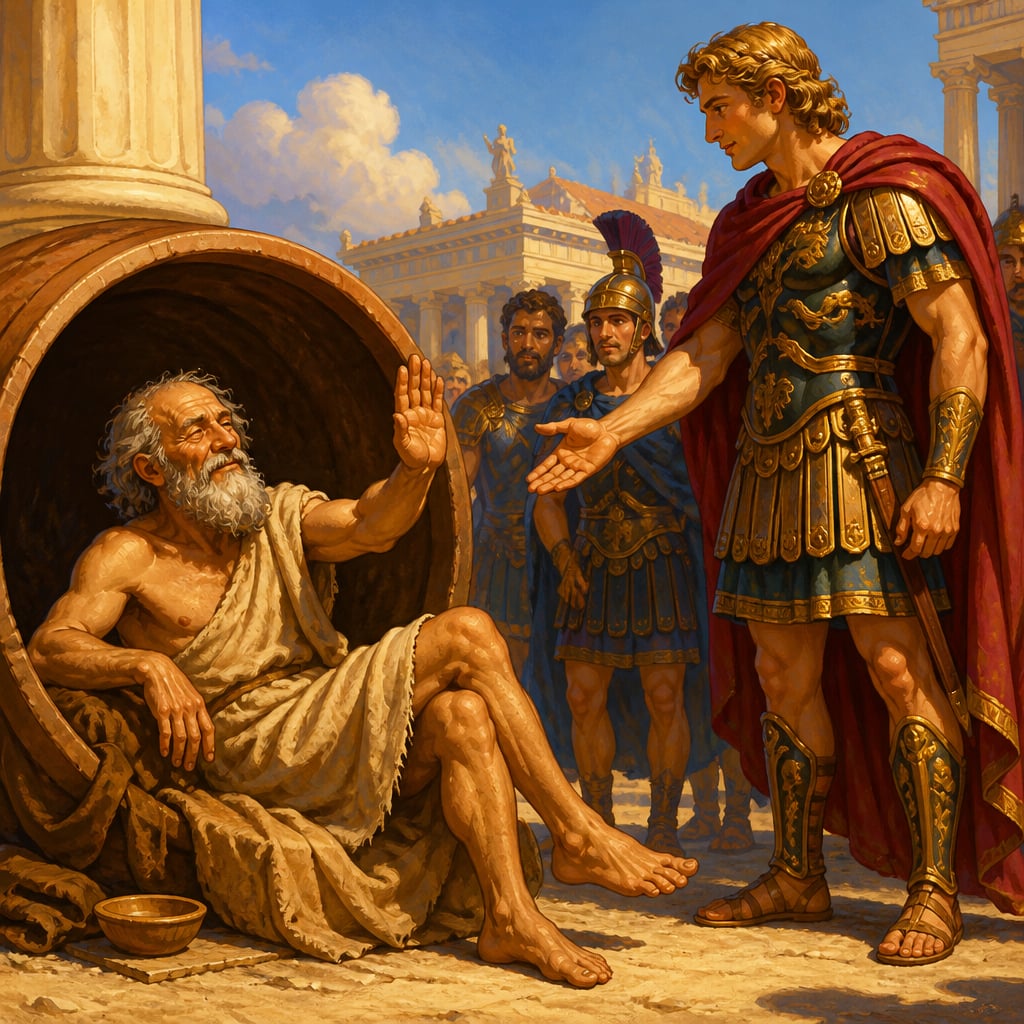
Alexander stood over him and made the offer only Alexander could make: ask me for anything, and it is yours. The man in the barrel considered the most open-ended offer in the world, delivered by its most unlimited giver, and answered: "Stand a little out of my sunlight."
The story's punchline is usually left there, but its sting is in what Alexander is said to have replied: were I not Alexander, I would wish to be Diogenes. Read the exchange as an accounting. One man could obtain anything and was still acquiring; the other wanted nothing and was therefore complete, mid-morning, in free sunlight. Between them stands the question the Garuda Purana has saved for its final chapter, the last question Garuda asks: what would it actually mean to be free?
The Last Question
The course stands at its summit. The road has been walked, the court visited, the counsel taken, the rare seat priced. And the whole map, remember, is a wheel: even its heavens are waiting rooms, even its releases from the narakas are returns to the cycle. So Garuda asks the only question left: is there a way off the wheel entirely? Not a better rotation. An exit.
The tradition's word for the exit is moksha, and the first work of this chapter is to clear away what moksha is not. It is not extinction: nothing in this text's picture is annihilated. And it is not a place: not a walled paradise to which the fortunate are admitted. Every place in this cosmology, up to and including the enjoyment-realms of the gods, is inside the wheel, leased against merit, and temporary. The word itself carries the definition: moksha, from the same root as the vimukta of Chapter 3's naraka gates, means simply release. Not arrival somewhere better. Release from the needing to arrive: from the whole engine of craving, karma, and return that the course has spent six chapters mapping. In this Vaishnava text's warm picture, what release opens into is nearness to Vishnu, the ocean the river of a jiva finally reaches. But the mechanism of freedom is stated without decoration, and the Gita, the philosophical heart of the same tradition, gives it in one verse:
कर्मजं बुद्धियुक्ता हि फलं त्यक्त्वा मनीषिणः । जन्मबन्धविनिर्मुक्ताः पदं गच्छन्त्यनामयम् ॥
karma-jaṃ buddhi-yuktā hi phalaṃ tyaktvā manīṣiṇaḥ janma-bandha-vinirmuktāḥ padaṃ gacchanty anāmayam
The wise, yoked to understanding, abandon the fruit born of action; freed from the bondage of birth, they reach the state beyond affliction.
Bhagavad Gita 2.51
Mark the sequence. The abandoning comes first; the freedom follows. What is released is not the world, not the family, not the work, the householder's text has defended all three for five chapters, but the clutch on outcomes: the wanting that Chapter 5's escalator verses showed renewing at every rung, all the way past heaven. The bondage, in this analysis, was never made of circumstances. It was made of wanting. Freedom is what the wanting was standing in front of, the way Alexander stood in front of the sun.
Two Freedoms
Now set the text's freedom beside the one our age optimizes, because they are close enough to be confused and opposite enough to matter.
Modern freedom is option-maximization: more choices, more exits, more purchasing power, fewer commitments that bind. It is a real good, and hard-won; nothing here disputes the value of an open door. But run it through the course's instruments and its limit appears. Options feed the escalator: every widened menu widens the wanting, and a person with infinite choices and an unexamined craving is not free. They are optimally supplied, which is a different condition, and researchers who study choice keep documenting its signature: past a modest threshold, more options produce not more satisfaction but more restlessness, more regret, more of the exact anxiety the menu was meant to end.
The text's freedom runs on the other axis entirely. It does not widen the menu; it quiets the hunger. And its test is Diogenes's test: not what can you obtain? but what can you be complete without? By that test, a man in a barrel outranked the owner of the known world, and the owner knew it.

The tradition's demonstrations of this freedom are not all ancient, and not all barrels. Through the middle of the twentieth century, in a lane off a Bombay thoroughfare, a beedi-shop keeper named Maruti Kampli lived over his small tobacco stall with his family: a householder of no property worth naming, no ashram, no renunciation. Seekers came to that upstairs room from across the world. The shopkeeper, known by then as Nisargadatta Maharaj, spoke of the Self from direct knowledge. His clarity filled one of the century's most read spiritual books, I Am That. Visitors kept recording the same astonishment: the man had nothing, sought nothing, and was, unmistakably, the freest person in the room, mid-city, mid-family, mid-commerce. The barrel is optional. The release is the point.
Freedom, Located
So the chapter's opening work is done, and the last question has its terms. Freedom, here, is not elsewhere and not later: not a place the road leads to, but the road's own engine, switched off. The wheel is turned by wanting; the exit is through the wanting; and the exit, therefore, is exactly where you are standing, which is why the text could hand this teaching to householders with jobs and call the kitchen an ashram.
But an exit's location is not a route. How does a person actually walk out of their own wanting: by understanding it, by loving past it, by disciplining it quiet? The text's answer is generous in a way modern advice rarely manages: it names several routes, refuses to rank them, and matches them to the traveler. The gates in the wall, and the reason there is more than one, are the next lesson.
Case studies
Stand Out of My Sunlight
The encounter is recorded across ancient sources: Alexander, master of the Greek world and en route to conquering the Persian one, visited Corinth, where the famously possessionless Diogenes lived in a large ceramic jar. Finding the philosopher sunning himself, the king announced himself and offered to grant any request. Diogenes asked him to step aside from the sun. The sources add Alexander's reflection to his laughing companions: were he not Alexander, he would wish to be Diogenes.
The exchange is the two freedoms meeting in one frame: option-maximization at its historical peak, standing over release at its purest, and recognizing the superior condition on sight. The text's moksha analysis explains the recognition: Alexander's freedom still ran on wanting, and wanting is bondage wearing armour; the man who wanted nothing was already where every conquest was trying to arrive.
The story became the ancient world's standing shorthand for the sovereignty of the released, retold from Plutarch to the present, and the two men, tradition notes with a smile, died in the same year, one having needed the world and one having not.
Completeness is the only wealth that cannot be offered by a king, because it is not obtained. The freest person in any encounter is the one who needs nothing from it.
The meeting at Corinth is recorded in Plutarch's Life of Alexander and multiple other ancient sources; tradition places both deaths in 323 BCE.
The Room Above the Beedi Shop
Maruti Kampli ran a small beedi shop in the Khetwadi lanes of Bombay, a married householder with children, who took spiritual instruction from his guru in the Navnath lineage and, following it with total seriousness while continuing his trade, arrived at settled Self-knowledge. As Nisargadatta Maharaj, he taught for decades from a small upstairs room in the same building: no ashram, no organisation, no fees. The dialogues recorded there became I Am That in 1973, and seekers from every continent climbed the narrow stair until his death in 1981.
Nisargadatta is the course's own claims converging: the kitchen-as-ashram of Chapter 5, the shaping that travels of Chapter 6, and this lesson's release located exactly where the person stands. The circumstances never changed, the shop, the lane, the family; the wanting was seen through, and the freedom that followed was unmistakable enough to draw the world upstairs.
I Am That remains continuously in print in dozens of languages, one of the most influential spiritual books of the twentieth century, produced not by an institution but by a shopkeeper's spare room.
The release requires no change of address. What it requires, the shopkeeper's life says plainly, is the seriousness to follow the inquiry all the way through, from wherever you already are.
I Am That, compiled from Nisargadatta's Marathi talks and published in 1973, has been translated into dozens of languages and has never been out of print.
Living traditions
The release-not-arrival understanding of freedom stays alive across the tradition's living registers: the sannyasi's deliberate possessionlessness at one pole, and at the other the householder ideal of the Gita, working fully with the clutch released, quoted daily in Indian offices and kitchens as nishkama karma. Nisargadatta's upstairs room in Khetwadi still receives visitors, the vairagya vocabulary survives in ordinary speech, and every year's viral minimalism and simple-living movements rediscover, under new names, the sunlight test.
Reflection
- Run the sunlight test honestly: what is the smallest list of things your completeness currently depends on? What was on the list five years ago that no longer is, and what does that subtraction teach you?
- Where in your life are you currently solving a wanting problem with a supply solution: widening a menu, adding options, upgrading circumstances, while the restlessness survives every addition?
- The text says the exit is where you are standing, and Nisargadatta proved it above a beedi shop. What has been your version of waiting for the barrel: the belief that freedom requires circumstances you do not yet have?