The Map Read Back
The death book, retired.
The synthesis: the whole road reread from the far end, and the opening myth formally retired. The reader now knows the so-called death book was the tradition’s most complete manual for living; the course ends where the text ends: in light.
Back Down the Mountain
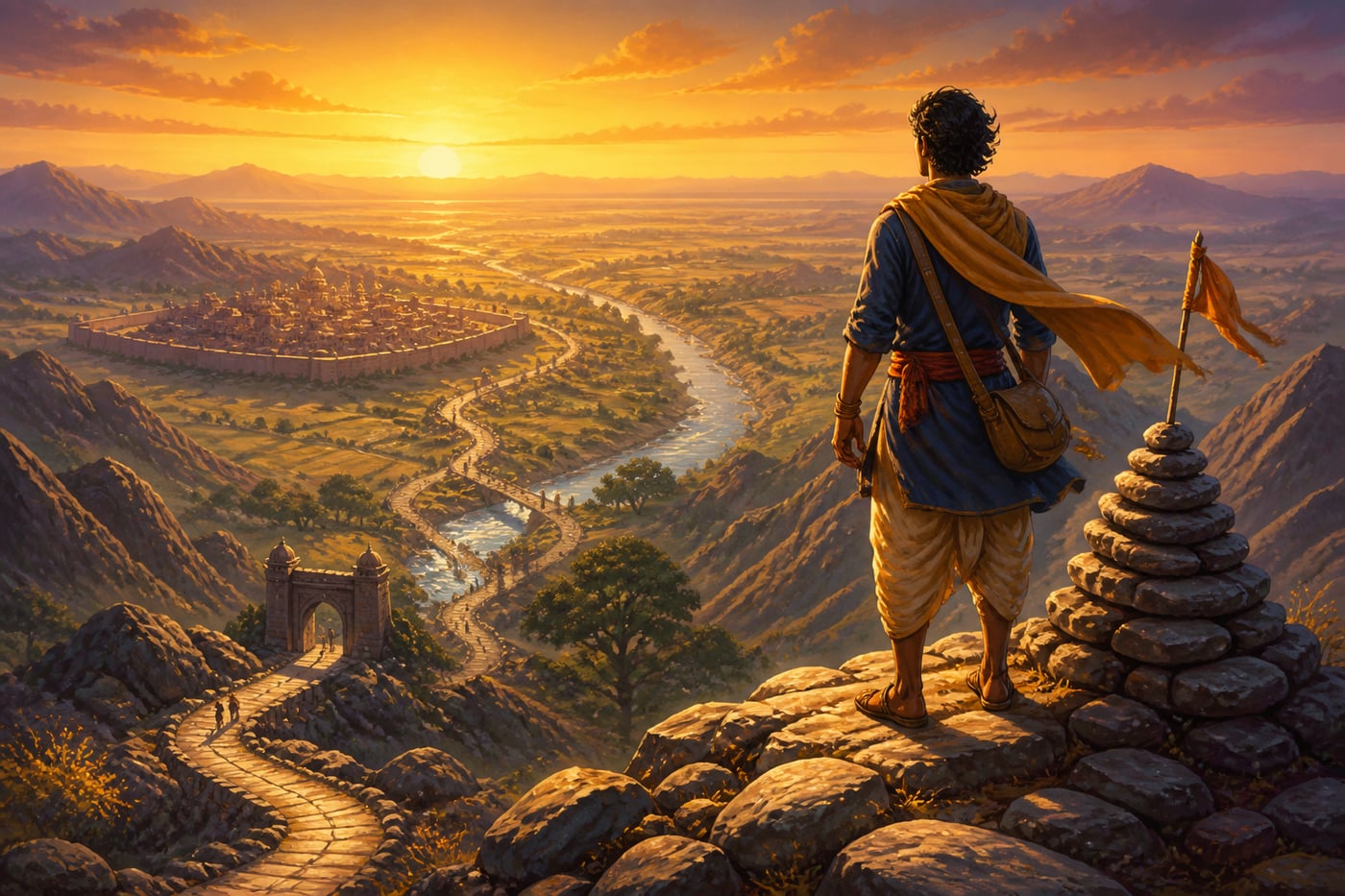
Every serious journey is made twice: once walking it, and once turning at the summit to see, in a single view, the road that brought you up. The second seeing is not repetition. Switchbacks that felt like detours reveal themselves as the only possible line; the hard stretches show what they were for. This final lesson is the turn at the summit. Nothing new is taught. The whole map is read back, from the far end, and then the course does the one thing it promised in its first lesson: it formally retires a myth.
Start the rereading where the course started: the book kept outside the house. A text so feared that families would not shelve it, opened only when death had already come, read by priests across thirteen days and returned to its wrapping. That was Chapter 1's inheritance, and the course's first move was simply to open the book on an ordinary day and find, inside the fearsome wrapping, a Mahapurana: gemology, medicine, statecraft, grammar, and a dialogue in which an eagle asks a god the questions every human carries and hides.
Now watch the road assemble, chapter by chapter, into one architecture.
Does anything I do matter if no one is watching? The ledger answered: the score keeps itself, the witnesses were never absent, and the record is exact. That is either dread or comfort depending entirely on how you live, and the text meant it as both, in that order.
What actually happens when we die? The road answered: a departure shaped by the life, a journey provisioned by love, a river crossed on generosity, a level court under a fair judge, and sentences that end. The chapter everyone feared held, at its center, the map's most hopeful law: no verdict in this cosmology is ever final, and everyone comes back.
Why do we do all those rituals? The decoded fortnight answered: the rites carry the dead, and the same choreography, in plain sight, carries the living. A task for every day of shock; a door marked in advance out of acute grief; a seat at the family table that death cannot revoke. The tradition never chose between serving the departed and serving the bereaved. It wrote one design for both.
So how should I actually live? The counsel answered from the only qualified vantage: wealth converts at exactly one counter, company is fate arriving slowly, speech is the fastest karma. The body is issued equipment, and the ordinary day, the kitchen, the commute, the desk, was the ashram all along.
Why does this life feel urgent if the soul is eternal? The womb answered: you arrived mid-vow, the vow was erased, and the drift is amnesia, not laziness. What travels is the shape your choices build, and the building can happen only here, on the rarest seat in the cosmos, leased for a term you are not shown.
Is there a way off the wheel? The summit answered: the exit is release, not arrival; the gates are several and unranked; and every question the eagle ever asked converged on one discovery, the Self no court can weigh and no fire can touch, before which the great questioner finally fell silent.
The Myth, Formally Retired
Now stand at the summit and pronounce on the myth, because the evidence is complete.
The myth said: this is a death book, morbid and inauspicious, unsafe to keep, unfit to read while alive. The road you have just walked says: this is the most complete manual for living that the tradition ever compressed into one text. It teaches accountability without surveillance, grief with an architecture, wealth with an exit strategy, company as destiny, days as practice, urgency without despair, and freedom without leaving home. Death appears in it the way the border appears on a map: not as the map's subject, but as the fact that gives every road on it direction. The text was never about how to die. It was about how to live so completely that dying changes nothing essential. The reputation was not merely unfair; it was precisely inverted, and the course now sets it down for good. A book is not morbid because it looks at death steadily. A culture is morbid when it cannot.
And the text's own last word on the matter has been waiting in the tradition's heart all along. The Gita's final teaching, the verse the whole Vaishnava tradition holds as Krishna's ultimate assurance, ends on the exact note this course's text has been building toward for seven chapters:
सर्वधर्मान्परित्यज्य मामेकं शरणं व्रज । अहं त्वां सर्वपापेभ्यो मोक्षयिष्यामि मा शुचः ॥
sarva-dharmān parityajya mām ekaṃ śaraṇaṃ vraja ahaṃ tvāṃ sarva-pāpebhyo mokṣayiṣyāmi mā śucaḥ
Setting aside all dharmas, come to Me alone for refuge. I shall release you from every wrong. Do not grieve.
Bhagavad Gita 18.66

Read the last two words and let them land: ma shucah. Do not grieve. The tradition's final instruction, at the summit of its most exalted text, is the sentence a friend says at a funeral. That is where the whole architecture was always pointing. The ledger, the road, the court, the rites, the counsel, the vow, the gates: all of it scaffolding around two words of consolation. Spoken by the divine to the frightened, with the full authority of the entire map behind them. The book read over the thirteen days ends its own tradition's teaching, and this course, on the words the grieving most need and can now, finally, believe: do not grieve. The map has been shown to you. Nothing essential is ever lost.
Leaving the House With the Book

So the course ends by reversing its first image. The Garuda Purana was the book kept outside the house. You now know what is actually in it, and the knowing changes the keeping.
What you carry out of this course is not information about death; it is the whole equipment for the road this side of it. The evening ledger, the first thought, the month-nine calendar, the release dates, the first deduction. The four gates of speech, the steward's walk, the vow redrafted, the rope tied against forgetting, the knower's pause, the three minutes of silence. Keep the practices that fit your gate and let the rest go; the tradition's own generosity demands no less. And when death next enters your circle, as it will, you will be the person in the room who knows. You will know what the thirteen days are doing, why the pot is broken, what the crow means, where the road goes. And you will know that the recited text is no book of fear, but the oldest consolation your civilization owns, read aloud at the exact hour it is needed.
The eagle is still. The map is complete. The book belongs inside the house.
Om shanti, shanti, shantih.
Living traditions
The text's living presence is exactly where this course found it: recited across the thirteen days in homes from Varanasi to New Jersey, its Saroddhara chanted by priests who learned it from their fathers. What is changing is the reading this course has argued for: teachers and householders increasingly open the Purana outside the mourning fortnight, for its counsel, its map, and its consolation, and the old superstition of the unshelvable book recedes a little each year. The eagle still faces the sanctum in every Vaishnava temple, the ma shucah is still spoken at every funeral where the Gita is read, and the map remains what it has always been: the tradition's steadiest light, kept lit for the hour the house goes dark.
Reflection
- Reread your own road: which chapter of this course changed you most, and what specifically did it change: a fear, a habit, a relationship, a plan?
- The course leaves you the equipment: which two or three practices will you actually keep, chosen by your gate, and which anchor in your day will hold them after the course stops asking?
- When death next enters your circle, what will you do differently, in the first days, across the year, and in what you say, because you have walked this map?