Mango Boughs and Chillies
Gunda Dhur, Lal Kalendra Singh, and the rising that crossed Bastar by mango bough and chilli in February 1910
In January 1910 messengers carried mango boughs, red chillies, lumps of earth and clay bows from village to village across Bastar, calling a rising against reserved forest, begar and the state's demands. The Bhumkal was led in the open by Gunda Dhur of Nethanar and quietly by Lal Kalendra Singh, a kinsman of the raja and a former diwan. Troops broke it by the end of February, Kalendra Singh died in exile at Ellichpur in 1916, and Gunda Dhur was never caught: how his life ended is not known, and this lesson says so.
The Bough and the Chilli
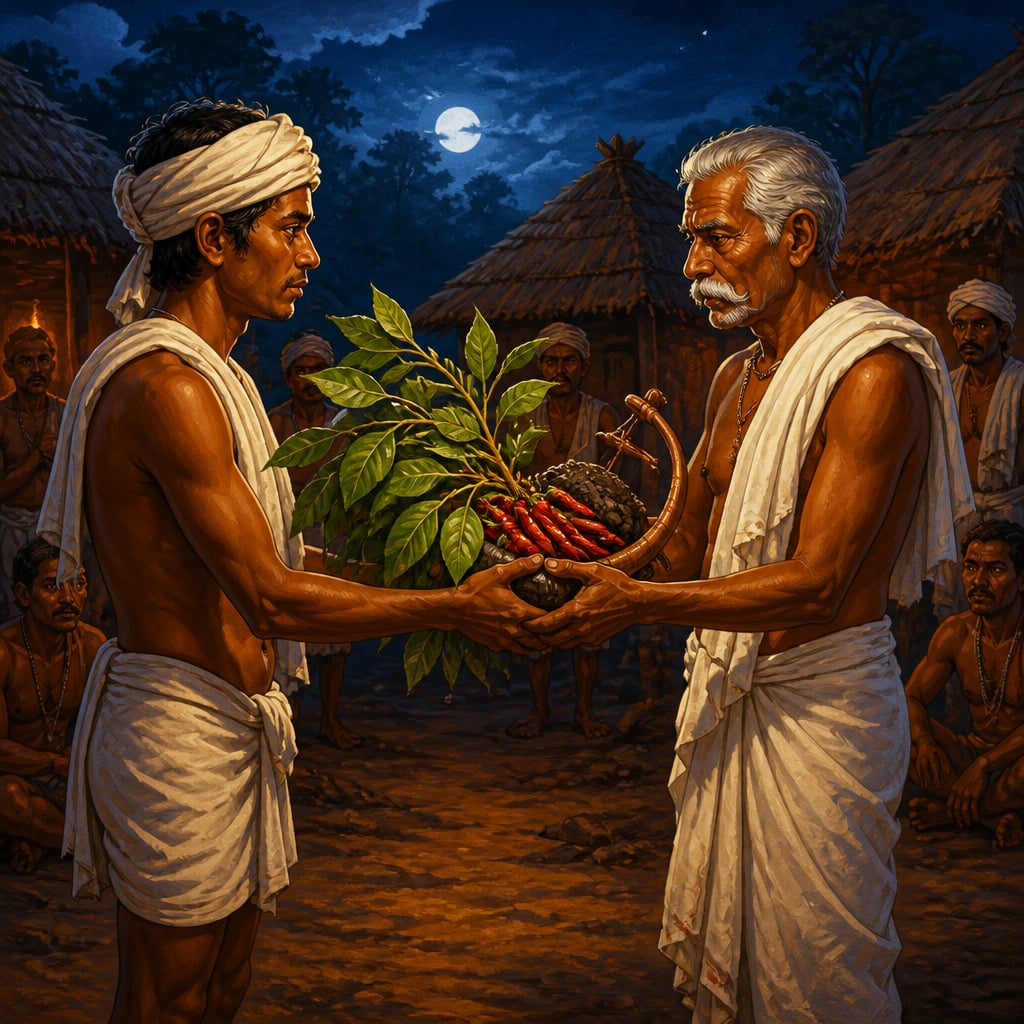
It is January 1910, in a village in the Kanger forest of Bastar. Records tell us what moved through these villages that month, not which man carried it, so picture one of them. He walks in from the next village with four things. A cut branch of mango, still in leaf. A handful of red chillies. A small lump of earth. A clay bow with arrows.
He does not make a speech. He hands the bundle to the village headman and walks on to the next village with another one. The headman knows what it means, because every village in this forest has been waiting for it. The earth is the land. The chilli is anger. The bough is the call. Bhumkal is coming, the word Bastar uses for an earthquake.
Nobody signed anything. Nobody wrote a plan down. That was the point. Within weeks the messages had crossed a state the size of Kerala, and in the first week of February the rising began.
The man most people name as the leader was a Dhurwa of the village of Nethanar, near Jagdalpur. His name was Gunda Dhur. What happened to him afterwards is the only part of this story nobody can tell you, and this lesson will not pretend otherwise.
What Bastar Had Lost
Bastar in 1910 was a princely state in the forests of what is now south Chhattisgarh. Its raja was Rudra Pratap Deo, installed in January 1908. The British did not govern it directly. They governed it through the state, which is a harder thing to fight. The officials who came to your village carried the raja's authority and the Raj's rules at the same time.
The pressure came in layers, and every layer touched food.
- Reserved forest. From 1871 the administration began marking blocks of forest as reserved. A proposal in the 1900s would have reserved roughly two thirds of Bastar's woodland. Inside a reserve you could not clear a patch for podu, the shifting cultivation the hill villages lived on. You could not always graze, cut, or gather.
- Begar. Unpaid labour owed to officials and their camps. A man could be pulled off his own field to carry loads for a touring officer.
- Rent and moneylenders. Traders and lenders from outside the forest had arrived with the roads, and the land revenue had been pushed up.
- The school and the ghotul. The new schools cut across the ghotul, the village dormitory where Muria young people learned their own songs, work and marriage customs.
- Liquor. Home brewing from the mahua flower, part of every household and every ritual, was restricted in favour of licensed shops.