Shuchi-Vyapara: Clean and Honest Business Practices

The Ancient Science of Fair Dealing

Beyond righteous income sources lies the question of daily practice. How do you weigh goods, price services, and honor contracts? The Dharmashastras developed remarkably specific standards for clean commerce - from honest weights to fair margins - that anticipated modern consumer protection by millennia.

The Weighing Stone That Built an Empire

Balvantrai Parekh mixing adhesive in his Mumbai workshop

In 1959, in a small workshop in Mumbai, Balvantrai Kalyanji Parekh was mixing chemicals to create an adhesive. His competitors had a simple formula for success: dilute the product, advertise aggressively, and let customers discover the weak glue after purchase. The profit margins were higher.

Parekh chose differently. He made Fevicol so strong that carpenters joked it would outlast the furniture it held together. When customers asked why his adhesive cost more, he said: "Use less, it works better. The price per joint is actually lower."

This wasn't just good marketing. It was the ancient principle of shuchi-vyapara - clean commerce - applied to 20th-century India. The Dharmashastras that Parekh's ancestors studied had a word for what his competitors practiced: kuta-tula (false weighing). And they had a prediction: such wealth never lasts.

The Dharmashastra Standards: Specific, Practical, Enforceable

The Narada Smriti and Brihaspati Smriti - legal texts from the early centuries CE - devoted entire chapters to commercial ethics. This wasn't abstract philosophy; these were enforceable standards that merchant guilds (shrenis) implemented.

The Three Pillars of Shuchi-Vyapara:

1. Mana-Shuddhata (Pure Measurement)
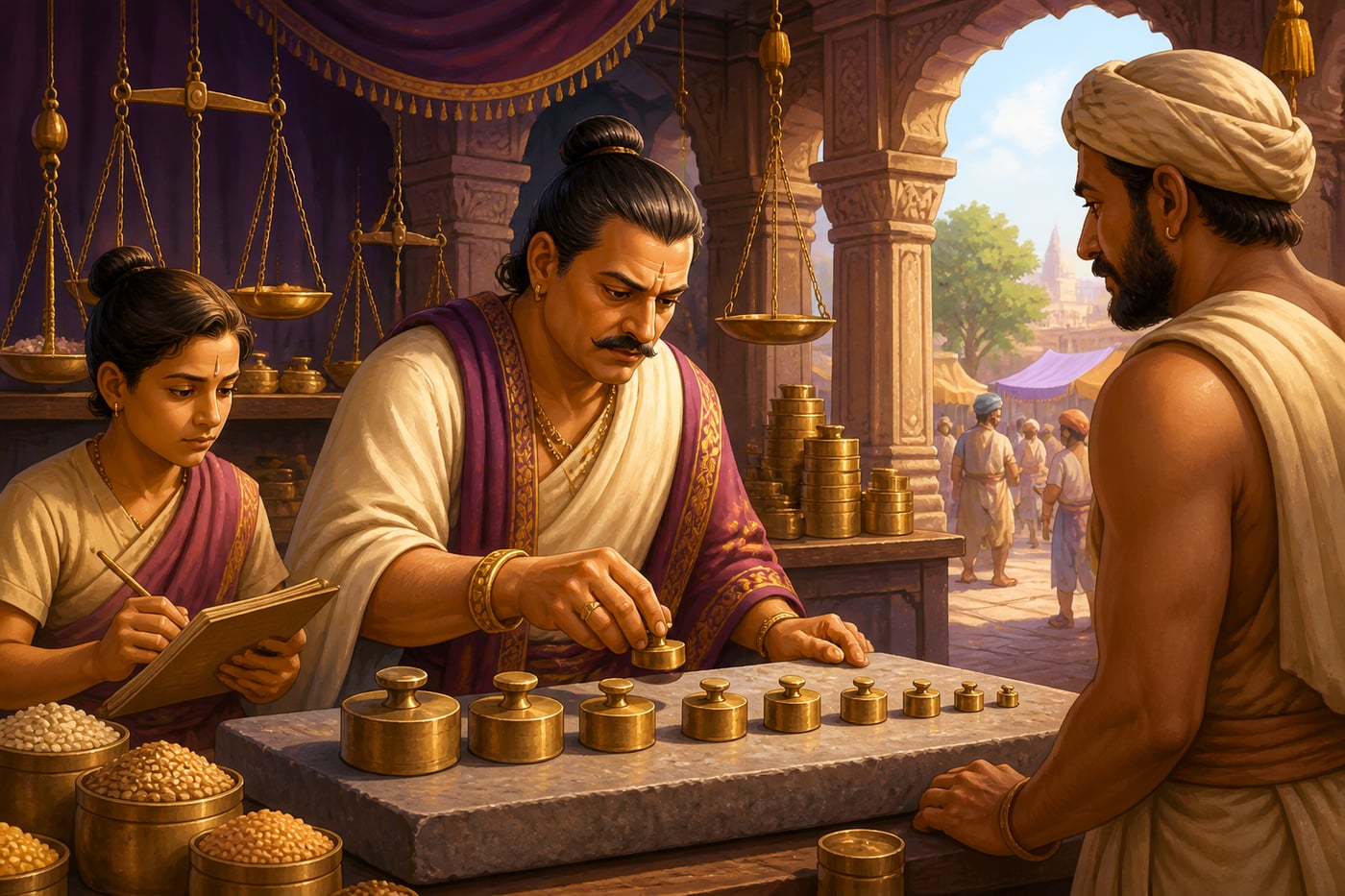
Kautilya's Manadhyaksha inspecting standardized weights

The texts specified that weights and measures must be standardized and verified. A merchant using false weights committed mahapapa (grave sin) - placed in the same category as theft. The penalty wasn't just spiritual; guilds expelled violators, destroying their livelihood.

"He who uses false weights and measures, though he may gain the whole world, loses his soul and his standing among honest men." - Brihaspati Smriti

2. Mulya-Nyaya (Just Pricing)

Profit itself was dharmic - but within limits. The texts prescribed reasonable profit margins based on the type of goods:

Goods Type Acceptable Margin Rationale
Perishables Up to 10% High risk of spoilage justifies higher margin
Cloth & Textiles 5-7% Moderate risk, essential goods
Gold & Jewels 3-5% Low risk, luxury items
Daily necessities 2-3% Essential for survival, minimal margin

Notice the inversion: luxury goods had lower acceptable margins than perishables. Why? Because those who could afford luxuries didn't need price protection, while essential goods had to remain accessible.

3. Vakya-Shuddhata (Truth in Representation)

Misrepresenting quality, origin, or characteristics of goods was explicitly forbidden. The Sanskrit term mayamrita (sweet deception) described marketing that technically didn't lie but created false impressions. Sound familiar? The Dharmashastras anticipated modern concerns about misleading advertising.

Global Perspectives on Clean Commerce

The concern with honest dealing spans cultures, but different traditions emphasized different aspects.

The Quaker Business Tradition (17th century onward) developed fixed pricing - refusing to haggle - as a spiritual practice. Quaker merchants like Cadbury (chocolate) and Barclays (banking) built global enterprises on the principle that the first price named should be the fair price. Their motto: "Let your yea be yea, and your nay be nay." This echoes the Dharmashastra emphasis on vakya-shuddhata, but focuses on pricing rather than product representation.

John Mackey (1953-present), co-founder of Whole Foods and theorist of "Conscious Capitalism," argued that business integrity creates competitive advantage. His four pillars - higher purpose, stakeholder orientation, conscious leadership, and conscious culture - systematize what Indian merchants practiced under guild supervision. Mackey's innovation was proving this works in modern corporate contexts.

Confucian Commercial Ethics in China developed the concept of yi (righteousness) in business. The merchant should be li (proper) in all dealings. Unlike the Dharmashastra approach, Confucian ethics ranked merchants lowest in social hierarchy even while prescribing their ethical conduct. The Indian tradition uniquely elevated commerce (vaishya dharma) as itself a form of dharmic practice, not merely constrained by ethics from outside.

Tradition Key Emphasis Unique Contribution
Dharmashastra Comprehensive guild-enforced standards Integration of spiritual and commercial ethics
Quaker Fixed pricing, plain dealing Simplicity as integrity
Conscious Capitalism Stakeholder value Modern corporate application
Confucian Righteousness in conduct Relationship-based trust

What distinguished the Indian approach was the shreni (guild) system - self-regulating bodies that enforced standards without state intervention. This anticipated modern industry self-regulation, but with teeth: expulsion from the guild meant economic death.

Modern Resonance: When Clean Commerce Wins

In 2024, India's pharmaceutical industry faces a credibility crisis. WHO reports flagged several Indian manufacturers for quality lapses. But some companies stand apart.

Divi's Laboratories scientist examining a medicine vial

Divi's Laboratories, founded by Dr. Murali K. Divi in 1990, took a counterintuitive path. While competitors cut costs to win contracts, Divi's invested obsessively in quality systems. Their API (Active Pharmaceutical Ingredients) cost more - but global pharma giants kept coming back because they never failed an inspection.

The company's mantra: "Quality is not negotiable." This echoes mana-shuddhata - pure measurement. When you manufacture drugs, measurement isn't just ethics; it's life and death.

Divi's current market cap exceeds Rs. 1.2 lakh crore. The "expensive" choice of quality created more wealth than the "smart" choice of cutting corners.

The Economics of Honesty: Why It Works

The Dharmashastras weren't naive about markets. They understood something modern behavioral economics rediscovered: reputation is a form of capital.

Consider the calculation:

The shreni system accelerated this by making reputation visible. A merchant's standing in the guild was public knowledge. Modern platforms like Amazon ratings and Google reviews recreate this ancient mechanism.

Key Principle: "Shuchina vyaparam dharma, ashuchina cha papam" - Clean commerce is dharma; unclean commerce is sin.

But the texts went further. They recognized that dishonesty corrupts the dishonest person. The merchant who adulterates goods begins to see all commerce as deception. They lose the capacity to build genuine relationships. Their own judgment becomes unreliable because they assume others are also cheating.

Your Turn: The Clean Commerce Audit

Whether you're an entrepreneur, employee, or consumer, the shuchi-vyapara principles apply:

The Daily Practice:

  1. Measure accurately - In your work, do you deliver what was promised? Not less (obviously), but also not overpromising and underdelivering?

  2. Price fairly - Are your prices (or salary expectations) based on genuine value, or on what you can extract from information asymmetry?

  3. Represent truthfully - Does your resume, your product description, your service offering create accurate expectations? Or are you practicing mayamrita - technically-true deception?

The Parekh family understood something the Dharmashastras taught: clean commerce isn't just ethically required - it's strategically superior. Fevicol's market share after 65+ years proves the point.

Pidilite today is a Rs. 80,000 crore company. Built on one principle: make the product better than people expect.

The next lesson examines what happens when you've established righteous earning and clean dealing: how do you set prices that are fair to all parties? The subtle art of sama-mulya - equitable pricing - awaits.

Quality assurance, delivery verification, contractual compliance

Modern quality management (ISO standards, Six Sigma) institutionalizes what Kautilya's Manadhyaksha (Superintendent of Weights) did - systematic verification of delivery against promise.

The ancient Indian approach combined external verification with internal motivation (dharmic duty), while modern systems often rely solely on external audits.

Companies with ISO 9001 certification show 10-15% higher customer retention rates, quantifying the business value of 'pure measurement' in modern terms.

Truth in advertising, anti-greenwashing, informed consent

Modern advertising standards (ASCI in India, FTC in USA) struggle with 'puffery' - exaggerated claims deemed acceptable. The Dharmashastra standard was stricter: even technically-true misleading claims were violations.

Key terms

shuchi-vyapara
Clean/pure commerce; business conducted with complete honesty in measurement, pricing, and representation
kuta-tula
False/fraudulent weights; using dishonest measures to cheat customers
mayamrita
Sweet deception; misleading representations that technically don't lie but create false impressions
shreni-vidhi
Guild regulations; the rules and standards enforced by merchant guilds

Key figures

Narada

Dr. Murali K. Divi

John Mackey

Case studies

Divi's Laboratories: When Quality Is Non-Negotiable

In the early 2000s, Indian pharmaceutical companies faced a choice. Global pharma giants were outsourcing API (Active Pharmaceutical Ingredients) manufacturing to reduce costs. The temptation was clear: cut corners on quality systems, win contracts on price, deal with FDA issues later. Dr. Murali Divi chose the opposite path. He invested heavily in quality infrastructure - certified labs, validated processes, redundant checks. Divi's APIs cost 15-20% more than competitors. When procurement managers asked why, the answer was simple: 'Because ours work. Every time.' Many competitors won contracts with lower bids, then faced FDA warning letters, import alerts, and plant shutdowns. Divi's steadily gained market share as clients learned that the 'expensive' option was actually cheaper when you factored in recalls, delays, and regulatory penalties.

Divi's practiced mana-shuddhata (pure measurement) at the molecular level. In pharmaceuticals, the 'weight' is the purity of the compound. A 99.5% pure API vs. 99.9% might seem close, but in drugs, that 0.4% can mean side effects, reduced efficacy, or harm. The Dharmashastra standard of shuchi-vyapara wasn't about being 'good enough' - it was about being correct. Divi's adopted this absolute standard: either the molecule is right, or it's not. There's no 'almost right' in dharmic commerce.

By 2024, Divi's is India's largest custom synthesis company with a market cap exceeding Rs. 1.2 lakh crore. More telling: when the COVID-19 pandemic created API shortages, Divi's was among the few Indian companies that global pharma trusted for critical supplies. The company has never received an FDA warning letter for manufacturing violations - a nearly unique record in Indian pharma. Dr. Divi attributes this to 'building quality in, not inspecting it in' - echoing the shreni tradition of internalized standards.

Shuchi-vyapara creates competitive moats. When quality is genuinely non-negotiable, customers eventually learn they can't afford to go elsewhere. The premium price includes the guarantee - and that guarantee has economic value that exceeds the premium.

The COVID-19 pandemic exposed how fragile global pharmaceutical supply chains become when quality is sacrificed for cost. Divi's Laboratories emerged as a critical supplier during the crisis precisely because its decades of quality investment had built the reliability that other manufacturers could not match under pressure.

Divi's operating margins (35%+) are among the highest in global pharma manufacturing, proving that quality-premium positioning can be more profitable than cost-cutting.

Pidilite: Fevicol and the Fifty-Year Test

In 1959, Balvantrai Kalyanji Parekh started manufacturing industrial adhesives in a Mumbai workshop. The adhesive market was crowded with products that made impressive claims but often failed in real use. The industry standard was diluted products and aggressive advertising. Parekh took a different approach. He formulated Fevicol to be so strong that carpenters began calling it 'the bond that outlasts furniture.' He invested in understanding how carpenters actually used adhesive - the humidity, the wood types, the time constraints - and optimized for their real needs, not lab specifications. Crucially, he resisted the temptation to dilute. When costs rose, competitors diluted their products. Pidilite reformulated to maintain quality at the same price point - accepting lower margins rather than lower quality.

Pidilite's story illustrates vakya-shuddhata (truth in representation). When Fevicol claimed to be strong, it was genuinely strong. There was no mayamrita - no gap between what advertising suggested and what customers experienced. The company also practiced mulya-nyaya (just pricing). By optimizing 'cost per joint' rather than 'cost per gram,' they gave customers genuine value. A more expensive product that required less quantity and delivered better results was actually fair pricing.

Pidilite today dominates Indian adhesives with 70%+ market share - a position held for decades. The company's market cap exceeds Rs. 80,000 crore. More remarkably, Fevicol has become a synonym for strong bonding in Indian culture - entering language as a metaphor. Three generations of the Parekh family have maintained the same principles. Madhukar Parekh (current Chairman Emeritus) describes the philosophy: 'Underpromise and overdeliver. Every time.'

The fifty-year test of shuchi-vyapara: can you maintain quality and honesty across generations? Pidilite shows that dharmic practices create institutional culture that outlasts individual leaders.

In an age of viral marketing and influencer-driven brand building, Fevicol's dominance built entirely on product performance is a striking anomaly. The brand's multi-generational trust, passed from carpenter to apprentice as professional knowledge, shows that genuine quality creates distribution networks that no advertising budget can buy.

Fevicol's brand recall in India exceeds 95%, built entirely through product performance rather than celebrity endorsements - proving that genuine quality is the most effective marketing.

Historical context

Smriti Period and Guild Era: 200 BCE - 600 CE

This period saw the formalization of India's guild system. Shrenis (merchant guilds) became powerful economic institutions - collecting deposits, providing loans, and most importantly, enforcing ethical standards among members. Expulsion from a guild meant economic ruin, making guild ethics more enforceable than state law.

Roman commercial law focused on contract enforcement but left ethical standards largely to individual conscience. Chinese commerce operated under Confucian social rankings that placed merchants low. The Indian guild system uniquely combined high social respect for commerce with institutionalized ethical enforcement.

Guild inscriptions from this period record donations to temples, indicating substantial wealth. One Mandasor inscription (473 CE) records silk weavers' guild donations exceeding 10,000 dinars - showing that ethical commerce generated significant prosperity.

Understanding that shuchi-vyapara standards were guild-enforced - not just individual aspirations - shows they were practical business requirements, not utopian ideals. The guilds proved ethical commerce was sustainable and profitable.

Living traditions

India's Consumer Protection Act (2019) mandates disclosure standards that echo Dharmashastra prohibitions on mayamrita (sweet deception). The ASCI (Advertising Standards Council of India) self-regulatory system resembles shreni enforcement - industry policing its own.

Reflection

More in Dharmashastra: Ethics of Earning & Spending

All lessons in Dharmashastra: Ethics of Earning & Spending ยท Dharmic Economics course