Nyaya-Arjana: Righteous Earning Principles

Dharmic vs Adharmic Sources of Income

What makes income dharmic? Ancient Dharmashastra texts didn't just say 'earn money' - they specified which professions and methods were spiritually pure, which were acceptable, and which would corrupt both the earner and society. These distinctions remain startlingly relevant in an age of gig economies, crypto speculation, and ethical investing.

The Merchant's Dilemma
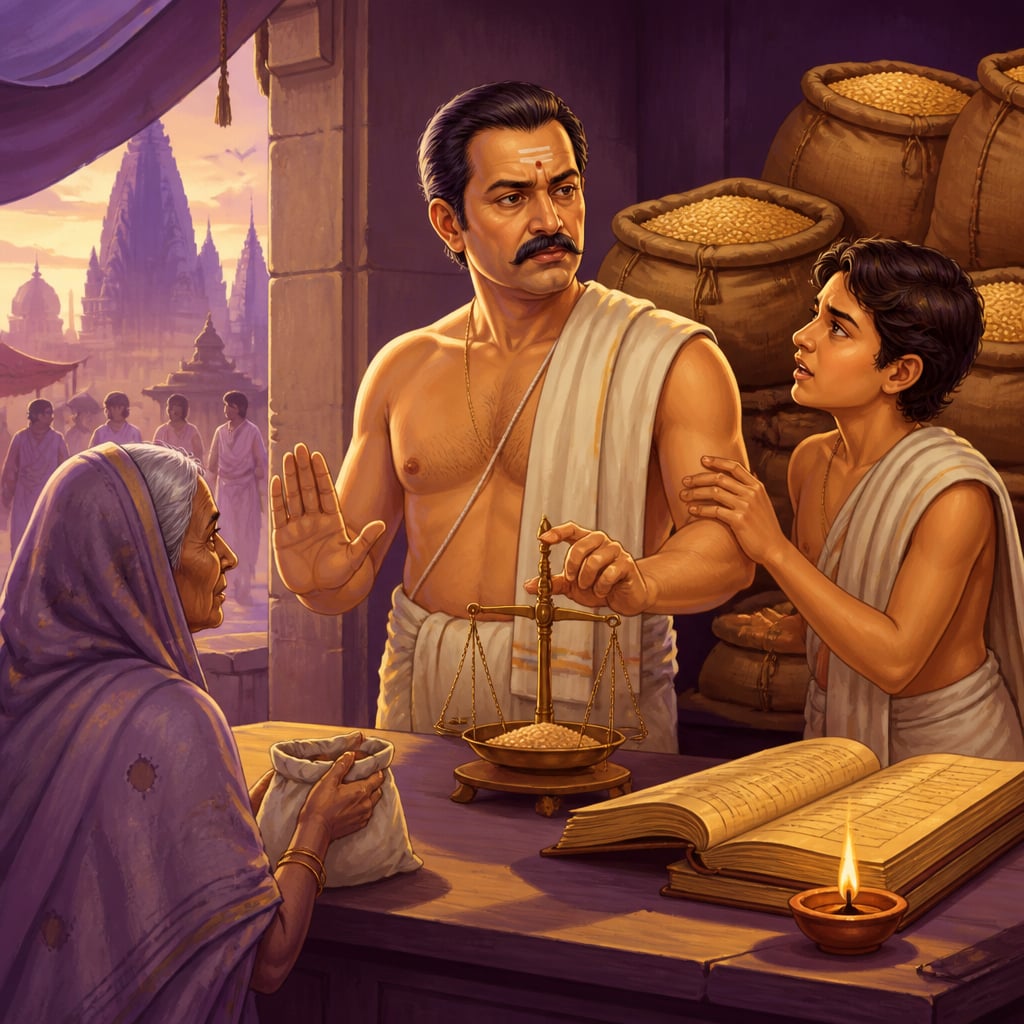
Devadatta the grain merchant holding prices steady

In the bustling markets of ancient Varanasi, a grain merchant named Devadatta faced a choice that would define his family's fortune for generations. The monsoon had failed in the eastern provinces, and grain prices were soaring. His warehouses were full. He could triple his wealth overnight - or follow the path his father had taught him.

"The profit is there for the taking," his assistant urged. "Everyone else is raising prices."

Devadatta remembered the verse his father recited each morning: "Nyayena margena dhanam arjayet" - wealth must be earned through righteous means. But what exactly made a means righteous? This wasn't just philosophy. His decision would determine whether his family prospered with honor or wealth built on others' suffering.

The Ancient Framework: Three Categories of Livelihood

The Dharmashastra texts, particularly the Manusmriti and Yajnavalkya Smriti, developed a sophisticated classification of economic activity that went far beyond simple rules. They recognized that not all income is equal in its spiritual and social effects.

Manu identified three fundamental categories:

  1. Shukla (White/Pure) - Income from teaching, agriculture, honest trade, and skilled crafts. These activities create genuine value without harming others.

  2. Shyama (Grey/Mixed) - Income from activities like warfare, government service, and certain types of commerce. These might be necessary for society but carry ethical complexities.

  3. Krishna (Black/Impure) - Income from deception, exploitation, gambling, usury (excessive interest), and professions that cause clear harm to others or society.

The revolutionary insight wasn't just the categories - it was the recognition that the same profession could fall into different categories depending on how it was practiced. A merchant selling honestly engaged in shukla activity; the same merchant adulterating goods performed krishna actions.

Key Principle: "Dharma-mula dhanam shreshtham, adharma-mula dhanam hatam" - Wealth rooted in dharma is excellent; wealth rooted in adharma is destroyed.

This meant wealth itself wasn't the problem. The source and method determined whether it would bring lasting prosperity or eventual ruin.

The Prohibited List: What Ancient Texts Explicitly Forbade

The Dharmashastras were remarkably specific about adharmic income sources:

What's striking is how these align with modern ethical investing criteria. ESG (Environmental, Social, Governance) frameworks essentially rediscover what Manu articulated two millennia ago.

Global Perspectives on Righteous Earning

The Indian approach wasn't unique in recognizing ethical dimensions of income, but it was unusually systematic. Comparing with other traditions reveals both parallels and distinctive insights.

Aristotle (384-322 BCE) distinguished between oikonomia (household management, the root of 'economics') and chrematistics (wealth-acquisition). Natural wealth-getting served human needs and had natural limits. Unnatural chrematistics - accumulating money for its own sake through speculation - he considered corrupting. This parallels the Dharmic distinction between wealth as a means (artha serving dharma) versus wealth as an end.

Adam Smith (1723-1790), before writing The Wealth of Nations, wrote The Theory of Moral Sentiments. He argued that commerce only functions within a framework of trust and moral restraint. Smith's famous "invisible hand" only works when participants follow rules of justice. "Though the principles of common prudence do not always govern the conduct of every individual," Smith wrote, "they always influence that of the majority." This resonates with the Dharmashastra assumption that ethical constraints enable rather than limit prosperity.

Max Weber writing on the Protestant ethic

Max Weber (1864-1920) documented how Calvinist Protestant ethics created what he called the "spirit of capitalism" - viewing honest work and frugality as religious duties. The key parallel with nyaya-arjana is seeing ethical earning not as a constraint on religious life but as part of spiritual practice.

Thinker Key Insight Dharmic Parallel
Aristotle Natural vs unnatural wealth-getting Shukla vs Krishna income
Adam Smith Commerce requires moral framework Dharma as foundation of sustainable artha
Max Weber Work as spiritual calling Artha as legitimate purushartha

The distinctive Dharmic contribution was integrating this into a comprehensive life framework (the Purusharthas) rather than treating ethics and economics as separate domains.

Modern Resonance: The 2025 Reality

In January 2025, SEBI issued new guidelines on ESG disclosure requirements for Indian companies. The criteria - environmental impact, labor practices, governance transparency - echo the ancient threefold test: Does this income create genuine value? Does it harm others? Is the process honest?

Consider current debates:

Natco scientist inspecting affordable cancer medicine

The principle remains: Wealth earned through others' harm is spiritually toxic, regardless of legal status.

Your Turn: The Modern Test

You face versions of Devadatta's choice regularly. When you evaluate a job offer, investment opportunity, or business decision, the ancient framework offers clarity:

The Three-Question Test:

  1. Does this income create genuine value for someone? (Production vs extraction)
  2. Does earning it require harming others or exploiting the vulnerable? (The dependency test)
  3. Would I be comfortable if everyone knew exactly how I earned this? (The transparency test)

If any answer gives you pause, you've encountered shyama or krishna territory.

Devadatta, by the way, held his prices steady during the famine. His immediate profits were lower. But when the rains returned, his reputation for fairness attracted customers from across the region. His grandson became the wealthiest merchant in Varanasi - not despite the ethical choice, but because of it.

The Dharmashastras weren't naive about economics. They understood that nyaya-arjana isn't just morally superior - it's strategically wise. Wealth built on exploitation requires constant defense. Wealth built on genuine value creates its own protection.

In the next lesson, we examine what happens after you've earned righteously: how do you conduct business day-to-day? The principles of shuchi-vyapara - clean commerce - await.

Sustainable vs extractive business models; long-term value creation vs short-term extraction

Milton Friedman's 'shareholder primacy' would evaluate income solely by returns. Stakeholder capitalism and ESG frameworks echo the Dharmic view that source and method matter for sustainability.

The Dharmic approach doesn't rely on external regulation - it internalizes ethical constraints as spiritual practice, creating self-regulating economic actors.

A 2023 Morningstar study found ESG-compliant funds in India outperformed conventional funds by 2.3% over 5 years, suggesting 'dharmic' screening enhances rather than limits returns.

Negative externalities; stakeholder impact; social cost accounting

Economists like Arthur Pigou developed 'externality' theory - costs imposed on third parties. The Dharmic approach goes further, treating such costs as spiritually significant, not just economically.

Key terms

nyaya-arjana
Righteous earning; acquiring wealth through just and ethical means
shubha labha
Auspicious profit; gain that is both materially beneficial and spiritually pure
shukla karma
White/pure action; livelihood that creates genuine value without harm
krishna marga
The black/dark path; methods of earning that harm others or corrupt society

Key figures

Manu

S. Gurumurthy

Max Weber

Case studies

SELCO India: Harish Hande's Righteous Path in Solar Energy

In 1995, Dr. Harish Hande founded SELCO India with a radical premise: bring solar energy to India's poorest households - the 400 million without reliable electricity. The conventional business model would target urban, wealthy customers who could pay upfront. That was the 'smart' path. Hande rejected it. He built a business serving rural poor, creating innovative financing through partnerships with regional rural banks and microfinance institutions. Families paid Rs. 50-100 per month - less than they spent on kerosene - and owned solar systems after 2-3 years. When venture capitalists approached with growth capital, many wanted SELCO to pivot to urban markets for faster returns. Hande refused, staying focused on the underserved. When competitors offered cheaper but lower-quality systems, SELCO maintained its standards even at the cost of market share.

By the nyaya-arjana framework, Hande chose shukla karma over faster returns. His income came from genuine value creation - replacing polluting kerosene with clean energy for families who needed it most. He rejected the shyama path of serving the already-served, and never considered krishna approaches like cutting quality or exploiting rural ignorance. The Dharmashastra principle that righteous earning considers all affected parties is visible in SELCO's stakeholder map: rural families, women (who suffered most from kerosene fumes), local technicians trained and employed, and the environment.

By 2024, SELCO has served over 500,000 households across six states. Hande won the Magsaysay Award (2011) and the Global Social Entrepreneurship Award. More importantly, SELCO proved the model: serving the poor profitably and ethically. The company remains financially sustainable while competitors who chose faster paths have often failed or pivoted away from social impact. Hande's daughter now works with SELCO Foundation, extending the impact. Like Devadatta in our opening story, the ethical choice created multi-generational prosperity.

Nyaya-arjana isn't charity or sacrifice - it's choosing which version of success you want. Hande could have built a larger company serving the wealthy. Instead, he built a sustainable enterprise serving those who needed it most. The Dharmashastra framework predicted this: shukla karma creates lasting wealth; shortcuts create temporary gain.

As climate finance debates focus on large-scale renewable projects, SELCO's bottom-up model of serving individual rural households proves that clean energy access and commercial viability are not competing goals. The company's expansion into health and education applications of solar energy shows how ethical business models naturally extend their impact over time.

SELCO's customer default rate is under 2% - lower than most urban consumer lending - proving that ethical business serving the poor can be more sustainable than extractive models.

Paper Boat: The 'Slow Path' to Authentic Success

In 2013, Neeraj Kakkar and Neeraj Biyani launched Paper Boat beverages with a counterintuitive bet: in an industry dominated by cola giants and 'fast growth' metrics, they would build a brand around authenticity, nostalgia, and traditional Indian drinks. They could have played the startup game - burn capital on aggressive marketing, prioritize growth over unit economics, and cut costs on ingredients. Instead, Paper Boat chose what they called 'honest drinks': real kokum, real aam panna, real jaljeera. No artificial flavors or colors. Higher costs, lower margins. When investors pushed for faster growth, the founders held firm: authentic recipes, quality ingredients, build slowly. They rejected the 'blitzscaling' playbook that had made unicorns but often destroyed value.

Paper Boat practiced shubha labha - auspicious profit. Their earning came from genuine value: recreating drinks people's grandmothers made, using real ingredients. The alternative - artificial flavors, misleading 'natural' claims, growth-at-all-costs - would have been krishna marga despite being industry-standard. The three-question test from our lesson: 1. Does this create genuine value? Yes - authentic products filling a real market gap. 2. Does it require harming others? No - no exploitative supply chains or deceptive marketing. 3. Would we be comfortable with transparency? Yes - their ingredient story is their marketing.

By 2024, Paper Boat has grown to Rs. 500+ crore revenue, achieving profitability while most 'fast growth' beverage startups have failed or remain cash-burning. Coca-Cola acquired a stake, validating the model. More significantly, Paper Boat inspired a wave of 'heritage' beverage brands, shifting industry norms. The founders describe their approach as 'building for decades, not quarters.' This echoes the Dharmashastra wisdom: righteous earning may be slower, but it creates foundations that endure.

The distinction between shukla and krishna marga isn't always dramatic. Sometimes it's simply choosing authentic ingredients over artificial ones, honest margins over inflated growth. Small ethical choices compound into fundamentally different businesses.

The broader consumer shift toward authenticity, visible in the success of craft beverages, farm-to-table dining, and heritage brands, validates Paper Boat's bet on genuine ingredients over synthetic formulations. In a market saturated with artificially flavored drinks, honest product design has become a differentiator rather than a disadvantage.

Paper Boat's repeat purchase rate is 3x the industry average, demonstrating that ethical product quality creates customer loyalty that outlasts marketing spend.

Historical context

Dharmashastra Period: 200 BCE - 500 CE

This period saw India as a major node in global trade, contributing an estimated 25-30% of world GDP. The Dharmashastra economic ethics developed in an environment of sophisticated commerce - not pastoral simplicity. These were rules for complex economies.

Roman law developed commercial regulations but focused on contractual enforcement rather than ethical classification of income sources. Chinese Confucian ethics ranked merchants low in social hierarchy but didn't develop comparable frameworks for distinguishing ethical from unethical commerce within merchant activity.

Archaeological evidence from this period shows merchant guild inscriptions explicitly referencing dharmic obligations, indicating these weren't just textual ideals but practiced business ethics.

Understanding that nyaya-arjana principles emerged during India's commercial peak - not in isolation from economic complexity - shows they were pragmatic frameworks for real business challenges, not otherworldly idealism.

Living traditions

The rise of ESG investing in India can be understood as a rediscovery of nyaya-arjana principles in institutional form. SEBI's ESG disclosure requirements (2021, updated 2024) effectively mandate what Manu recommended: transparency about how wealth is earned.

Reflection

More in Dharmashastra: Ethics of Earning & Spending

All lessons in Dharmashastra: Ethics of Earning & Spending ยท Dharmic Economics course