Rina-Niti: Debt Ethics and Interest Principles
When Borrowing Is Wise and What Interest Is Fair
Debt is neither good nor evil - it depends on purpose, terms, and conduct. The Dharmashastras developed sophisticated ethics for borrowing and lending: when debt is wise, what interest rates are just, and the mutual obligations binding creditor and debtor. These principles offer guidance for everything from personal loans to India's microfinance revolution.
The Moneylender's Dilemma
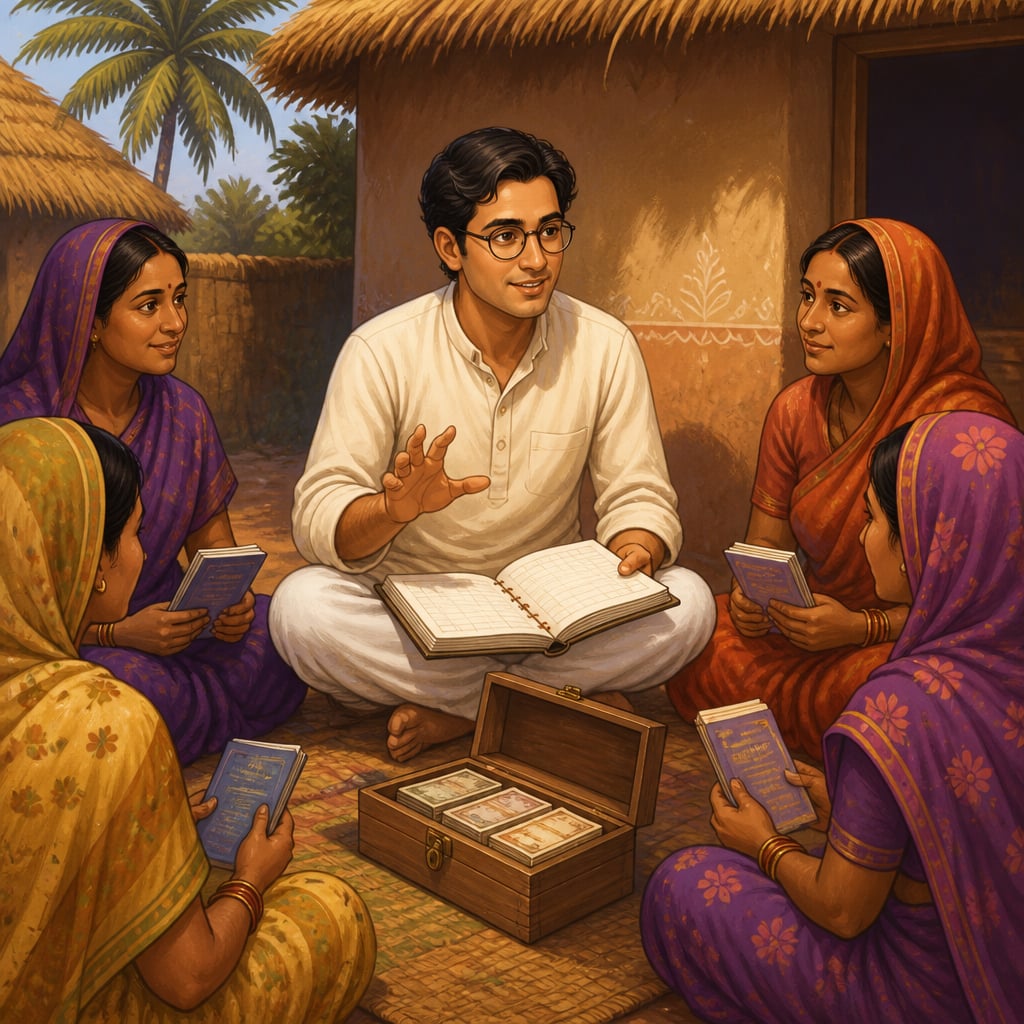
In 1999, Chandra Shekhar Ghosh faced a choice that would shape millions of lives. He had spent years working in microfinance, watching it transform poor households. But he had also watched something troubling: as microfinance institutions grew, some abandoned their mission. Interest rates crept up. Collection practices hardened. The poor, who were supposed to be helped, were sometimes being trapped.
Ghosh could have followed the prevailing model - prioritize growth, maximize returns, treat social impact as marketing. Instead, he founded Bandhan with a different premise: lending to the poor could be both ethical and sustainable. Fair interest rates. Respectful collection. Genuine financial inclusion.
The industry veterans were skeptical. You couldn't serve the poorest profitably without cutting ethical corners, they said. Ghosh disagreed. He was practicing what the ancient texts called rina-niti - the ethics of debt - without perhaps knowing the Sanskrit term.
Two decades later, Bandhan is India's largest microfinance institution, a universal bank with over 3 crore customers. The 'impossible' ethical model became the most successful one.
The Dharmashastra Framework: Debt as Relationship
The ancient texts - particularly the Yajnavalkya Smriti, Narada Smriti, and Arthashastra - devoted extensive attention to debt (rina). Their approach was distinctive: debt wasn't a mere transaction but a relationship creating mutual obligations.
The Three Dimensions of Rina-Niti:
1. Rina-Grahana (When to Borrow)
The texts distinguished between wise and unwise debt:
Dharmic reasons to borrow:
- Productive investment (seeds, tools, inventory)
- Family emergencies (illness, essential ceremonies)
- Education and skill development
- Starting or expanding a livelihood
Adharmic reasons to borrow:
- Consumption beyond means
- Gambling or speculation
- Status display (jewelry, celebrations beyond capacity)
- Covering losses from previous unwise borrowing
"He who borrows for productive purpose increases his prosperity; he who borrows for consumption increases his bondage." - Dharmashastra tradition
The distinction anticipates modern concepts of 'good debt' vs 'bad debt' - but frames it in terms of dharma rather than just financial returns.
2. Vriddhi-Niyama (Interest Rate Limits)
Remarkably, the Dharmashastras specified maximum interest rates - perhaps the world's first interest rate caps:
| Loan Type | Maximum Monthly Rate | Annual Equivalent |
|---|---|---|
| Secured (with collateral) | 1.25% | 15% |
| Unsecured (personal) | 2% | 24% |
| Commercial/trade | 5% | 60% |
| High-risk ventures | Higher permitted | Case-by-case |
These weren't arbitrary. The principle was: interest should compensate the lender fairly but not exploit the borrower's necessity.
"Interest that doubles the principal is the maximum; beyond this, the creditor becomes a thief." - Yajnavalkya Smriti

This 'damdupat' rule - that total interest cannot exceed the principal - was revolutionary. It prevented debt spirals where interest accumulated faster than the borrower could ever repay.
3. Ubhaya-Dharma (Mutual Obligations)
Both creditor and debtor had dharmic duties:
Creditor's obligations:
- Lend at fair rates (within prescribed limits)
- Give reasonable time for repayment
- Not harass or humiliate the debtor
- Accept partial payments graciously
- Consider debtor's circumstances in collection
Debtor's obligations:
- Repay as agreed (this was a sacred duty)
- Not default when capable of paying
- Communicate difficulties early
- Prioritize debt repayment over luxuries
- Pass unpaid debts to heirs if necessary
The concept of rina as a sacred obligation was so strong that texts described three fundamental debts every person carries: to the gods (deva-rina), to the ancestors (pitri-rina), and to teachers (rishi-rina). Financial debt was understood through this lens - as a serious moral obligation, not just a contract.
Global Perspectives on Debt Ethics
The ethics of lending has occupied thinkers across civilizations, with significantly different conclusions.
Abrahamic Traditions historically prohibited or restricted interest (usury). The Hebrew Bible forbade interest on loans to fellow Israelites. Medieval Christianity banned usury entirely, seeing money as 'barren' - it shouldn't breed. Islam developed elaborate structures to avoid riba (interest) while enabling commercial lending.
Jeremy Bentham (1748-1832), the British philosopher, wrote 'Defence of Usury' arguing against interest rate caps. His position: let market forces determine rates; caps just prevent lending to high-risk borrowers who need credit most. This became the dominant Western economic view.
The Dharmic Middle Path: Unlike Abrahamic blanket prohibitions or Bentham's complete deregulation, the Dharmashastra approach permitted interest but within limits. It recognized that:
- Lenders deserve compensation for risk and opportunity cost
- But borrowers' necessity shouldn't be exploited
- Market rates alone don't determine ethical rates
- Context matters - different limits for different situations
| Tradition | Position on Interest | Key Principle |
|---|---|---|
| Medieval Christian | Prohibited (usury is sin) | Money shouldn't breed money |
| Islamic | Prohibited (riba) | Risk-sharing instead |
| Bentham/Classical | Unregulated markets | Supply-demand determines fair rate |
| Dharmashastra | Permitted with caps | Compensation yes, exploitation no |
The Dharmic framework was pragmatically sophisticated - acknowledging the legitimate function of credit while preventing its abuse.
The Microfinance Test: Ancient Principles, Modern Crisis
India's microfinance sector became an unexpected testing ground for rina-niti principles.
In the 2000s, microfinance exploded in India. Institutions promised to help the poor through small loans. Some, like Bandhan, maintained ethical standards. Others prioritized growth over everything.
The crisis came in 2010, centered in Andhra Pradesh. Some MFIs were charging 30-40% interest, using aggressive collection practices, and making multiple loans to the same borrowers. Debt spirals formed. Farmer suicides were linked to MFI pressure. The state government effectively shut down the sector.
By Dharmashastra standards, these institutions had violated every principle:
- Interest rates exceeding damdupat limits
- Humiliating collection practices violating creditor's dharma
- Lending for consumption rather than production
- Multiple lending creating unpayable debt burdens
The crisis wasn't a failure of microfinance - it was a failure of rina-niti.
The Small Finance Bank Revolution

From this crisis emerged something remarkable: the Small Finance Bank model. In 2015, RBI licensed 10 entities to become Small Finance Banks - institutions specifically mandated to serve the underserved.
These banks represent rina-niti principles institutionalized:
Bandhan Bank (Chandra Shekhar Ghosh): From microfinance NGO to India's largest SFB. Interest rates 18-24% (within traditional vriddhi limits). Focus on women borrowers. Doorstep service preserving dignity.
Equitas Small Finance Bank (P.N. Vasudevan): Started serving the Tamil Nadu working class. Transparent pricing - no hidden charges. Financial literacy programs for borrowers. Now serves over 50 lakh customers.
Ujjivan Small Finance Bank (Samit Ghosh): Mission to serve the 'unbanked and underbanked.' Interest rates among the lowest in microfinance. Strong emphasis on borrower capability assessment - refusing to overlend.
AU Small Finance Bank (Sanjay Agarwal): Started with vehicle financing in Rajasthan. Built on relationship-based lending where the lender knows the borrower's actual capacity.
These institutions prove the Dharmashastra insight: ethical lending isn't charity - it's sustainable business. When you lend at rates borrowers can actually repay, they repay. When you treat them with dignity, they become loyal customers. When you assess capacity honestly, defaults drop.
The Damdupat Principle: Preventing Debt Traps
The most distinctive Dharmashastra contribution to debt ethics was damdupat - the rule that accumulated interest cannot exceed the principal amount.
Consider what this prevents:
- A Rs. 10,000 loan at 24% interest can never require more than Rs. 20,000 total repayment
- Interest stops accruing once it equals principal
- Debt spirals become mathematically impossible
Modern India has partially implemented this. The Supreme Court has upheld damdupat in several judgments. Some states have codified it. But implementation remains inconsistent.
The principle recognizes something profound: at some point, interest transforms from fair compensation into extraction. The creditor has been compensated enough. Further accumulation is adharma.
Your Turn: The Borrower's and Lender's Mirror
Whether you're taking a loan, giving one, or investing in lending institutions, rina-niti applies:
For Borrowers - The Four Questions:
Is this productive or consumptive? Will this loan increase your capacity to earn/create, or just fund current consumption?
Can you actually repay? Not "can you make minimum payments" but "can you clear this debt within reasonable time?"
What's the true cost? Calculate total interest paid, not just the rate. Does it pass the damdupat test?
Are you borrowing from strength or desperation? Borrowing to seize opportunity is dharmic; borrowing because you're already drowning rarely helps.
For Lenders - The Four Questions:
Is your rate fair compensation or exploitation? Would you borrow at this rate in the borrower's circumstances?
Can the borrower realistically repay? Not "will they try" but "is this mathematically possible given their income?"
How would you collect? Is your collection process something you'd accept being subjected to?
What's your relationship to the borrower's success? If they fail, does your model still profit? That's a warning sign.
Ghosh at Bandhan understood something the ancient texts taught: the lender's prosperity and the borrower's prosperity are linked. Exploitative lending destroys both - the borrower immediately, the lender eventually.
The next lesson brings us to the householder's comprehensive economic duties. Grihastha-dharma synthesizes earning, spending, saving, and giving into an integrated framework for the economically active life stage.
Interest rate caps, debt trap prevention, usury limits
Modern Western finance has no universal equivalent, though some jurisdictions cap certain loan types. The 2008 financial crisis partly resulted from unregulated lending that would have violated damdupat. Payday loans routinely exceed damdupat limits.
Indian courts have repeatedly upheld damdupat in civil suits, providing legal protection that borrowers in many Western countries lack. RBI's interest rate guidelines for microfinance echo this ancient principle.
US payday loans average 400% APR - violating damdupat in just weeks. Indian microfinance, even at its worst, rarely exceeded this; post-crisis regulations brought it within traditional vriddhi limits.
Fair debt collection, dignified recovery, harassment prevention
The US Fair Debt Collection Practices Act (1977) implements similar principles - prohibiting harassment, threats, and abusive practices. The ancient Indian framework predates this by 1,500+ years.
Key terms
- rina-niti
- The ethics/policy of debt; principles governing borrowing, lending, and the creditor-debtor relationship
- damdupat
- The rule that interest cannot exceed the principal; total debt (interest + principal) cannot be more than double the original loan
- vriddhi
- Interest on loans; the increase/growth charged for the use of borrowed money
- rina-moksha
- Release/liberation from debt; the state of being debt-free
Key figures
Yajnavalkya
Chandra Shekhar Ghosh
Jeremy Bentham
Case studies
Bandhan Bank: From Village Microfinance to Universal Bank
In 2001, Chandra Shekhar Ghosh started Bandhan (meaning 'bonding' or 'relationship') in Kolkata with a simple premise: poor women, if given fair access to credit, could transform their lives. Unlike other MFIs pursuing aggressive growth, Ghosh focused on relationship-based lending. His model was distinctive: - Interest rates of 18-24% (when competitors charged 30%+) - Doorstep service preserving borrower dignity - Financial literacy training before lending - No coercive group pressure in collections - Focus on productive loans (livestock, small trade, equipment) When the 2010 microfinance crisis hit, many MFIs collapsed or abandoned their mission. Bandhan's portfolio quality remained strong because borrowers were never overleveraged and relationships were genuine.
Bandhan practiced comprehensive rina-niti: 1. **Vriddhi-niyama (Interest limits)** - Rates within traditional Dharmashastra guidelines (under 24% annually). No compounding that would violate damdupat. 2. **Rina-grahana assessment** - Loans for productive purposes, not consumption. Capacity assessment before lending, not just willingness to sign. 3. **Dignified collection** - No public shaming, no coercive group pressure. The relationship model meant borrowers wanted to repay to maintain the relationship, not from fear. 4. **Ubhaya-dharma (Mutual obligations)** - Ghosh explicitly framed lending as a relationship where both parties had responsibilities. This wasn't transactional extraction.
By 2024, Bandhan Bank: - Serves 3+ crore customers across India - Market cap exceeds Rs. 40,000 crore - Gross NPA remains among the lowest in the industry (under 7% even post-COVID) - Consistently ranked among India's best banks for customer service - Has created generational wealth for early employees through ESOPs Ghosh was awarded Padma Shri (2014) and recognized globally for financial inclusion. The 'impractical' ethical model became the most practically successful one.
Rina-niti isn't charity - it's smart lending. When you lend at rates people can repay, they repay. When you treat borrowers as partners, they protect the relationship. When you assess capacity honestly, defaults drop. The ancient principles aren't constraints on good business; they are good business.
The global microfinance movement has split between institutions pursuing aggressive growth (often leading to borrower distress) and those maintaining relationship-based models. Bandhan's successful transition from microfinance to universal bank, while maintaining its original mission, demonstrates that ethical lending principles can scale through institutional evolution.
Bandhan's cost of credit (including all fees) is 40-50% lower than payday lenders in developed countries, yet the company is profitable. Ethical lending can cost less than predatory lending.
India's Small Finance Banks: Institutionalizing Rina-Niti
In 2015, RBI licensed 10 institutions to become Small Finance Banks (SFBs) - a new category specifically mandated to serve the underserved. This wasn't just regulatory action; it was India institutionalizing rina-niti principles learned from the microfinance crisis. The SFB mandate includes: - 75% of loans must be to 'priority sector' (small borrowers, farmers, micro-enterprises) - At least 50% of loans must be under Rs. 25 lakh - Interest rates must be 'reasonable' (implicitly, not predatory) - Branch presence required in underserved areas Key players emerged with distinctive approaches: **Equitas** (P.N. Vasudevan): Focused on vehicle finance for working class, later expanded. Transparent pricing, no hidden charges. Now serves 50+ lakh customers. **Ujjivan** (Samit Ghosh): Mission-driven from inception - 'banking the unbanked.' Strong emphasis on borrower capacity assessment. Among lowest NPAs in the sector. **AU Small Finance Bank** (Sanjay Agarwal): Built on relationship-based lending in Rajasthan. Deep local knowledge enabling responsible lending. Now India's second-largest SFB.
The SFB framework embodies multiple rina-niti principles: 1. **Productive lending emphasis** - Priority sector mandate ensures loans go to productive use (farming, micro-enterprise), not consumption spiral. 2. **Rate reasonableness** - RBI's implicit expectation of 'reasonable' rates functions like ancient vriddhi-niyama, even without explicit caps. 3. **Relationship preservation** - The requirement to serve underserved areas builds long-term relationships, not one-time extraction. 4. **Capacity-matched lending** - The Rs. 25 lakh threshold ensures loans match borrower scale, preventing overleveraging. The framework essentially codifies what Yajnavalkya prescribed: lend for productive purposes, at fair rates, in proportion to capacity, with ongoing relationship.
By 2024, India's 12 SFBs collectively: - Serve over 10 crore customers - Have combined assets exceeding Rs. 3 lakh crore - Maintain lower NPAs than commercial banks in similar segments - Have expanded credit access to millions previously dependent on moneylenders - Created a new category of ethically-mandated banking The SFB model is now studied globally as a framework for financial inclusion that avoids microfinance crisis pitfalls.
When rina-niti principles are institutionalized through regulation, they create sustainable systems rather than relying on individual virtue. The SFB success shows that good ethics can be good policy - regulators can mandate dharmic lending without destroying credit markets.
India's SFB experiment is now studied by central banks worldwide as a model for financial inclusion regulation. By embedding ethical lending requirements into banking licenses rather than relying on voluntary compliance, the RBI created a structural mechanism for institutionalizing fair credit practices.
SFB lending rates (16-24%) are within traditional Dharmashastra vriddhi limits, while moneylender rates they replace often exceeded 40-60%. Institutionalizing rina-niti reduced credit costs by half for millions.
Historical context
Smriti Period & Medieval Commerce: 200 BCE - 1200 CE
Ancient and medieval India had sophisticated credit markets. Merchant guilds (shrenis) provided credit to members. Temples functioned as banks, accepting deposits and making loans. The Dharmashastra regulations weren't theoretical - they governed actual commercial practice enforced through royal courts and guild mechanisms.
Medieval Europe prohibited interest entirely, pushing lending underground or to Jewish communities (exempted from Christian usury rules). China had less developed formal credit markets. India's middle path - permitted interest with ethical limits - enabled more developed credit markets while preventing worst abuses.
Temple inscriptions from 10th-12th century South India record interest rates of 12-15% annually - within Dharmashastra vriddhi limits - suggesting that the ancient regulations were actually implemented in medieval commercial practice.
Understanding that rina-niti was practiced, not just preached, shows these principles sustained real economies. India had functioning credit markets with ethical guardrails centuries before modern financial regulation developed.
Living traditions
India's financial inclusion frameworks - Jan Dhan accounts, SFB regulations, microfinance guidelines - implement rina-niti principles. RBI's interest rate guidance for microfinance (currently capping at cost + 10-12% margin) echoes Yajnavalkya's vriddhi limits. The Supreme Court's damdupat rulings continue ancient jurisprudence.
- Self-Help Group (SHG) lending: India's 9+ million SHGs represent community-based lending where members save together and lend to each other. Interest rates are decided collectively, keeping within what borrowers can bear. This echoes ancient guild-based credit.
- Chit funds (Kuri/Chitty): Traditional rotating savings and credit associations where members contribute regularly and take turns receiving the pool. Interest is determined by auction among members, creating market-based but community-limited rates.
- Bandhan Bank branches in rural Bengal: Visit doorstep banking in action - loan officers traveling to villages, maintaining relationships that make ethical lending sustainable.
- SHG federation meetings: Observe how community lending decisions are made - collective assessment of borrower capacity, peer support for repayment, community accountability.
- Shirdi Sai Baba Temple: Sai Baba's teaching 'Shraddha aur Saburi' (faith and patience) directly addresses rina-niti - debt repayment requires patience and sustained effort; Baba himself practiced living simply without accumulating debts or wealth
- Mata Amritanandamayi Math (Amma's Ashram): Amma's humanitarian organization provides interest-free housing loans to the poor and disaster relief without repayment expectation - embodying the spirit of rina-niti that lending should enable, not trap
Reflection
- The Dharmashastras saw debt repayment as a sacred obligation while also protecting borrowers from exploitation. How do you balance these? When is defaulting on debt acceptable? When is aggressive collection acceptable? Where are the lines?
- Apply the rina-niti audit to your debts and/or lending: (1) Are your debts for productive or consumptive purposes? (2) Do the terms pass the damdupat test (interest won't exceed principal)? (3) If you lend or invest in lending, are the rates and practices ones you'd accept as a borrower?