Bhritaka-Dharma: Just Wages and Labor Ethics

What Employers Owe Workers Beyond Money

The employer-employee relationship is the most personal economic bond. The Dharmashastras developed detailed ethics for this relationship: timely payment, fair compensation, dignified treatment, and obligations that went far beyond the modern employment contract. These principles challenge both exploitative capitalism and impersonal corporate culture.

The Carpet That Changed Everything
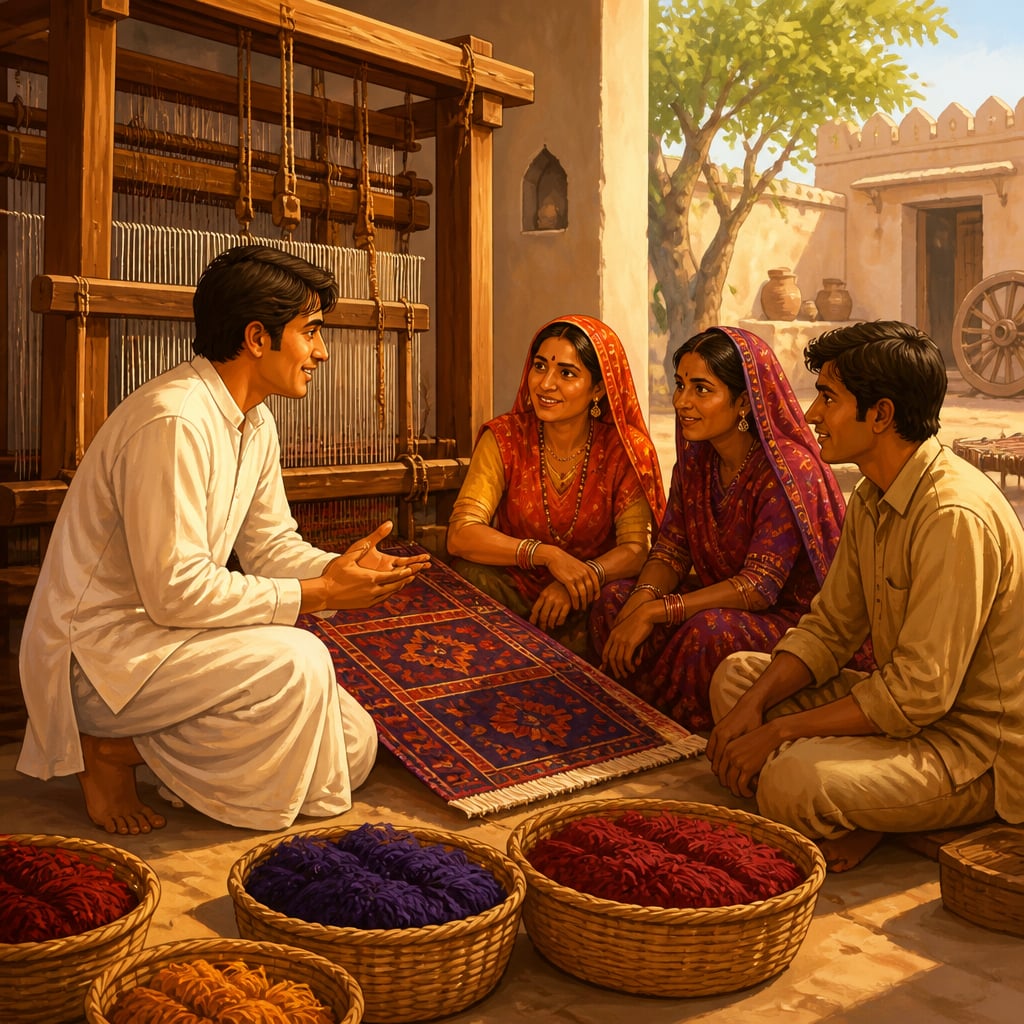
Nand Kishore Chaudhary with weavers at Jaipur Rugs

In 1978, Nand Kishore Chaudhary was a young man in Rajasthan watching an ancient craft die. Village weavers who had created magnificent carpets for generations were abandoning their looms. Why? The middlemen who bought their work paid so little that weaving couldn't sustain a family. Skilled artisans were becoming construction laborers.

Chaudhary had a choice. He could enter the carpet business the conventional way - squeeze suppliers, maximize margins, treat weavers as interchangeable labor. Or he could try something the market considered foolish: pay weavers what their work was actually worth.

He chose the latter. Jaipur Rugs was born not as a company that happened to employ weavers, but as a company built around the principle that weavers deserved dignity. He paid 2-3 times the market rate. He eliminated middlemen. He shared profits.

The industry predicted bankruptcy. Instead, Jaipur Rugs became one of India's largest carpet exporters, with 40,000 artisans across 600 villages. The "naive" approach to labor turned out to be brilliant business.

Chaudhary was practicing bhritaka-dharma - the ancient ethics of the employer - without perhaps knowing the Sanskrit term. The Dharmashastras had been clear: how you treat those who work for you defines your dharma more than almost anything else.

The Dharmashastra Framework: Workers Are Not Tools

The Shukraniti, Manusmriti, and other texts devoted considerable attention to the treatment of workers - from household servants to skilled craftsmen to agricultural laborers. The core principle was revolutionary for its time (and ours): workers are not instruments but persons with claims on their employers beyond mere wages.

The Four Obligations of Bhritaka-Dharma:

1. Vetana-Dana (Timely Wage Payment)

The texts were emphatic: wages must be paid promptly and in full. Delaying payment was considered a serious dharmic violation.

"The wages of a laborer should not remain unpaid overnight. He who withholds wages due becomes bound by that debt in his next life." - Shukraniti

Notice the severity: karmic debt across lifetimes for wage theft. This wasn't because wages were sacred, but because delayed payment exploits the worker's vulnerability - they need the money now, and the employer's power to withhold it is coercive.

2. Yukta-Bhritya (Appropriate Compensation)

Wages should reflect the skill, effort, and value of the work - not merely what the market allows an employer to extract. The concept of yukta (appropriate, fitting) suggests that just wages aren't simply "what you can get away with paying."

The texts recognized different categories:

Work Type Compensation Principle
Skilled crafts Premium for expertise and training invested
Physical labor Adequate for sustenance and family support
Dangerous work Additional compensation for risk borne
Seasonal work Consideration for periods without income

3. Bhritya-Poshana (Worker Welfare)

Beyond wages, employers had obligations for worker welfare - food, shelter (for live-in workers), medical care during illness, and support during hardship. This wasn't charity but dharma - the natural obligation arising from the employment relationship.

"The master who does not care for a sick servant incurs the sin of abandoning a dependent." - Dharmashastra tradition

Modern equivalents: health insurance, sick leave, emergency support. These weren't invented by labor movements - they were ancient dharmic obligations.

4. Mana-Raksha (Dignity Protection)

Perhaps most distinctive: employers must protect worker dignity. Humiliating workers, regardless of their status, violated dharma. The power differential in employment created special obligations - precisely because employers could demean workers, they had a duty not to.

Global Perspectives on Labor Ethics

The treatment of workers has concerned ethical thinkers across civilizations, but the framing and emphasis differ.

Robert Owen observing workers at New Lanark mill

Robert Owen (1771-1858), the Welsh industrialist and reformer, was among the first in the West to argue that treating workers well was both morally right and economically smart. At his New Lanark mills in Scotland, he reduced working hours, banned child labor, provided education for workers' children, and created decent housing. His contemporaries thought him mad. His mills became among the most profitable in Britain.

Owen articulated what he called the "paradox of benevolence" - treating workers as human beings rather than inputs actually increased productivity and loyalty. This echoes the Dharmashastra insight that bhritaka-dharma creates prosperity, not despite the "cost" but because of the relationships it builds.

Confucian Ethics emphasized hierarchical relationships with mutual obligations. The employer-employee bond was analogized to ruler-subject and parent-child relationships - the superior had obligations of care, the subordinate of loyalty. The limitation: this could justify paternalism and resistance to worker agency.

Islamic Labor Ethics prohibited exploiting workers' necessity. A hadith states: "Give the worker his wages before his sweat dries." The emphasis on immediate payment parallels the Dharmashastra prohibition on overnight wage delay. Both traditions recognized that delayed payment exploits the worker's weaker bargaining position.

Tradition Key Emphasis Unique Contribution
Dharmashastra Comprehensive obligations beyond wages Karmic consequences for exploitation
Robert Owen Business case for worker welfare Empirical proof that ethics pays
Confucian Mutual obligations in hierarchy Reciprocal duties, not one-way
Islamic Immediate payment, no exploitation Prohibition on profiting from necessity

The distinctive Dharmic contribution was the integration of worker treatment with karma and dharma - making labor ethics not merely good policy but spiritual practice with cosmic consequences.

Modern Resonance: The Gig Economy Challenge

Bengaluru gig rider watching app rates on phone

India in 2025 faces a labor ethics crisis the ancient texts didn't anticipate: the gig economy. Zomato, Swiggy, Ola, and Urban Company employ millions of workers who are technically "partners" - not employees. This classification exempts platforms from traditional employer obligations.

By bhritaka-dharma standards, the question isn't legal classification but actual relationship. When a platform:

...they have the obligations of an employer regardless of what contracts say. The ancient test wasn't formal designation but substantive reality.

Some companies are recognizing this. Biocon, under Kiran Mazumdar-Shaw, has been recognized for worker-friendly policies that go beyond legal requirements - healthcare, skill development, reasonable hours, and paths for advancement. In an industry that could easily exploit workers' need for employment, Biocon demonstrates that bhritaka-dharma is viable in modern corporate contexts.

The Economics of Dignity

The Dharmashastras weren't naive about power. They understood that employers could exploit workers. The question was: should they? And the answer was layered:

Spiritual Level: Exploitation creates karmic debt. The employer who underpays, delays wages, or demeans workers accumulates papa (sin) that will manifest in this life or future lives.

Social Level: How workers are treated affects the entire community. Exploitative employers create resentful workers, unstable families, and social unrest. The employer's dharma isn't just to the worker but to society.

Economic Level: And here's where it gets interesting - even from pure self-interest, exploitation is often counterproductive:

Jaipur Rugs' experience confirms the ancient insight: paying artisans well created loyalty, quality, and a waiting list of skilled weavers wanting to join. The "expensive" approach was actually cheaper when accounting for full costs.

The Specific Obligations: A Practical Guide

The texts weren't abstract. They specified concrete obligations:

Regarding Payment:

Regarding Treatment:

Regarding Termination:

These read like a modern HR policy manual - but from texts over 1,500 years old.

Your Turn: The Employer's Mirror

Whether you employ one assistant or manage thousands, bhritaka-dharma applies:

The Four Questions:

  1. Would you accept this treatment? If you were in your worker's position, would you consider the wages, conditions, and treatment fair?

  2. Are you paying for the work or exploiting the need? Is your compensation based on the value of labor, or on what workers' desperation forces them to accept?

  3. Do your workers have dignity? Not just absence of abuse, but genuine respect - are they treated as persons or as inputs?

  4. What happens when they're vulnerable? Illness, family crisis, economic downturn - does your treatment change when their bargaining power weakens?

Chaudhary at Jaipur Rugs understood something the ancient texts taught: the workers aren't working for you - you're working with them. The relationship is reciprocal. Your prosperity depends on their skill and commitment. Their welfare is, in a real sense, your welfare.

The next lesson shifts from earning and employing to borrowing and lending. Rina-niti - the ethics of debt - governs another crucial economic relationship: creditor and debtor. When is borrowing wise? What interest is fair? The ancient answers shaped Indian finance for millennia.

Cash flow asymmetry, payment timing, wage theft prevention

Modern labor law in most countries requires regular payment schedules (weekly, bi-weekly, monthly). The US Fair Labor Standards Act requires timely payment, echoing the ancient principle. Yet wage theft remains among the most common workplace violations.

By framing delayed payment as karmic debt (rina), the Dharmic approach creates internal motivation beyond legal compliance. The employer who delays payment isn't just breaking law but accumulating spiritual debt.

A 2023 study found that delayed wage payments in India's informal sector affect over 100 million workers, with average delays of 15-30 days. The ancient prohibition on overnight delay seems increasingly urgent.

Workplace dignity, psychological safety, power dynamics in employment

Modern management research (like Google's Project Aristotle) finds psychological safety is the #1 predictor of team performance. The ancient insight that dignity enables productivity is now empirically confirmed.

Key terms

bhritaka-dharma
The dharma/ethics regarding hired workers; the employer's moral obligations to those who work for them
vetana-dana
The giving/payment of wages; the act of compensating workers for their labor
bhritya-poshana
Worker nourishment/welfare; the employer's obligation to support worker well-being beyond basic wages
mana-raksha
Protection of honor/dignity; the obligation to preserve workers' self-respect and social standing

Key figures

Shukracharya

Kiran Mazumdar-Shaw

Robert Owen

Case studies

Jaipur Rugs: When Workers Come First

In 1978, Nand Kishore Chaudhary started Jaipur Rugs with nine weavers and a principle: artisans deserve dignity and fair compensation. The traditional carpet industry operated through layers of middlemen, each taking margins while weavers earned survival wages. A master weaver might create a carpet worth Rs. 50,000 and receive Rs. 2,000. Chaudhary eliminated middlemen, going directly to village weavers. He paid 2-3 times market rates. He provided design training, healthcare support, and education for weavers' children. When critics said this would make his carpets uncompetitive, he disagreed: 'Better-paid weavers make better carpets. Happy artisans create art.' He also did something radical: he shared profit margins with weavers, not as charity but as recognition that the value was co-created. The weaver wasn't just an 'input' - they were a partner.

Jaipur Rugs embodies multiple dimensions of bhritaka-dharma: 1. **Yukta-bhritya (Appropriate wages)** - Paying for the value of work, not the desperation of workers. Village weavers had no alternatives; Chaudhary refused to exploit that. 2. **Bhritya-poshana (Worker welfare)** - Healthcare, education support, and skill development went far beyond wages. The employer's obligation extended to the worker's whole life. 3. **Mana-raksha (Dignity protection)** - By calling weavers 'artisans' and treating them as creative partners, not labor inputs, Chaudhary restored dignity that the middleman system had stripped away. The Dharmashastra principle that worker prosperity and employer prosperity are linked - not opposed - found vivid demonstration.

By 2024, Jaipur Rugs: - Employs 40,000+ artisans across 600 villages in 5 states - Exports to 60+ countries with revenues exceeding Rs. 450 crore - Has been featured in Harvard Business School case studies - Won numerous awards for social entrepreneurship - Maintains waiting lists of weavers wanting to join Chaudhary's daughter now leads the Jaipur Rugs Foundation, expanding education and healthcare to weaver communities. The 'naive' approach created a multi-generational enterprise - exactly as the Dharmashastras predicted for those who practice bhritaka-dharma faithfully.

The 'business case' for treating workers well isn't separate from the ethical case - it's the same case. Artisans treated with dignity create products worth premium prices. Workers fairly compensated become loyal partners. The ancient texts weren't idealistic; they were pragmatic about what actually creates lasting prosperity.

As global supply chains face increasing pressure for ethical sourcing and fair labor practices, Jaipur Rugs' direct-artisan model has become a reference case in responsible business circles. Luxury consumers increasingly demand provenance and maker stories, turning what was once a cost (fair wages) into a selling point (authentic craftsmanship).

Jaipur Rugs' artisan retention rate exceeds 95% - extraordinary in an industry with typically high turnover. Fair treatment creates stability that compounds into quality and reputation over decades.

Biocon: Bhritaka-Dharma in Biotech

When Kiran Mazumdar-Shaw started Biocon in 1978, India's biotechnology industry didn't exist. She built it from her garage with borrowed money and a conviction that treating scientists and workers well would create better science. As Biocon grew, Mazumdar-Shaw faced choices every growing company faces: how much to invest in worker welfare versus shareholder returns. She consistently chose worker investment - healthcare benefits beyond legal requirements, education support, transparent career paths, and genuine work-life balance in an industry known for burning out talent. Critics (and some shareholders) questioned whether this was 'efficient.' Mazumdar-Shaw's response: 'How can I ask scientists to develop life-saving drugs if I don't care about their lives?'

Biocon demonstrates bhritaka-dharma in knowledge work: 1. **Vetana-dana (Fair compensation)** - Biocon pays competitively, but more importantly, transparently. Workers understand how their compensation is determined. 2. **Bhritya-poshana (Comprehensive welfare)** - Healthcare, childcare support, mental health resources, and family medical coverage treat workers as whole people, not just productive units. 3. **Skill investment** - Continuous learning opportunities and genuine career development. Workers aren't just used; they're grown. 4. **Mana-raksha (Dignity)** - Mazumdar-Shaw famously maintains open-door accessibility. The hierarchy exists but doesn't demean. Scientists are respected as scientists regardless of position.

By 2024, Biocon: - Is Asia's largest biopharmaceutical company by market cap - Maintains industry-low attrition rates (single digits when industry average is 15-20%) - Consistently ranks among India's best workplaces - Has developed biosimilars that provide affordable medicine globally - Created hundreds of millionaires through ESOPs among long-tenured employees Mazumdar-Shaw became India's richest self-made woman not despite her worker-focused approach, but in significant part because of it. In biotech, intellectual capital is the company - treating it well is literally treating the company well.

In knowledge industries, worker treatment isn't 'HR expense' - it's core business strategy. When your competitive advantage walks out the door every evening, how you treat those people determines whether they return with enthusiasm or resentment. Bhritaka-dharma is especially crucial when workers have alternatives.

The global biotech talent war, intensified by the COVID-19 vaccine development race, proved that companies with strong employee cultures retained critical scientists while competitors faced crippling attrition. Biocon's decades of investment in worker welfare positioned it as a preferred employer precisely when talent scarcity peaked.

Biocon's R&D productivity (new products per scientist-year) significantly exceeds industry averages, suggesting that worker investment translates directly to innovation output.

Historical context

Classical & Medieval Periods: 300 BCE - 1200 CE

Ancient and medieval India had sophisticated labor relations through the guild (shreni) system. Guilds regulated wages, working conditions, and protected workers' rights collectively. The Dharmashastra ethical framework was implemented through these institutional structures, not just individual conscience.

Roman law treated slaves as property with no rights. Medieval European serfs had obligations but minimal protections. China's Confucian hierarchy prescribed mutual obligations but favored employers. India's guild system uniquely combined ethical framework (Dharmashastra), institutional enforcement (shreni), and worker collective power.

Guild inscriptions from 5th-6th century India record standardized wages for various crafts, dispute resolution procedures, and penalties for wage violations - a formalized labor relations system predating European equivalents by over a millennium.

Understanding that bhritaka-dharma was institutionally enforced through guilds - not just personal ethics - shows these weren't idealistic aspirations but working social systems. India had organized labor rights before the industrial revolution made them 'necessary' in Europe.

Living traditions

India's labor laws - Minimum Wages Act (1948), Payment of Wages Act (1936), and the recent Labour Codes - implement Dharmashastra principles in statutory form. The emphasis on timely payment, fair wages, and working conditions all echo ancient prescriptions.

Reflection

More in Dharmashastra: Ethics of Earning & Spending

All lessons in Dharmashastra: Ethics of Earning & Spending ยท Dharmic Economics course