Sama-Mulya: The Ethics of Fair Pricing

When Is Profit 'Too Much'?

What price is just? The Dharmashastras and Arthashastra grappled with questions that still vex economists: How much profit is ethical? Should prices rise during scarcity? What obligations do sellers have to buyers who need their goods? The ancient answers reveal a sophisticated understanding of markets, necessity, and dharma.

The Price of Life

Yusuf Hamied announcing one-dollar AIDS drugs at Durban

In 2001, Yusuf Hamied, chairman of Cipla, stood before a conference of AIDS activists in Durban, South Africa. The HIV/AIDS epidemic was killing millions across Africa. The drugs that could save them existed - but cost $12,000 per patient per year. For most Africans, this was a death sentence priced as treatment.

Hamied made an announcement that shook the pharmaceutical world: Cipla would provide the same drugs for $350 per year - later reduced to $1 per day.

"We're not in the business of profits," Hamied said. "We're in the business of affordable medicine."

The global pharmaceutical industry called it unsustainable, illegal, even dangerous. But Hamied was practicing something ancient: sama-mulya - equitable pricing. The Dharmashastras had a clear principle: when someone's life or survival depends on your goods, your pricing obligations change fundamentally.

The Arthashastra Framework: Price as Governance

Kautilya devoted substantial attention to pricing - not as market theory, but as statecraft. In his view, price wasn't just what buyers and sellers agreed upon; it was a matter of social order.

The Three Pricing Principles:

1. Panya-Mulya (Commodity Pricing)
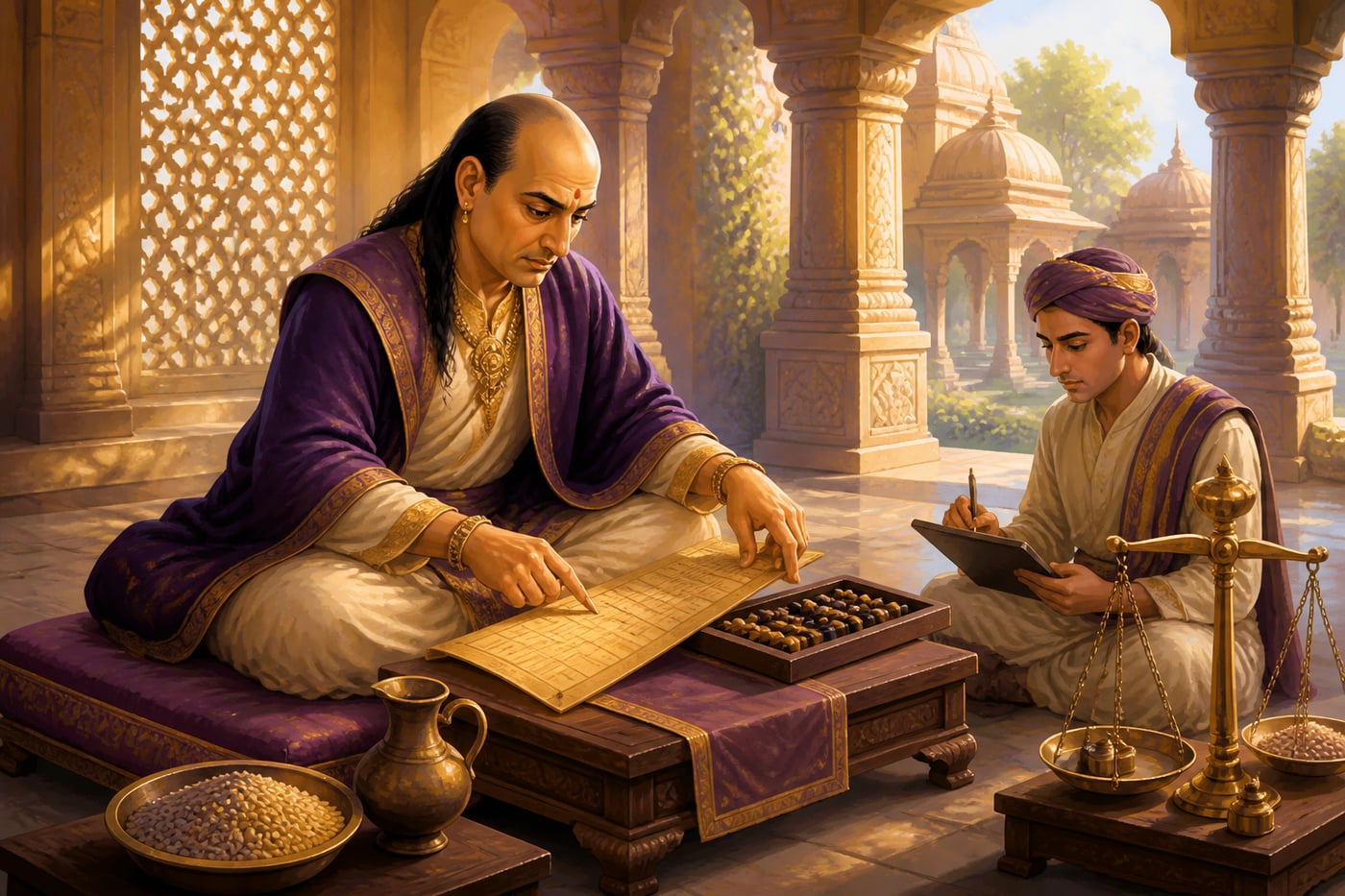
Kautilya's Panyadhyaksha calculating reference grain prices

Kautilya specified that the Superintendent of Commerce (Panyadhyaksha) should establish reference prices for essential goods. These weren't fixed prices but benchmarks - if market prices deviated significantly, it triggered investigation.

"The superintendent shall fix the price of goods after calculating the investment, the quantity, the duty, the interest, the rent, and the wages." - Arthashastra 2.16.6

Notice what's included: not just cost, but reasonable return on investment and fair wages for workers. The "just price" wasn't arbitrary - it was calculated.

2. Kala-Mulya (Time-Based Pricing)

Prices could legitimately vary based on season, availability, and storage costs. A grain merchant who stored grain through monsoon, protecting it from rot, could charge more - that represented genuine value added.

But artificial scarcity was punished severely. Hoarding goods to create false shortages was a crime against the state.

3. Apad-Mulya (Crisis Pricing)

Here the Dharmashastras were most distinctive. During famines, floods, or epidemics, normal pricing rules were suspended - but not in the way you might expect. Sellers were prohibited from raising prices on necessities during emergencies.

"He who raises the price of grain during famine commits a sin equal to killing a hundred Brahmins." - Dharmashastra tradition

The logic: when people have no choice, the market isn't functioning - it's extortion. Dharmic pricing requires that both parties have genuine alternatives.

Global Perspectives on Just Price

The question of "fair price" has occupied thinkers across civilizations, each approaching it from different angles.

Thomas Aquinas (1225-1274), the medieval Christian philosopher, developed the most influential Western theory of just price. In his Summa Theologica, Aquinas argued that a just price reflects the "common estimation" of a good's worth - essentially, what informed buyers and sellers in a competitive market would agree upon. Crucially, he condemned taking advantage of a buyer's urgent need: "If someone would be greatly helped by something belonging to someone else, and the seller would not be similarly harmed by losing it, the seller must not sell at a higher price."

This parallels the Dharmashastra prohibition on crisis pricing. Both traditions recognized that genuine market transactions require genuine choice.

Ibn Khaldun (1332-1406), the Arab historian and economist, observed that prices naturally fluctuate based on supply, demand, and the prosperity of cities. He accepted this as normal. But he distinguished between price changes from natural market forces versus those from "ichtikar" (hoarding/monopoly) - which he condemned as destructive to civilization itself.

Adam Smith (1723-1790) is often misread as endorsing any price the market will bear. In fact, Smith distinguished between "natural price" (covering costs plus normal profit) and "market price" (what's actually charged). He expected competitive markets to push market prices toward natural prices. When they didn't - due to monopoly, collusion, or artificial scarcity - Smith was critical.

Thinker Just Price Definition Key Constraint
Kautilya Calculated: cost + reasonable margin + wages State supervision, anti-hoarding laws
Aquinas Common estimation in fair exchange Cannot exploit buyer's urgent need
Ibn Khaldun Natural market forces Prohibit hoarding/monopoly
Adam Smith Natural price (costs + normal profit) Competition prevents exploitation

The Dharmic contribution was integrating these insights with karma - the understanding that exploitative pricing corrupts the seller spiritually, not just economically.

The Jan Aushadhi Revolution: Ancient Principles in Modern Form

Elderly woman receiving affordable medicines at Jan Aushadhi

In 2008, the Government of India launched Jan Aushadhi - a network of stores selling generic medicines at 50-90% below market prices. The premise was pure sama-mulya: essential medicines shouldn't be priced based on what desperate patients will pay, but on what genuine cost-plus-fair-margin requires.

By 2024, over 10,000 Jan Aushadhi stores operate across India, providing affordable medicines to millions. The economics work because:

  1. Eliminating artificial margins - Brand-name drugs often carry 300-1000% markups over manufacturing cost. Generic equivalents with the same efficacy need only cover actual costs.

  2. State as market-maker - Like Kautilya's Panyadhyaksha, the government established reference pricing that exposed how far "market" prices had strayed from just prices.

  3. Dharmic framing - The program explicitly invokes the principle that healthcare is a right, not a privilege. Pricing should enable access, not extract maximum willingness-to-pay.

The pharmaceutical industry's initial predictions of collapse proved wrong. Jan Aushadhi is financially sustainable while providing medicines at a fraction of market prices.

When Price Becomes Violence

The Dharmashastras made a startling claim: exploitative pricing during necessity is a form of violence (himsa). This wasn't metaphor.

Consider: if a drowning person needs a rope, and you demand their life savings for it, you haven't saved them - you've extorted them. The "transaction" occurred under duress. The Dharmic view is that such a transaction lacks moral validity regardless of legal enforceability.

This principle applies broadly:

Modern economics often treats these as efficient market outcomes. The Dharmic view is that they're efficient extraction - and extraction isn't commerce, it's himsa with extra steps.

The Balance: Fair to Whom?

Sama-mulya doesn't mean sellers should sacrifice themselves. The principle is balance - pricing that serves both parties fairly.

The Arthashastra formula included:

What it excluded:

This is more nuanced than either "charge what the market will bear" or "minimize prices." It's contextual ethics - recognizing that fair price depends on the nature of the good, the situation of the buyer, and the genuine costs of the seller.

Your Turn: The Pricing Mirror

Whether you're pricing products, negotiating salary, or simply buying and selling, sama-mulya offers a framework:

The Four Questions:

  1. Does the buyer have genuine choice? If they're desperate, your pricing power increases - but your dharmic obligation does too.

  2. Does my price reflect genuine value added? Costs, risk, skill, and service are legitimate. Exploitation of information or position is not.

  3. Would I accept this price in reverse? If you were the buyer in this situation, would you consider the price fair?

  4. What would transparency reveal? If your cost structure were fully visible, would the price still seem justified?

Hamied's Cipla decision wasn't charity - the company remained profitable on $1/day AIDS drugs. It was sama-mulya: pricing that covered genuine costs while serving those who needed the medicine.

The next lesson asks: you've earned righteously, dealt cleanly, and priced fairly - but what do you owe the people who work for you? Bhritaka-dharma - the ethics of wages and labor - takes us from market transactions to the most personal economic relationship of all.

Price inelasticity of demand, essential goods pricing, anti-gouging principles

Most US states have anti-price gouging laws that activate during declared emergencies. However, many economists (like those at Chicago School) argue price increases during shortages are efficient. The Dharmic view rejects this - efficiency in extraction is still extraction.

Indian law includes the Essential Commodities Act (1955) which allows price controls on necessities - a direct legal descendant of Kautilya's Panyadhyaksha framework. The dharmic approach integrates legal and moral constraints.

During COVID-19, India's National Pharmaceutical Pricing Authority capped prices on essential medicines, preventing the price spikes seen in less-regulated markets. This intervention reflected ancient apad-mulya principles in modern form.

Cost-plus pricing, transparent pricing, price justification

Modern 'value-based pricing' often means 'charge what the market will bear regardless of cost.' Kautilya's approach is closer to 'cost-plus-reasonable-margin' - a more constrained and transparent model.

Key terms

sama-mulya
Equitable/fair price; pricing that balances the legitimate interests of buyer and seller
avarodha
Obstruction, hoarding; artificially restricting supply to manipulate prices
panyadhyaksha
Superintendent of Commerce; the state official responsible for market regulation and fair pricing
apad-mulya
Crisis/emergency pricing; the ethical standards for pricing during disasters, famines, or emergencies

Key figures

Kautilya (Chanakya)

Yusuf Hamied

Thomas Aquinas

Case studies

Cipla's $1/Day AIDS Drugs: Sama-Mulya at Global Scale

In 2001, AIDS was killing over 3 million people annually, mostly in Africa and developing Asia. Triple-combination antiretroviral therapy could suppress the virus and allow patients to live normal lives - but at $10,000-15,000 per patient per year, it was beyond reach for the vast majority of those infected. Yusuf Hamied of Cipla analyzed the actual cost of manufacturing these drugs. The answer: about $350 per patient per year, which he later reduced to $1 per day. The difference wasn't manufacturing - it was patents, marketing, and profit margins. Hamied announced Cipla would supply AIDS drugs to Africa at cost. The global pharmaceutical industry was outraged. They called it piracy, theft, and predicted the collapse of pharmaceutical innovation. Western governments threatened trade sanctions on India.

Hamied's decision perfectly illustrates sama-mulya principles: 1. **Necessity creates obligation** - AIDS patients had no alternatives; their desperation couldn't ethically be the basis for pricing. 2. **Price can be calculated** - Hamied demonstrated that actual manufacturing cost was a fraction of market price. The 'market price' wasn't based on genuine costs. 3. **Hoarding is violence** - Keeping life-saving drugs artificially expensive through patent enforcement, when cheap production was possible, constituted modern avarodha (obstruction). The Dharmashastra principle that exploitation during crisis equals violence finds stark application: pricing AIDS drugs beyond reach was, functionally, a death sentence for millions.

Cipla's announcement catalyzed a global movement for affordable medicines. The WHO approved generic AIDS drugs, PEPFAR (US program) began purchasing generics, and prices across the market collapsed. By 2024, over 28 million people receive antiretroviral treatment, mostly via generic drugs. Cipla itself thrived. The company's market cap grew from about Rs. 3,000 crore in 2001 to over Rs. 95,000 crore by 2024. Ethical pricing didn't destroy the business - it defined a market leadership position. Hamied was awarded the Padma Bhushan and numerous global honors. More importantly, an estimated 10+ million lives were saved by the affordable medicines his decision enabled.

Sama-mulya at its most profound isn't just about fair profit margins - it's about recognizing when 'market pricing' becomes a mechanism of violence. Hamied proved that ethical pricing could be commercially viable while saving millions of lives.

The COVID-19 vaccine pricing debates replayed the exact same tensions Cipla confronted in 2001. India's role as 'pharmacy of the world,' supplying affordable generics to over 200 countries, traces directly to the precedent Cipla set by proving that ethical pricing and commercial viability can coexist in pharmaceutical manufacturing.

AIDS treatment costs dropped from $10,000+/year in 2001 to under $100/year by 2020 - a 99% reduction - largely due to generic competition that Cipla's decision catalyzed.

Jan Aushadhi: Government as Panyadhyaksha

In 2008, India launched the Pradhan Mantri Bhartiya Janaushadhi Pariyojana (PMBJP) - a network of stores selling generic medicines at 50-90% below market prices. The premise was simple: branded medicines often carried massive markups unrelated to manufacturing cost. Generic equivalents with the same efficacy could be sold much cheaper. The pharmaceutical industry predicted failure. They argued that quality would suffer, that patients wouldn't trust cheap medicines, and that the stores would be financially unsustainable. But Jan Aushadhi persisted. The government established quality standards, created supply chains, and gradually expanded the network. By 2024, over 10,000 stores operate across India.

Jan Aushadhi represents the modern state acting as Panyadhyaksha - the Arthashastra's Superintendent of Commerce: 1. **Establishing reference prices** - Jan Aushadhi prices reveal what medicines should cost, exposing how far market prices have strayed from sama-mulya. 2. **Anti-avarodha function** - By ensuring supply of affordable alternatives, the program breaks the artificial scarcity created by high-priced branded monopolies. 3. **Quality assurance** - Like the ancient Manadhyaksha (Superintendent of Weights), the program certifies that generic medicines meet standards. The program demonstrates that 'market prices' for essential goods often don't reflect genuine costs - and state intervention can restore fair pricing without destroying markets.

By 2024: - 10,000+ Jan Aushadhi stores operating - Over 1,800 medicines and 285 surgical items available - Estimated Rs. 28,000 crore savings to citizens (cumulative) - Stores are financially sustainable through volume - Quality complaints remain minimal, challenging industry predictions The program has inspired similar initiatives across states and influenced pharmaceutical pricing policy globally.

When markets fail to provide sama-mulya for essentials, the state can act as market-maker to restore fair pricing. This isn't socialism - it's Kautilya. The Panyadhyaksha's role was exactly this: ensure markets serve public welfare.

The Jan Aushadhi network has grown to 10,000+ stores by 2024, becoming one of the world's largest government-backed generic pharmacy chains. Its success has inspired similar initiatives in other developing nations, demonstrating that state intervention in essential medicine pricing can work without destroying private pharmaceutical innovation.

A diabetes medicine that costs Rs. 350 at regular pharmacies sells for Rs. 32 at Jan Aushadhi - an 91% reduction - with the same active ingredient and quality certification.

Historical context

Mauryan Empire & Classical Period: 300 BCE - 500 CE

The Mauryan period saw India's first large-scale market economy under centralized governance. The Arthashastra's pricing regulations weren't theoretical - they were implemented across an empire spanning most of South Asia. Archaeological evidence shows standardized weights and market infrastructure.

Roman markets operated with minimal price regulation except during crises (annona for grain). Chinese markets were regulated but more through sumptuary laws (who could buy what) than fair pricing. The Indian approach uniquely combined spiritual ethics (dharma), legal enforcement (danda), and market supervision (Panyadhyaksha).

Mauryan-era inscriptions reference specific price controls for essential goods during famines - the earliest documented implementation of anti-price-gouging regulation anywhere in the world.

Understanding that sama-mulya wasn't just ethical teaching but implemented state policy shows these weren't naive ideals. The Mauryan Empire - one of history's largest and most prosperous states - operated on these principles, proving their economic viability.

Living traditions

India's pharmaceutical pricing policies - from DPCO (Drug Price Control Order) to Jan Aushadhi - represent the world's most comprehensive application of ancient fair pricing principles to modern essential medicines. Other countries studying universal healthcare often look to India's pricing models.

Reflection

More in Dharmashastra: Ethics of Earning & Spending

All lessons in Dharmashastra: Ethics of Earning & Spending ยท Dharmic Economics course