Yoga-Kshema: Security and Prosperity Combined

Viksit Bharat 2047

In the Bhagavad Gita, Krishna makes an extraordinary promise: those who worship Him with single-minded devotion will have their 'yoga-kshema', both acquisition and protection, secured. This ancient concept now animates India's 2047 vision. This lesson explores how national development is collective purushartha, and why your prosperity is patriotic duty.

The Promise That Built a Nation

In the ninth chapter of the Bhagavad Gita, Krishna makes perhaps His most reassuring promise:
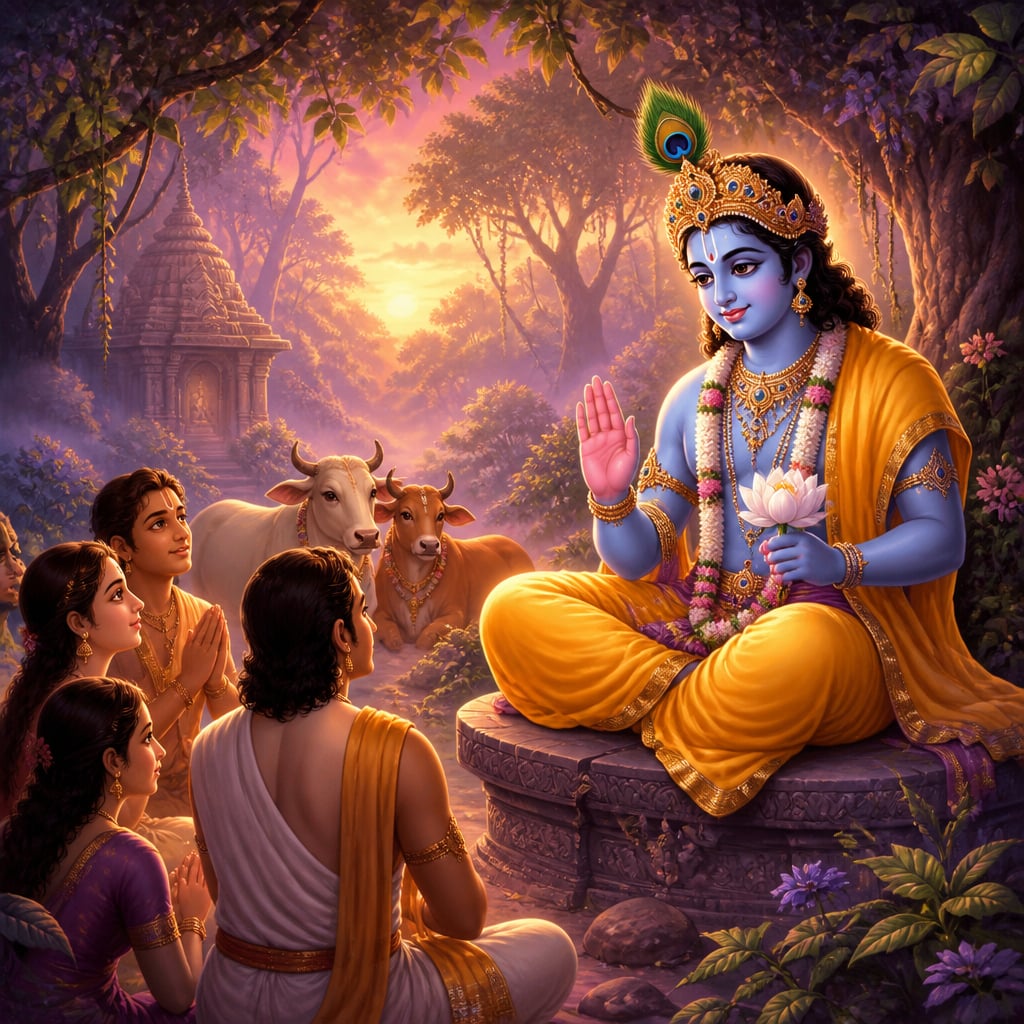
Krishna raises his hand in the yoga-kshema promise

"अनन्याश्चिन्तयन्तो मां ये जनाः पर्युपासते। तेषां नित्याभियुक्तानां योगक्षेमं वहाम्यहम्॥"

"For those who worship Me with undivided attention, ever united, I personally carry their yoga-kshema."

, Bhagavad Gita 9.22

When a young Mahatma Gandhi read this verse for the first time, he reportedly wept. The God of the universe, personally guaranteeing both acquisition and protection? It seemed too generous.

But yoga-kshema isn't just personal promise. It's a political philosophy. When India's founders designed the Constitution, they embedded this concept: the state's duty is to secure both the getting and the keeping of prosperity for all citizens.

Today, as India pursues Viksit Bharat by 2047, the vision of becoming a developed nation by independence's centenary, yoga-kshema remains the guiding principle. Not just growth. Not just security. Both, together, for everyone.

What Yoga-Kshema Actually Means

The compound yoga-kshema breaks into two Sanskrit words:

Yoga (here) = acquisition, obtaining, securing what you don't yet have

Kshema = protection, preservation, maintaining what you've acquired

Together, they represent the complete economic cycle:

Stage Sanskrit Meaning Example
Getting Yoga Acquiring new prosperity Starting a business, getting a job
Keeping Kshema Protecting what you have Savings, insurance, security

A society that only enables yoga (getting) but not kshema (keeping) produces inequality and instability. A society that only provides kshema but stifles yoga produces stagnation. The dharmic ideal is both, in balance.

From Personal Promise to National Policy

When Krishna promises yoga-kshema to His devotees, He's modeling what good governance should do for citizens. The Arthashastra makes this explicit:

"प्रजासुखे सुखं राज्ञः प्रजानां च हिते हितम्। नात्मप्रियं हितं राज्ञः प्रजानां तु प्रियं हितम्॥"

"In the happiness of his subjects lies the happiness of the king. In the welfare of the subjects lies the king's welfare. What is pleasing to himself is not the king's good, what pleases the subjects is his good."

, Kautilya, Arthashastra 1.19.34

Notice: the ruler's job is ensuring subjects' prosperity, their ability to get (yoga) and keep (kshema). Modern governance adds scale: millions of citizens, complex economies, global competition. But the principle remains: the state exists to secure yoga-kshema for all.

India's Journey: The Numbers Tell a Story

India's post-independence economic story is one of learning, sometimes slowly, how to deliver yoga-kshema:

1947-1991: The License Raj

1991-2014: Liberalization

A fruit vendor accepts a UPI payment in an Indian market

2014-Present: Sabka Saath, Sabka Vikas

The data validates the yoga-kshema approach:

Metric 2014 2024
GDP $2.0 trillion $3.5 trillion
Bank accounts 53% adults 80%+ adults
Poverty rate 22% ~12%
DBT transfers ₹0 ₹35+ lakh crore

Viksit Bharat 2047: The Collective Purushartha

On August 15, 2047, India will complete 100 years of independence. The Viksit Bharat vision is that this centenary finds India as a developed nation, not just in GDP, but in human development, infrastructure, and civilizational confidence.

What does "developed" mean in dharmic terms?

Conventional Metric Dharmic Equivalent
High GDP per capita Sufficient artha for all to pursue dharma
Low poverty Daridrata-nivarana achieved
Quality healthcare Ahimsa through protection of life
Universal education Vidya accessible to all
Strong defense Kshema from external threats
Good governance Raja-dharma fulfilled

This is collective purushartha, national pursuit of artha that enables national pursuit of dharma.

Your Role in 2047

Viksit Bharat isn't just government's project. It's everyone's rashtra-dharma (national duty).

When you:

Every rupee you earn honestly, every job you create, every product you export, this is yoga-kshema in action. Your personal artha becomes national artha.

Finance Minister Nirmala Sitharaman frames budgets in these terms: "The budget is not just numbers. It reflects our civilizational priorities." When she allocates for infrastructure, it's national yoga. When she allocates for welfare, it's national kshema. When she balances both, she's practicing dharmic economics at scale.

The Indigenous Advantage

Economist R. Vaidyanathan argues that India's economic DNA differs from the West, and that's an advantage:

Western Model Indian Model
Individual entrepreneur Family enterprise
Shareholder primacy Stakeholder balance
Quarterly focus Generational thinking
Contract-based trust Relationship-based trust

India's traditional business communities, Marwaris, Chettiars, Gujaratis, practiced yoga-kshema naturally. They built wealth (yoga) while maintaining it across generations (kshema). They created prosperity while ensuring community welfare.

The startup ecosystem is now rediscovering these principles. Long-term orientation over quick exits. Employee welfare alongside investor returns. Customer relationships over transactional efficiency. This is yoga-kshema for the 21st century.

Global Lessons: Yoga-Kshema in Nation-Building

India isn't the first nation to pursue rapid development. Several leaders have demonstrated yoga-kshema principles in transforming their economies:

Park Chung-hee (South Korea, 1961-1979) inherited one of the world's poorest nations, poorer than Ghana at independence. Through disciplined industrial policy, strategic chaebols, and relentless export orientation, he delivered both yoga (Korea became an industrial power) and kshema (poverty virtually eliminated). The 'Miracle on the Han River' transformed Korea from rice paddies to semiconductors in one generation.

Mahathir Mohamad (Malaysia, 1981-2003, 2018-2020) articulated 'Vision 2020', Malaysia's own viksit vision. He balanced rapid industrialization (yoga) with affirmative action policies (kshema) for marginalized communities. His approach, strategic industries, infrastructure investment, human capital development, offers lessons for India's own journey.

Alexander Hamilton (United States, 1789-1795) proved that new nations can build economic power through deliberate institutional design. His creation of the national bank, assumption of state debts, and promotion of manufacturing transformed a struggling confederation into an economic power. Hamilton understood that young nations must actively build vibhava rather than passively hope markets will provide.

Each of these leaders practiced yoga-kshema at national scale: enabling wealth creation while ensuring broad-based prosperity.

The Security Dimension

Kshema includes protection from threats, external and internal. A prosperous nation that can't defend itself isn't truly prosperous. The Arthashastra is blunt:

"षाड्गुण्यगुणोपेतो मन्त्रशक्त्या विजयी भवेत्। कोषमूलो दण्डः"

Indian Coast Guard patrol at dawn off the Arabian Sea

"Victory comes through counsel, the treasury, and the army. The treasury is the foundation of the army."

Military power requires economic power. India's defense budget, growing consistently, reflects this understanding. The indigenous defense production program, from Tejas fighters to INS Vikrant aircraft carrier, represents yoga (acquiring capability) and kshema (protecting the nation).

When you contribute to the economy, you indirectly fund defense. Your tax rupees protect India's sovereignty. Economic patriotism and territorial patriotism are connected.

Your Yoga-Kshema Commitment

As we complete this chapter on Artha as sacred duty, consider your personal yoga-kshema practice:

For Yoga (Acquisition):

For Kshema (Protection):

For National Yoga-Kshema:

The dharmic economics of Chapter 1 synthesizes: Artha is purushartha. Dharma guides artha. Artha enables dharma. Nishkama karma brings peace. Vibhava builds nations. And yoga-kshema, the divine promise of acquisition and protection, becomes national policy when every citizen participates.

Viksit Bharat 2047 isn't just a government target. It's our generation's collective purushartha.

Will you participate?

Western political economy debates 'night watchman' state (minimal, just protection) versus 'welfare' state (extensive services). Yoga-kshema integrates both: enable prosperity AND protect it.

This provides indigenous framework for what India should aim for: not just growth (yoga), not just security (kshema), but both in balance. The false choice between development and welfare dissolves.

India's combined spending on development (capex) and welfare (DBT, subsidies) has increased from 8% to 12% of GDP since 2014, reflecting yoga-kshema balance in fiscal policy.

Utilitarian philosophy (Bentham, Mill) similarly aimed at 'greatest good for greatest number.' But Kautilya adds the governance duty: the ruler must actively create conditions for this good.

This frames national development as collective purushartha, not just economic target but dharmic obligation. Viksit Bharat isn't just policy goal; it's national karma yoga.

India's per capita income has grown from $400 (1991) to $2,600 (2024). The 2047 target of ~$15,000 would bring India to developed nation status, collective artha at scale.

Key terms

Yoga-Kṣema
The compound of 'yoga' (acquisition, obtaining) and 'kshema' (protection, preservation), together representing the complete cycle of getting and keeping prosperity.
Viksit Bhārat
Developed India, the national vision of India becoming a fully developed nation by 2047, the centenary of independence.
Rāṣṭra-Dharma
National duty, the dharmic obligations of citizens toward national prosperity and civilizational revival. Each person's artha contributes to collective artha.
Sabkā Sāth
'Together with all', the governing philosophy that development must include everyone. Growth without inclusion is incomplete yoga-kshema; true prosperity lifts all citizens, not just elites.

Verses

अनन्याश्चिन्तयन्तो मां ये जनाः पर्युपासते। तेषां नित्याभियुक्तानां योगक्षेमं वहाम्यहम्॥

ananyāścintayanto māṃ ye janāḥ paryupāsate | teṣāṃ nityābhiyuktānāṃ yogakṣemaṃ vahāmyaham ||

For those who worship Me with undivided attention, ever united with Me, I personally carry their yoga and kshema.

This verse provides the conceptual foundation for what modern governance should deliver: not just growth (yoga) or just security (kshema), but both. The state that enables citizens to prosper AND protects their prosperity fulfills the divine template.

Bhagavad Gita, Chapter 9, Verse 22 (Swami Chinmayananda)

प्रजासुखे सुखं राज्ञः प्रजानां च हिते हितम्। नात्मप्रियं हितं राज्ञः प्रजानां तु प्रियं हितम्॥

prajāsukhe sukhaṃ rājñaḥ prajānāṃ ca hite hitam | nātmapriyaṃ hitaṃ rājñaḥ prajānāṃ tu priyaṃ hitam ||

In the happiness of subjects lies the king's happiness; in their welfare, his welfare. What pleases himself is not the king's good, what pleases the subjects is his true good.

This provides the philosophical foundation for 'Sabka Saath, Sabka Vikas', development for all. The government's success is measured by citizens' prosperity, not by its own aggrandizement.

Arthashastra, Chapter 1.19, Verse 34 (R. Shamasastry)

कोशमूलो दण्डो दण्डमूलाः प्रजाः। प्रजामूला च कृषिः सा च वाणिज्यमूला॥

kośamūlo daṇḍo daṇḍamūlāḥ prajāḥ | prajāmūlā ca kṛṣiḥ sā ca vāṇijyamūlā ||

The army is rooted in the treasury; the people are rooted in state power; agriculture is rooted in the people; and all this is rooted in trade.

This articulates the multiplier effect centuries before modern economics. Economic activity (trade) is the foundation of everything else, including the state's ability to protect and govern. Yoga-kshema begins with economic vitality.

Shukra Niti, Chapter 1 (B.K. Sarkar)

Key figures

Shukracharya

Author of Shukra Niti, treatise on governance and economics; traditionally, the preceptor of the Asuras in Hindu mythology · Ancient (Vedic period, traditionally)

Nirmala Sitharaman

Finance Minister of India (2019-present), first full-time female Finance Minister, responsible for Union Budgets during India's economic resurgence · Contemporary (born 1959)

Alexander Hamilton

First U.S. Secretary of the Treasury; architect of American economic institutions and national financial system · Modern (1755-1804)

Case studies

South Korea: The Miracle on the Han River

In 1960, South Korea's per capita GDP was $79, lower than Ghana and most of sub-Saharan Africa. The nation had no natural resources, a devastated post-war economy, and 6,000 years of poverty. President Park Chung-hee launched an aggressive industrial policy: strategic chaebols (Samsung, Hyundai), mandatory savings, export orientation, and heavy investment in education.

Park's approach exemplified yoga-kshema at national scale. The 'yoga' came through aggressive industrial development, export promotion, and wealth creation. The 'kshema' came through land reform, universal education, and eventually democratic institutions that protected gains. He built national vibhava before distributing prosperity, capacity preceded charity.

By 2023, South Korea's per capita GDP reached $33,000, a 400x increase in real terms over 60 years. From rice paddies to semiconductors, from aid recipient to OECD member. Korean companies (Samsung, Hyundai, LG) now compete globally. The 'Miracle on the Han' remains the most dramatic economic transformation in human history.

Disciplined national yoga-kshema, strategic capacity building, delayed gratification, and long-term thinking, can transform even the poorest nations. India, starting from a stronger base, can achieve similar transformation by 2047 with sustained yoga-kshema policy.

South Korea's transformation from aid recipient to G7-level economy within a single generation remains the most compelling proof that strategic industrial policy works. India's Production Linked Incentive schemes and semiconductor investments follow a similar logic of targeted national capacity building.

South Korea's GDP grew from $4 billion (1960) to $1.7 trillion (2023). In purchasing power terms, Koreans went from among the world's poorest to richer than most Europeans, in one generation.

Venezuela vs. Norway: Oil Wealth as Yoga Without Kshema

Both Venezuela and Norway discovered massive oil reserves in the 1970s. Both became among the world's largest oil exporters. Both faced the same question: how to manage sudden resource wealth. Their choices, and outcomes, could not be more different.

Venezuela pursued yoga without kshema: immediate consumption without protection. Oil revenues funded subsidies and consumption but not diversification or savings. When oil prices fell, there was nothing to fall back on. Norway pursued yoga with kshema: a sovereign wealth fund (now $1.4 trillion) that protected wealth across generations, strict fiscal rules, and continued investment in non-oil industries.

Venezuela: From Latin America's richest nation to economic collapse. Hyperinflation, mass emigration, poverty. The oil wealth evaporated because there was no kshema. Norway: Among the world's highest living standards. The Government Pension Fund Global ensures prosperity for future generations. Same resource, opposite outcomes, yoga-kshema made the difference.

Prosperity without protection is illusion. Venezuela's cautionary tale shows that yoga (acquiring wealth) without kshema (protecting and sustaining it) leads to ruin. India must ensure that its economic growth translates into durable, protected prosperity, not consumption that disappears when conditions change.

Resource-rich nations continue to diverge based on institutional quality. Countries like Botswana (diamonds) and Chile (copper) that built sovereign wealth funds thrive, while those that consumed windfalls, like Libya and Iraq, face instability. The pattern confirms that protecting wealth requires as much discipline as creating it.

Norway's sovereign wealth fund: $1.4 trillion (2024), equal to $260,000 per citizen. Venezuela's reserves: effectively depleted, with 7 million citizens fleeing economic collapse. Same starting point, opposite yoga-kshema choices.

Historical context

Vedic period through contemporary India

India's economic policy has evolved toward better yoga-kshema integration. The early emphasis on 'security' (controls, licenses) sacrificed growth. Liberalization emphasized growth but left many behind. Current policy aims for both, closest to the dharmic ideal.

Compare to China (growth-first, social stability through control), European welfare states (high kshema, lower yoga), and US (high yoga, variable kshema). India's dharmic framework seeks integration rather than trade-off.

India's GINI coefficient (inequality measure) has declined from 0.38 (2011) to 0.35 (2022) even as GDP grew, evidence that yoga-kshema integration is working.

Understanding yoga-kshema transforms how you view government policy and your own economic role. You're not just pursuing personal prosperity, you're participating in delivering yoga-kshema to a nation of 1.4 billion.

Living traditions

India's 2024 budget allocated both for infrastructure (yoga) and welfare (kshema). The goal: 8%+ growth while reducing poverty to single digits. This is yoga-kshema as fiscal policy, the dharmic economics of Viksit Bharat.

Reflection

More in Artha: Wealth as Sacred Duty

All lessons in Artha: Wealth as Sacred Duty · Dharmic Economics course