Purushartha: The Four Goals of Human Life

Life's Four Goals in Balance

When King Yudhishthira asked Bhishma what makes a life worth living, the dying patriarch revealed a secret that modern economics has forgotten: wealth is not the enemy of spirituality, it's one of four sacred duties every human must fulfill. This lesson unpacks the Purushartha framework that made ancient India the world's richest civilization.

The Question on the Battlefield
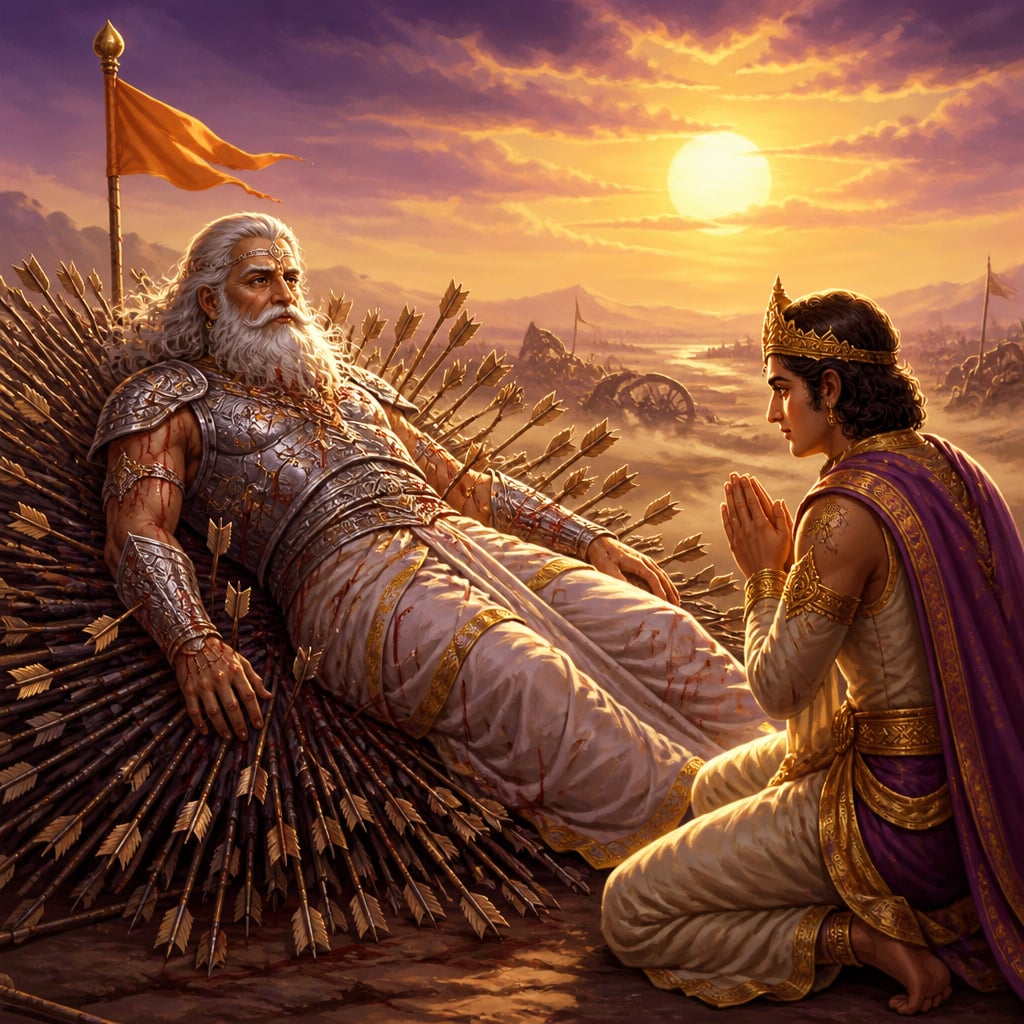
Bhishma on the bed of arrows at Kurukshetra

The winter sun hung low over Kurukshetra, casting long shadows across a field still reeking of death. Vultures circled overhead. The stench of eighteen days of slaughter, blood, sweat, elephant dung, rotting flesh, hung thick in the cold air. Amidst the silence where war cries had thundered just days before, one man lay suspended between earth and sky.

Bhishma, the grand patriarch of the Kuru dynasty, rested on a bed of arrows, hundreds of shafts piercing his body, holding him aloft like some grotesque throne. The white-haired warrior, who had seen six generations of kings, who had fought like a god and killed like a demon, now waited for the sun to turn north so he could finally die.

Yudhishthira approached, his royal robes still stained with the dust of battle. The newly victorious king looked nothing like a conqueror. His eyes were hollow, haunted by the faces of cousins, teachers, and friends he had slain. He fell at Bhishma's feet.

"Pitamaha," he whispered, his voice cracking. "I have won a kingdom but lost my peace. Millions lie dead because of my claim to this throne. What is the purpose of such a life? Should I not renounce this blood-stained crown and seek the forest?"

Bhishma's eyes, still sharp despite his wounds, softened with compassion. What he said next would echo through millennia, a teaching that built the world's richest civilization, that India forgot, and that we are only now rediscovering.

The Four-Fold Framework

Bhishma did not tell Yudhishthira to renounce wealth. Instead, he revealed the Purushartha framework, the four goals worthy of human pursuit:

"धर्मार्थकाममोक्षाणां प्राणाः स्थानस्य चापनः। यस्यैकोऽपि न लभ्येत किं तेन जीवितेन च॥"

"Dharma, Artha, Kama, and Moksha are the very breath of existence. Without even one of these, what use is life?"

Notice what Bhishma did NOT say. He didn't say "reject wealth." He didn't say "pleasure is sin." He said that all four goals are essential, like the four legs of a table. Remove one, and the whole structure collapses.

Dharma (धर्म), Righteous conduct, ethical duty, cosmic order. This is the foundation. Without dharma, the other three become destructive.

Artha (अर्थ), Wealth, resources, economic security. Not merely permitted but required. A householder who neglects artha fails in dharma toward his family.

Kama (काम), Pleasure, aesthetic enjoyment, emotional fulfillment. Love, art, music, beauty, all valid pursuits within dharmic bounds.

Moksha (मोक्ष), Liberation, spiritual freedom. The ultimate goal that gives meaning to the temporal pursuits.

Why Artha Is Sacred (Not Shameful)

Here's where ancient India differed radically from medieval Europe's "money is the root of evil" or modern capitalism's "greed is good." The Vedic position is more sophisticated:

"धर्मादर्थः प्रभवति धर्मात्प्रभवते सुखम्। धर्मेण लभते सर्वं धर्मसारमिदं जगत्॥"

"From dharma comes artha, from dharma comes happiness. Through dharma, one obtains everything, this world is founded on dharma."

, Mahabharata, Shanti Parva 124.60

The sequence matters: Dharma first, then artha. Wealth built on ethics is blessed. Wealth built on exploitation is cursed. This is not anti-wealth, it's pro-ethical-wealth.

The Shanti Parva goes further: A person who has the capacity to earn but fails to provide for dependents, perform rituals, or give charity is failing in dharma. Poverty, when avoidable, is not virtue, it's negligence.

Kautilya's Counterpoint: Artha as Foundation

But here's where Dharmic thought shows its intellectual richness. Not everyone agreed with the dharma-first hierarchy.

Kautilya drafting the Arthashastra by oil lamp

Kautilya, the master strategist who built the Mauryan Empire, offered a provocative counterpoint in his Arthashastra:

"अर्थ एव प्रधानं इति कौटिल्यः। अर्थमूलौ हि धर्मकामाविति।"

"Artha alone is supreme, says Kautilya. For dharma and kama are both rooted in artha."

, Arthashastra 1.7.6-7

Kautilya's argument is pragmatic: Without economic resources, how can you perform dharmic duties? How can you fund temples, feed the poor, or defend your kingdom? A king without treasury cannot protect dharma. A householder without income cannot fulfill family obligations.

This is not greed speaking, it's strategic realism. Kautilya saw artha as the enabler of dharma, not its competitor.

The Synthesis: These two views, Bhishma's dharma-first and Kautilya's artha-foundation, are not contradictory but complementary:

Bhishma's View Kautilya's View
Dharma is the purpose Artha is the means
Ethics must guide wealth Wealth must fund ethics
Without dharma, artha corrupts Without artha, dharma starves

Together, they form a complete picture: Pursue artha vigorously (Kautilya), but always within dharmic bounds (Bhishma). The Mauryan Empire that Kautilya built lasted centuries precisely because it combined both, economic power channeled through ethical governance.

What Adam Smith Missed

In 1776, Adam Smith published The Wealth of Nations, arguing that individual self-interest, guided by an "invisible hand," creates collective prosperity. It was revolutionary for the West.

Vidura advising blind King Dhritarashtra in Hastinapura

But compare this to what Vidura told King Dhritarashtra two thousand years earlier:

"The wise man pursues artha, but always remembers that artha serves dharma, dharma serves society, and society serves the cosmic order."

Smith's framework has no dharma, no ethical foundation. It assumes self-interest is sufficient. The Purushartha framework says: self-interest constrained by dharma is what creates lasting prosperity. Unconstrained self-interest creates Duryodhanas.

Western Economics Purushartha Economics
Self-interest drives growth Dharma channels self-interest
Profit is the measure Dharmic profit is the measure
Externalities are "market failures" Adharmic business is inherent failure
Philanthropy is optional Dana is mandatory (see Chapter 4)

This is why India, operating on Purushartha principles, remained 25-30% of world GDP for nearly two millennia, without the social instability that plagued other wealthy civilizations.

India's $5 Trillion and Purushartha

Fast forward to December 2024. Finance Minister Nirmala Sitharaman presents the Economic Survey projecting India as the world's third-largest economy by 2027. Prime Minister Modi speaks of Viksit Bharat, a developed India by 2047.

Economic historian Sanjeev Sanyal argues that this isn't just about GDP, it's about civilizational recovery. "Indians need to understand," he writes in The Ocean of Churn, "that we were not always poor. For most of recorded history, India was among the wealthiest regions on Earth. The poverty we associate with India is a colonial aberration, not our civilizational norm."

What went wrong? Sanyal and scholars like Bibek Debroy suggest that somewhere along the way, India forgot Bhishma's teaching. We started romanticizing poverty as "spiritual." We confused vairagya (detachment from results) with daridrya (material destitution). We forgot that artha is purushartha, a sacred human goal.

The Viksit Bharat vision is, in essence, a return to Purushartha economics: prosperity as dharmic duty, not as corruption of spirituality.

Living the Four Goals

Bhishma's teaching wasn't just for kings. It applies to you, right now.

Ask yourself:

If any one is neglected, the others suffer. The entrepreneur who ignores dharma may get rich but will lose peace. The spiritual seeker who neglects artha may achieve inner tranquility but fail family obligations. The workaholic who ignores kama may build an empire but lose the capacity to enjoy it.

The Purushartha framework says: you don't have to choose. You're supposed to have all four. The question isn't "material OR spiritual", it's "how do I integrate them?"

In our next lesson, we'll explore what happens when artha is pursued WITHOUT dharma, through the cautionary tale of Duryodhana, who had every material advantage and lost everything.

Holistic utility function / Multi-capital framework

Classical economics assumes a single utility function (maximize wealth/pleasure). Behavioral economics adds psychological factors. The Purushartha model is more comprehensive, integrating material, emotional, ethical, and transcendent dimensions.

By making dharma foundational, the Purushartha framework prevents the 'tragedy of the commons' and other market failures that arise from unconstrained self-interest.

India maintained 25-30% of world GDP for nearly 2,000 years under Purushartha-influenced governance, far longer than any modern economic power has sustained dominance.

Institutional economics / Rule of law as economic foundation

Douglas North won the Nobel Prize for showing that institutions (rules, norms, enforcement) determine economic outcomes. India knew this millennia earlier, dharma (ethical-institutional framework) precedes artha (prosperity).

Key terms

Puruṣārtha
The four goals worthy of human pursuit: Dharma (righteousness), Artha (wealth), Kama (pleasure), and Moksha (liberation). Together they constitute a complete and balanced life.
Artha
Wealth, material prosperity, economic resources, and the means of livelihood. One of the four Purusharthas, considered a sacred duty for householders.
Dharma
Cosmic order, righteous conduct, ethical duty, and the moral law that sustains the universe. The foundation upon which all other Purusharthas must rest.
Mokṣa
Liberation, spiritual freedom, release from the cycle of rebirth (samsara). The ultimate goal of human existence that gives transcendent meaning to temporal pursuits like wealth and pleasure.

Verses

धर्मार्थकाममोक्षाणां प्राणाः स्थानस्य चापनः। यस्यैकोऽपि न लभ्येत किं तेन जीवितेन च॥

dharmārthakāmamokṣāṇāṃ prāṇāḥ sthānasya cāpanaḥ | yasyaiko'pi na labhyeta kiṃ tena jīvitena ca ||

Dharma, Wealth, Pleasure, Liberation, these are the very breath of meaningful existence. A life lacking even one of these, what purpose does it serve?

This verse establishes that wealth (artha) is not optional or shameful but one of four sacred duties. Economic success is spiritually mandated, not merely tolerated.

Mahabharata, Shanti Parva, Chapter 124 (Bibek Debroy translation (Penguin))

धर्मादर्थः प्रभवति धर्मात्प्रभवते सुखम्। धर्मेण लभते सर्वं धर्मसारमिदं जगत्॥

dharmādarthaḥ prabhavati dharmātprabhavate sukham | dharmeṇa labhate sarvaṃ dharmasāramidaṃ jagat ||

From righteousness springs wealth; from righteousness, happiness flows. Through dharma, one gains all, for this world rests on dharma's foundation.

This provides the framework for 'stakeholder capitalism' millennia before the term was coined. Economic activity must be grounded in ethical duty to be sustainable.

Mahabharata, Shanti Parva, Chapter 124, Verse 60 (K.M. Ganguli translation)

Key figures

Bhishma

Grand patriarch of the Kuru dynasty, regent, and repository of dharmic knowledge · Mahabharata period (traditionally ~3100 BCE; scholarly estimates vary)

Sanjeev Sanyal

Economic historian, author, and Principal Economic Adviser to the Government of India · Contemporary (born 1971)

Adam Smith

Scottish economist and philosopher, considered the father of modern economics · 1723-1790 CE

Case studies

Narayana Murthy's Purushartha: Building Infosys on Four Pillars

In 1981, N.R. Narayana Murthy started Infosys with Rs. 10,000 borrowed from his wife. Unlike many tech founders who prioritize growth at all costs, Murthy structured Infosys around principles that mirror the Purushartha framework, though he rarely used that term publicly. **Dharma:** He instituted radical transparency, publishing executive salaries and creating India's first ESOP (Employee Stock Ownership Plan) program. He famously refused to pay bribes even when it cost contracts, declaring 'We will be poor but we will be principled.' **Artha:** He pursued aggressive growth but never through shortcuts. When offered a contract that required compromising on quality, he walked away. **Kama:** He prioritized work-life balance decades before it was fashionable, insisting executives spend time with families and building a campus culture that valued employee wellbeing. **Moksha:** He spoke openly about building an institution that would outlast him, eventually donating most of his wealth to education and stepping back to let the next generation lead.

Conventional business wisdom says 'move fast and break things' and prioritize shareholder value above all. Adam Smith's invisible hand suggests self-interest alone creates prosperity. The Purushartha framework prescribes something different: Dharma first (ethical foundation), then Artha (sustainable wealth), Kama (stakeholder satisfaction), all oriented toward Moksha (transcendent purpose). Murthy's refusal to pay bribes cost short-term contracts but built long-term trust that attracted global clients like Goldman Sachs and GE. His ESOP program created wealth not just for founders but for thousands of employees, artha shared rather than hoarded. This is precisely what Bhishma taught: 'धर्मादर्थः प्रभवति', from dharma, wealth arises.

Infosys grew from Rs. 10,000 to a $75+ billion market cap (2024), becoming India's second-largest IT company. More significantly: zero major scandals in 40+ years, industry-leading employee retention in its early decades, and the creation of an entire generation of ethical Indian tech leaders who went on to found their own companies with similar values. When Murthy was asked his secret, he quoted his mother: 'Earn wealth through dharma, use it for service.' The Purushartha framework, practiced without naming it.

The four Purusharthas aren't just philosophy, they're a business model. When dharma leads, sustainable artha follows. Murthy proved that ethical constraints don't limit growth; they channel it toward lasting prosperity. In an era of startup scandals (WeWork, Theranos, FTX), Infosys stands as evidence that the ancient framework works.

The collapse of companies like FTX and WeWork in the 2020s, built on growth-at-all-costs models, has renewed interest in purpose-driven business. Infosys's four-decade track record shows that integrating ethical principles into corporate DNA produces resilient, compounding value that purely profit-maximizing firms struggle to match.

Infosys created 4,000+ dollar-millionaires among employees through ethical wealth-sharing, more than most Silicon Valley unicorns. The company's founding team donated over $1 billion to education and healthcare.

Historical context

Mahabharata period and Vedic-Upanishadic synthesis

During this period, India was the world's largest economy, producing approximately 25-30% of global GDP. The Purushartha framework provided the philosophical infrastructure for this prosperity, integrating commerce with ethics, individual wealth with social responsibility.

While Greek philosophers like Plato viewed commerce as base and Roman economy relied heavily on slave labor, Indian civilization developed an integrated view where trade was honorable (Vaishya dharma) and wealth was a spiritual duty. This philosophical advantage contributed to India's economic dominance.

According to economic historian Angus Maddison, India's share of world GDP was approximately 32% in 1 CE, compared to 26% for China and 21% for the Roman Empire.

Understanding that India's historical prosperity was built on Purushartha principles, not despite them, is crucial for modern economic policy. The Viksit Bharat vision represents a return to this integrated approach.

Living traditions

India's current economic vision, Viksit Bharat 2047, implicitly draws on Purushartha principles. Finance Minister Sitharaman's emphasis on 'growth with equity' and PM Modi's 'Sabka Saath, Sabka Vikas' echo the integration of artha with dharma. The UPI revolution enabling 10 billion+ monthly transactions represents artha (wealth circulation) enabled by institutional dharma (trustworthy systems).

Reflection

More in Artha: Wealth as Sacred Duty

All lessons in Artha: Wealth as Sacred Duty · Dharmic Economics course