Vibhava: Wealth Creation as National Duty
India's Decline from Rejecting Artha
When India commanded 25% of world GDP for two millennia, its philosophers treated wealth creation as sacred duty. When India fell to 4% under colonialism, something more than invasion had happened, we had forgotten our own economics. This lesson traces how India's civilizational decline followed its rejection of Artha, and how recovery requires remembering what we once knew.
The Ships That Never Sailed
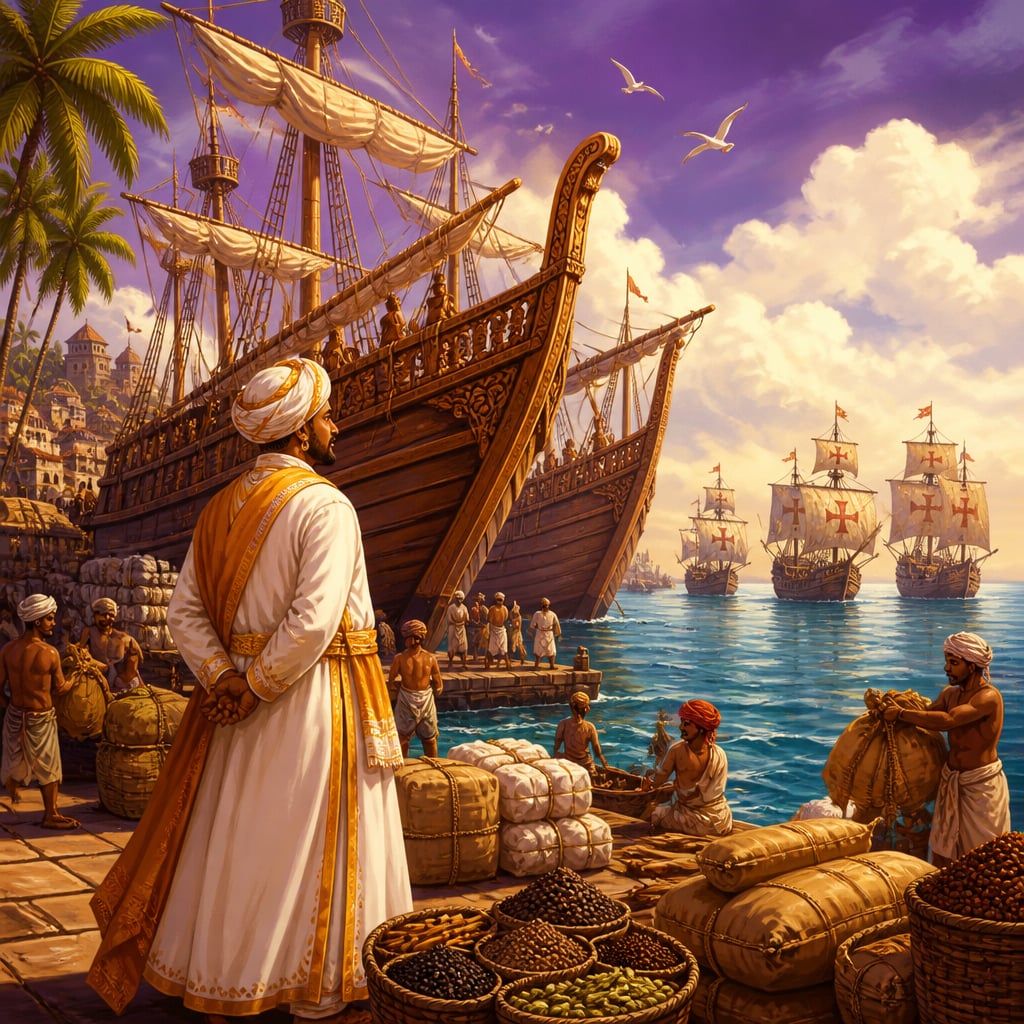
In 1498, when Vasco da Gama's battered fleet of four ships arrived at Calicut, the Zamorin's harbor master was unimpressed. Indian ships were larger, better built, and more numerous. The subcontinent's shipyards at Surat, Calicut, and Cochin produced vessels that dominated the Indian Ocean.
Fifty years later, Portuguese ships controlled the sea routes. By 1700, European trading companies dictated terms to Indian merchants. By 1800, the East India Company was conquering kingdoms.
What happened wasn't primarily military defeat. It was economic surrender, a civilization that forgot its own Artha.
The Greatest Economic Collapse in History
The data is stark:
| Period | India's Share of World GDP |
|---|---|
| 1 CE | ~32% |
| 1000 CE | ~28% |
| 1700 CE | ~24% |
| 1870 CE | ~12% |
| 1947 CE | ~4% |
For two thousand years, India produced one-quarter to one-third of everything made on Earth. Textiles, steel, spices, medicines, ships, Indian manufacturing fed global demand. Roman senators complained that Indian luxuries were draining Rome's gold.
Then came the collapse. Not gradual, catastrophic. India went from workshop of the world to impoverished colony in two centuries.
Historian Sanjeev Sanyal asks the uncomfortable question: How could a civilization that dominated global trade for millennia lose everything so quickly?
The invasions were real. Colonial exploitation was brutal. But Sanyal argues something else happened first: India stopped believing in Artha.
The Internal Surrender
Long before British ships arrived, Indian civilization had begun retreating from the world. The symptoms were everywhere:

Maritime Withdrawal: India's ocean-going navies disappeared. The Chola dynasty once projected power across Southeast Asia; by 1500, no Indian state maintained significant naval capacity. When the Portuguese arrived, they found rich ports with no means to defend them.
Commercial Passivity: Indian merchants who once financed armies and influenced politics became passive tax-payers to whoever controlled their cities. The aggressive trading culture that had reached Rome, Africa, and China turned inward.
Strategic Fatalism: Defeat became karma to be accepted rather than failure to be corrected. The fierce kshatriya spirit that had resisted Alexander's invasion gave way to philosophical resignation.
Intellectual Retreat: India's intellectual energy shifted from statecraft to abstract metaphysics. Kautilya's Arthashastra, once studied by every ruler, was forgotten. Practical economics gave way to otherworldly speculation.
The Distortion of Dharma
How did the civilization that produced Chanakya come to despise commerce?
Sanyal traces a dangerous distortion that entered Indian thought:
| Original Dharmic Teaching | Distorted Version |
|---|---|
| Artha is a purushartha (sacred goal) | Artha is maya (illusion) |
| Wealth enables dharma | Wealth corrupts dharma |
| Kshatriya must fight | All violence is adharma |
| Renounce after duties fulfilled | Renounce to escape duties |
| Detachment from outcomes | Detachment from all action |
The tragedy: this wasn't what the texts said. The Mahabharata explicitly declares poverty a form of death. The Gita commands Arjuna to fight. The Arthashastra treats statecraft as sacred science.
But traumatized by centuries of invasion, portions of Indian society took refuge in a distorted spirituality. "The world is maya anyway. Wealth doesn't matter. Fighting is violence."
This wasn't traditional dharma, it was civilizational PTSD dressed as philosophy.
The Colonizer's Convenient Narrative
The British found this distortion extremely useful. A population that believed poverty was spiritual, fighting was wrong, and commerce was low, that was a population that wouldn't resist economic extraction.
Macaulay's famous minute advocating English education explicitly aimed to create a class "Indian in blood and colour, but English in taste, opinions, morals, and intellect." Part of that "improvement" was accepting British superiority in practical matters while Indians focused on "spiritual" concerns.
The romanticization of "spiritual India" versus "materialist West" served colonialism perfectly. It kept Indians passive while their wealth was shipped to Manchester and Birmingham.
Vibhava: Reclaiming National Wealth-Duty
The Sanskrit word Vibhava means "power, wealth, prosperity." It shares roots with vibhu (mighty, powerful). In dharmic economics, national wealth isn't just nice-to-have, it's sovereign duty.
The Arthashastra is explicit:
"सुखस्य मूलं धर्मः। धर्मस्य मूलं अर्थः। अर्थस्य मूलं राज्यम्। राज्यस्य मूलं इन्द्रियजयः॥"
"The root of happiness is dharma. The root of dharma is artha (wealth). The root of artha is good governance. The root of governance is self-mastery."
, Kautilya, Arthashastra 1.7.6-7
Notice the chain: you can't have dharma without artha. You can't have artha without good governance. Spirituality without economics is incomplete, and ultimately unsustainable.
The Recovery in Progress
India's post-1991 economic transformation is, in Sanyal's framework, civilizational recovery. And India isn't alone in this pattern.
Friedrich List, the 19th-century German economist, challenged British free trade doctrine with a powerful insight: nations at different development stages need different policies. Britain preached free trade only after achieving industrial dominance through protection. List's 'National System of Political Economy' argued that developing nations must build capacity before competing, exactly what Kautilya taught about rashtra-vibhava. Germany, Japan, and Korea all followed List's prescriptions.
Deng Xiaoping led China's 'Reform and Opening Up' from 1978, transforming a nation humiliated by the 'Century of Humiliation' into the world's second-largest economy. His famous saying, 'It doesn't matter if a cat is black or white, as long as it catches mice,' embodied the pragmatic Arthashastra spirit: do what works to build national capacity. China's rise from 2% of world GDP (1980) to 18% (2024) demonstrates civilizational recovery at unprecedented scale.
India's trajectory follows the same pattern. The data tells a story:
1991: GDP ~$275 billion. Forex reserves nearly zero. Begging the IMF for loans.
2024: GDP ~$3.5 trillion. Forex reserves ~$600 billion. Fifth-largest economy globally.
2047 target: GDP ~$30 trillion. Third-largest economy. Return to 10%+ of world GDP.
This isn't Western materialism corrupting India. It's India remembering what it once knew.

When Prime Minister Modi launched Make in India, Sagarmala (port development), and Gati Shakti (infrastructure), these weren't foreign imports. They were recovery of an ancient understanding: national prosperity is sovereign duty.
When ISRO lands on the Moon's south pole, when Indian startups reach $100 billion valuations, when UPI processes more digital transactions than the rest of the world combined, this is vibhava returning.
Your Role in Civilizational Recovery
This isn't just national policy, it's personal calling.
When you:
- Build a business that employs people
- Create technology that India exports
- Generate wealth that funds dharmic activities
- Develop skills that increase national capacity
You're not pursuing crass materialism. You're participating in civilizational recovery. Your success is India remembering its true nature.
The distortion told you that spiritual people don't care about money. The original teaching says: economic capacity enables dharmic life, for you, your family, your community, and your civilization.
Your Vibhava Commitment
Consider this reframing:
| Old Mindset | Vibhava Mindset |
|---|---|
| "Money doesn't matter" | "Wealth enables dharma" |
| "I'm not business-minded" | "Economic skill is trainable" |
| "Someone else will build India" | "I am that someone" |
| "Success is personal" | "My success is civilizational" |
The ships that didn't sail in 1500 created conditions for colonial subjugation. Every Indian today who builds economic capacity is sailing a ship that should have sailed centuries ago.
Sanjeev Sanyal puts it directly: "We're not building something new. We're recovering what was stolen, from us, by us."
The civilization that once commanded global trade is awakening. The question is: will you participate in the recovery, or watch from the sidelines?
In our next lesson, we'll explore Yoga-Kshema, how Bharat 2047 integrates security and prosperity in the dharmic vision.
Max Weber traced the 'Protestant work ethic' to religious values enabling capitalism. But Kautilya articulated the connection between economic and spiritual life 2000 years earlier, and more explicitly.
This provides scriptural authority for economic engagement that many modern Indians doubt. You're not compromising spirituality by building wealth, you're creating the foundation for dharmic life, as Kautilya taught.
Historical analysis by Angus Maddison shows India at 25%+ of world GDP for centuries when Arthashastra principles were practiced. Decline followed forgetting these principles.
Modern development economics debates the role of state in economic growth. East Asian 'developmental states' (Japan, Korea, China) actively promoted industrial development. Kautilya advocated similar activism 2300 years ago.
India has indigenous tradition supporting active economic policy. Make in India, Digital India, Startup India aren't Western imports, they're recovery of Arthashastra principles where state enables prosperity.
India's economic transformation since 1991, and acceleration since 2014, shows what happens when governance focuses on wealth creation. GDP growth, forex reserves, and FDI all validate the 'rashtra must build vibhava' principle.
Key terms
- Vibhava
- Power, wealth, prosperity, might, the material capacity of a person or nation to act effectively in the world. In dharmic economics, vibhava is not opposed to spirituality but enables it.
- Swadeshi
- Of one's own country, the principle of supporting domestic production and building national economic capacity rather than remaining dependent on foreign production.
- Rāṣṭra
- Nation, kingdom, realm, the political-economic unit whose prosperity is the ruler's (and citizen's) dharmic responsibility.
- Ātmanirbhar
- Self-reliance, the capacity to meet one's own needs without external dependence. In national context, atmanirbharta means building indigenous capability rather than remaining dependent on foreign production or technology.
Verses
सुखस्य मूलं धर्मः। धर्मस्य मूलं अर्थः। अर्थस्य मूलं राज्यम्। राज्यस्य मूलं इन्द्रियजयः॥
sukhasya mūlaṃ dharmaḥ | dharmasya mūlaṃ arthaḥ | arthasya mūlaṃ rājyam | rājyasya mūlaṃ indriyajayaḥ ||
Happiness is rooted in dharma; dharma is rooted in wealth; wealth is rooted in good governance; governance is rooted in self-mastery.
This shloka demolishes the false dichotomy between spiritual and economic life. Kautilya explicitly states that dharma depends on artha. A poor nation cannot sustain dharmic civilization; therefore, wealth creation is spiritual duty.
Arthashastra, Chapter 1.7, Verses 6-7 (R. Shamasastry)
अर्थमूलौ हि धर्मकामावर्थपूर्वो धर्मकामार्थसमुच्चयश्च॥
arthamūlau hi dharmakāmāvarthapūrvo dharmakāmārthasamuccayaśca ||
Dharma and Kama are indeed rooted in Artha. Artha comes first; then the three, dharma, kama, and artha, may be pursued together.
This provides scriptural authority for economic prioritization. It's not that dharma doesn't matter, it's that dharma requires resources. The practical implication: build economic capacity first, then deploy it dharmically.
Arthashastra, Chapter 1.19, Verse 34 (R. Shamasastry)
न दीनः दीनमाश्रयेत् समो वा समभाजने। दानस्य कर्ता भवति यः सामर्थ्येन युज्यते॥
na dīnaḥ dīnamāśrayet samo vā samabhājane | dānasya kartā bhavati yaḥ sāmarthyena yujyate ||
The poor cannot support the poor, nor can equals share equally. Only one endowed with capacity can become the giver of charity.
This demolishes virtue-signaling without capacity. You cannot effectively help the poor if you are poor yourself. Building wealth isn't selfishness, it's building the capacity for dharmic action.
Mahabharata, Shanti Parva, Chapter 167 (K.M. Ganguli)
Key figures
Kautilya (Chanakya)
Author of the Arthashastra, adviser to Chandragupta Maurya, architect of the Mauryan Empire's administration and economic policies · 4th century BCE
Sanjeev Sanyal
Member of Economic Advisory Council to the Prime Minister, economic historian, author of 'The Ocean of Churn' and 'Land of Seven Rivers' · Contemporary (born 1971)
Friedrich List
German economist who developed the 'National System of Political Economy,' advocating protective industrial policy for developing nations · 19th century (1789-1846)
Case studies
Japan's Meiji Restoration: Conscious Civilizational Modernization
In 1853, American Commodore Perry's 'Black Ships' forced Japan to open its ports after 200 years of isolation. The humiliation was stark: Japan's samurai swords were useless against steam-powered warships with cannons. Rather than accept subordination, Japan launched the Meiji Restoration (1868), a deliberate program of civilizational modernization. Within 40 years, Japan had built modern industries, a constitutional government, a powerful navy, and defeated Russia (1905), the first Asian nation to defeat a European power in modern times.
The Meiji reformers embodied the Arthashastra principle that national capacity is sovereign duty. Their slogan 'Fukoku Kyōhei' (Rich Nation, Strong Army) echoed Kautilya's chain: artha (wealth) enables dharma (duty). They studied foreign systems pragmatically, taking Germany's constitution, Britain's navy, America's education, while maintaining Japanese identity. This wasn't surrender to the West; it was strategic adaptation to preserve civilizational autonomy. They built vibhava to protect dharma.
Japan industrialized faster than any nation in history. By 1905, it was a great power. By 1968, it was the world's second-largest economy. The Meiji reformers proved that deliberate civilizational recovery is possible, that a nation humiliated by technological inferiority could catch up within a generation through focused national effort.
Civilizational recovery requires conscious choice, not passive hope. The Meiji leaders didn't wait for conditions to improve, they created conditions. They treated national capacity-building as urgent dharmic duty, not optional policy. India's current initiatives echo this: Make in India, Atmanirbhar Bharat, semiconductor fabs, deliberate action to build vibhava.
India's current push for semiconductor manufacturing, space technology, and defense self-reliance mirrors the Meiji playbook of deliberate capacity building. The success of ISRO, UPI, and vaccine manufacturing during COVID demonstrates that civilizational transformation through strategic investment remains viable in the 21st century.
Japan's GDP per capita grew 4x between 1870 and 1913. Its industrial output grew 10x. The lesson: civilizational transformation is possible within decades when treated as urgent national mission.
Singapore: Lee Kuan Yew's Dharmic Governance
In 1965, Singapore was expelled from Malaysia, a tiny island with no natural resources, no hinterland, and hostile neighbors. Lee Kuan Yew, its founding Prime Minister, faced what seemed impossible: building a viable nation from 700 square kilometers of swamp. Within one generation, Singapore transformed from third-world to first, achieving per capita income higher than its former colonial master Britain. Lee governed for 31 years, applying principles remarkably aligned with Arthashastra: meritocracy, long-term thinking, pragmatic adaptation, and relentless focus on national capacity.
Lee Kuan Yew's governance embodied Kautilya's principles without naming them. He prioritized 'indriya-jaya' (self-mastery) in leadership, famously incorruptible and demanding the same from his government. He built rashtra-vibhava (national capacity) through education, infrastructure, and strategic industries. He practiced pragmatic adaptation, 'It doesn't matter if a policy is left or right, only if it works.' His approach to governance was essentially dharmic: treating national prosperity as sovereign duty, not optional goal.
Singapore's GDP per capita grew from $500 (1965) to $65,000 (2024), 130x increase. It consistently ranks among the world's least corrupt, most competitive, and best-governed nations. A resource-less island became a global financial center, shipping hub, and technology leader. Lee proved that small size and lack of resources are no barrier to civilizational success, what matters is quality of governance and national will.
National prosperity follows from governance quality, not natural resources. Singapore has no oil, no land, no population, yet outperforms resource-rich nations. Lee's Arthashastra-aligned approach, self-mastery enabling good governance enabling national prosperity, worked. India, with vastly greater resources, can achieve proportionally greater results with similar governance commitment.
Singapore's continued prosperity under successive leaders proves that good governance systems outlast individual founders. India's digital public infrastructure (UPI, Aadhaar, ONDC) represents a similar bet: building governance systems so robust that they generate prosperity regardless of who holds office.
Singapore's transformation took 30 years, one generation. If India achieves similar governance quality, its 2047 targets become conservative. Lee Kuan Yew himself said India was 'held back not by lack of ability but by lack of governance', a dharmic diagnosis.
Historical context
1st century CE through contemporary India
India's economic history is one of long prosperity followed by collapse followed by recovery. Understanding this pattern is essential: we're not building something new but recovering what was lost, through external exploitation and internal forgetting.
Compare to China's similar trajectory: historical prosperity, colonial humiliation, then deliberate recovery. Both civilizations are reclaiming positions they held for most of recorded history. The 'rise' of India and China is actually 'return.'
Economist Angus Maddison's data shows India held 25-32% of world GDP for centuries. Current 3.5% share means India has grown 10x since 1991 but still has far to go to reclaim historical significance.
Understanding that economic prosperity is India's heritage, not foreign import, changes psychology. You're not pursuing Western materialism; you're participating in civilizational recovery.
Living traditions
India's 2024 economic initiatives, from semiconductor manufacturing to defense indigenization to space exploration, all reflect the Arthashastra principle that national prosperity requires conscious policy action. The civilizational recovery is underway.
- Make in India: Launched in 2014 to revive manufacturing, Make in India explicitly aims to rebuild industrial capacity that was destroyed during colonial deindustrialization. It's Arthashastra's principle of state-enabled prosperity in modern form.
- Sagarmala: India's port-led development program aims to rebuild maritime capacity. For a civilization that once dominated Indian Ocean trade, Sagarmala represents recovery of naval and commercial sea power.
- Nalanda University Ruins & Museum: The original Nalanda was the world's first residential university (5th-12th century CE), hosting 10,000 students from across Asia. Its destruction by Bakhtiyar Khilji in 1193 symbolizes India's civilizational decline, the burning library allegedly smoldered for months. Today, the UNESCO World Heritage ruins and adjacent museum remind visitors of what was lost. The new Nalanda University (reopened 2014) represents conscious recovery.
- Lothal: Ancient Port City: One of the Indus Valley Civilization's most important trading ports (2400-1900 BCE), featuring the world's oldest known dock. Lothal demonstrates India's ancient maritime and commercial prowess, trade connections reached Mesopotamia and beyond. The ASI museum displays seals, weights, and artifacts showing sophisticated economic activity. A reminder that India's prosperity isn't a modern aspiration but civilizational recovery.
- Somnath Temple: Destroyed and rebuilt multiple times throughout history, Somnath represents civilizational resilience and recovery. The temple's current magnificent form (rebuilt with government support after 1947) embodies the principle of Vibhava - rebuilding wealth and capacity after devastation. Sardar Patel championed its reconstruction as a symbol of national recovery.
- Brihadeeswarar Temple: Built by Raja Raja Chola I during India's peak economic power, this temple demonstrates what civilizational prosperity can achieve. Its construction employed 130,000 workers and showcases engineering excellence that remains unmatched. A living reminder of India's historical vibhava (prosperity capacity).
Reflection
- Have you internalized any beliefs that economic success is somehow 'unspiritual' or 'materialistic'? Where did these beliefs come from? How might they be the 'distorted dharma' that Sanyal describes?
- How does knowing that India held 25% of world GDP for millennia change your perception of what's possible? What specific actions would you take differently if you saw your economic success as civilizational recovery rather than personal ambition?