Bhagya: The Dharmic View of Prosperity
Nishkama Karma in Economics
When Krishna told Arjuna to work without attachment to results, he wasn't preaching passive resignation, he was revealing the secret to sustainable success. The dharmic view of prosperity (Bhagya) sees wealth as divine blessing, earned through detached excellence. This lesson explores how Nishkama Karma, desireless action, transforms anxiety-driven work into liberated, effective engagement.
The Charioteer's Economic Masterclass
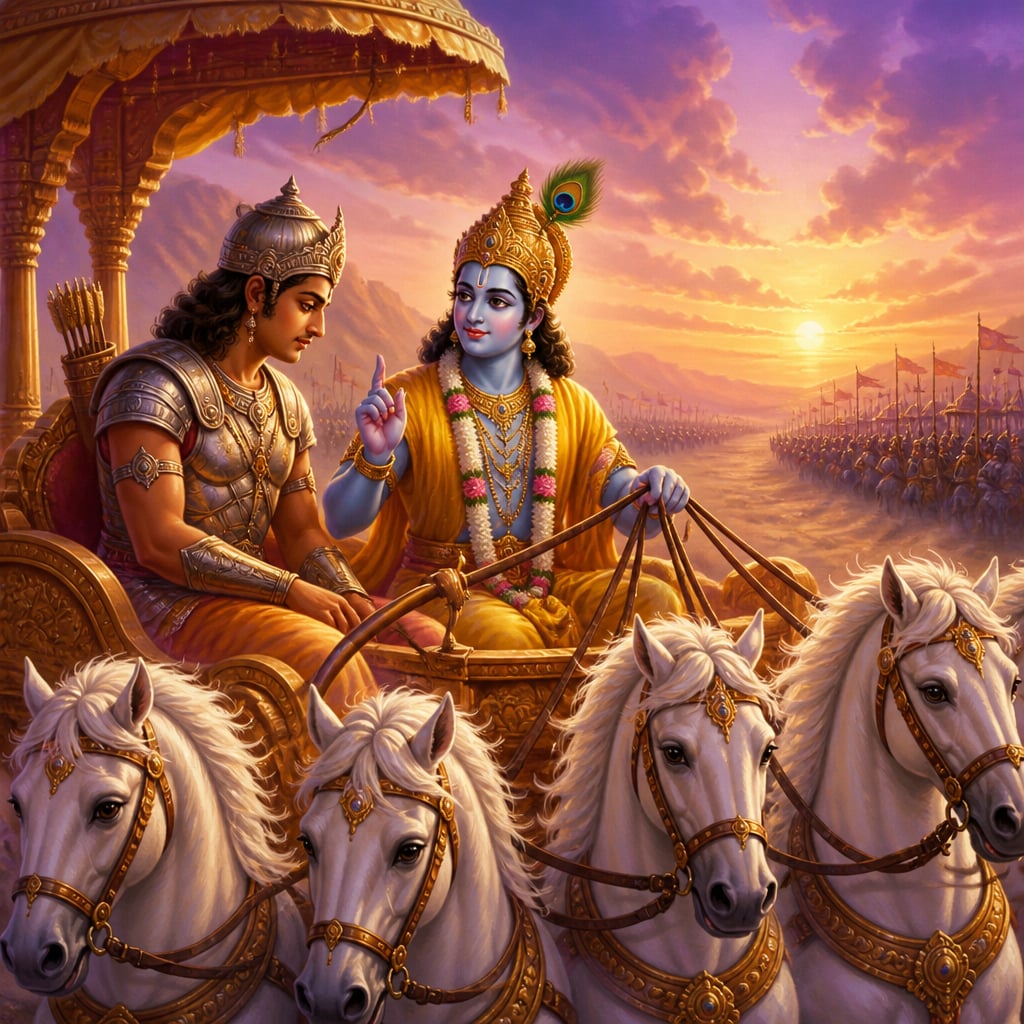
The morning mist had barely lifted from Kurukshetra when Arjuna dropped his bow. The greatest archer of his age, trembling before the battle of his life, had just received the most counterintuitive advice in human history.
"कर्मण्येवाधिकारस्ते मा फलेषु कदाचन।"
"You have the right to action alone, never to its fruits."
Arjuna must have been bewildered. How can you fight a war without caring about victory? How can you work without wanting results?
Krishna's answer would revolutionize not just warfare but economics itself. The principle he revealed, Nishkama Karma (desireless action), remains the most sophisticated response to the anxiety that plagues every entrepreneur, professional, and worker: "What if I fail? What if it doesn't work out?"
The Gita's response isn't "Don't worry, you'll succeed." It's something far more radical: "Your job is excellent effort. Success and failure are not entirely in your hands."
The Anxiety Paradox
Modern psychology has confirmed what Krishna taught 5,000 years ago: anxiety about results harms performance. Athletes call it "choking." Entrepreneurs call it "analysis paralysis." The desperate need for success creates the very tension that undermines it.
Consider two salespeople:
| Anxious Salesperson | Nishkama Salesperson |
|---|---|
| Desperate energy repels customers | Confident presence attracts |
| Every rejection feels personal | Rejection is data, not identity |
| Successes create pressure to repeat | Successes are enjoyed, not clung to |
| Eventual burnout from stress | Sustainable engagement over decades |
The paradox: detachment from results often produces better results. Not because effort decreases, but because effort becomes cleaner, free from the contamination of fear and grasping.
What Nishkama Karma Is NOT
Before going further, let's demolish common misunderstandings:
"Don't care about outcomes", Wrong. You absolutely set goals and measure results. Nishkama Karma means not being enslaved by outcomes, not ignoring them.
"Work without trying hard", Wrong. Krishna demands excellence: "योगः कर्मसु कौशलम्", "Yoga is skill in action." You work with full competence and effort.
"Accept whatever happens passively", Wrong. You course-correct based on feedback. Detachment is from anxiety, not from intelligence.
"Avoid wealth and success", Wrong. Arjuna is told to fight and WIN. The Pandavas regain their kingdom. Prosperity is not rejected, attachment to it is.
The actual teaching is subtler: Full effort with equanimity toward outcomes. Work as if everything depends on you; accept results as if everything depends on the Divine.
The Three Gunas in Business
The Gita provides a diagnostic framework for work quality through the three gunas (modes of nature):
Sattvic Work (Ideal)

"नियतं सङ्गरहितमरागद्वेषतः कृतम्। अफलप्रेप्सुना कर्म यत्तत्सात्त्विकमुच्यते॥"
"Action performed as duty, without attachment, without love or hate, by one not seeking results, that is sattvic."
, Bhagavad Gita 18.23
In business: The CEO who builds with excellence because it's her dharma, not because she's desperate for the next funding round. She competes fiercely but doesn't hate competitors. She enjoys profits but isn't intoxicated by them. She handles losses without being devastated.
Rajasic Work (Common)
"यत्तु कामेप्सुना कर्म साहङ्कारेण वा पुनः। क्रियते बहुलायासं तद्राजसमुदाहृतम्॥"
"Action performed with desire for fruits, with ego, with excessive effort, that is rajasic."
, Bhagavad Gita 18.24
In business: The startup founder fueled by comparison and status anxiety. He works 100-hour weeks not from devotion but from fear of being seen as a failure. Every competitor's success feels like personal insult. Success brings brief elation followed by pressure to do more.
Tamasic Work (Destructive)
"अनुबन्धं क्षयं हिंसामनवेक्ष्य च पौरुषम्। मोहादारभ्यते कर्म यत्तत्तामसमुच्यते॥"
"Action undertaken through delusion, without regard to consequences, loss, injury to others, or one's own capacity, that is tamasic."
, Bhagavad Gita 18.25
In business: The executive who cuts corners, ignores consequences, exploits workers, and damages the environment for short-term gain. Enron before the collapse. Deluded action that eventually destroys everything.
The Sattvic Entrepreneur's Practice
How does one actually practice Nishkama Karma in modern economic life?
Step 1: Identify Your Svadharma What is your unique combination of talent, training, and circumstance? Your economic role should align with your nature. A born teacher forced into sales suffers; their work becomes rajasic (strained) rather than sattvic (natural).
Step 2: Commit to Excellence Within your role, pursue mastery. Krishna doesn't validate mediocrity. "Yoga is skill in action" means your professional competence is spiritual practice. The engineer who writes elegant code, the chef who crafts perfect meals, the accountant who maintains flawless books, all are practicing yoga.
Step 3: Surrender Outcomes Here's the hard part. After doing your absolute best, release attachment to results. This doesn't mean not measuring outcomes, it means not letting your inner peace depend on them. Ratan Tata didn't stop caring when Tata Motors lost money; he stopped letting it destroy his equanimity while he worked on solutions.
Step 4: Accept Equanimously "सिद्ध्यसिद्ध्योः समो भूत्वा समत्वं योग उच्यते।"
"Remaining equanimous in success and failure, that equanimity is called yoga."
, Bhagavad Gita 2.48
Neither elation nor devastation. The business succeeds? Gratitude, not arrogance. The business fails? Learning, not despair. This equanimity is what the Gita calls Bhagya, true prosperity, because it cannot be taken from you by external circumstances.
Bhagya: Fortune as Fruit of Dharma
The Sanskrit word Bhagya (fortune, prosperity) comes from Bhaga, the divine share, the blessing. In dharmic economics, prosperity isn't random luck or pure merit. It's the fruit of aligned action.
When you:
- Work according to your svadharma (aligned role)
- With nishkama approach (detached excellence)
- Within dharmic constraints (ethical boundaries)
Then bhagya naturally flows. Not because the universe owes you, but because you've aligned with how reality works.
This explains why some entrepreneurs succeed despite apparent disadvantages while others fail despite every advantage. The anxious, grasping, ethically-flexible operator may win short-term but rarely builds lasting wealth. The sattvic worker playing the long game often emerges ahead.
The Modern Resonance
Today's workplace is drowning in anxiety. Surveys show 76% of workers experience burnout. The constant pressure to achieve, compare, and validate through results creates epidemic stress.
The Gita offers a cure that psychologists are only now rediscovering. Cognitive behavioral therapy teaches "separating effort from outcome." Mindfulness training teaches "non-attachment." High-performance coaching teaches "process focus over results focus."
Krishna taught it all five millennia ago, in one verse on a battlefield.
The principle transcends cultures. Marcus Aurelius, the Stoic Roman Emperor, wrote in his Meditations: "You have power over your mind, not outside events. Realize this, and you will find strength." This mirrors BG 2.47 precisely. Ray Dalio, founder of Bridgewater Associates (the world's largest hedge fund), built his "Principles" around radical transparency and equanimity through market cycles, maintaining detached engagement when others panic. Phil Jackson, the most successful NBA coach in history (11 championships), famously applied Zen principles to basketball, teaching players to focus on each moment's action rather than the scoreboard. Whether called Nishkama Karma, Stoicism, or "Zen basketball," the principle remains: focus on what you control, release attachment to what you cannot.
N.R. Narayana Murthy, founder of Infosys, explicitly credits Nishkama Karma for his approach: "We built Infosys by focusing on what we could control, our effort, our ethics, our excellence. The market response was never guaranteed. But the practice of detached engagement kept us sane through decades of uncertainty."
Your Bhagya Practice
This isn't abstract philosophy. It's a daily practice:
Morning: Before work, clarify your svadharma for the day. What is your duty? Not what will bring maximum reward, what is your role's requirement?
During work: Notice when anxiety about results arises. Don't suppress it; acknowledge it. Then return focus to the task itself, the process, the excellence, the present action.
Evening: Review without judgment. What effort did you make? That's yours. What results came? Those belong to the cosmic order. Learn what's learnable, release what's not controllable.
Over time: This practice rewires the mind. Work becomes lighter. Creativity increases (anxiety constrains creativity). Relationships improve (desperate people are difficult to work with). And paradoxically, results often improve, because excellence uncontaminated by anxiety simply performs better.
The charioteer's advice on that misty morning wasn't about war. It was about how to engage with any consequential action, including the economic actions that consume most of our waking hours.
Work fully. Detach wisely. Let bhagya find you.
Stoic philosophy teaches similar principles: focus on what you can control. Sports psychology calls it 'process focus', elite athletes concentrate on execution, not scoreboard. The Gita articulated this principle millennia earlier.
The dharmic framework embeds this in daily practice, not just elite performance. Every worker can practice karma yoga, making sustainable excellence accessible to all, not just those with access to performance coaches.
Research shows process-focused workers outperform outcome-obsessed ones. A Harvard Business Review study found that 'learning goals' (process) produce better results than 'performance goals' (outcome) in complex tasks.
Self-determination theory distinguishes intrinsic motivation (doing work because it's meaningful) from extrinsic motivation (doing work for external rewards). Sattvic work is intrinsically motivated; rajasic work is extrinsically driven.
The guna framework goes beyond motivation to include ethical quality. Western psychology might ask 'are you enjoying it?' The dharmic framework asks 'is it aligned with dharma?', a fuller evaluation.
Research shows intrinsically motivated workers are more creative, more persistent, and produce higher quality work. Google's '20% time' policy (allowing employees to work on passion projects) produced Gmail and AdSense, sattvic innovation.
Key terms
- Nishkama Karma
- Desireless action, performing duties with full effort and excellence while releasing attachment to specific outcomes. The work is offered as an act of devotion rather than a transaction for results.
- Bhāgya
- Fortune, prosperity, or good destiny, understood in dharmic thought as the natural fruit of aligned, ethical action rather than random luck or pure individual merit.
- Svadharma
- One's own duty or natural role, the unique combination of one's nature (svabhava), stage of life (ashrama), and circumstances that determines appropriate action.
- Sattva
- The quality of purity, balance, and illumination, one of the three gunas. Sattvic action is duty-bound, detached, and performed without ego or anxiety about results.
Verses
कर्मण्येवाधिकारस्ते मा फलेषु कदाचन। मा कर्मफलहेतुर्भूर्मा ते सङ्गोऽस्त्वकर्मणि॥
karmaṇyevādhikāraste mā phaleṣu kadācana | mā karmaphalaheturbhūrmā te saṅgo'stvakarmaṇi ||
Your right is to action alone, never to its fruits at any time. Let not the fruit of action be your motive, nor let your attachment be to inaction.
This verse provides the ultimate antidote to workplace anxiety. Effort is yours to control; results involve countless factors beyond your control. Focus on what's yours, excellent work, and release what isn't, specific outcomes.
Bhagavad Gita, Chapter 2, Verse 47 (Swami Chinmayananda)
योगस्थः कुरु कर्माणि सङ्गं त्यक्त्वा धनञ्जय। सिद्ध्यसिद्ध्योः समो भूत्वा समत्वं योग उच्यते॥
yogasthaḥ kuru karmāṇi saṅgaṃ tyaktvā dhanañjaya | siddhyasiddhyoḥ samo bhūtvā samatvaṃ yoga ucyate ||
Perform actions, O Arjuna, established in yoga, abandoning attachment, remaining equal in success and failure. Such equanimity is called yoga.
This defines sustainable success: the ability to keep working through both booms and busts without being destabilized by either. It's the psychological resilience that distinguishes long-term wealth builders from flash-in-the-pan winners.
Bhagavad Gita, Chapter 2, Verse 48 (Swami Chinmayananda)
नियतं सङ्गरहितमरागद्वेषतः कृतम्। अफलप्रेप्सुना कर्म यत्तत्सात्त्विकमुच्यते॥
niyataṃ saṅgarahitam arāgadveṣataḥ kṛtam | aphalaprepsuṇā karma yat tat sāttvikam ucyate ||
Action that is duty-bound, performed without attachment, without love or hate, by one not seeking its fruit, such action is called sattvic.
This provides a diagnostic for your work quality. Is your economic activity duty-bound, detached, balanced, and result-released? Then it's sattvic and sustainable. If driven by ego, comparison, and anxiety, it's rajasic and eventually exhausting.
Bhagavad Gita, Chapter 18, Verse 23 (Swami Chinmayananda)
Key figures
Krishna
Avatar of Vishnu, charioteer to Arjuna, speaker of the Bhagavad Gita, the primary text on Nishkama Karma · Mahabharata period
N.R. Narayana Murthy
Co-founder of Infosys, one of India's largest IT services companies, and explicit proponent of Gita-based business ethics · Contemporary (born 1946)
Marcus Aurelius
Roman Emperor and Stoic philosopher, author of 'Meditations' · Roman Empire (121-180 CE)
Case studies
Tata Group: 150 Years of Equanimity
In 1868, Jamsetji Tata founded a trading company with a vision that went far beyond personal wealth. Over 156 years, the Tata Group has grown into a $150 billion conglomerate spanning steel, automobiles, IT, hospitality, and consumer goods. But what sets Tata apart isn't scale, it's sustainability through equanimity. The group has navigated colonial rule, independence, license raj, liberalization, and global competition. Ratan Tata walked away from the Nano project when regulations made it impractical; he acquired Jaguar Land Rover when others saw only risk. Through booms and busts, the Tata approach remained constant: excellence in execution, ethical constraints, and equanimity in outcomes.
The Tata Group embodies Nishkama Karma at institutional scale. The founding family's 66% stake flows to charitable trusts, not personal wealth, a structural release of attachment to results. When Tata Steel faced the 2008 crisis after acquiring Corus, the response was characteristic: no panic, systematic restructuring, long-term perspective. As Ratan Tata said, 'I believe in setbacks, because that's when you discover your character.' This is BG 2.48 in corporate form: remaining equal in success and failure.
The Tata Group employs 935,000 people across 100+ countries. It contributes $1 billion annually to philanthropy through Tata Trusts. Brands like TCS, Titan, and Tata Consumer have become global leaders. More significantly, the Tata name remains synonymous with trust, a reputational asset built over five generations through consistent dharmic practice. While flashier conglomerates have risen and collapsed, Tata endures.
Equanimity enables longevity. The Tatas didn't chase every opportunity or panic at every crisis. They maintained svadharma (their role as nation-builders) with nishkama approach (detached from short-term results). This produced bhagya (sustained fortune) across 150+ years.
In an era when the average S&P 500 company lifespan has shrunk from 60 years to under 20, Tata's 156-year survival challenges the assumption that aggressive disruption is the only path to relevance. Patient, values-driven stewardship may be the ultimate competitive advantage in a world of increasing volatility.
66% of Tata Sons is held by charitable trusts, the founding family literally structured release of attachment to results. Tata Trusts have contributed over $100 billion to Indian development since inception. This is institutionalized Nishkama Karma.
WeWork vs. Basecamp: Rajasic Collapse, Sattvic Sustainability
In 2019, WeWork was valued at $47 billion. Founder Adam Neumann lived lavishly, bought multiple properties, and cultivated a messianic image. The company burned billions pursuing growth at any cost, subsidizing rents to acquire customers. When the IPO approached, investors examined the fundamentals and recoiled. Valuation collapsed to under $10 billion; Neumann was ousted. Meanwhile, Basecamp (founded 1999) took the opposite approach. Founders Jason Fried and David Heinemeier Hansson refused venture capital, grew profitably, maintained work-life balance, and explicitly rejected the 'hustle culture' of Silicon Valley. They wrote books titled 'Rework' and 'It Doesn't Have to Be Crazy at Work', manifestos of sattvic entrepreneurship.
WeWork exemplified rajasic work: ego-driven, outcome-obsessed, fueled by comparison and status anxiety. Neumann's approach was pure rajas, working 'with desire for fruits, with ego, with excessive effort' (BG 18.24). Basecamp exemplified sattvic work: building because it's their dharma, without attachment to becoming a unicorn. Fried has said, 'We don't need to dominate the market. We need to serve our customers well.' This is Nishkama Karma applied to product development.
WeWork's valuation collapsed from $47 billion to near bankruptcy. Neumann was ousted and the company became a cautionary tale. Basecamp remains profitable after 25 years, with millions of users, sustainable business model, and founders who work 40-hour weeks. The sattvic approach produced less spectacular headlines but far more durable success. Basecamp's team doesn't experience burnout; WeWork's culture was defined by it.
The guna framework predicts outcomes. Rajasic work (ego-driven, anxious, grasping) may produce short-term spectacular results but rarely sustains. Sattvic work (duty-bound, detached, balanced) appears slower but compounds over decades. WeWork vs. Basecamp is the Gita's teaching demonstrated in startup culture.
The venture capital industry's reckoning after 2022, when rising interest rates exposed unsustainable business models, validated the bootstrapped approach. Companies like Basecamp, Mailchimp (sold for $12B with no VC), and Zoho demonstrate that sustainable profitability consistently outperforms subsidized growth over full business cycles.
WeWork raised $12+ billion and lost most of it. Basecamp never raised external funding and has been profitable for 20+ years. Revenue per employee at Basecamp exceeds most venture-funded startups. Sometimes the 'boring' sattvic path is the most effective.
Historical context
Mahabharata period through contemporary India
The Bhagavad Gita is the most widely read Hindu scripture globally, with over a billion copies in print. Its teaching on Nishkama Karma has influenced Indian business culture, political leadership (Gandhi), and daily practice for millennia.
Compare to Protestant work ethic (Max Weber) which dignified work but tied it to salvation anxiety. Or to Buddhist right livelihood which emphasizes ethical constraints but less the positive theology of prosperity. The Gita uniquely combines full engagement, ethical constraints, AND psychological freedom.
A 2019 survey found 68% of Indian business leaders cite religious/philosophical texts as influencing their business ethics. The Bhagavad Gita ranked first among texts cited, ahead of any Western management literature.
As workplace anxiety reaches epidemic levels globally, the Gita's 5,000-year-old teaching on detached engagement offers a tested alternative. This isn't ancient irrelevance, it's precisely what modern workers need.
Living traditions
Indian tech companies increasingly emphasize 'mindful leadership' and 'work-life integration', modern terms for ancient Gita teachings. Yoga programs in corporations, meditation in startups, and executive coaching that draws on Indian philosophy all reflect the living relevance of Nishkama Karma.
- Marwari Business Culture: Traditional Marwari merchants practice equanimity through business cycles, neither over-expanding in booms nor panicking in busts. Their multi-generational wealth reflects the sustainability of dharmic principles over time.
- Tata Group's Long-Term Orientation: The Tata Group famously takes long-term views over quarterly pressures. This Nishkama approach, building for decades, not quarters, has produced one of Asia's most respected business houses.
- Jnana Prabodhini: A unique institution founded in 1962 that teaches Bhagavad Gita principles applied to modern life. Students learn Nishkama Karma as practical life skill, detached excellence in academics, sports, and eventually careers. The campus includes schools, research centers, and training programs that demonstrate how ancient wisdom translates to contemporary achievement.
- Infosys Campus, Mysore: The Global Education Center where Narayana Murthy's Gita-inspired leadership philosophy is transmitted to new employees. The sprawling 340-acre campus embodies sattvic work culture: emphasis on ethics, excellence, and long-term thinking over short-term gains. Tours available by prior arrangement, see how Nishkama Karma principles built a $100 billion company.
- ISKCON Temple, Bangalore: The temple embodies Nishkama Karma in its operations, thousands of volunteers serve without expectation of personal reward. The Akshaya Patra mid-day meal program, run from this temple, serves 2 million children daily as an expression of selfless service (karma yoga) at massive scale.
- Shirdi Sai Baba Temple: Sai Baba's teaching 'Shraddha aur Saburi' (faith and patience) perfectly embodies Nishkama Karma, doing your duty with faith but patience for results. The temple trust operates with transparency and efficiency, demonstrating institutional application of detached excellence.
Reflection
- When you examine your daily work, which guna predominates? Is your effort sattvic (duty-bound, detached, balanced), rajasic (ego-driven, anxious, comparative), or tamasic (deluded, careless, harmful)? What would shifting toward sattvic engagement look like?
- Identify one current project where anxiety about results is affecting your work quality. How would you approach this project differently if you practiced 'right to action, not to fruits'? What specific changes would you make this week?