Artha-Dharma: When Wealth Serves Righteousness

When Wealth Destroys

Duryodhana had everything, royal birth, world-class education, unlimited resources, the mightiest army. Yet he lost everything and destroyed his entire lineage. His story reveals the most important lesson in economics: wealth without dharma is poison. This lesson explores why the Mahabharata's richest prince became its greatest cautionary tale.

The Prince Who Had Everything
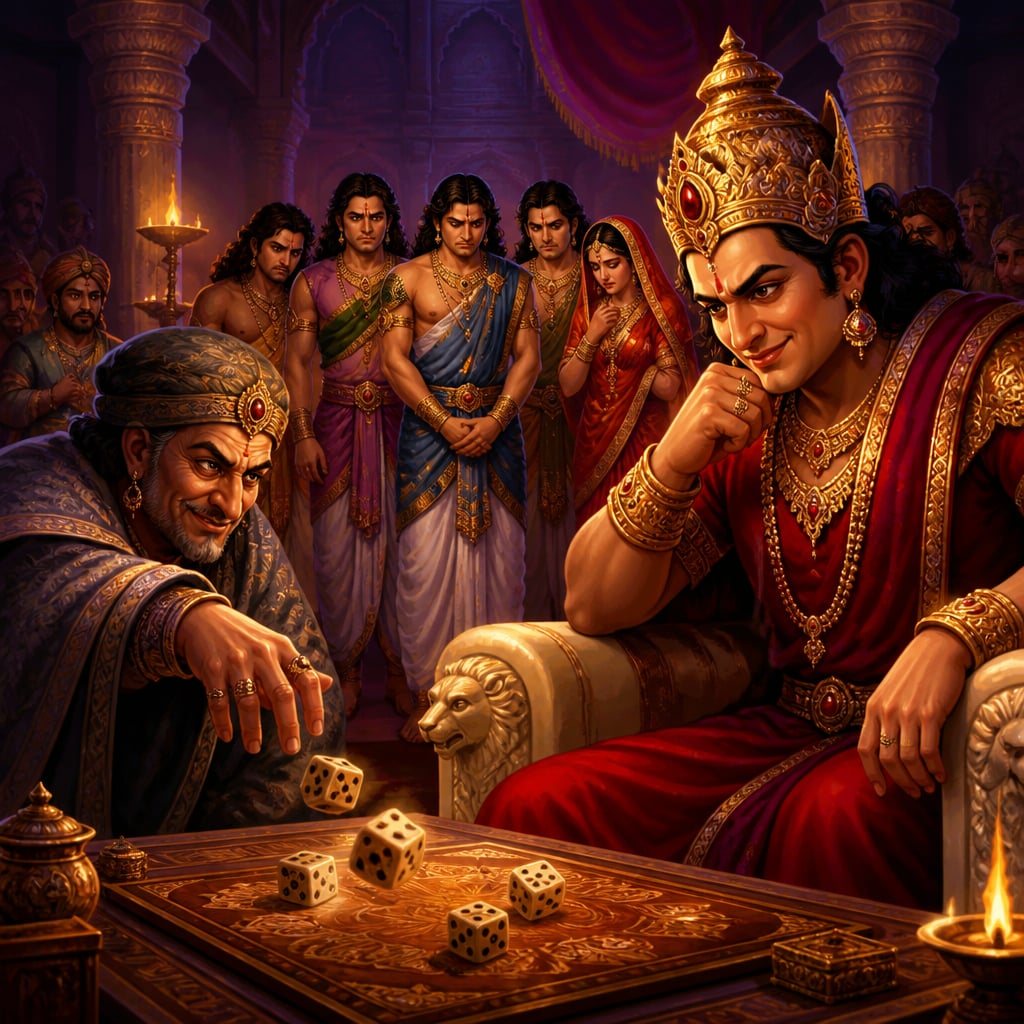
Duryodhana and Shakuni at the dice game in Hastinapura

In the gambling hall at Hastinapura, Duryodhana watched with gleaming eyes as his uncle Shakuni rolled the dice. Each throw stripped the Pandavas of another kingdom, another treasure, another freedom. When Draupadi was dragged into the hall, Duryodhana laughed and slapped his thigh.

"Look at this!" he gloated. "The great Pandavas, now our slaves. And their queen, she can serve in my household."

He had won. Through cunning, manipulation, and rigged dice, he had taken everything from his cousins. The Kuru treasury overflowed. The army was the mightiest in Aryavarta. Victory seemed complete.
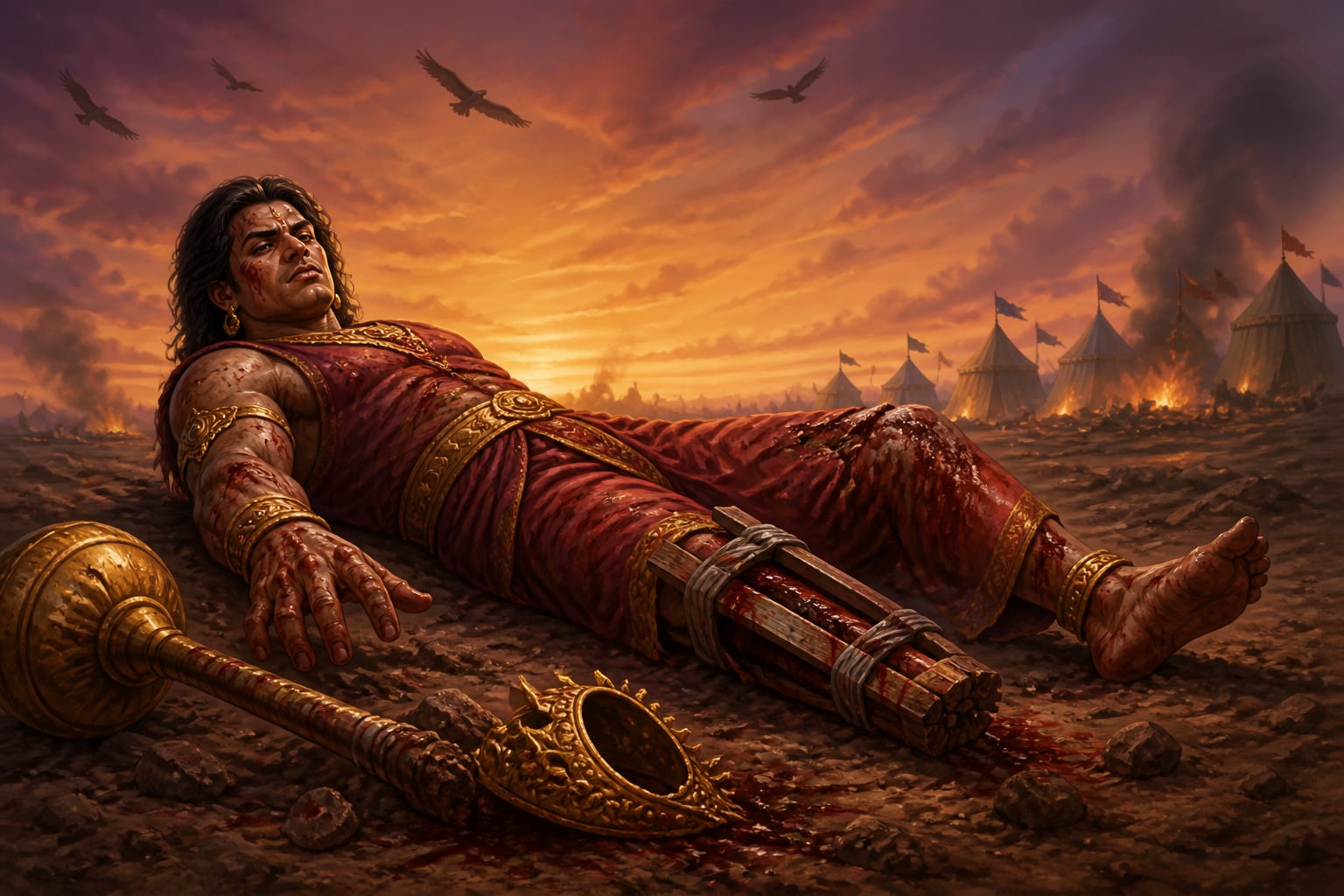
Duryodhana fallen on the Kurukshetra battlefield at dusk

Eighteen years later, Duryodhana lay dying on the battlefield of Kurukshetra. His brothers, all ninety-nine of them, dead. His army, eleven akshauhinis, over two million soldiers, annihilated. His sons, nephews, uncles, teachers, all gone. The dynasty he killed millions to control would end with him.

What went wrong?

The Mahabharata's Economic Warning

The Mahabharata is not subtle about Duryodhana. The text tells us explicitly:

"धर्मं जानाति चाधर्मं च दुर्योधनो न तु। जानन्नपि च कौन्तेय न करोति समाचरेत्॥"

"Duryodhana knows what is dharma but has no inclination toward it. He knows what is adharma but cannot restrain himself from it."

, Mahabharata, Sabha Parva

This is the key insight: Duryodhana was not ignorant. He had the same teachers as the Pandavas, Drona, Kripa, Bhishma. He knew right from wrong. His failure was not intellectual but volitional. He chose adharma because it seemed to offer faster, easier artha.

The Mahabharata presents this as the fundamental economic error: believing that unethical means can secure lasting wealth.

The Anatomy of Adharmic Wealth

How did Duryodhana accumulate? Let's trace his methods:

1. Denying Rightful Share The Pandavas were entitled to half the kingdom. Duryodhana refused. When forced to give them something, he gave them Khandavaprastha, a barren forest. When they transformed it into the magnificent Indraprastha, his envy burned hotter.

2. Deception in Transactions The dice game was not a fair wager. Shakuni's dice were loaded. The entire "game" was a sophisticated fraud designed to strip the Pandavas of everything through the appearance of legitimate contest.

3. Exploiting Vulnerability When Yudhishthira, bound by his word, continued playing despite losses, Duryodhana exploited this. When Draupadi was wagered and lost, he exploited her vulnerability for public humiliation.

4. Corrupting Good People Bhishma, Drona, Karna, all knew Duryodhana was wrong. But through obligation, affection, or manipulation, he drew them into his adharmic enterprise. The greatest warriors fought for the wrong side.

The Shakuni Factor: Enablers of Adharma

Behind every Duryodhana stands a Shakuni, the clever advisor who provides the means for unethical accumulation.

Shakuni didn't roll dice for wealth. He did it for revenge (his family had been destroyed by the Kurus). But his brilliance served Duryodhana's greed. The combination was catastrophic.

"A king with evil counselors is like a man drinking honey mixed with poison, the sweetness is momentary, the death is certain." , Vidura Niti

Modern parallels abound:

These are the Shakunis of 2025. They don't wield loaded dice, they wield spreadsheets, contracts, and "creative" interpretations. The result is the same: wealth that seems solid but is built on sand.

Why Adharmic Wealth Self-Destructs

Kautilya, writing his Arthashastra, was clear:

"अधर्मार्जितं धनं मूलं विनाशयति।"

"Wealth earned through adharma destroys its very foundation."

This isn't mysticism, it's economics. Consider the mechanisms:

Trust Deficit: Others learn. Partners avoid you. Suppliers demand upfront payment. Talented employees leave. Your network, the foundation of business success, erodes.

Legal Risk: Unethical practices create liabilities. Today's "clever deal" becomes tomorrow's lawsuit, regulatory action, or criminal charge.

Reputation Damage: In the age of social media, reputation destruction is faster than ever. One viral exposé can undo decades of brand building.

Psychological Cost: The stress of maintaining deceptions, the fear of exposure, the inability to trust anyone, these exact a toll that wealth cannot compensate.

Duryodhana's Pattern Modern Equivalent Inevitable Result
Denied rightful share Wage theft, unpaid suppliers Lawsuits, talent flight
Loaded dice Fraudulent accounting Criminal charges
Public humiliation Exploitative contracts Reputation destruction
Corrupting mentors Compromising advisors Everyone goes down together

The Contrast: How the Pandavas Built

The Pandavas faced the same choice. After losing everything, they could have turned to adharmic means. They didn't.

Pandavas sharing a fire with a forest sage during exile

During their thirteen years of exile:

The result? They won. Not because they were stronger, Duryodhana's army was larger. They won because their foundation was dharmic. Allies remained loyal. Krishna chose their side. Even enemy warriors secretly wished them victory.

2025: Corporate Duryodhanas and Pandavas

Finance Minister Nirmala Sitharaman has repeatedly emphasized the importance of ethical business practices. The government's push for corporate governance reforms, stricter audit requirements, independent directors, whistleblower protections, reflects the Mahabharata's wisdom: adharmic wealth destroys.

Consider recent examples:

Contrast with Tata Group. Ratan Tata once walked away from a major deal rather than pay bribes. The short-term loss was real. The long-term result? Tata is trusted globally, attracts the best talent, and has survived for over 150 years. That's dharmic wealth, it compounds across generations.

The Duryodhana Test

Before any significant financial decision, apply the Duryodhana Test:

  1. Am I denying someone their rightful due? (suppliers, employees, partners, shareholders)
  2. Is there deception involved? (hidden terms, misleading claims, rigged processes)
  3. Am I exploiting someone's vulnerability? (desperation, ignorance, power imbalance)
  4. Am I asking good people to compromise their values? (pressuring employees to cut corners)

If any answer is yes, you're on Duryodhana's path. The dice may seem loaded in your favor today. But the Kurukshetra comes for everyone.

Your Turn: Beware Your Shakunis

Duryodhana's tragedy wasn't just his greed, it was his choice of advisors. Shakuni whispered what Duryodhana wanted to hear. Karna's loyalty blinded him to Duryodhana's flaws. Even Bhishma, who knew better, stayed silent too long.

Who are your advisors? Do they tell you what's right, or what you want to hear? Do they help you build dharmically, or do they offer clever shortcuts?

The Mahabharata's economic lesson is stark: Artha without dharma is not wealth, it's a time bomb. The interest rate on adharmic gains is destruction, and it compounds.

In our next lesson, we explore the opposite error, those who romanticize poverty, treating material destitution as spiritual virtue. Spoiler: the texts don't support that either.

Warren Buffett's 'newspaper test' (would you be comfortable if this appeared on the front page?) is similar but less systematic. The Duryodhana Test provides specific categories of adharmic behavior to check against.

The narrative power of Duryodhana makes the test memorable and emotionally resonant. It's easier to ask 'Am I being a Duryodhana?' than to apply abstract ethical frameworks.

A 2023 study found that companies with strong ethical cultures had 40% fewer fraud incidents and 25% higher employee retention. The 'Duryodhana cost' is quantifiable.

Game theory shows that 'defectors' (those who cheat) may win individual rounds but lose the iterated game. Societies punish cheaters, exclude them from future transactions, and remember their behavior.

The Indian framework goes beyond game theory to include karmic and social dimensions. Adharmic wealth doesn't just invite external punishment, it corrupts the earner internally, affecting judgment, relationships, and peace of mind.

The median time from peak to collapse for major corporate frauds is 7-10 years. Enron: 16 years. Theranos: 15 years. The dice seem loaded in your favor, until suddenly they're not.

Key terms

Adharma
The opposite of dharma, unrighteous action, violation of ethical and cosmic order. In economics, any wealth-building practice that harms others, violates trust, or undermines social fabric.
Lobha
Greed, one of the six internal enemies (shadripu) that corrupt the pursuit of artha. The excessive craving for wealth that overrides ethical restraint.
Viśvāsa
Trust, faith, confidence, the foundation of all sustainable economic relationships. What adharmic behavior destroys and dharmic behavior builds.
Karma-phala
The fruit or consequence of action, the inevitable result that follows from deeds. In dharmic economics, every transaction has karma-phala; ethical actions compound positively, unethical actions compound negatively.

Verses

धर्मं जानाति दुर्योधनो न करोति च। जानन्नपि च कौन्तेय न निवर्तति दुर्मतिः॥

dharmaṃ jānāti duryodhano na karoti ca | jānannapi ca kaunteya na nivartati durmatiḥ ||

Duryodhana knows well what dharma demands, yet acts against it still. Though fully aware of evil's path, the wicked one will not turn from ill.

This verse warns against 'willful blindness' in business, knowing that a practice is unethical but proceeding anyway because it's profitable. Modern corporate ethics scandals often involve executives who 'knew better' but chose short-term gains.

Mahabharata, Sabha Parva (Bibek Debroy translation)

अधर्मेणाऽर्जितं वित्तं मूलं नाशयति स्वयम्।

adharmeṇā'rjitaṃ vittaṃ mūlaṃ nāśayati svayam |

Wealth won through crooked ways destroys the very ground on which it stays.

This principle anticipates modern insights about institutional economics: sustainable wealth requires trust, rule of law, and ethical foundations. 'Get rich quick' schemes through fraud may work short-term but destroy long-term wealth-generating capacity.

Arthashastra, Book 1, Chapter 7 (R.P. Kangle edition)

दुर्जनः सर्वभूतानां वैरी भवति सर्वदा। न कश्चित्तस्य विश्वास्यो विश्वासे च विपद्यते॥

durjanaḥ sarvabhūtānāṃ vairī bhavati sarvadā | na kaścittasya viśvāsyo viśvāse ca vipadyate ||

The wicked man makes enemies of all, and trusts in none who heed his call. Those who place faith in such a one find ruin when their trust is done.

Trust is the lubricant of economic transactions. When trust is destroyed through unethical behavior, transaction costs skyrocket. Partners demand guarantees, suppliers demand upfront payment, talented employees leave. The 'trust deficit' is a real economic cost.

Vidura Niti (Mahabharata), Udyoga Parva (K.M. Ganguli)

Key figures

Duryodhana

Crown prince and later king of Hastinapura; primary antagonist of the Mahabharata · Mahabharata period

Bibek Debroy

Economist, Sanskrit scholar, and Chairman of the Economic Advisory Council to the Prime Minister of India · Contemporary (born 1955)

Warren Buffett

Chairman of Berkshire Hathaway, legendary investor known as the 'Oracle of Omaha' · Contemporary (born 1930)

Case studies

Enron: The Shakuni Factor in Corporate America

In 2001, Enron was America's seventh-largest company, valued at $70 billion. CEO Jeffrey Skilling and CFO Andrew Fastow had created a labyrinth of off-balance-sheet partnerships to hide billions in debt while inflating profits. Their auditor, Arthur Andersen, one of the 'Big Five' accounting firms, not only approved the deception but actively helped design it. Employees who questioned the numbers were silenced or fired. Wall Street analysts who raised concerns were cut off from access. The loaded dice rolled for years.

Enron exemplifies the Shakuni-Duryodhana partnership at corporate scale. Skilling (Duryodhana) had the ambition and willful blindness; Fastow and Arthur Andersen (Shakunis) provided the loaded dice, 'special purpose entities' that made fraud look like accounting innovation. The Vidura Niti warning proved prophetic: 'A king with evil counselors is like a man drinking honey mixed with poison.' Conventional economics focused on 'shareholder value maximization', dharmic economics would have asked: whose dues are being denied? What deception is involved?

Enron filed for bankruptcy in December 2001, then the largest in American history. $74 billion in shareholder value vanished. 20,000 employees lost jobs and retirement savings. Skilling received 24 years in prison; Fastow, 6 years. Arthur Andersen, an 89-year-old firm with 85,000 employees, was destroyed, collateral damage of the Shakuni role. The Sarbanes-Oxley Act was passed specifically to prevent future Enrons.

When Shakuni falls, everyone falls together. Arthur Andersen's partners thought they were just 'serving the client.' They enabled adharma and shared its destruction. Your choice of whom to advise, and how, shapes your own karma.

The 2023 collapse of Silicon Valley Bank and ongoing concerns about audit quality at major firms echo the Enron pattern. When professional gatekeepers prioritize client revenue over honest assessment, systemic risk builds invisibly until the entire structure fails at once.

Arthur Andersen went from 85,000 employees to effectively zero within months of the scandal. The median time from Enron's peak stock price ($90) to bankruptcy filing was 10 months. Adharmic wealth's collapse, when it comes, is swift.

Theranos: The Duryodhana Who Knew

Elizabeth Holmes founded Theranos at 19, promising a device that could run hundreds of blood tests from a single finger prick. By 2014, the company was valued at $9 billion; Holmes was celebrated as the next Steve Jobs. There was one problem: the technology didn't work. Internal scientists reported failures repeatedly. Holmes knew, and chose to deploy faulty devices in Walgreens stores anyway, running real patients' blood samples. When whistleblowers emerged, she sued them into silence. When journalists investigated, she threatened them. She knew the truth and chose deception because admitting failure seemed worse than the fraud.

The Mahabharata's description of Duryodhana applies precisely: 'knows what is dharma but has no inclination toward it; knows what is adharma but cannot restrain himself from it.' Holmes wasn't ignorant, she had the data. Her choice was volitional. Unlike Duryodhana's loaded dice, her fraud had direct victims: patients received incorrect blood test results, potentially affecting medical decisions. The dharmic violation extended from deception (investors, partners) to exploitation (desperate patients seeking affordable testing) to corrupting good people (scientists pressured to fake data).

Theranos collapsed in 2018. Holmes was convicted on four counts of fraud in 2022 and sentenced to over 11 years in prison. Investors lost $600+ million. Walgreens, who partnered with Theranos, paid $30 million to settle a lawsuit from Arizona. Most significantly: the promise of accessible blood testing, a genuinely valuable goal, was set back by years because one founder chose adharmic shortcuts over the slower dharmic path of actual R&D.

Duryodhana's tragedy wasn't his ambition, it was his impatience. Holmes could have built real technology; she had funding, talent, and time. But the dharmic path (years of R&D, honest about limitations) seemed slower than the adharmic path (fake it until you make it). The Arthashastra's warning proved true: wealth earned through adharma destroys its own foundation.

The 'fake it till you make it' culture in Silicon Valley continues to produce spectacular failures, from Nikola Motors to IRL. Holmes's conviction and prison sentence have not deterred the pattern, suggesting the incentive structures that reward deception over honest R&D remain intact.

Holmes raised $700 million on a $9 billion valuation for technology that never worked. Her prison sentence (11+ years) exceeds the entire lifespan of Theranos as a company (15 years from founding to dissolution).

Historical context

Mahabharata period and classical Indian economic thought

The Mahabharata emerged from a civilization grappling with the relationship between power, wealth, and ethics. The epic's detailed exploration of economic ethics, taxation, property rights, fair governance, reflects a society with sophisticated commerce requiring ethical frameworks.

While Greek tragedy showed heroes undone by fate (hamartia), the Mahabharata shows Duryodhana undone by choice. This is more economically relevant: his destruction wasn't destined but earned through specific, avoidable decisions. The lesson is practical, not fatalistic.

The Mahabharata war traditionally involved 18 akshauhinis (armies), approximately 4 million combatants. Whether literal or metaphorical, this scale emphasizes the magnitude of destruction that adharmic leadership can cause.

Every corporate scandal, every family business destroyed by greed, every economy damaged by corrupt leadership, these are Kurukshetras of our time. The Duryodhana archetype remains relevant because human nature hasn't changed.

Living traditions

SEBI (Securities and Exchange Board of India) has strengthened corporate governance norms, including requirements for independent directors, audit committees, and whistleblower mechanisms. These are institutional responses to the Shakuni problem, creating structures that constrain adharmic advisors. The 2013 Companies Act's CSR mandate also reflects the teaching that business must serve dharma, not just shareholders.

Reflection

More in Artha: Wealth as Sacred Duty

All lessons in Artha: Wealth as Sacred Duty · Dharmic Economics course