Daridrata-Nivarana: Why Poverty is Addressable, Not Inevitable
Why Poverty Isn't Virtue
A wandering sadhu told Bhishma that poverty was the greatest sin. Coming from a renunciate who owned nothing, this shocked even the dying patriarch. But the sadhu wasn't preaching greed, he was revealing a truth that modern 'spiritual materialism' has inverted: poverty doesn't purify; it imprisons. This lesson dismantles the myth that destitution equals devotion.
The Sadhu's Shocking Statement
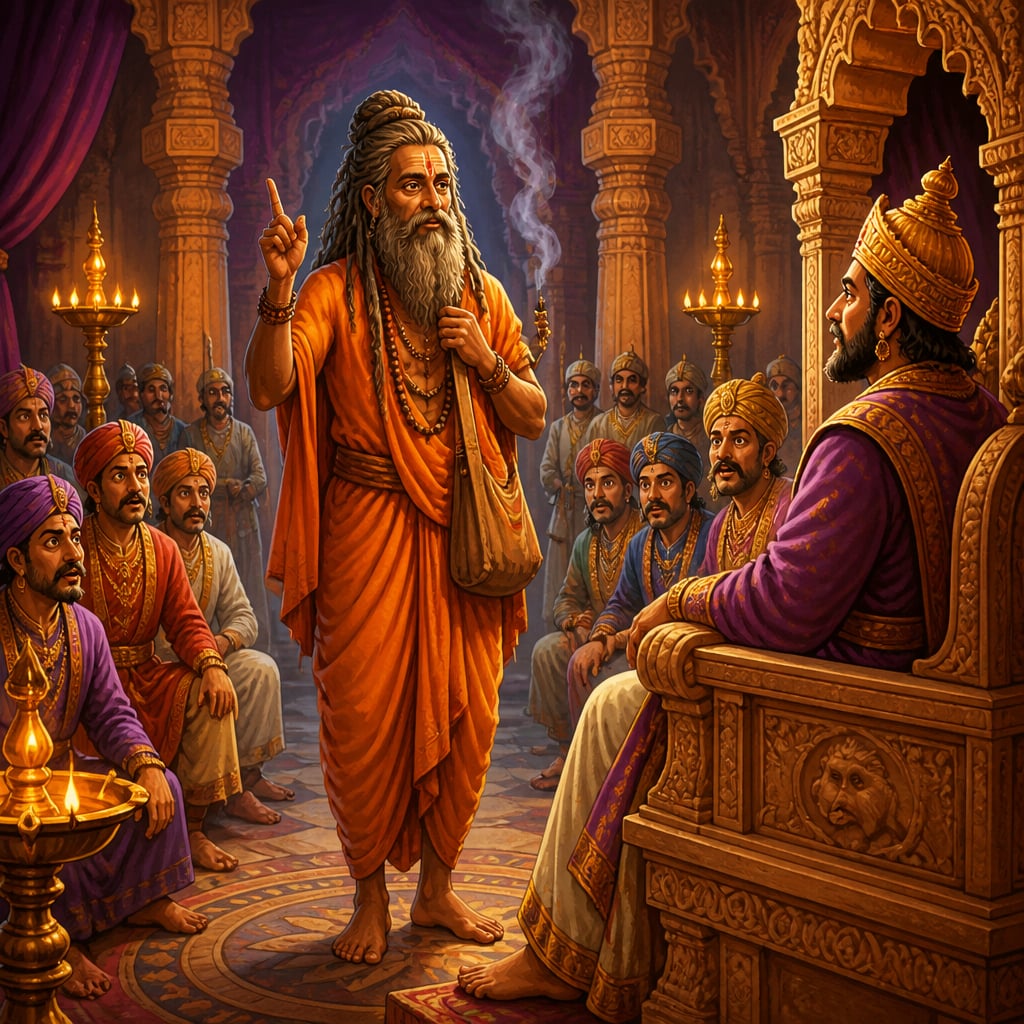
In the Shanti Parva, Bhishma recounts a story that still startles readers today. A wandering sadhu, emaciated and dressed in rags, approached a king's court. The king, expecting platitudes about detachment, asked: "O holy one, what is the greatest sin?"
The sadhu didn't hesitate: "दारिद्र्यं सर्वपापानां मूलम्", "Poverty is the root of all sins."
The court gasped. How could a renunciate, a man who had given up everything, call poverty a sin? Wasn't he himself poor by choice?
The sadhu smiled. "I chose poverty for moksha, having first fulfilled all duties. But the poverty of incapacity, where a man cannot feed his children, cannot perform shraddha for ancestors, cannot give a coin to the needy, that poverty is not spiritual. It is a cage that prevents dharma itself."
"दारिद्र्यं मरणं प्राहुर्जीवन्नपि मृतो हि सः। अयज्वा च अदाता च अश्रौत्रश्च भवेन्नरः॥"
"Poverty is called a kind of death. Though living, a poor man is as good as dead, unable to perform sacrifices, unable to give, unable to learn."
, Mahabharata, Shanti Parva 8.17-18
This wasn't one stray quote. The Mahabharata returns to this theme repeatedly. Poverty isn't romanticized, it's diagnosed as a disease that blocks the patient from dharma.
What Poverty Actually Prevents
Consider the five great duties (Pancha Mahayajna) every householder must perform:
| Duty | What It Requires | Why Poverty Blocks It |
|---|---|---|
| Brahma Yajna (Study) | Time, texts, teachers | Survival takes all time |
| Deva Yajna (Worship) | Offerings, materials | Nothing to offer |
| Pitri Yajna (Ancestors) | Shraddha rituals | Cannot afford rituals |
| Manushya Yajna (Hospitality) | Food for guests | No surplus to share |
| Bhuta Yajna (Creatures) | Feeding animals | Struggle to feed self |
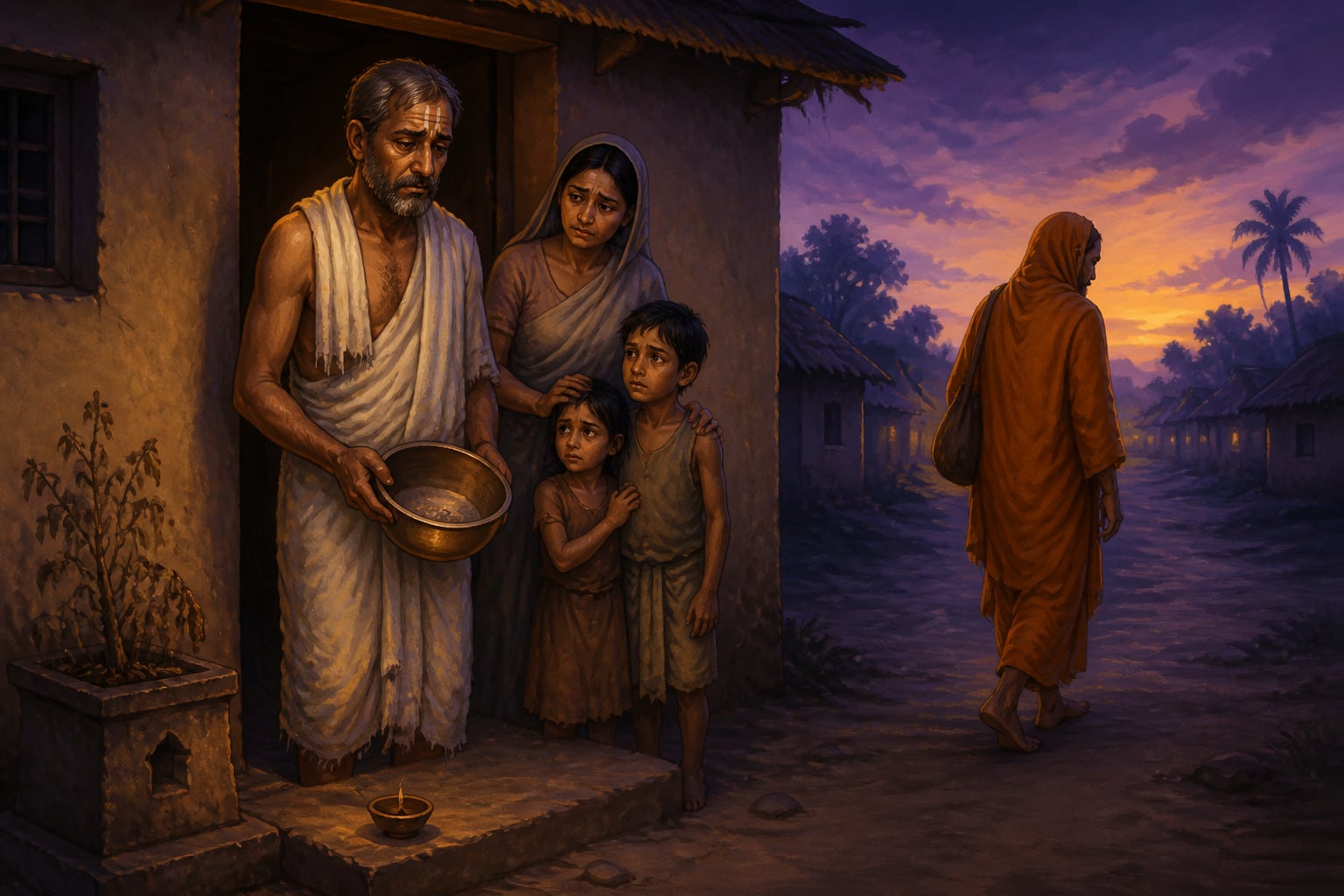
The poor person isn't failing from lack of devotion. They're failing because the system requires resources. The Dharmashastras understood what modern romantics forget: spirituality has material prerequisites.
Vidura put it bluntly to Dhritarashtra:
"अर्थेन हि विहीनस्य पुरुषस्य विचेष्टितम्। अन्धस्येवाक्षिविषये व्यर्थं भवति सर्वदा॥"
"The actions of a man without wealth are always futile, like a blind man's efforts to see."
This isn't cruelty toward the poor. It's a clear-eyed recognition that poverty creates structural barriers to dharmic life.
The Dangerous Inversion
Somewhere in India's long history, a terrible confusion entered the discourse. Detachment (vairagya) got confused with destitution (daridrya). Renunciation (sannyasa) got confused with failure. The result? A culture that began celebrating poverty as "spiritual" while its temples were plundered, its trade routes collapsed, and its prosperity drained.
Sanjeev Sanyal, in The Ocean of Churn, traces this decay: "The original Vedic culture was deeply prosperity-affirming. Sri Sukta celebrates Lakshmi. Kubera is a god, not a demon. Merchants were honored. Kings were measured by their treasury AND their subjects' welfare. The poverty-worship that characterized later periods was not Vedic, it was a symptom of civilizational decline."
The inversion works like this:
| Original Teaching | Distorted Version |
|---|---|
| Wealth should serve dharma | Wealth is evil |
| Detachment from results | Detachment from effort |
| Sannyasa after duties fulfilled | Sannyasa as escape from duties |
| Poverty is obstacle to dharma | Poverty is proof of spirituality |
This confusion served colonizers well. A population that believed poverty was virtue wouldn't fight economic exploitation. "Spiritual India" became a convenient fiction that justified material plunder.
The Ashrama Distinction
The Vedic system was precise about when renunciation was appropriate:
Brahmacharya (Student): Focus on learning, not earning, but supported by family.
Grihastha (Householder): This is when you MUST earn. The householder supports students, retirees, and renunciates. Economic duty is paramount.
Vanaprastha (Retirement): Gradual withdrawal, after providing for the next generation.
Sannyasa (Renunciation): Only after all obligations fulfilled. Not escape but culmination.
The texts are explicit: a young person avoiding economic engagement isn't spiritual, they're shirking. A householder citing "detachment" while dependents suffer isn't enlightened, they're negligent.
"गृहस्थ एव यज्वानं दाता च स प्रकीर्तितः। तस्मात्सर्वाश्रमाणां हि गृहस्थः श्रेष्ठ उच्यते॥"
"The householder alone can perform sacrifices and give charity. Therefore, among all ashramas, the householder is declared supreme."
, Manusmriti 3.78
Notice: the earning stage is called supreme, not the renouncing stage. Because without someone generating wealth, the entire spiritual ecosystem collapses.
From Romanticizing to Solving

In 2014, when Prime Minister Modi launched the Jan Dhan Yojana, bringing 500 million people into the banking system, he was practicing Daridrata-Nivarana. When Finance Minister Sitharaman's budgets prioritize rural employment and financial inclusion, this is dharmic economics in action.
The shift is from romanticizing poverty to solving it:
| Poverty Romanticism | Dharmic Approach |
|---|---|
| "The poor are simple and pure" | "The poor deserve opportunity" |
| "Money corrupts" | "Money enables dharma" |
| "Accept your karma" | "Transform your karma" |
| "Detach from material world" | "Engage ethically with material world" |
India's GDP growth from $400 billion (1991) to $3.5 trillion (2024) isn't Western materialism corrupting Bharat. It's Bharat remembering what Bhishma knew: prosperity is prerequisite for dharma. The 415 million Indians lifted from poverty between 2005-2021 aren't abandoning spirituality, they're finally able to practice it.
Your Poverty Check
This teaching applies personally too. Ask yourself:
- Am I romanticizing my financial struggles as "simple living"?
- Am I using "spirituality" to justify not building economic capacity?
- Are there dharmic duties I cannot perform due to insufficient resources?
- Is my poverty chosen (legitimate vairagya) or circumstantial (requiring address)?
The sadhu in the story chose poverty after fulfilling all duties, with genuine dispassion, for focused sadhana. That's legitimate.
But if poverty prevents you from caring for parents, educating children, giving to the needy, or performing basic dharmic duties, that's not spiritual. That's an obstacle to be overcome, not a virtue to be celebrated.
The Mahabharata's message echoes across millennia: Daridrata-Nivarana, the removal of poverty, is dharmic duty, not materialistic corruption.
In our next lesson, we'll explore how the Vedic tradition views prosperity itself, not as neutral resource but as Bhagya, a divine blessing with its own theology of abundance.
Amartya Sen's capability approach (Nobel Prize 1998) argues poverty is not just income lack but deprivation of capabilities to function. The Shanti Parva made this point 2000+ years earlier, poverty prevents functioning in dharmic roles.
By framing poverty removal as dharmic duty (not just humanitarian concern), the Indian framework provides stronger motivation. You're not just helping the poor, you're fulfilling sacred obligation.
India lifted 415 million people out of poverty between 2005-2021 (UNDP 2023). This is Daridrata-Nivarana at civilizational scale, the largest poverty reduction in human history.
Max Weber's 'Protestant work ethic' gave spiritual dignity to labor. But the gṛhastha concept is older and more explicit: the earning stage isn't just blessed, it's declared supreme because it enables all else.
This teaching counters 'spiritual bypassing', using spiritual language to avoid material responsibility. The tradition is clear: earn first, serve through earning, then (if called) renounce.
In traditional joint families, 3-4 gṛhasthas typically supported 15-20 people across generations. The entire social security system rested on the earning householder's dharmic duty.
Key terms
- Dāridrya
- Poverty, destitution, explicitly described in the Mahabharata as a form of living death that prevents the performance of dharmic duties.
- Vairāgya
- Genuine dispassion, non-attachment, a spiritual state of freedom from craving, distinct from poverty or failure. True vairagya comes from fulfillment, not deprivation.
- Gṛhastha
- Householder, the second ashrama of life when one marries, earns, raises children, and fulfills economic duties. Declared 'supreme among ashramas' because it supports all others.
- Dāna
- Charitable giving, one of the essential duties that poverty prevents. Dana is not optional generosity but dharmic obligation, impossible without surplus resources.
Verses
दारिद्र्यं मरणं प्राहुर्जीवन्नपि मृतो हि सः। अयज्वा च अदाता च अश्रौत्रश्च भवेन्नरः॥
dāridryaṃ maraṇaṃ prāhurjīvannapi mṛto hi saḥ | ayajvā ca adātā ca aśrautraśca bhavennараḥ ||
Poverty, the sages say, is death while yet alive. The poor man cannot sacrifice, cannot give, cannot learn, a life in name only.
This verse reframes poverty from 'simple living' to structural barrier. It supports policies that prioritize poverty eradication not as materialism but as enabling dharmic capacity.
Mahabharata, Shanti Parva, Chapter 8, Verses 17-18 (K.M. Ganguli translation)
गृहस्थ एव यज्वानं दाता च स प्रकीर्तितः। तस्मात्सर्वाश्रमाणां हि गृहस्थः श्रेष्ठ उच्यते॥
gṛhastha eva yajvānaṃ dātā ca sa prakīrtitaḥ | tasmātsarvāśramāṇāṃ hi gṛhasthaḥ śreṣṭha ucyate ||
Only the householder can perform sacrifice and give with open hands. Therefore, among all life-stages, the householder stands supreme.
This provides scriptural authority for the dignity of economic work. The earning professional is not spiritually inferior to the renunciate, they are the foundation upon which spiritual life rests.
Manusmriti, Chapter 3, Verse 78 (Patrick Olivelle translation)
अर्थेन हि विहीनस्य पुरुषस्य विचेष्टितम्। अन्धस्येवाक्षिविषये व्यर्थं भवति सर्वदा॥
arthena hi vihīnasya puruṣasya viceṣṭitam | andhasyevākṣiviṣaye vyarthaṃ bhavati sarvadā ||
The efforts of one without wealth are always futile, like a blind man trying to see.
This verse articulates what economists call 'poverty traps', structural conditions where lack of resources makes escape from poverty nearly impossible without intervention.
Vidura Niti (Mahabharata), Udyoga Parva (Bibek Debroy)
Key figures
Vidura
Prime minister to King Dhritarashtra, half-brother of Pandu and Dhritarashtra, born of a servant woman to sage Vyasa · Mahabharata period
Sanjeev Sanyal
Economic historian, author, and Member of the Economic Advisory Council to the Prime Minister · Contemporary (born 1971)
Amartya Sen
Nobel Prize-winning economist (1998), philosopher, and architect of the Human Development Index · Contemporary (born 1933)
Case studies
India's 415 Million: The Largest Poverty Exit in Human History
Between 2005 and 2021, India achieved what no nation has ever accomplished: lifting 415 million people out of multidimensional poverty. This wasn't gradual drift but deliberate policy, a civilizational commitment to Daridrata-Nivarana. The UNDP's 2023 report documented that India's poverty rate fell from 55% to under 15%, with improvements across nutrition, education, sanitation, and living standards. Rural India, long romanticized as 'simple' but actually trapped in capability deprivation, saw the most dramatic gains.
The dharmic texts declared poverty a 'living death' that prevents performing duties. India's poverty reduction program reversed this, enabling 415 million people to finally practice dana (charity), perform rituals, educate children, and participate in civic life. This wasn't 'Western materialism', it was civilizational recovery of the original Vedic prosperity-affirmation. The Shanti Parva's teaching that poverty blocks dharma became policy: remove the barrier, enable the dharma.
By 2024, India had transformed from a country where majority lived in poverty to one where majority had escaped it. The 415 million represents more people than the entire population of the United States. These aren't statistics, they're 415 million people now able to fulfill dharmic duties that poverty had blocked: feeding families, educating children, giving to causes, participating in community life.
Poverty removal at scale is possible when treated as dharmic duty rather than charity. India proved that the Mahabharata's teaching, poverty is addressable, not inevitable, applies at civilizational scale.
India's poverty reduction achievement provides a counter-narrative to the widespread assumption that only Western-style welfare states can address poverty. Programs like DBT (Direct Benefit Transfer) through Aadhaar demonstrate that targeted, technology-enabled approaches rooted in local context can outperform traditional aid models.
India's poverty reduction (415 million, 2005-2021) exceeds the total poverty reduction of all other countries combined during the same period. This is the Shanti Parva's Daridrata-Nivarana teaching implemented as national mission.
Amul: Verghese Kurien and the White Revolution
In 1949, dairy farmers in Gujarat's Kaira district were exploited by middlemen who bought milk cheap and sold dear. Dr. Verghese Kurien, a young engineer, helped them form a cooperative, Amul. The model was revolutionary: farmers owned the processing facilities, set prices collectively, and shared profits. By 2024, Amul had become India's largest food brand (₹72,000 crore revenue), with 3.6 million farmer-members across 18,700 village cooperatives.
Kurien called it 'the billion-liter idea', treating farmers as producers, not peasants. This echoes the dharmic distinction between daridrya (poverty of incapacity) and productive gṛhastha dignity. The cooperative model eliminated adharmic middlemen (like DBT would decades later), ensuring farmers received fair value. Kurien famously said, 'I used modern management for a traditional purpose: farmers' dignity.' That purpose was dharmic.
India transformed from milk-deficient to world's largest milk producer (230 million tonnes/year). 3.6 million farmer families earn regular income through Amul cooperatives. The 'Amul model' was replicated nationwide through Operation Flood, touching 100 million rural households. Poor farmers became prosperous dairymen, poverty transformed to productive dignity.
Cooperative ownership transforms the poverty dynamic: from exploited producer to empowered stakeholder. Kurien proved that poor farmers weren't lacking capability, they were lacking fair structures. Remove the adharmic extraction, enable the dharmic production.
Amul's cooperative model now inspires agricultural reforms worldwide, from Kenyan dairy cooperatives to Southeast Asian farmer producer organizations. The principle of cutting out exploitative middlemen through collective ownership remains one of the most effective anti-poverty strategies available.
Before Amul, farmers received 30 paise per liter; middlemen took 70 paise. After Amul, farmers receive 80+ paise per liter. This price reversal, from 30% to 80% value retention, represents the economic impact of removing adharmic intermediaries.
Historical context
Mahabharata period through colonial and post-colonial India
The poverty-romanticization that characterized parts of Indian discourse was not ancient wisdom but a colonial-era adaptation. When you can't prevent plunder, you learn to call poverty virtue. India's current economic renaissance represents a return to the original Vedic prosperity-affirmation.
Compare to 'prosperity gospel' in American Christianity, also affirming wealth, but without dharmic constraints. Or to Catholic 'preferential option for the poor', concerned with poverty but sometimes romanticizing it. The dharmic position is distinctive: remove poverty to enable dharma.
India's poverty rate fell from 55% (1990) to under 15% (2023) using national measures. The World Bank's $2.15/day measure shows similar trajectory. This represents the largest poverty reduction in human history.
Understanding that poverty-romanticism was a deviation, not tradition, liberates India from false choices. Economic growth isn't Western corruption, it's civilizational recovery. Development policy becomes dharmic duty.
Living traditions
India's development programs, from MGNREGA (rural employment) to PM-KISAN (farmer support) to skill development initiatives, all reflect the dharmic principle that poverty is barrier to be removed, not virtue to be celebrated. The $5 trillion economy goal is Daridrata-Nivarana at national scale.
- Jan Dhan Yojana: Launched in 2014, this program brought 500+ million people into the formal banking system. Financial inclusion enables participation in the modern economy, a contemporary form of removing barriers to dharmic life.
- Direct Benefit Transfer (DBT): Over ₹35 lakh crore ($420 billion) transferred directly to beneficiaries, eliminating middlemen who siphoned funds. Technology enabling dharmic governance, resources reaching those who need them.
- Mahalakshmi Temple: One of India's most important Lakshmi temples, visited by millions seeking prosperity blessings. Built in 1831 after Goddess Lakshmi appeared in a dream to Dhakji Dadaji, the temple enshrines the tradition of seeking wealth as divine grace, not rejecting it. Businesspeople, traders, and professionals come here to inaugurate new ventures, reinforcing the dharmic view that prosperity is sacred, not shameful.
- Anand Dairy (Amul) Cooperative: The birthplace of India's White Revolution, where Verghese Kurien transformed exploited farmers into prosperous cooperative owners. The Amul factory tour and museum tell the story of Daridrata-Nivarana through collective action, removing poverty by restoring productive dignity. See where 3.6 million farmers now earn fair prices for their milk.
- Akshardham Temple: BAPS Swaminarayan temple that embodies the principle of Daridrata-Nivarana through its extensive humanitarian programs. The organization runs schools, hospitals, and disaster relief, demonstrating that temple wealth should flow toward removing poverty rather than just accumulating.
- Dwarkadheesh Temple: Ancient temple dedicated to Lord Krishna, whose teachings in the Gita emphasized that poverty should not be romanticized but addressed. The temple's charitable programs for pilgrims, free meals, accommodation for the poor, exemplify dharmic wealth redistribution.
Reflection
- Have you ever used 'spirituality,' 'simplicity,' or 'non-attachment' to justify not building economic capacity? Looking honestly: was this genuine vairagya (dispassion after fulfillment) or escapism (avoiding difficult work)?
- What dharmic duties are you currently unable to perform due to insufficient resources? (Supporting parents, educating children, giving to causes, hosting guests, etc.) What would it take to remove this barrier, and when will you start?