Vāstu & Sthāpatya: Architecture as Applied Science
Orientation, climate optimization, and what passive design is rediscovering
Explore Vāstu principles of orientation and climate optimization, proportional systems and sacred geometry, and what modern passive design is rediscovering from ancient wisdom.
Vāstu & Sthāpatya: The Science Within the Sacred
Walk into a traditional Indian home on a scorching summer afternoon. Outside, the temperature exceeds 40°C. Inside, it's cool without air conditioning. The breeze finds its way through latticed screens. The courtyard draws hot air upward, pulling cooler air from shaded verandas. This isn't magic, it's science encoded in centuries of architectural tradition.

Understanding Vāstu: Beyond Superstition
Vāstu Śāstra is often dismissed as mere superstition or praised as mystical wisdom. Both views miss the point. At its core, Vāstu represents India's accumulated knowledge of how buildings interact with climate, light, wind, and human psychology.
The word vāstu itself comes from the Sanskrit root 'vas' meaning 'to dwell.' Vāstu Śāstra is literally 'the science of dwelling', how to create spaces where life flourishes.
The foundational texts, Mayamatam, Mānasāra, Samarāṅgaṇa Sūtradhāra, contain detailed specifications for:
- Site selection based on soil quality, slope, and water availability
- Building orientation relative to sun path and prevailing winds
- Room proportions affecting acoustics and thermal comfort
- Material selection for different climates
- Ventilation patterns for natural air conditioning
The Vāstu Purusha Mandala: A Planning Grid
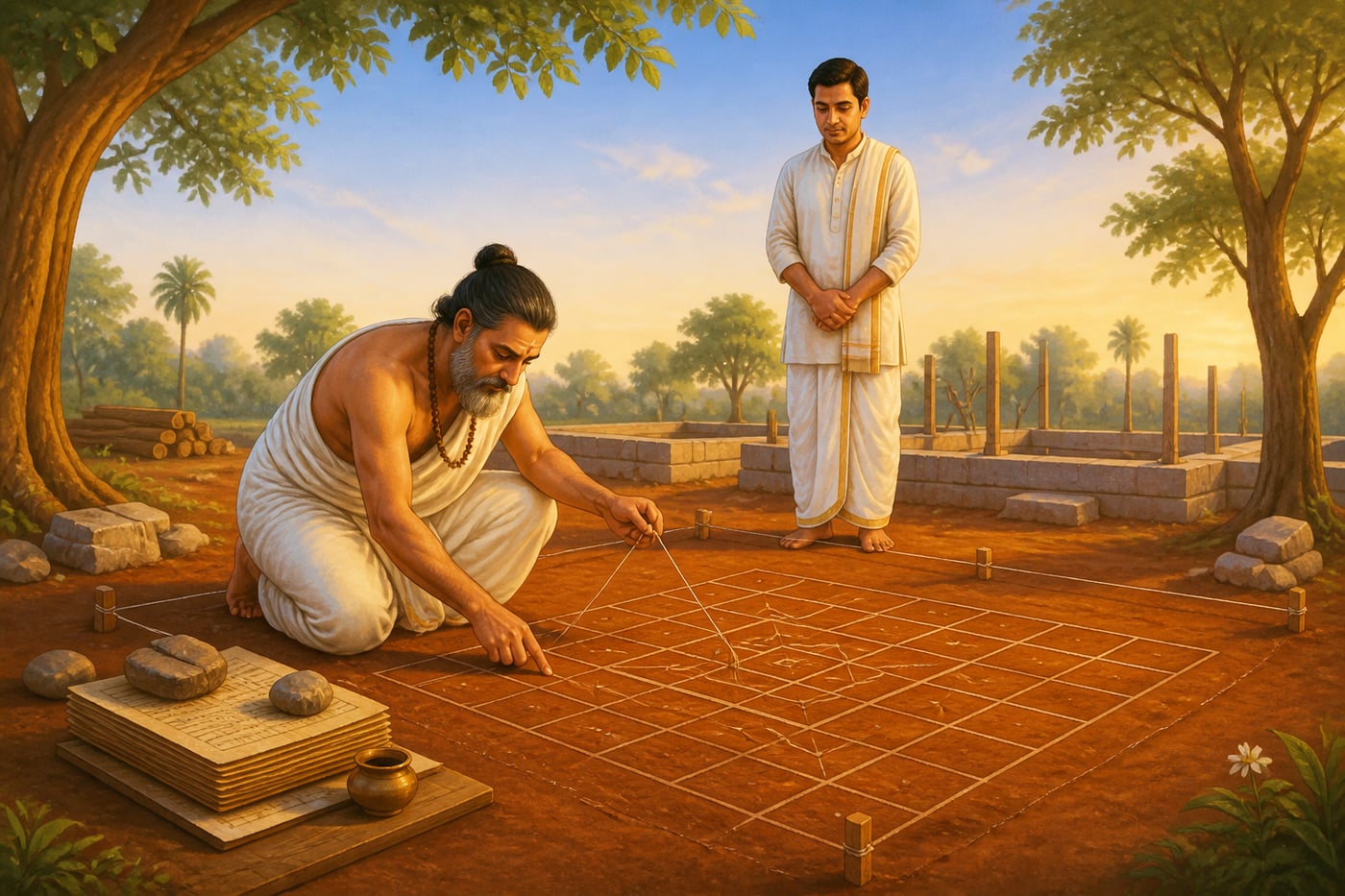
Central to Vāstu is the Vāstu Purusha Mandala, a grid overlaid on any building site. Popular understanding treats this as a mystical diagram with a deity trapped beneath the earth. The engineering reality is more practical.
The mandala divides the site into 64 or 81 squares, each associated with different qualities. When we strip away the cosmological language, we find:
The Northeast (Īśāna): Kept open and low. Why? In the Northern Hemisphere, morning light from the east and northeast is gentle and psychologically uplifting. Lower structures here allow winter sun to penetrate deep into the home.
The South and West: Built higher and more massive. These directions receive harsh afternoon sun. Thick walls here absorb heat during the day and release it slowly at night, natural thermal regulation.
The Center (Brahmasthāna): Kept open, often as a courtyard. This creates a convection engine: as the courtyard heats during the day, hot air rises and escapes, drawing cooler air from the shaded periphery.
The Southwest (Nairṛti): Reserved for the master bedroom or treasury. This corner receives least direct sunlight, remaining coolest and most private, ideal for sleep and valuables.
The mandala is essentially a zoning diagram optimized for the Indian subcontinent's climate.
Orientation: The Science of Directions
Vāstu's emphasis on prāgmukha (east-facing) entrances is often cited without explanation. The reasoning combines multiple factors:
Light Quality: Morning eastern light is rich in blue wavelengths that suppress melatonin and enhance alertness. An east-facing entrance ensures occupants begin their day with energizing light.
Wind Patterns: In much of India, summer mornings bring cooler breezes from the east before the land heats up. East-facing openings capture this natural cooling.
Cultural Rhythm: Traditional Hindu households began the day facing east for morning prayers (sandhyavandana). The architecture supported the ritual, which itself aligned with circadian biology.
The North Factor: North-facing openings provide consistent indirect light without harsh direct sun, ideal for work areas. This explains Vāstu's preference for treasury and study rooms in the north.
The Courtyard: India's Air Conditioning System
The aṅgaṇa (courtyard) is perhaps Indian architecture's greatest gift to passive design. Found from Kerala's nalukettu to Rajasthan's havelis, from Tamil agraharam to Chettinad mansions, the courtyard operates as a sophisticated thermal engine.
Daytime Cycle:
- Morning sun heats the courtyard
- Hot air rises, creating a low-pressure zone
- Cool air is drawn from shaded verandas and rooms
- Cross-ventilation cools the interior
Nighttime Cycle:
- The courtyard radiates heat to the cool night sky
- Cool air settles in the courtyard
- This dense cool air flows into surrounding rooms
- The massive walls release stored heat outward
Measurements in traditional Rajasthani havelis show interior temperatures 10-15°C cooler than outside during peak summer, achieved purely through design.
The Jaali: Engineered Air Flow

The jāli (perforated screen) exemplifies how decoration and function merge in Indian architecture. These intricate stone or wooden lattices aren't mere ornament, they're precision airflow devices.
When wind passes through a jaali's small openings:
- Velocity increases (Venturi effect)
- Pressure drops
- Temperature falls slightly
- The accelerated airflow reaches further into the room
The geometric patterns aren't arbitrary. Traditional craftsmen developed patterns that maximized airflow while minimizing dust entry and maintaining privacy. Modern computational fluid dynamics confirms what generations of craftsmen knew intuitively.
Proportional Systems: The Mathematics of Harmony
Vāstu texts specify elaborate proportional systems for every architectural element. The tāla (module) system relates room height to width, doorway dimensions to room size, and wall thickness to span.
Consider the rules for doorways:
- Height should be twice the width
- Width should be half the wall thickness on either side
- Threshold height should be one-twelfth the door height
These aren't arbitrary. The 2:1 height-to-width ratio creates visual stability (the golden section approximation). The width-to-wall relationship ensures structural integrity. The threshold height prevents water ingress during monsoons while remaining easy to step over.
Similar rational bases underlie most Vāstu proportions, though the original reasoning was often encoded in symbolic or astrological language.
Climate Zones and Regional Adaptations
Vāstu principles adapted systematically to India's diverse climates:
Hot-Dry (Rajasthan, Gujarat):
- Thick walls (60-90cm) for thermal mass
- Small north-facing windows
- Underground rooms (teh-khana) for summer refuge
- Light-colored exteriors reflecting heat
- Compact planning minimizing exposed surface
Hot-Humid (Kerala, Bengal, Konkan):
- Thin walls allowing heat to escape
- Large openings on all sides for cross-ventilation
- Steep sloped roofs shedding monsoon rain
- Raised plinths avoiding flood and damp
- Wide overhanging eaves for shade and rain protection
Composite (Delhi, Madhya Pradesh):
- Moderate wall thickness
- Adjustable screens (chicks, jaalis) for seasonal variation
- Courtyards with retractable covers
- Combination of thermal mass and ventilation strategies
Cold (Kashmir, Himachal):
- Timber construction with air gaps for insulation
- South-facing principal rooms
- Small openings minimizing heat loss
- Low ceilings retaining warmth
- Sloped roofs shedding snow
Materials and Thermal Wisdom
Traditional material choices reflect deep understanding of thermal properties:
Mud and Lime: The ubiquitous mud wall with lime plaster has remarkably low thermal conductivity. It absorbs heat slowly, releases it slowly, and 'breathes' to regulate humidity. Modern engineers now call this 'hygrothermal buffering.'
Terracotta Tiles: Mangalore tiles and traditional pan tiles create an air gap above the ceiling. This gap acts as insulation, while the tiles' thermal mass moderates temperature swings.
Thatch: Before corrugated sheets, India used grass and palm thatch extensively. Despite its humble appearance, thatch is an excellent insulator with R-values matching modern materials.
Stone: Granite and sandstone were used strategically, for floors (remaining cool underfoot), for thick southern walls (absorbing heat), but rarely for roofs (too heavy, poor insulation).
What Modern Science Is Rediscovering
Contemporary 'passive design,' 'bioclimatic architecture,' and 'net-zero buildings' often reinvent principles embedded in Vāstu:
Stack Ventilation: The courtyard's convective cooling is now modeled with computational fluid dynamics and deliberately incorporated into 'green' buildings.
Thermal Mass: After decades of lightweight construction, architects are returning to massive walls that moderate temperature swings, exactly what traditional buildings always used.
Orientation Optimization: LEED and GRIHA rating systems award points for orientation strategies that traditional builders followed instinctively.
Daylighting: Modern standards recommend daylight factors that traditional homes achieved through carefully positioned openings and light wells.
The Laurie Baker Centre in Kerala and the Centre for Development Studies (Trivandrum) demonstrate how traditional principles can be adapted for contemporary buildings, achieving thermal comfort without air conditioning.
The Integration of Knowledge
Vāstu represents something remarkable: the integration of structural engineering, climate science, psychology, and sacred symbolism into a unified practice. The sthāpati (master architect) was expected to know:
- Bhū-parikṣā: Soil testing and site selection
- Jyotiṣa: Astronomical calculations for orientation
- Gaṇita: Mathematics for proportions and structures
- Śilpa: Craft traditions of carving and construction
- Āgama: Ritual requirements for sacred buildings
This holistic approach meant that function, structure, climate response, and meaning were designed together, not treated as separate concerns to be reconciled later.
Learning from Tradition
As India urbanizes rapidly, the default has become glass-and-concrete boxes requiring massive energy for cooling. Yet traditional buildings in the same climates remained comfortable for centuries without external energy.
The answer isn't to replicate old buildings, but to understand their principles:
- Orientation matters: Place openings and masses deliberately
- Thermal mass works: Heavy materials moderate temperature swings
- Ventilation is free: Design for air movement, not mechanical cooling
- Proportions affect experience: Ratios matter for comfort and beauty
- Local climate is the starting point: Every region has its own strategies
Vāstu, stripped of its superstitious accretions and understood as accumulated climate wisdom, offers a foundation for architecture that works with nature rather than against it.
Key figures
Maya (Mayāsura)
Credited as the divine architect who composed the Mayamatam, one of the most comprehensive Vāstu texts. Whether historical or legendary, the text bearing his name systematizes building science from site selection to final ornamentation.
Varāhamihira
Dedicated chapters of the Bṛhat Saṃhitā to architectural principles, including site selection, building orientation, and material properties. His work synthesized earlier traditions into accessible guidelines.
King Bhoja of Dhārā
Authored the Samarāṅgaṇa Sūtradhāra, a comprehensive architectural treatise covering everything from town planning to furniture design. His text includes remarkably detailed mechanical devices and building specifications.
Laurie Baker
British-born architect who spent most of his life in Kerala, demonstrating how traditional Indian building principles could create modern, affordable, energy-efficient homes. His 'cost-effective' techniques drew heavily on vernacular wisdom.
Case studies
Chettinad Mansions: Climate Control Through Design
[Tamil Nadu] [19th-early 20th century CE] The Nattukotai Chettiars, wealthy traders, built palatial homes in the hot-dry Chettinad region without any mechanical cooling. These mansions feature multiple courtyards in sequence, creating progressive cooling as air moves inward. Burma teak columns, Italian marble floors (which stay cool), and thick walls of local 'karai' limestone create thermal mass. The innermost rooms remain comfortable even when outside temperatures exceed 42°C. Roof tiles are laid on a bed of seashell lime that insulates and reflects heat. Every material and spatial decision serves the thermal strategy.
This case reflects the deep knowledge tradition of Indian architecture and engineering (Shilpa Shastra), where empirical observation and systematic methods were developed centuries before similar Western discoveries.
The knowledge demonstrated in this case study contributed to the broader legacy of Indian architecture and engineering (Shilpa Shastra), influencing developments across Asia and eventually the world.
Chettinad homes demonstrate that comfort in extreme heat is achievable through design alone. The combination of courtyards, thermal mass, and strategic material selection creates habitable spaces without energy consumption.
Passive house design standards in Europe aim for buildings that need almost no active heating or cooling. The principles they apply, including thermal mass, cross-ventilation, and strategic shading, are the same techniques Chettinad mansions used. Modern building science is quantifying and systematizing what traditional builders understood intuitively.
Ancient Indian stepwells (vav) could store millions of liters of water, serving communities for centuries without mechanical pumps.
Jaisalmer Havelis: Desert Architecture Perfected
[Rajasthan] [17th-19th century CE] In the Thar Desert, where daytime temperatures can exceed 45°C and nights can be cold, the havelis of Jaisalmer represent extreme climate adaptation. Built from local yellow sandstone, their walls are often 1-meter thick. Windows are small, north-facing, and filled with intricate jaalis that accelerate incoming breezes. Underground rooms (teh-khana) served as summer retreats where temperatures stay around 25°C year-round. The famous Patwon ki Haveli has 60 balconies, each positioned to capture prevailing winds while shading the walls below. The golden sandstone absorbs heat all day, then radiates it through the cold desert night.
This case reflects the deep knowledge tradition of Indian architecture and engineering (Shilpa Shastra), where empirical observation and systematic methods were developed centuries before similar Western discoveries.
The knowledge demonstrated in this case study contributed to the broader legacy of Indian architecture and engineering (Shilpa Shastra), influencing developments across Asia and eventually the world.
Jaisalmer shows how even extreme environments can be made comfortable through careful material selection, thermal mass, strategic openings, and underground spaces - all without external energy.
Net-zero energy buildings in hot climates increasingly incorporate underground thermal storage, high thermal mass walls, and controlled ventilation. Jaisalmer's haveli builders solved the same problem centuries ago using locally available sandstone and traditional knowledge of desert climate patterns.
Ancient Indian stepwells (vav) could store millions of liters of water, serving communities for centuries without mechanical pumps.
Auroville Earth Centre: Traditional Principles, Modern Methods
[1990s-present] The Auroville Earth Centre has spent decades researching and applying traditional building techniques with modern analysis. Their buildings use compressed stabilized earth blocks (a modern version of mud brick), lime plasters, and vaulted roofs that eliminate the need for steel or concrete while providing excellent thermal performance. Studies show their buildings maintain internal temperatures 8-10°C below ambient without any cooling system. They've trained thousands of masons and architects in these techniques, proving they can be scaled for contemporary needs. The Centre's own campus demonstrates comfort without air conditioning even in Tamil Nadu's oppressive summer humidity.
This case reflects the deep knowledge tradition of Indian architecture and engineering (Shilpa Shastra), where empirical observation and systematic methods were developed centuries before similar Western discoveries.
The knowledge demonstrated in this case study contributed to the broader legacy of Indian architecture and engineering (Shilpa Shastra), influencing developments across Asia and eventually the world.
Auroville proves that traditional materials and principles, analyzed with modern scientific methods, can meet contemporary building needs sustainably. The barrier isn't technical - it's overcoming the assumption that 'modern' means glass and steel.
The green building movement (LEED, BREEAM, GRIHA certifications) promotes many of the same strategies that traditional Indian architecture employed: local materials, passive cooling, rainwater harvesting, and thermal mass. The barrier to adoption is not technical knowledge but construction industry inertia and the lower upfront cost of concrete-and-AC buildings.
Ancient Indian stepwells (vav) could store millions of liters of water, serving communities for centuries without mechanical pumps.
Historical context
1500 BCE - Present
Living traditions
Vāstu principles are being rediscovered by sustainable architecture movements worldwide. LEED and GRIHA green building standards incorporate orientation and daylighting criteria that Vāstu codified centuries ago. Passive House standards emphasize thermal mass and controlled ventilation, core Vāstu principles. Architects like Laurie Baker, Balkrishna Doshi, and the Auroville community have demonstrated that traditional wisdom can inform world-class contemporary design.
Reflection
- Why did traditional architects encode practical building knowledge in religious or astrological language? What advantages and disadvantages did this approach have for preserving the knowledge?
- Modern buildings often require constant air conditioning to remain habitable. Traditional buildings in the same climates did not. What do you think was lost, and why, in the transition to contemporary construction?
- Vāstu texts describe the building as a living entity (Vāstu Purusha). Modern architecture treats buildings as machines. How might these different conceptual frameworks affect how we design and inhabit spaces?