Jala Yantra: Water Lifting and Distribution

Persian wheel adaptations, underground aqueducts, and tank cascades

Explore Persian wheel adaptations, underground aqueducts (karez/qanats), and the sophisticated tank cascade systems of South India.

Jala Yantra: The Science of Moving Water

Water, the giver of life, rarely appears where we most need it. Ancient Indian engineers faced a fundamental challenge: how to lift water from deep wells, carry it across parched landscapes, and distribute it equitably among fields and homes. Their solutions, elegant machines and invisible underground rivers, transformed deserts into gardens.
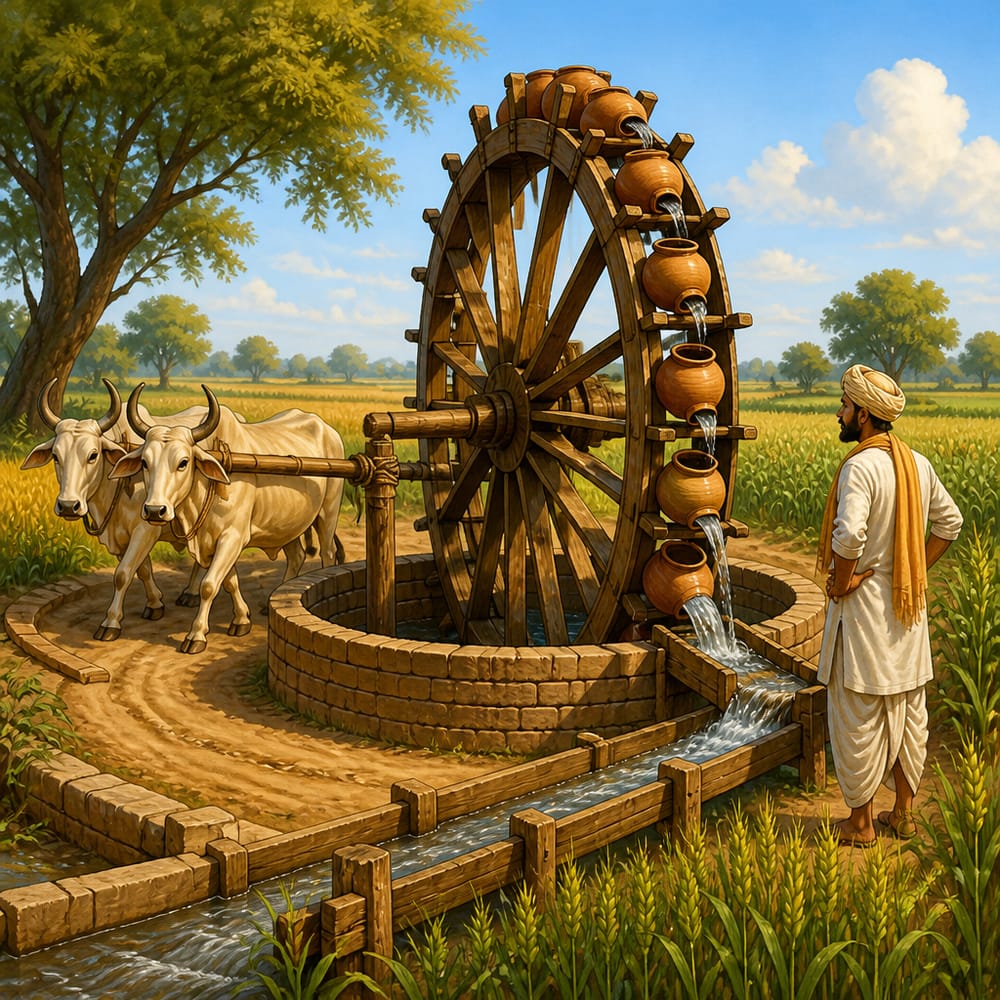
Persian wheel araghatta

The Araghatta: India's Water-Lifting Wheel

The araghatta (अरघट्ट, 'water wheel') appears in Sanskrit texts from the 4th century BCE onward. Kautilya's Arthashastra mentions it alongside other irrigation devices, suggesting widespread use even then. But what exactly was this machine?

Picture a large wooden wheel positioned vertically over a well. Along its rim, clay pots (ghata) are attached by ropes. As oxen walk in circles, rotating the wheel through a gearing mechanism, the pots dip into the water, fill, rise, and tip their contents into a channel, all in continuous motion.

The genius lies in the mechanical advantage. A single ox can lift thousands of liters daily, far more than human labor alone. The system is:

Regional Adaptations

As the araghatta spread across India, it adapted to local conditions:

Punjab and Rajasthan - The Rahat: The Persian wheel (rahat) became central to North Indian agriculture. In arid Rajasthan, where groundwater lies 15-30 meters deep, larger wheels with longer pot-chains evolved. The characteristic creaking of the rahat became synonymous with village life.

Gujarat - The Kos: A variant using leather buckets instead of clay pots, better suited for very deep wells. The leather lasted longer under constant wet-dry cycles.

South India - The Kapile/Yetam: Tamil Nadu developed the yetam, using coconut shells as water containers, lighter, cheaper, and locally abundant. The kapile of Karnataka used wooden buckets.

Bengal - The Don: Eastern India adapted the mechanism for its shallower water tables, using smaller wheels that a single person could operate.

The Invisible Rivers: Karez and Surangam

Inside one of Burhanpur's underground karez water tunnels

More remarkable than any surface machine were the underground aqueducts that channeled water across impossible distances. These karez (Persian origin) or surangam (South Indian) were engineering marvels of patient precision.

The principle is elegant: instead of lifting water, let gravity do the work. Find a water source at elevation, an aquifer in the hills, perhaps, and dig a gently sloping tunnel that carries water underground to where it's needed. No evaporation. No pumping. Silent, invisible rivers flowing through the rock.

The Construction Challenge

Building a karez required extraordinary skill:

  1. Survey: Locate the water source and calculate the precise gradient (typically 1:1000 to 1:1500)
  2. Vertical shafts: Dig access shafts every 20-50 meters for construction and maintenance
  3. Horizontal tunnel: Connect the shafts at the correct depth, maintaining exact slope
  4. Waterproofing: Line sections through porous rock with clay or stone

Workers, often specialized communities, dug in teams, one person in the dark tunnel, others hauling debris through the shafts. A single karez might take years to complete, stretching kilometers from source to outlet.

Pan-Indian Distribution

The Tank Cascade: South India's Network Genius

While individual tanks (eri/kere/cheruvu) stored water, the true innovation was connecting them into cascade systems, chains of tanks at different elevations, each feeding the next.

How Cascades Work

Water from monsoon rains fills the uppermost tank. When it overflows, a regulated surplus channel (called madagu in Karnataka) directs water to the next tank downstream. This continues through 5, 10, even 20 linked tanks until the water reaches major rivers or the coast.

The benefits multiplied:

The Numbers Astound

The Social Engineering of Water

Technology alone didn't ensure water reached all. Indian villages developed intricate social systems for water governance:

The Kudimaramat System: In Tamil Nadu, tank maintenance was a community responsibility. Each landowner contributed labor proportional to their irrigated area. Festivals like the annual tank desilting brought entire villages together.

The neerkatti opening a Tamil village tank sluice at dawn

The Neerkatti: A hereditary position in South Indian villages, the 'water guardian' who regulated sluice gates, maintained channels, and mediated disputes. Their knowledge passed through generations.

Water Rights as Social Contract: The Arthashastra outlines water distribution rules that prioritized upstream users but protected downstream rights. Violations carried heavy penalties.

The Colonial Decline and Modern Revival

British administration, focused on large dams and canals, neglected traditional systems. By independence:

Yet revival is underway:

Lessons for a Thirsty World

As groundwater depletes and climate patterns shift, ancient water wisdom gains new relevance:

The jala yantra, whether a creaking Persian wheel or an invisible underground river, reminds us that moving water sustainably requires not just engineering skill but social wisdom.

Key figures

Kautilya (Chanakya)

Documented comprehensive irrigation administration in the Arthashastra, including specifications for water-lifting machines, tank construction, and water rights distribution.

Varāhamihira

In Brihat Samhita, detailed methods for groundwater prospecting (daka-argala), identifying underground water sources through surface vegetation, soil color, and geological indicators.

Ibrahim Adil Shah II

Commissioned the massive underground water system of Bijapur, including the Taj Bavdi and interconnected karez networks supplying the city and its famous gardens.

Rajendra Singh

Known as the 'Waterman of India,' led community-driven revival of traditional johads (earthen dams) and water harvesting structures in Rajasthan through Tarun Bharat Sangh.

Case studies

Burhanpur's Kundi Bhandara: Underground Water City

[Madhya Pradesh] [16th-17th century CE] The city of Burhanpur, administrative center of the Mughals in the Deccan, relied entirely on an underground water supply system called Kundi Bhandara. Built during the Faruqi and Mughal periods, this network of 103 underground channels (kundis) stretched over 100 kilometers, tapping aquifers in the nearby Satpura hills and delivering water through gravity to the city's homes, gardens, and industries. The system included filtering chambers (bhandra) that purified water before distribution. At its peak, it supplied water to 200,000 residents without any pumping mechanism.

This case reflects the deep knowledge tradition of Indian architecture and engineering (Shilpa Shastra), where empirical observation and systematic methods were developed centuries before similar Western discoveries.

The knowledge demonstrated in this case study contributed to the broader legacy of Indian architecture and engineering (Shilpa Shastra), influencing developments across Asia and eventually the world.

The Kundi Bhandara demonstrates how gravity-fed underground systems can supply entire cities sustainably. Its decline began only when modern tubewells lowered the water table, cutting off the karez sources - a lesson in how new technology can inadvertently destroy older, sustainable systems.

Gravity-fed water systems require zero energy input and minimal maintenance. Modern engineers designing off-grid water supply for rural communities in developing countries often find that gravity-fed designs outperform solar-powered pumps in reliability and longevity, validating the same engineering philosophy behind the Kundi Bhandara.

100 kilometers - referenced in the context of Burhanpur's Kundi Bhandara: Underground Water City.

The Chola Tank Cascade: Irrigating an Empire

[Tamil Nadu] [9th-13th century CE] The Chola dynasty engineered the most extensive tank cascade system in Indian history across the Cauvery delta. Starting from the Grand Anicut (Kallanai), water flowed through a hierarchy of thousands of interconnected tanks. Inscriptions from Rajaraja I's reign detail the precise water allocations: 'From the surplus of Periya Eri shall flow one-eighth to Chinna Eri, and from its surplus one-tenth to Kudimaramat Eri.' Each tank had designated sluice gates (madagu), maintenance responsibilities (kudimaramat), and hereditary water managers (neerkatti). The system irrigated over 360,000 hectares and supported one of medieval India's densest agricultural populations.

This case reflects the deep knowledge tradition of Indian architecture and engineering (Shilpa Shastra), where empirical observation and systematic methods were developed centuries before similar Western discoveries.

The knowledge demonstrated in this case study contributed to the broader legacy of Indian architecture and engineering (Shilpa Shastra), influencing developments across Asia and eventually the world.

The Chola cascade teaches that water infrastructure is inseparable from social infrastructure. The tanks lasted because communities owned them, maintained them, and had legal stakes in their proper function.

Community-managed natural resources, from fishing cooperatives in Japan to community forests in Nepal, demonstrate the same principle. Infrastructure lasts when the people who depend on it have ownership and legal authority over its maintenance. Top-down management without local buy-in consistently underperforms.

over 360,000 - referenced in the context of The Chola Tank Cascade: Irrigating an Empire.

Chennai's Tank Revival: From Water Crisis to Sufficiency

[Tamil Nadu] [2019-2024] Chennai's 2019 'Day Zero' crisis, when reservoirs ran dry, prompted a return to traditional water sources. The government and NGOs launched systematic restoration of the city's 350+ traditional tanks (eris), many buried under encroachments or silted up. At Ambattur Eri, restoration involved removing silt accumulated over decades, rebuilding supply channels, and clearing encroachments. Within three monsoons, restored tanks significantly improved groundwater recharge. The Chembarambakkam tank, once dry, now consistently holds water, and the city's groundwater levels have recovered in adjacent areas by several meters.

This case reflects the deep knowledge tradition of Indian architecture and engineering (Shilpa Shastra), where empirical observation and systematic methods were developed centuries before similar Western discoveries.

The knowledge demonstrated in this case study contributed to the broader legacy of Indian architecture and engineering (Shilpa Shastra), influencing developments across Asia and eventually the world.

Chennai's revival proves that traditional water systems remain viable even in modern megacities. Tanks don't compete with modern supply - they complement it by recharging groundwater and providing buffer storage.

Cities worldwide are rediscovering that distributed water systems complement centralized supply. Melbourne, Beijing, and Mexico City now invest in rainwater harvesting, groundwater recharge, and restored wetlands alongside conventional reservoirs and pipelines. Chennai's tank revival demonstrates that traditional and modern water infrastructure work best together.

Ancient Indian stepwells (vav) could store millions of liters of water, serving communities for centuries without mechanical pumps.

Historical context

3rd millennium BCE - Present

Living traditions

Ancient water wisdom influences modern sustainable design worldwide. Qanat-inspired cooling systems are being built in Middle Eastern cities. Tank cascade restoration has become official policy in Tamil Nadu and Karnataka. The global 'managed aquifer recharge' movement draws heavily on Indian traditional knowledge. Rajendra Singh's work has inspired water harvesting movements across Africa and South America.

Reflection

More in Śilpa: Engineering That Built Wonders

All lessons in Śilpa: Engineering That Built Wonders · Bharatiya Vigyan: Inventions & Discoveries course