Nau: Shipbuilding and Maritime Technology
Stitched boats, Lothal's tidal dock, and Indian Ocean trade
Explore stitched boat construction (no nails, flexibility advantage), Lothal as the world's first tidal dock, and Indian Ocean trade ship specifications.
Nau: Shipbuilding and Maritime Technology
In the waters off the Malabar Coast, fishermen still build boats the way their ancestors did two thousand years ago. They take planks of mango or jackfruit wood, drill holes along the edges, and stitch them together with coir rope, no nails, no metal fastenings. The resulting hull flexes with the waves rather than fighting them, absorbing impacts that would crack rigid construction.
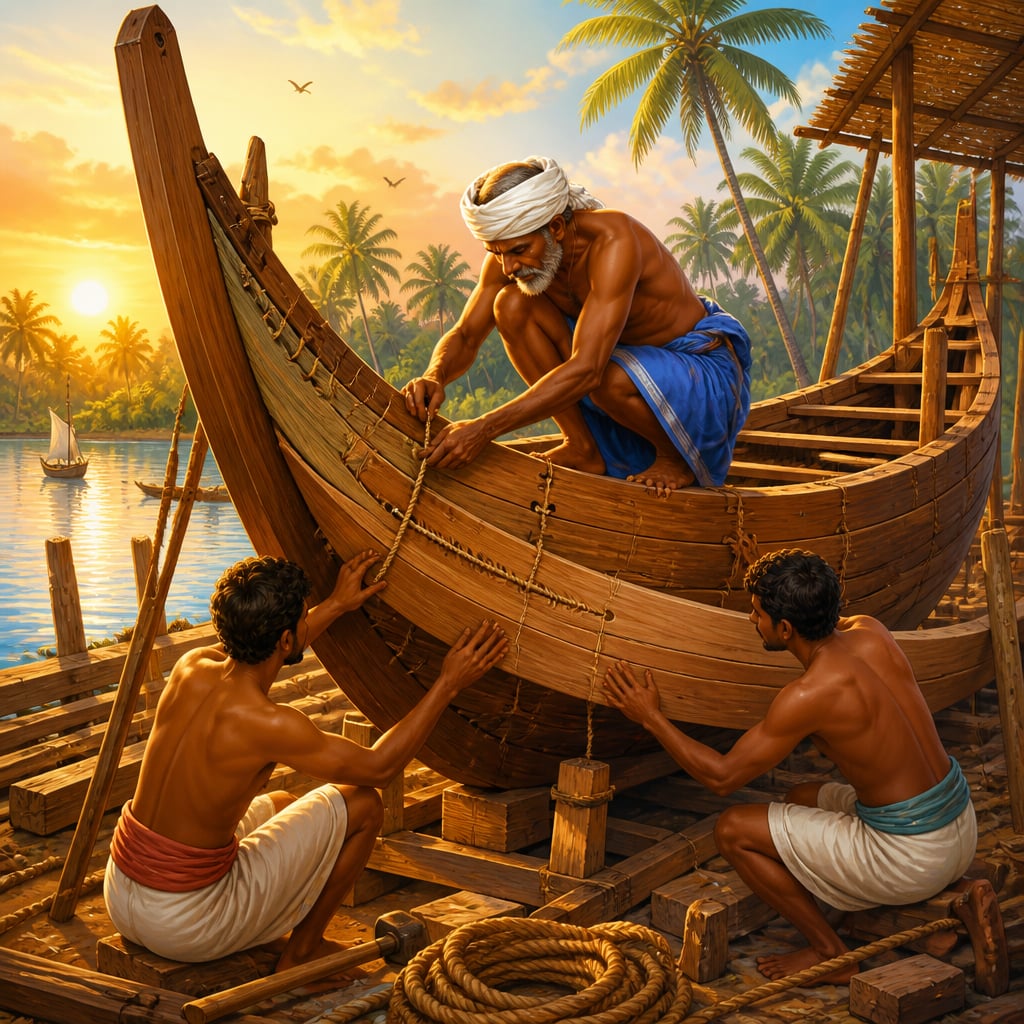
This is the stitched boat tradition, one of India's distinctive contributions to maritime technology. While Mediterranean shipbuilders fastened planks with mortise-and-tenon joints and metal nails, Indian builders developed a parallel tradition using fiber bindings. The technique spread across the Indian Ocean, from East Africa to Southeast Asia, creating a maritime world connected by ships that shared design principles.
Indian maritime history stretches back to the Indus Valley civilization, which built the world's first known tidal dock at Lothal around 2400 BCE. For the next four millennia, Indian ships would carry cotton, spices, and ideas across the ocean that bears India's name, making the subcontinent a hub of global trade long before Europeans rounded the Cape of Good Hope.
The Stitched Boat Tradition
Why stitch boats rather than nail them? The answer lies in the Indian Ocean's unique conditions and the properties of available materials.
Flexibility: Stitched hulls flex under stress. When a wave lifts the bow and drops the stern, a nailed hull develops rigid stress points that can crack over time. A stitched hull bends, distributing stress throughout the structure. In the choppy monsoon seas of the Indian Ocean, this flexibility proved advantageous.
Impact Absorption: When stitched boats ground on coral reefs or sandbars, common in shallow coastal waters, they can deform and spring back. Nailed boats in the same situation often suffer broken planks.
Repairability: A damaged stitched boat can be repaired by re-stitching. No special materials are needed, any strong fiber will do. Sailors could repair boats far from shipyards using locally available materials.
Material Availability: India lacked the long, straight timber that European boatbuilding preferred. The shorter, curved pieces available from Indian forests were actually well-suited to stitched construction, where flexibility mattered more than rigidity.
The construction process involved:
Plank Preparation: Planks were shaped from suitable timber, teak, mango, jackfruit, or sal depending on the region.
Hole Drilling: Holes were drilled at regular intervals along plank edges, angled to receive the stitching.
Stitching: Coir (coconut fiber) rope was threaded through the holes in overlapping patterns, pulling planks tightly together.
Caulking: The seams were sealed with a mixture of fish oil, lime, and resin, forming a waterproof compound that remained flexible.
Ribbing: Internal frames (phaḍā) were added after the hull was stitched, providing structural support.
This shell-first construction (building the outer hull before the internal framework) contrasts with European skeleton-first methods, representing fundamentally different approaches to the same engineering problem.
Lothal: The First Tidal Dock

The Indus Valley city of Lothal in Gujarat housed the world's oldest known dockyard, a rectangular basin measuring 218 meters long and 37 meters wide, with walls standing 4 meters high. Built around 2400 BCE, this dock connected to an ancient channel of the Sabarmati River, providing access to the Gulf of Khambhat and the open sea.
The engineering challenges were significant:
Tidal Management: The Gulf of Khambhat has dramatic tidal ranges, water levels can vary by 10 meters between high and low tide. A simple harbor would leave ships stranded on mud twice daily. Lothal's dock maintained water levels through sluice gates, allowing ships to remain afloat regardless of external tide conditions.
Siltation Prevention: River-connected harbors accumulate sediment. Lothal's spillway system channeled overflow water to carry silt away, keeping the dock navigable.
Loading Facilities: Warehouse structures adjacent to the dock stored goods awaiting shipment. The remains suggest organized trade operations with designated storage areas.
Archaeological finds at Lothal include seals from Mesopotamia, indicating trade connections across the Arabian Sea. Bead-making workshops at the site produced goods for export. The dock served a commercial hub, not merely a fishing village.
Lothal's decline around 1900 BCE likely resulted from changes in river courses, the same climate shifts that affected the broader Indus civilization. The dock silted up when its channel to the sea was cut off. But for perhaps 500 years, it demonstrated that planned maritime infrastructure could support international trade.
The Yuktikalpataru: A Shipbuilding Manual

King Bhoja of Dhara (1010-1055 CE) compiled the Yuktikalpataru, one of history's most detailed pre-modern shipbuilding texts. The text describes ship types, construction methods, materials, and ritual ceremonies for launching, a comprehensive manual for the medieval Indian shipwright.
Bhoja classifies ships by size and function:
Sāmānya (ordinary boats): Small vessels for river and coastal use.
Viśeṣa (special boats): Larger vessels for sea voyages, subdivided by purpose, trade, war, passenger transport, or royal use.
The text specifies ideal proportions:
- Length should be 3 to 10 times the beam (width)
- Depth should be proportional to intended cargo
- Draft (underwater depth) should allow passage over expected shallows
Timber selection receives detailed attention:
Teak (sāla): The premier shipbuilding timber, resistant to rot, marine borers, and warping. Teak forests of the Western Ghats supplied shipyards across the Indian Ocean.
Mango (āmra): Suitable for planking, readily available.
Coconut (nārikela): Used for masts and spars where flexibility mattered.
Sal (sāla): Strong and durable, used for keels and frames.
The Yuktikalpataru also describes decorations, auspicious symbols, and the ceremonies required before a ship's first voyage, integrating technical knowledge with cultural practice.
Regional Boat Traditions
India's long coastline and diverse river systems generated multiple distinct boatbuilding traditions:
Kerala (Malabar Coast): The uru tradition produced large sewn boats capable of oceanic voyages. Beypore shipyards near Kozhikode built ships for Arabian traders for centuries. The kettuvallam (houseboat) represents the domestic river adaptation of the same construction principles.
Gujarat: The kotia and baghla were sailing ships built for the Arabian Sea trade. Gujarat's boat-builders incorporated Arab influences while maintaining indigenous construction methods. The dhow tradition of the Persian Gulf shares design elements with Gujarati vessels.
Bengal: The Ganges delta required boats adapted to river conditions, shallow draft, maneuverable, capable of handling both river currents and tidal bores. The patela and dinghi served these needs.
Coromandel (East Coast): The masula boat used stitched construction adapted for surf landings on the harborless coast. These boats were deliberately flexible, riding over breaking waves that would destroy rigid vessels.
Odisha: The nauka tradition built boats for both fishing and coastal trade. Annual festivals still celebrate boat-building, maintaining cultural memory of maritime heritage.
Each tradition developed solutions suited to local conditions, materials, waters, trading patterns, and cultural preferences.
Indian Ocean Trade Networks
Indian ships didn't merely sail, they connected civilizations. From at least the 3rd century BCE, Indian merchants operated trading networks reaching from East Africa to Southeast Asia. This "Indian Ocean World" represented the largest interconnected economic zone before the modern era.
Westward Trade: Indian ships carried cotton textiles, spices, gems, and ironwork to the Arabian Peninsula, Persia, and East Africa. They returned with gold, ivory, incense, and Arabian horses. Roman-era hoards of Roman coins found in South India attest to the scale of this trade.
Eastward Trade: Indian merchants colonized trading posts across Southeast Asia, bringing Hindu-Buddhist culture along with commerce. The Indianized kingdoms of Srivijaya, Angkor, and Majapahit emerged from these connections. Indian textiles, beads, and metalwork traveled to Indonesia, Malaysia, and beyond.
The Monsoon Rhythm: Indian Ocean navigation depended on monsoon winds. Ships sailed southwest from India to Arabia and Africa during the summer (southwest) monsoon, returning with the winter (northeast) monsoon. This seasonal rhythm shaped trading patterns and settlement locations.
Navigational Knowledge: Indian navigators developed sophisticated wayfinding techniques. The maṅgalasūtra (magnetic compass) appears in Indian texts by the 4th century CE, earlier than clear European references. Star navigation, wave reading, and bird observation supplemented compass use.
Colonial Disruption and Legacy
Portuguese arrival in 1498 began the disruption of Indian maritime traditions. European powers sought to monopolize Indian Ocean trade, viewing indigenous shipping as competition to be eliminated.
The Portuguese bombardment of Calicut (1500) and subsequent attacks on Indian shipping established a pattern of maritime violence. Later, British East India Company regulations restricted Indian shipbuilding and trading rights, favoring British vessels for international trade.
Despite these pressures, traditional boatbuilding survived in niches. Fishing communities maintained their craft traditions. Coastal trade continued in indigenous vessels where European ships were impractical. The uru tradition of Beypore survived into the 21st century, building wooden ships for Arabian clients.
Today, traditional boatbuilding faces economic rather than political pressures. Fiberglass and steel have replaced wood for most commercial purposes. But scattered communities maintain traditional skills, fishing boats on the Kerala coast, ceremonial vessels for festivals, and occasional commissions from Gulf states seeking authentic wooden dhows.
Lessons for Modern Maritime Design
Traditional Indian boatbuilding offers insights relevant to contemporary challenges:
Flexible Design: The stitched boat's flexibility inspired modern composite hull designs that use fiber-reinforced materials to achieve similar stress distribution.
Local Materials: Traditional builders used locally available materials sustainably. Modern "green shipbuilding" movements emphasize similar principles, reducing transported materials, using renewable resources.
Repair Over Replace: The repairability of traditional boats contrasts with modern vessels designed for replacement rather than repair. Sustainability concerns are driving renewed interest in designs that facilitate maintenance.
Appropriate Technology: Traditional boats were adapted to specific conditions, hull shapes for local waters, rigs for local winds, materials for local forests. This place-specific design philosophy offers alternatives to one-size-fits-all global shipping.
Key figures
Bhoja of Dhara
1010-1055 CE
Kanhoji Angre
1669-1729 CE
Hippalus
c. 1st century BCE
Case studies
Lothal: Engineering a Tidal Harbor
[2400-1900 BCE] The Gulf of Khambhat presents extreme tidal challenges - 10-meter tidal ranges that would strand ships twice daily in a simple harbor. Yet Lothal's dock maintained navigable water levels regardless of external tides. Sluice gates controlled water flow; a spillway managed overflow. The system worked for five centuries until river course changes cut off its connection to the sea.
Lothal's dock required understanding of tidal patterns, sediment dynamics, and hydraulic engineering. The design anticipated problems - siltation, tidal variation, flood risk - and incorporated solutions. The lock principle (controlling water levels through gates) anticipates modern canal locks by over four millennia.
Modern port engineering faces similar challenges. The Thames Barrier protects London from tidal surges using principles not fundamentally different from Lothal's - controlling water levels through engineered barriers.
Infrastructure requires understanding the full system - not just the structure itself but its environment. Lothal worked because its builders understood tides, rivers, and sediment as an integrated system.
Modern coastal engineering still struggles with tidal extremes. The Thames Barrier in London and the MOSE system in Venice address the same challenge Lothal's engineers faced: managing large tidal ranges to protect infrastructure. Understanding the full environmental system, not just the structure, remains the key to effective design.
Ancient Indian stepwells (vav) could store millions of liters of water, serving communities for centuries without mechanical pumps.
Why Stitched Boats Survived Where Nailed Boats Failed
[Throughout History] When Portuguese carracks and galleons arrived in Indian waters, their nailed construction was considered superior - stronger, faster, more imposing. Yet for shallow coastal waters, reef navigation, and surf landings, local stitched boats outperformed European vessels. The masula boats of the Coromandel coast landed through surf that wrecked European longboats.
Stitched construction wasn't 'primitive' - it was adapted. Where flexibility mattered more than rigidity, where repair materials needed to be universally available, where local conditions differed from European waters, stitched boats excelled. The Portuguese eventually commissioned stitched boats for specific purposes.
Modern debates about 'appropriate technology' echo this lesson. High-tech solutions aren't always best for local conditions. The principles of stitched boats - flexibility, local materials, repairability - inform sustainable design movements.
Technology superiority is context-dependent. The 'best' design depends on conditions, requirements, and constraints. Adaptation to local conditions often outperforms imported 'superior' technology.
Context-dependent design choices appear throughout modern technology. SUVs outperform sports cars off-road. Satellite internet beats fiber optic in remote areas. 'Superior' technology is always superior for a specific set of conditions. Stitched boats winning in shallow waters illustrates a universal design principle.
Ancient Indian stepwells (vav) could store millions of liters of water, serving communities for centuries without mechanical pumps.
Beypore: Where Traditional Shipbuilding Survives
The town of Beypore near Kozhikode, Kerala, has built wooden ships for Arabian traders for over a thousand years. Even today, skilled craftsmen construct 'uru' boats using traditional methods - hand-hewn teak, stitched and doweled construction, minimal machinery. Gulf Arab clients commission these vessels for traditional dhow racing and heritage preservation.
Beypore survives because it occupies a niche - luxury heritage vessels rather than commercial shipping. The skills persist because there's demand, however limited. The transition from necessity to heritage parallels other traditional crafts.
Many traditional technologies survive through similar transitions - from utility to heritage, from necessity to luxury. The challenge is maintaining enough activity to transmit skills across generations.
Traditional knowledge survives when it finds new purposes. Beypore's shift from commercial shipbuilding to heritage craft preserved skills that would otherwise have vanished.
Traditional craft industries worldwide are finding survival niches in luxury, heritage, and tourism markets. Scottish whisky distilleries, Swiss watchmakers, and Japanese pottery workshops all preserve traditional methods by finding customers who value craft over mass production. The economic model that sustains Beypore's shipbuilders applies broadly.
Ancient Indian stepwells (vav) could store millions of liters of water, serving communities for centuries without mechanical pumps.
Historical context
Indian Maritime History (2500 BCE - 19th century CE)
Living traditions
Traditional Indian boatbuilding has largely given way to modern materials and methods, but its legacy persists. The stitched boat principle, flexibility through connected segments rather than rigid structure, influences modern composite design. The Beypore shipyards maintain traditional skills for heritage vessels. And across India's coasts and rivers, fishing communities continue using evolved versions of traditional designs, maintaining practical knowledge even as the cultural context fades.
- Lothal Archaeological Site: The remains of the world's oldest known dock, with visible basin outlines, warehouse foundations, and an excellent on-site museum explaining Indus maritime trade.
- Beypore Shipyards: One of the last places where traditional wooden ship construction continues. Skilled craftsmen build uru boats using methods largely unchanged for centuries.
- Maritime Heritage Complex: India is developing a major maritime heritage museum at Lothal, scheduled to become one of the world's largest maritime museums.
- Alappuzha (Alleppey) Backwaters: Traditional kettuvallam houseboats ply the Kerala backwaters. These stitched-plank vessels are direct descendants of ancient boat-building traditions.
Reflection
- Indian stitched boats prioritized flexibility and repairability; European nailed boats prioritized strength and speed. Neither was objectively 'better', they reflected different priorities. How do we decide what to optimize for in design?
- The Portuguese and British deliberately destroyed Indian maritime traditions to eliminate competition. What responsibilities do powerful actors have toward technologies and traditions they displace?
- Beypore survives by building luxury heritage vessels rather than commercial ships. Is transformation from utility to heritage a preservation of tradition or its death?