Vāpi: Stepwells as Water Engineering Marvels

Rani ki Vav, Chand Baori, temperature regulation and water storage rediscovered

Explore the engineering marvels of stepwells like Rani ki Vav, Chand Baori, and Adalaj Vav, their temperature regulation, water storage, and how modern rainwater harvesting is rediscovering these principles.

Vāpi: Stepwells as Water Engineering Marvels

Descend into Rani ki Vav in Patan, Gujarat, and you enter another world. The temperature drops noticeably, as much as 6°C cooler than the surface. The air is humid, scented with the mineral coolness of deep earth. Seven storeys of carved galleries step down around you, each level revealing more intricate sculptures of gods, celestial beings, and everyday life. At the bottom, 30 meters below the surface, you reach the water, stored in the aquifer, naturally filtered, cool even in the fiercest summer.
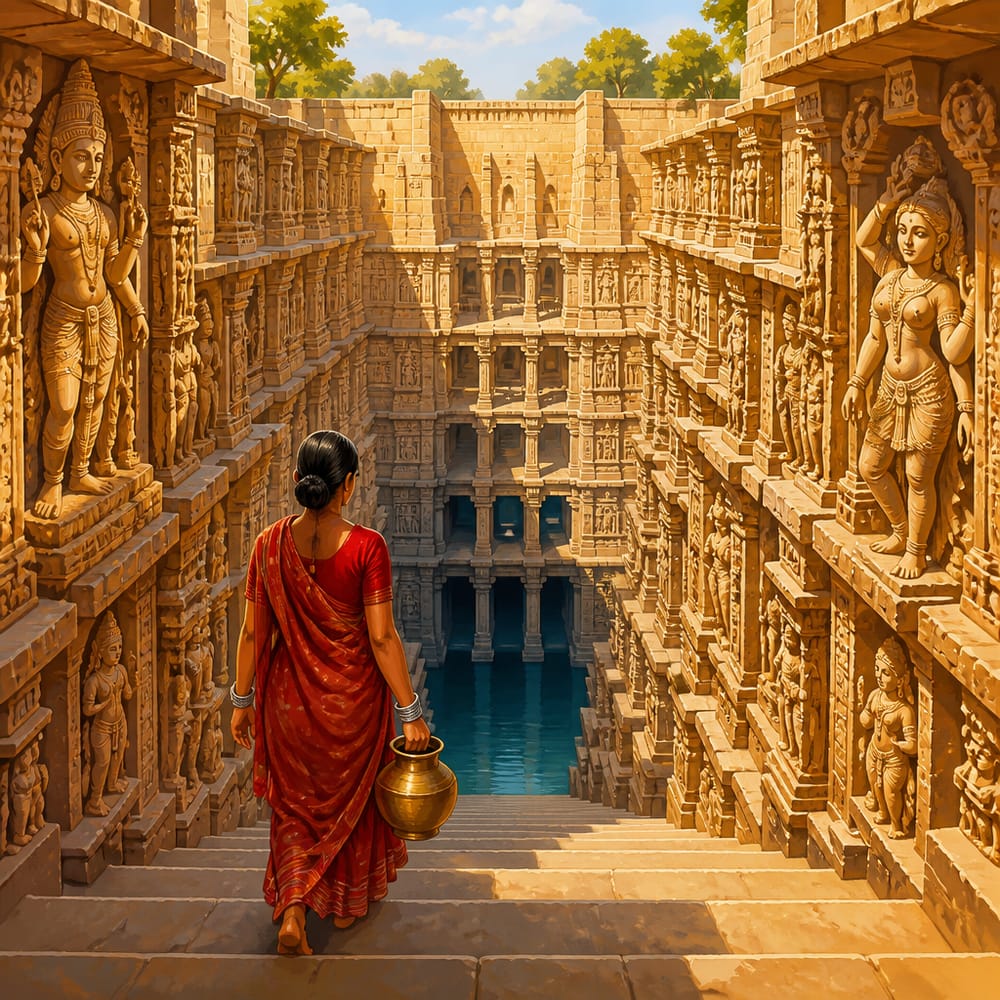
Rani ki Vav stepwell

This is not merely a well. This is a vāv, a vāpi, a bāoli, what English inadequately translates as "stepwell." For over a thousand years, these structures served as water sources, community gathering spaces, refuge from heat, and temples to the sacred nature of water itself.

India has over 3,000 known stepwells, ranging from simple utilitarian structures to architectural masterpieces rivaling any cathedral. They represent one of humanity's most sophisticated responses to water scarcity, and as modern India confronts groundwater depletion, their principles are being rediscovered.

Why Stepwells?

The Indian subcontinent's water challenge is not total rainfall, most regions receive adequate monsoon precipitation. The challenge is timing. Three to four months of intense rain, followed by eight to nine months of drought. Water falls abundantly but must be captured, stored, and accessed throughout the dry season.

Ordinary wells presented problems. As the dry season progressed and water tables dropped, wells became difficult to access. Hauling water from increasing depths required more energy, animal or human. And as water levels fluctuated seasonally, the effort required varied unpredictably.

Stepwells solved this elegantly. By building stairs down to the water, people could walk to whatever level the water had reached. No ropes, no pulleys, no animals required for basic household needs. As water levels rose during monsoon, the stairs became a cascade of reflecting pools. As levels dropped, more steps became accessible, but water remained reachable.

The Anatomy of a Stepwell

Stepwells share common structural elements, though their execution varies from simple to spectacular:

The Vertical Shaft (Kūpa): The actual well, dug deep into the water table. This cylindrical shaft accessed groundwater and served as the stepwell's water reservoir.

The Stepped Corridor (Sopāna): Stairs descending from the surface to the water level. These might be simple straight flights or elaborate zigzagging passages with multiple levels and landings.

The Galleries (Mandapa): Covered pavilions at various levels, providing shade, rest areas, and often richly decorated with sculptures and carvings.

The Entrance Pavilion: At ground level, often the most ornate section, marking the transition from the profane surface world to the sacred depths.

The engineering challenge was substantial. Excavating 20-30 meters into the earth, stabilizing walls against collapse, waterproofing structures against seepage, and designing drainage to prevent flooding during monsoons, all required sophisticated understanding of geology, hydrology, and structural engineering.

Rani ki Vav: The Queen of Stepwells

Rani ki Vav in Patan, Gujarat, represents the stepwell tradition at its most magnificent. Built around 1063 CE by Queen Udayamati to commemorate her husband Bhimdev I, it was designed as an inverted temple, a sacred space that descended into the earth rather than rising toward heaven.

The structure spans 64 meters in length, 20 meters in width, and descends over 27 meters to water level. Seven storeys of ornate galleries feature more than 500 principal sculptures and over a thousand minor figures, depicting Vishnu in his various avatars, apsaras (celestial maidens), yoginis, and scenes of everyday life.

But Rani ki Vav is not merely decorative. Its engineering demonstrates remarkable sophistication:

Structural Stability: The walls are built with interlocking stones requiring no mortar, allowing flexibility during seismic events and preventing crack propagation.

Water Management: A complex system of channels directed rainwater away from the structure while allowing groundwater infiltration.

Temperature Regulation: The deep, shaded galleries create a natural cooling system. Temperature measurements show 6°C differences between surface and water level.

Light Design: The east-west orientation maximizes morning light penetration while providing afternoon shade, practical considerations woven into sacred geometry.

For centuries, Rani ki Vav lay buried under silt from Saraswati River flooding. Its rediscovery and excavation (1958-ongoing) revealed sculptures in remarkable preservation, the mud that buried it also protected it. Today it's a UNESCO World Heritage Site (2014), featured on India's ₹100 note.

Chand Baori: Geometry Descending

The geometric stepped descent of Chand Baori

While Rani ki Vav emphasizes sculpture, Chand Baori in Abhaneri, Rajasthan, stuns through pure geometry. Thirteen storeys of 3,500 narrow steps create a hypnotic pattern descending 20 meters to water level. The visual effect is vertiginous, a cubist staircase seemingly designed by M.C. Escher.

Built around 800 CE during the reign of King Chanda of the Nikumbh dynasty, Chand Baori was designed for a practical purpose that also produced aesthetic brilliance. The narrow steps conserve space, allowing maximum depth in minimum footprint. The crisscrossing pattern means that at any water level, stairs remain accessible from multiple directions.

The opposing pavilion side features carved galleries with sculptures of Ganesha, Mahishasuramardini, and other deities. This combination, utilitarian engineering meeting sacred architecture, characterizes the finest stepwells.

Chand Baori's thermal properties are remarkable. Even when summer surface temperatures exceed 45°C, the bottom levels remain comfortable. Before air conditioning, this made stepwells valuable as community cooling centers during the hottest months.

Adalaj Vav: Where Cultures Meet

The octagonal pillared landing at Adalaj Vav

Adalaj Vav near Ahmedabad demonstrates how stepwell architecture evolved across cultural boundaries. Originally commissioned by Hindu queen Rudabai in 1499, it was completed after the Islamic conquest of Gujarat under Sultan Mahmud Begada.

The result is a unique synthesis. The five-storey structure incorporates Hindu sculptural traditions, images of gods, goddesses, and protective figures, alongside Islamic geometric patterns and calligraphy. Octagonal platforms combine Hindu mandala geometry with Islamic eight-pointed star motifs.

Ami Khumbor (water pots) carvings on the walls represent the eternal nature of water and life. The Kalpa Vriksha (wish-fulfilling tree) appears repeatedly, a Hindu symbol adopted into Islamic decorative vocabulary.

Adalaj demonstrates that stepwells were not static traditions but evolving responses to changing social and political contexts. The engineering principles remained constant; the cultural expression adapted.

The Science of Passive Cooling

Stepwells functioned as pre-modern air conditioners through multiple mechanisms:

Geothermal Stability: Ground temperature below 3-4 meters remains relatively constant year-round (approximately 25°C in most of India). The deep stepwell structure accesses this thermal stability.

Evaporative Cooling: Water evaporating from the well surface and wet stone walls absorbs heat from surrounding air, reducing temperature.

Stack Effect: Hot air rises out of the open top while cooler, denser air from below replaces it, creating natural ventilation without mechanical assistance.

Thermal Mass: Massive stone construction absorbs heat during the day and releases it slowly at night, moderating temperature swings.

Shading: The stepped design ensures that lower levels remain shaded even when the sun is overhead, preventing direct solar heating.

Measurements at various stepwells show temperature differentials of 5-8°C between surface and water level. In regions where summer temperatures routinely exceed 45°C, this made stepwells refuges of life-saving coolness.

The Social Architecture of Water

Stepwells were never merely functional infrastructure. They served as nodes of community life:

Women's Spaces: In societies where women's public movement was constrained, stepwells provided legitimate destinations. Women could gather, socialize, and share news while collecting water, the stepwell as water cooler and social media of its era.

Sacred Sites: Many stepwells incorporated temples or shrines. Bathing before worship was ritual purification. The descent into the earth mirrored spiritual journeys, moving from the mundane surface world toward waters emerging from the underworld.

Caravan Stops: Stepwells along trade routes offered travelers water, shade, and rest. The merchant communities that funded many stepwells gained spiritual merit and practical goodwill.

Festival Venues: Seasonal festivals brought communities to stepwells for ritual bathing, celebration, and social bonding.

This multiplicity of functions meant that stepwells received sustained community investment over centuries. They weren't merely government projects but expressions of collective identity and piety.

Regional Variations Across India

Gujarat: The most elaborate sculptural tradition, with Rani ki Vav and Adalaj representing the high points. Gujarati stepwells often feature multiple galleries and extensive carved decoration.

Rajasthan: Geometric designs predominate, as at Chand Baori. The arid climate made stepwells essential for survival, and they were built throughout the region, from royal palaces to small villages.

Karnataka: The Kalyani tradition features rectangular tanks with stepped sides and often incorporates small temples. The Pushkarni at Hampi demonstrates this southern variant.

Maharashtra: The Bawdi tradition often features simpler construction but clever engineering, with some wells having multiple wells connected underground.

Delhi and North India: The Baoli tradition flourished under the Delhi Sultanate and Mughals. Agrasen ki Baoli in Delhi, though its origins are debated, represents this northern tradition, functional design with Islamic architectural elements.

Decline and Rediscovery

The British introduction of piped water systems in the 19th century began the stepwells' decline. When water could be delivered to homes through pipes, the daily pilgrimage to the stepwell lost its necessity. Stepwells were seen as unhygienic, potential disease vectors rather than engineering marvels.

Many were filled with garbage. Others were buried, built over, or simply forgotten. The social functions that stepwells served were replaced by other institutions. Within generations, stepwells went from community centers to archaeological curiosities.

But the 21st century has brought reassessment. As groundwater tables plummet across India, some cities have seen levels drop 20-30 meters in decades, the wisdom of water harvesting systems becomes newly relevant.

Organizations across India are now documenting, restoring, and reviving stepwells:

Documentation: Groups like INTACH (Indian National Trust for Art and Cultural Heritage) are mapping India's stepwell heritage before structures are lost.

Restoration: Major stepwells like Rani ki Vav and Chand Baori receive government protection and restoration funding.

Revival: Some communities are cleaning out filled stepwells and reconnecting them to groundwater systems, discovering they still function.

Inspiration: Modern architects incorporate stepwell principles into new buildings, using thermal mass, natural ventilation, and rainwater harvesting informed by traditional designs.

Lessons for Modern Water Management

The stepwell tradition offers principles relevant to contemporary challenges:

Harvest Before Crisis: Stepwells captured water during abundance for use during scarcity. Modern water management often waits for crisis before acting.

Multi-functional Infrastructure: Stepwells combined water storage, cooling, social gathering, and sacred space. Modern infrastructure often serves single purposes inefficiently.

Passive Systems: Stepwells required no external energy for cooling or water delivery. As climate change increases cooling demands, passive approaches become valuable.

Community Ownership: Stepwells were maintained by communities who used them. When water became government-piped, community responsibility dissolved, contributing to infrastructure neglect.

Aesthetic Function: Stepwells were beautiful. People cared for them because they valued them aesthetically and spiritually, not just functionally. Modern infrastructure, often ugly, commands little affection.

Key figures

Queen Udayamati

c. 1022-1063 CE

Queen Rudabai

c. 1499 CE

King Chanda of Nikumbh Dynasty

c. 800-900 CE

Case studies

Rani ki Vav: Natural Air Conditioning

[1063 CE - Present] Patan in Gujarat experiences summer temperatures exceeding 45°C. Yet measurements inside Rani ki Vav show temperatures of 38-39°C at the deepest galleries - a 6-7°C differential achieved without any mechanical systems. The stepwell provided refuge during heat waves for nearly a millennium.

The cooling effect combines multiple mechanisms: geothermal stability (constant ground temperature), evaporative cooling (water and wet stone), stack effect ventilation (hot air rises, cool air sinks), thermal mass (stone absorbs and slowly releases heat), and strategic shading (east-west orientation). These weren't accidental but designed features.

Modern 'passive house' designs incorporate similar principles - thermal mass, natural ventilation, earth coupling. The Pearl Academy in Jaipur explicitly draws on stepwell principles, achieving comfortable temperatures with minimal air conditioning.

Passive cooling through intelligent design can achieve significant temperature reduction without energy consumption. Ancient builders understood and applied these principles systematically.

Passive cooling strategies are experiencing a renaissance as buildings account for 40% of global energy consumption. Techniques like earth-air heat exchangers, thermal mass construction, and evaporative cooling draw directly on principles that stepwell builders mastered centuries ago, now rebranded as 'green building design.'

Ancient Indian stepwells (vav) could store millions of liters of water, serving communities for centuries without mechanical pumps.

Panna Meena Baori: From Garbage Dump to Tourist Attraction

Panna Meena ka Kund in Amer, Rajasthan, had been used as a garbage dump for decades. Its magnificent crisscrossing staircases were buried under refuse. In the 2000s, local activists and the government collaborated to clean and restore the structure. Today it's a popular tourist destination, featured in films and social media.

The revival demonstrates that stepwells can transition from forgotten infrastructure to cultural assets. Tourism provides economic incentive for maintenance, while social media creates visibility that protects against neglect. However, the stepwell no longer functions for water - it's a monument rather than infrastructure.

Similar transformations have occurred with industrial heritage worldwide - factories becoming museums, warehouses becoming lofts. The question is whether we can go beyond preservation to restoration of original function.

Cultural heritage can be preserved through new uses, but the shift from functional to decorative represents both opportunity and loss. True revival would restore water harvesting function alongside aesthetic appreciation.

Heritage tourism drives economic revival for historical sites worldwide, but risks reducing functional infrastructure to photo opportunities. The challenge facing stepwell restoration mirrors debates about industrial heritage sites: should old factories become museums, or should they find new productive uses?

Ancient Indian stepwells (vav) could store millions of liters of water, serving communities for centuries without mechanical pumps.

Bangalore's Lost Wells: A Cautionary Tale

Bangalore once had over 1,000 wells and tanks providing water and groundwater recharge. During rapid urbanization from 1970-2010, most were filled, built over, or contaminated. Today, Bangalore faces severe water crisis - tanker water, depleted aquifers, and seasonal shortages. The city now spends billions pumping water from 100+ kilometers away.

Bangalore's transformation illustrates the cost of abandoning traditional water infrastructure. Wells and tanks recharged groundwater; without them, aquifers depleted. The same area that once managed water locally now imports it at enormous expense. Some citizen groups are now mapping and attempting to revive remaining structures.

Cities worldwide face similar challenges. Los Angeles is now investing in groundwater recharge after decades of paving over absorption areas. Chennai's tank restoration efforts follow devastating droughts. The lesson: preserve before you must restore.

Traditional infrastructure often provides services we don't value until they're lost. Groundwater recharge, local water storage, and flood absorption were 'free' benefits that became expensive problems when the infrastructure disappeared.

Bangalore's water crisis is projected to worsen as the city's population grows. Cities worldwide that paved over traditional water systems now spend billions on desalination plants and long-distance pipelines. Restoring and maintaining existing water harvesting infrastructure is almost always cheaper than engineering replacements from scratch.

over 1,000 - referenced in the context of Bangalore's Lost Wells: A Cautionary Tale.

Historical context

Classical to Medieval India (3rd century BCE - 19th century CE)

Living traditions

Stepwell principles increasingly influence contemporary architecture. The Pearl Academy of Fashion in Jaipur uses stepwell-inspired design to achieve passive cooling. Architects like Balkrishna Doshi incorporate water and stepped access in designs. Meanwhile, water activists advocate stepwell restoration as part of groundwater recharge strategies. The UNESCO recognition of Rani ki Vav has elevated global awareness of this uniquely Indian water heritage.

Reflection

More in Śilpa: Engineering That Built Wonders

All lessons in Śilpa: Engineering That Built Wonders · Bharatiya Vigyan: Inventions & Discoveries course