Setu: Bridge and Dam Engineering

Grand Anicut (Kallanai), 2,000 years functional

Explore the Grand Anicut (Kallanai) dam built by the Cholas that has been functional for 2,000 years, examine ancient bridge construction techniques, and study traditional hydraulic engineering.

Setu: Bridge and Dam Engineering

In the fertile delta of the Kaveri River in Tamil Nadu, there stands a dam that has been continuously functional for nearly 2,000 years. The Grand Anicut, known locally as Kallanai, "the stone dam", was built by the Chola king Karikalan around the 2nd century CE. It still diverts water to irrigate over 400,000 hectares of farmland.
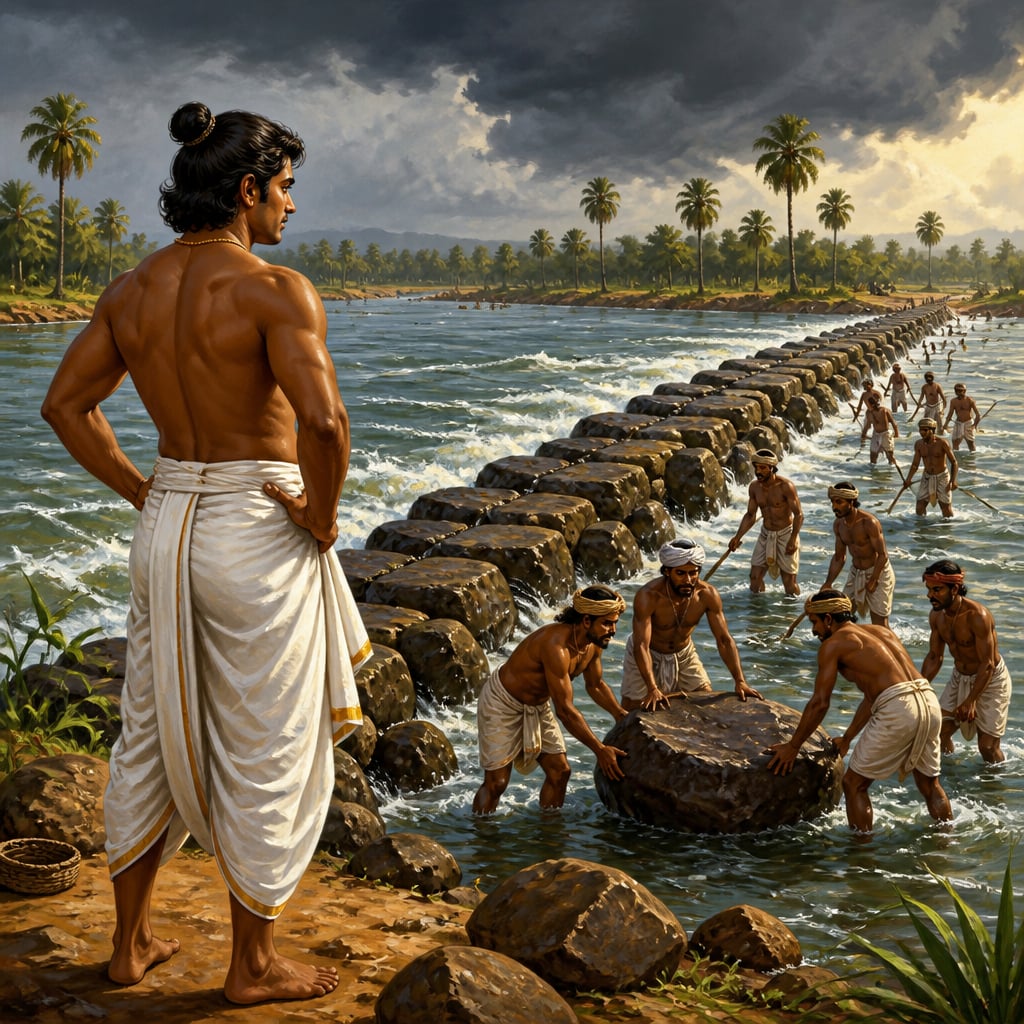
Kallanai dam on Kaveri

This is not a museum piece. This is working infrastructure, older than any bridge in Rome still carrying traffic, older than any dam in China still impounding water. Engineers have modified and strengthened it over two millennia, but the core structure, unhewn stones bound with no cement, continues to function as designed.

The Kallanai represents one end of a spectrum of Indian hydraulic engineering that ranges from simple village tanks to massive irrigation systems, from wooden plank bridges to sophisticated stone causeways. This tradition developed solutions to the Indian subcontinent's distinctive water challenges: seasonal monsoons, unpredictable rivers, and the need to store water for agriculture through long dry seasons.

The Grand Anicut: Engineering for Millennia

The Kallanai spans the Kaveri River near Tiruchirappalli, stretching 329 meters in length, 20 meters in width, and standing 5.4 meters high. Its purpose is not to store water, the Kaveri's flow is too powerful for that, but to raise the water level enough to divert flow into irrigation channels.

This is an "anicut" (from Tamil anaik kattu, "elephant dam"), a type of dam designed for diversion rather than storage. The raised water level feeds into canals that carry water to agricultural lands on both banks. The system irrigates the Thanjavur delta, historically known as the "rice bowl of Tamil Nadu."

The engineering principles are elegant:

No Mortar Construction: The dam is built from unhewn stones without cement or mortar. Water pressure forces the stones together; the structure strengthens under load rather than weakening.

Overflow Design: Unlike modern dams that must prevent overtopping, the Kallanai is designed for water to flow over it constantly. The broad, flat top dissipates energy from the flowing water, reducing erosive force.

Flexible Foundation: The dam rests on a bed of boulders rather than being anchored to bedrock. This allows slight movement during floods, distributing stress rather than concentrating it.

Sloped Upstream Face: The angled upstream face directs water force downward into the foundation rather than horizontally against the dam face.

Curved Alignment: The dam curves slightly upstream, like an arch turned on its side. This distributes lateral water pressure into the river banks.

These principles were so effective that when British engineers surveyed the Kallanai in the 19th century, they found it structurally sound after 1,700 years of continuous operation. Sir Arthur Cotton, who designed major irrigation works in South India, called it "the finest ancient structure I have ever seen."

Karikala Chola: The Builder King

Karikala Chola, who ruled in the 2nd century CE, is credited with building the Kallanai. Tamil Sangam literature celebrates him as a great warrior and administrator, but his most lasting legacy is this dam.

The name "Karikala" itself may derive from kari (charcoal) + kāl (leg), referring to a legend that his leg was burned in a fire during his youth. But he built a legacy in stone and water that has outlasted all military conquests.

Sangam poems describe the dam's construction:

"Karikala who made the water of the Kaveri Flow through channels to reach the sea, Who made the floods serve the fields..."

The construction required moving and placing thousands of tons of stone without modern equipment. The labor force likely included war captives (a common practice in ancient construction projects), coordinated by skilled engineers who understood river hydraulics.

The Science of Anicuts

The anicut principle, raising water level for diversion rather than creating storage, is ideally suited to monsoon rivers. These rivers have huge seasonal variation in flow: the Kaveri can carry 100 times more water during monsoon peak than during dry season. Building storage dams across such rivers requires enormous structures; building diversion anicuts requires understanding of hydraulics but not massive construction.

Anicut engineering involves several key calculations:

Crest Level: The dam height must raise water enough to flow into canals but not so much that normal floods overtop the banks.

Spillway Capacity: The dam must pass flood waters without damage. The Kallanai's broad, flat crest acts as an extended spillway.

Sluice Design: Controlled openings allow water volume into canals to be regulated based on agricultural needs.

Sediment Management: Rivers carry silt; structures must either pass sediment through or be designed for periodic clearing.

The Cholas and their successors built numerous anicuts across South India, creating integrated irrigation networks. The Thanjavur delta alone had over 15,000 tanks and channels fed by Kaveri diversions, a managed water system comparable in complexity to any ancient civilization.

Bridge Building: From Boats to Stone

India's rivers presented formidable bridge-building challenges. The Ganges, Brahmaputra, Indus, and their tributaries could be kilometers wide during floods. Seasonal variation meant structures had to survive both drought (when foundations were exposed) and monsoon (when waters rose meters in days).

Early solutions were pragmatic:

Boat Bridges: Boats lashed together with planks across them could span wide rivers quickly. The Arthaśāstra describes boat bridges as standard military equipment. Some permanent boat bridges served for centuries, the Delhi boat bridge across the Yamuna functioned from Mughal times until the 19th century.

Seasonal Bridges: In many locations, bridges were built for the dry season and deliberately dismantled or allowed to wash away before monsoon. The cost of rebuilding annually was less than building a permanent structure strong enough to survive floods.

Raised Causeways: Where rivers spread wide but shallow during monsoon, raised stone causeways allowed crossing even when submerged. Water flowed over and around them; their mass resisted displacement.

The Bridges of Vijayanagara

Vijayanagara bridge piers in the Tungabhadra river at Hampi

The ruins at Hampi, capital of the Vijayanagara Empire (14th-17th centuries), preserve remarkable bridge engineering. The Tungabhadra River flows through the site, and multiple bridge remains show sophisticated construction.

The most impressive is the "King's Balance" bridge near the royal center, not a complete bridge but abutments and piers showing the scale of planned construction. Stone piers were set into the riverbed using cofferdams (temporary enclosures pumped dry for construction). The spans between piers would have been wood or stone slabs.

Vijayanagara engineers also built the Talrigatta Gate and associated hydraulic works that channeled river water for the capital's needs. Channels, sluices, and tanks created an urban water supply system serving a city of perhaps 500,000 people.

The Pamban Bridge: Traditional Meets Modern

The narrow strait between mainland India and Rameswaram island presented a unique challenge. The Pamban Channel's strong currents and cyclone exposure made bridging difficult. For centuries, pilgrims crossed by boat.

In 1914, the British completed the Pamban Bridge, India's first sea bridge. But the engineering solution drew on observations of traditional construction: the bridge included a movable section (a bascule span) that could open to allow ships through, and the foundations used the same principle as ancient anicuts, mass and weight to resist current rather than rigid anchoring.

The bridge was damaged by the 1964 cyclone and rebuilt. A new road bridge parallels it today. But the challenge of bridging sea channels, first confronted at Pamban, anticipated the engineering questions now being asked about bridges to Sri Lanka or across the Palk Strait.

The Ram Setu Debate

Between India and Sri Lanka lies a chain of limestone shoals called Adam's Bridge or Ram Setu. Hindu tradition holds this is the remains of the bridge built by Lord Rama's army to reach Lanka, as described in the Ramayana.

Geological surveys show the shoals are natural formations, limestone ridges on a submarine ridge between the two landmasses. However, satellite imagery revealing their linear arrangement sparked renewed interest.

The scientific consensus is that the formation is natural, shaped by sea-level changes and sedimentation. The "bridge" appearance results from the underlying geology. However, some scholars note that the shoals could have served as natural stepping stones, supplemented by human construction, allowing ancient crossing, neither purely natural nor wholly artificial.

The debate matters less for engineering history than for demonstrating how traditional narratives preserve memory of geographical features. Whether Ram Setu was a constructed bridge, a natural causeway modified for crossing, or purely mythological, the story reflects awareness that the India-Lanka gap was once narrower and potentially crossable.

Tank Systems: Distributed Water Storage

A South Indian tank cascade stepping down a hillside

While large dams capture attention, India's most significant hydraulic engineering may be the humble village tank. The "tank", a reservoir created by building an earthen bund across a drainage line, captures and stores rainwater for irrigation and drinking.

Tank systems reached remarkable sophistication in South India:

Cascade Systems: Tanks were arranged in chains, with overflow from upper tanks feeding lower ones. This maximized water capture across watersheds.

Groundwater Recharge: Tank storage raised local water tables, feeding wells in surrounding villages. Even when tanks dried up, the recharged groundwater provided water.

Silt Fertilizer: Tanks collected silt from catchment areas. This silt, periodically removed, served as rich fertilizer for fields. The "tank bed" cultivation after water drew down produced exceptional crops.

Fish and Fodder: Tanks supported fish populations (protein for villages) and growth of water plants used as animal fodder. Multiple outputs from single infrastructure.

The Vijayanagara empire maintained records of over 50,000 tanks in its territory. The tank system of the Thanjavur delta comprised over 15,000 interconnected water bodies. This was hydraulic engineering at landscape scale.

Colonial Transformation and Modern Challenges

British colonial rule transformed Indian hydraulic engineering in contradictory ways. On one hand, engineers like Arthur Cotton built major irrigation works that expanded agricultural production. Cotton's anicuts on the Godavari and Krishna rivers extended Chola engineering principles to new regions.

On the other hand, colonial administrative changes disrupted traditional tank maintenance systems. Tanks had been maintained through village-level institutions with defined responsibilities and benefits. Colonial centralization broke these systems, and many tanks fell into disrepair.

Post-independence, large dam construction became a national priority, what Nehru called "temples of modern India." Major dams like Bhakra-Nangal, Hirakud, and Nagarjuna Sagar represented modernization and national capability.

But large dams also brought problems: displacement of populations, siltation reducing storage capacity, downstream ecological impacts, and concentration of benefits among large landowners. Some critics argue that traditional distributed systems, anicuts, tanks, and channels, were more equitable and sustainable, if less impressive.

Today, both approaches continue. Large dams provide hydropower and bulk water storage. But there's renewed interest in tank restoration, check dams, and local water harvesting, traditional engineering for contemporary water scarcity.

Key figures

Karikala Chola

c. 2nd century CE

Sir Arthur Cotton

1803-1899 CE

Krishnadevaraya

1471-1529 CE

Case studies

Grand Anicut: 2,000 Years of Continuous Service

[2nd century CE - Present] The Kallanai has been in continuous operation for nearly 2,000 years. It has survived floods, earthquakes, political upheavals, and the rise and fall of multiple empires. Engineers from the Cholas, Pandyas, Delhi Sultanate, Nayaks, British, and Indian Republic have all maintained it. Today it still irrigates over 400,000 hectares.

The dam's longevity stems from design principles: loose stone construction that flexes rather than cracks, overflow design that prevents destructive overtopping, and a shape that converts water pressure into stabilizing force. Each generation of engineers understood and maintained these principles.

Modern infrastructure is often designed for 50-100 year lifespans. The Kallanai suggests that longer-term thinking - building for centuries rather than decades - is possible when design prioritizes resilience over optimization.

Infrastructure designed for resilience can outlast any political system. The Kallanai's builders couldn't have imagined the Chola dynasty would fall, but they built for the river's timescale, not human politics.

Infrastructure longevity is a growing concern as modern dams, bridges, and tunnels age. The American Society of Civil Engineers rates US infrastructure a C-minus. The Kallanai's 2,000-year operational life challenges modern engineers to design for centuries rather than decades, prioritizing resilience over initial cost savings.

2,000 years - referenced in the context of Grand Anicut: 2,000 Years of Continuous Service.

The Thanjavur Tank Cascade: Landscape-Scale Water Management

[2nd-19th century CE] The Thanjavur delta contained over 15,000 interconnected tanks fed by the Kaveri and its distributaries. Tanks were arranged in cascades - overflow from upper tanks fed lower tanks, maximizing capture across the landscape. The system supported one of the densest agricultural populations in pre-modern Asia.

The cascade system represented distributed infrastructure - no single point of failure, maintenance responsibility spread across villages, and redundancy built in. If one tank failed, others compensated. The system evolved over centuries through incremental addition and modification.

Modern distributed systems - the internet, renewable energy microgrids, distributed computing - echo these principles. Resilience comes from redundancy and interconnection, not from individual component strength.

Distributed systems can achieve resilience impossible for centralized infrastructure. The tank cascade was built over centuries by countless communities, yet functioned as an integrated system.

Distributed computing networks, microgrids for electricity, and mesh communication networks all apply the same resilience principle. Systems with many small, interconnected nodes survive individual failures far better than centralized systems. The tank cascade's architecture maps directly onto modern distributed systems engineering.

over 15,000 - referenced in the context of The Thanjavur Tank Cascade: Landscape-Scale Water Management.

Bhakra Dam: Modern Temples or Flawed Monuments?

Bhakra Dam (1963) on the Sutlej River was India's highest dam at completion. Nehru called such dams 'temples of modern India.' Bhakra provides hydropower and irrigation to Punjab and Haryana. But it also displaced 30,000+ people, submerged forests, and accumulates silt reducing its effective storage annually.

Large dams represent a philosophy different from traditional hydraulics. Where anicuts and tanks worked with rivers, large dams attempt to control them. Benefits concentrate (electricity, irrigation water for commercial farming) while costs disperse (displacement, downstream ecological impacts). The tradeoffs were understood late.

Today's debates about large infrastructure (highways, airports, power plants) echo these tensions. The question isn't whether to build, but who benefits, who bears costs, and whether distributed alternatives exist.

Scale changes the nature of infrastructure. Traditional small-scale hydraulics distributed costs and benefits widely; large-scale projects concentrate both, creating winners and losers rather than shared public goods.

Large dam projects continue to generate controversy worldwide. The Three Gorges Dam displaced 1.3 million people. Ethiopia's Grand Renaissance Dam created diplomatic tensions with Egypt and Sudan. The tradeoff between concentrated power generation and distributed community impact remains one of infrastructure planning's most contentious debates.

Ancient Indian stepwells (vav) could store millions of liters of water, serving communities for centuries without mechanical pumps.

Historical context

Ancient to Modern India (2nd century CE - Present)

Living traditions

The Kallanai's principles continue to inform Indian water engineering. Arthur Cotton's 19th-century works applied anicut design with new materials. Today, 'check dams' and 'nala bunds' for watershed development use similar principles at smaller scales. The tank restoration movement seeks to revive traditional distributed storage. And the debate between large centralized dams and distributed alternatives continues, with the Kallanai standing as evidence that sometimes the old ways work best.

Reflection

More in Śilpa: Engineering That Built Wonders

All lessons in Śilpa: Engineering That Built Wonders · Bharatiya Vigyan: Inventions & Discoveries course