Yasada: World's First Zinc Distillation
Zawar mines, industrial-scale production 600 years before Europe
Explore the Zawar mines in Rajasthan where industrial-scale zinc distillation occurred from the 12th century, the unique downward distillation technique, and how Europe only learned this in the 18th century.
Yasada: World's First Zinc Distillation
In the Aravalli hills of Rajasthan, about 40 kilometers south of Udaipur, lies a mining complex that rewrites the history of chemistry. The Zawar mines produced metallic zinc on an industrial scale from at least the 12th century CE, roughly 600 years before European metallurgists figured out how to do it.
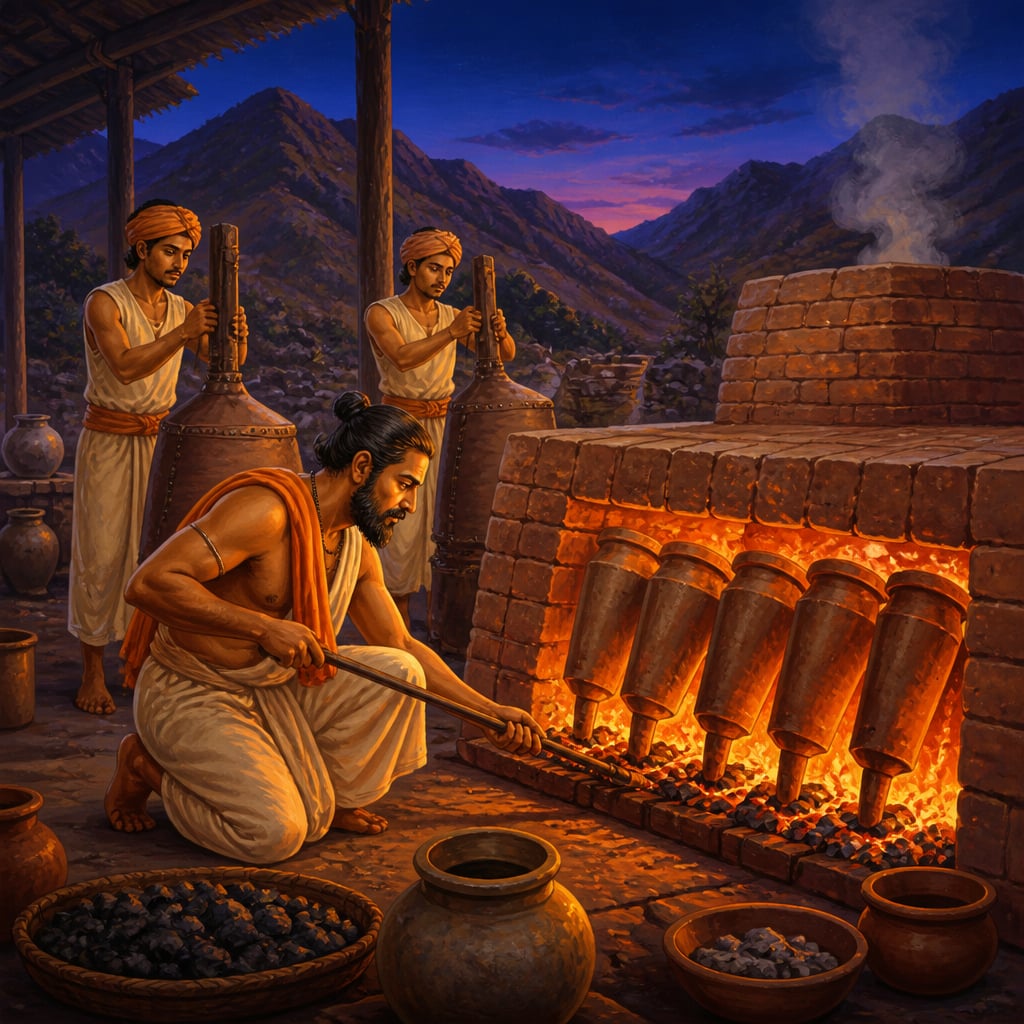
This wasn't a small operation. Archaeological excavations have revealed the remains of over 150,000 retorts (distillation vessels), millions of tons of slag, and extensive underground mine workings. At its peak, Zawar was producing zinc in quantities that wouldn't be matched in Europe until the Industrial Revolution.
The achievement was more than just early, it was technically sophisticated. Zinc presented a problem that defeated metallurgists for centuries: it vaporizes before it melts. Heat zinc ore, and the metal turns to vapor and escapes. The Zawar metallurgists solved this problem with an elegant innovation: downward distillation. Their solution anticipates principles that modern chemistry would only formalize centuries later.
The Problem with Zinc
Zinc is unusual among metals. Most metals can be smelted by heating their ores with charcoal, the metal melts, the impurities float off as slag, and you pour out liquid metal. This is how copper, iron, tin, and lead have been extracted since antiquity.
Zinc refuses to cooperate. Its boiling point (907°C) is lower than the temperature needed to reduce zinc oxide to metal (around 1000°C). By the time you've extracted zinc from its ore, it's already a vapor. Heat zinc ore in an open furnace, and the zinc simply disappears into the air, or immediately reoxidizes back to zinc oxide.
European metallurgists tried for centuries to produce zinc. They knew the metal existed, it appeared as a crust on copper smelting furnaces when zinc-bearing ores were used. They knew brass (copper-zinc alloy) and could make it by heating copper with zinc ore. But isolating pure zinc eluded them until 1746, when Andreas Marggraf in Germany finally succeeded.
The Zawar metallurgists had solved the problem 600 years earlier.
The Downward Distillation Breakthrough

The key insight at Zawar was counterintuitive: instead of trying to collect zinc vapor rising upward, they distilled it downward. The process worked like this:
The Retorts: Workers made small ceramic vessels called muflas (retorts), each about 25-30 cm long with a narrow neck. These were made from local clay mixed with rice husks, which burned out during firing to leave a porous, heat-resistant ceramic.
The Charge: Each retort was filled with a mixture of roasted zinc ore (zinc oxide, ZnO) and charcoal or other carbonaceous material. This charge was packed tightly.
The Furnace: Multiple retorts were arranged in banks within a furnace, with their narrow necks pointing downward into a collecting chamber. The retorts' bodies were surrounded by burning fuel.
The Chemistry: At high temperatures, the carbon reduced zinc oxide to zinc vapor:
ZnO + C → Zn(vapor) + CO
The zinc vapor, being heavier than air, traveled downward through the narrow necks into the cooler collecting chamber below, where it condensed to liquid metal.
The Collection: Liquid zinc collected in pots below the retort banks. Periodically, workers would tap off the accumulated metal.
This downward distillation was the crucial innovation. By making zinc vapor travel downward into a cooler zone, the Zawar metallurgists prevented reoxidation. The carbon monoxide gas produced by the reaction helped maintain a reducing atmosphere.
Archaeological Evidence
The Zawar complex has been extensively studied since the 1980s, particularly by teams from IIT Delhi and the British Museum. The evidence is overwhelming:
Retort Fragments: Over 150,000 retort fragments have been recovered. Analysis shows zinc metal residues on inner surfaces and the characteristic neck geometry for downward distillation.
Slag Heaps: Millions of tons of slag (the waste material from smelting) cover the site. Chemical analysis confirms zinc extraction processes.
Mine Workings: Extensive underground mining galleries, some extending hundreds of meters, exploited zinc-lead ore deposits. The scale indicates organized industrial operation.
Radiocarbon Dating: Organic materials (charcoal, rice husks in ceramics) date the major production period to 1100-1500 CE, with evidence of earlier experimental phases.
Production Estimates: Based on slag volumes, archaeologists estimate Zawar produced several thousand tonnes of zinc over its operational lifetime, an industrial scale of production.
The Mewar Connection
Zawar lay within the territory of Mewar, ruled by the Sisodia Rajputs from their capital at Chittorgarh and later Udaipur. The mining industry operated under royal patronage:
Royal Revenue: Zinc production generated significant revenue for Mewar rulers. Mining rights and metal taxes appear in historical records.
Military Application: Zinc was essential for making brass, which was used for cannons, decorative work, and religious objects. Control of zinc supplies gave Mewar strategic importance.
Trade Networks: Zawar zinc entered trade networks extending across India and potentially beyond. Brass-making centers in Gujarat, Maharashtra, and North India depended on zinc supplies.
The industry's decline in the 16th-17th centuries coincided with Mughal pressure on Mewar and the general disruption of regional economies. Production continued at reduced levels into the 18th century but never recovered its earlier scale.
The European Rediscovery
European metallurgists were aware of Indian zinc. In the 16th century, Portuguese traders brought zinc to Europe, calling it tutanaga (from the Hindi tutenag). But Europeans couldn't figure out how to make it.
The problem attracted serious scientific attention:
Johann Kunckel (1679) described zinc as a "semi-metal" that couldn't be produced in Europe.
Georg Stahl (1702) discussed zinc's peculiar behavior but couldn't produce it reliably.
Isaac Lawson (1738) described the Indian process based on travelers' accounts but couldn't replicate it.

Finally, Andreas Marggraf (1746) succeeded in producing zinc by heating zinc ore with charcoal in closed retorts, essentially reinventing what Zawar had done six centuries earlier. He didn't use downward distillation (his retorts were horizontal), but he solved the fundamental problem of preventing reoxidation.
Commercial European zinc production began in the 1740s in Bristol, England, and expanded rapidly. By the 19th century, European production had far surpassed what Zawar had achieved, but the Indian priority was clear.
Brass and Beyond: Why Zinc Mattered
Why did anyone need zinc? The primary answer is brass.
Brass (copper-zinc alloy) was valuable for multiple reasons:
Workability: Brass is easier to cast and machine than bronze. It flows well in molds and takes fine detail.
Appearance: Brass's golden color made it popular for decorative objects, religious items, and prestigious goods.
Corrosion Resistance: Brass resists seawater corrosion better than iron, making it valuable for ship fittings.
Musical Instruments: Brass's acoustic properties made it essential for horns, bells, and other instruments.
Before Zawar's innovation, brass was made by the "cementation" process: heating copper with zinc ore (calamine) and charcoal. Zinc vapor from the reduced ore dissolved into the copper. This worked but was inefficient and produced brass of variable composition.
Pure zinc allowed metallurgists to make brass by direct alloying, melting copper and adding precise amounts of zinc. This produced superior, consistent brass and made possible alloys with specific properties.
The Chemistry of Understanding
The Zawar metallurgists didn't have modern chemical theory. They didn't know about oxidation and reduction, vapor pressure, or the periodic table. Yet their process embodies sophisticated chemical principles:
Reduction: The carbon-zinc oxide reaction is a textbook reduction reaction. The Zawar smiths had empirically optimized conditions for this reaction.
Vapor Pressure: Zinc's low boiling point (relative to other metals) was a problem they solved by controlling where condensation occurred. They understood vapor behavior without having the concept of "vapor pressure."
Reducing Atmosphere: The carbon monoxide produced by the reaction prevented reoxidation of zinc vapor, a self-sustaining protective atmosphere.
Heat Transfer: The retort geometry (narrow necks for vapor exit, broad bodies for heating) optimized heat transfer while allowing vapor collection.
Modern chemical engineers, analyzing the Zawar process, find it remarkably well-designed. The empirical optimization achieved by generations of Indian metallurgists converged on solutions that chemical theory would later explain.
The Decline and Its Lessons
Zawar's zinc industry declined for reasons that echo the wootz story:
Political Disruption: Mughal campaigns against Mewar in the 16th-17th centuries disrupted the region. Mining operations were vulnerable to political instability.
Resource Depletion: After centuries of mining, the richest ore deposits were exhausted. Deeper mining became more difficult and expensive.
Deforestation: Zinc smelting required enormous quantities of charcoal. Local forests were depleted over centuries of operation.
Competition: European zinc production, once established, grew rapidly. Industrial-scale European zinc eventually dominated markets.
By the late 18th century, Zawar was a shadow of its former self. British colonial surveys noted the abandoned workings with curiosity but little understanding of what had been achieved there.
Modern Recognition
Zawar's significance was only fully recognized in the late 20th century:
1983-84: Teams from IIT Delhi began systematic archaeological investigation.
1990s: British Museum collaboration brought international attention.
2000s: Detailed publications established Zawar's priority in zinc distillation.
Today, Hindustan Zinc Limited (a Vedanta Resources subsidiary) operates modern mines in the Zawar region, continuing a metallurgical tradition that spans over a millennium. The ancient workings are being developed as a heritage site, though much remains to be excavated and documented.
A Note on Nomenclature
The Sanskrit term yasada (यसद) for zinc appears in texts from at least the 11th century. The word's etymology is uncertain, but it may relate to yaj (to sacrifice, worship), perhaps reflecting zinc's use in brass religious objects.
Interestingly, the English word "zinc" may derive from German Zinke (prong, spike), referring to the pointed shape of condensed zinc crystals. The metal's names in different languages reflect independent discoveries and the complex history of metallurgical knowledge.
Key figures
The Metallurgists of Zawar
12th-17th Century CE
Andreas Sigismund Marggraf
1709-1782 CE
Paul T. Craddock
Contemporary
Case studies
The Retort Makers: Industrial Organization at Zawar
[14th Century CE] You are a potter in a village near Zawar, specialized in making distillation retorts. Each retort must be made from the right clay mixture (local clay plus rice husks), formed to precise dimensions (broad body, narrow neck pointing at a specific angle), and fired to just the right temperature. Too fragile and it cracks during use; too thick and heat transfer suffers. You produce hundreds of retorts per season, and the smelting operations consume them constantly - each retort typically survives only a few heating cycles.
The scale of retort production at Zawar - over 150,000 fragments recovered - indicates a specialized pottery industry supporting the smelting operations. This required standardization (consistent dimensions), quality control (testing for heat resistance), and reliable supply chains (clay, rice husks, fuel for firing). The interdependence of pottery and metallurgy created an industrial ecosystem.
Semiconductor manufacturing today depends on specialized suppliers for silicon wafers, photoresists, ultra-pure gases, and precision equipment. The semiconductor itself is just the visible tip of an industrial ecosystem. Like Zawar, high-tech industries create networks of specialized supporting activities.
Major innovations rarely stand alone. Zinc distillation required advances in ceramic technology, mining, fuel supply, and market access. Industrial success requires supporting industries and infrastructure.
Modern semiconductor manufacturing depends on similarly complex supply chains: specialized chemicals, ultra-pure water, precision lithography machines, and clean rooms. TSMC's chip fabrication requires the same kind of multi-industry coordination that Zawar's zinc production demanded, just at a different technological scale.
over 150,000 - referenced in the context of The Retort Makers: Industrial Organization at Zawar.
Why Europe Couldn't Make Zinc: The Limits of Theory
[16th-18th Century CE] You are a European alchemist in 1700, trying to produce zinc. You've read travelers' accounts of Indian zinc. You understand that zinc exists in calamine ore. But when you heat the ore, you get only white powder (zinc oxide) - the zinc vapor escapes before you can collect it. You try different furnaces, different temperatures, different ores. Nothing works. The Indians clearly know something you don't, but you can't figure out what.
European metallurgists were trapped by their own assumptions. They expected metals to melt, not vaporize. They built furnaces for melting and pouring, not for condensation. The conceptual leap to downward distillation - letting zinc vapor fall rather than rise - didn't occur because it contradicted intuitions about how metals behave.
Companies today face similar challenges with 'technology transfer.' Having access to a product or even detailed specifications doesn't necessarily enable you to manufacture it. Tacit knowledge - the skills and insights that aren't written down - often makes the difference.
Knowledge doesn't transfer automatically. Indian traders brought zinc to Europe for centuries, but the production knowledge didn't travel with the product. Even knowing that something can be done doesn't tell you how to do it.
Trade secrets and tacit knowledge remain barriers to technology transfer today. Countries can buy finished products (semiconductors, jet engines) but struggle to replicate the manufacturing process without hands-on training. China's decades-long effort to build domestic chip fabrication illustrates that knowing what is possible is not the same as knowing how.
The Delhi Iron Pillar has resisted corrosion for over 1,600 years, demonstrating advanced metallurgical knowledge.
Zinc as Strategic Resource: Mewar's Military Advantage
[15th-16th Century CE] You are Rana Kumbha of Mewar, ruling one of the most militarily successful Rajput kingdoms. Your territories include the Zawar mines, the only significant source of zinc in the subcontinent. Zinc makes brass; brass makes cannons. Your foundries can produce artillery that other kingdoms struggle to match because they must import brass or use inferior bronze.
Control of strategic materials conferred military advantage long before the modern era. Mewar's zinc monopoly resembled OPEC's oil control or today's rare earth element dynamics. The kingdom's famous resistance to Mughal conquest may have been partly enabled by superior metallurgical resources.
Today, control of rare earth elements, lithium deposits, semiconductor fabrication capacity, and other strategic resources shapes international relations. China's dominance in rare earth processing, like Mewar's zinc monopoly, creates dependencies and vulnerabilities for other nations.
Strategic resources matter. Control of key materials can provide advantages that persist across generations. Resource geography shapes military and economic history.
Control over rare earth minerals, lithium deposits, and semiconductor-grade silicon gives modern nations strategic advantages comparable to Mewar's zinc monopoly. Resource geography still shapes geopolitics, as seen in tensions over cobalt from Congo, lithium from Chile, and chip manufacturing in Taiwan.
The Delhi Iron Pillar has resisted corrosion for over 1,600 years, demonstrating advanced metallurgical knowledge.
Historical context
Medieval Period (12th-18th Century CE)
Living traditions
Hindustan Zinc Limited, now owned by Vedanta Resources, operates large-scale zinc mines in the Zawar area, continuing a metallurgical tradition that began over 800 years ago. India remains a significant zinc producer globally. The archaeological site is increasingly recognized for heritage tourism, and efforts are underway to document and preserve the ancient workings. Modern chemical engineers study the Zawar process as an example of efficient pyrometallurgical design achieved through empirical optimization.
- Zawar Mines Archaeological Site: The ancient mining complex with extensive remains of retorts, slag heaps, and underground workings. Parts of the site are being developed for heritage tourism, though active modern mining continues in adjacent areas.
- City Palace Museum, Udaipur: The former residence of Mewar's rulers houses collections of brass and metalwork demonstrating the applications of Zawar's zinc. The palace itself features extensive brass decorative elements.
- Hindustan Zinc Visitors' Center: The modern mining company operating in the region has developed heritage displays acknowledging the area's metallurgical history alongside exhibits on contemporary zinc production.
Reflection
- The Zawar metallurgists solved a problem that defeated European chemists for centuries. What does this suggest about the relationship between practical knowledge and formal scientific training?
- Indian zinc was available in Europe for centuries before Europeans could produce it themselves. Why didn't the knowledge transfer along with the product? What modern parallels exist?
- Control of Zawar's zinc gave Mewar strategic advantages for centuries. What resources today play similar strategic roles, and who controls them?