Tāmra & Kaṃsa: Copper and Bronze Excellence
Lost-wax casting perfection and Chola bronze metallurgy
Explore the perfection of lost-wax (cire perdue) casting technique, the metallurgy behind Chola bronze sculptures, and alloy proportions that have lasted millennia.
Tāmra & Kaṃsa: Copper and Bronze Excellence
In the village of Swamimalai in Tamil Nadu, a tradition continues that stretches back over a thousand years. The sthapatis (master craftsmen) here still create bronze sculptures using techniques that the Chola empire perfected in the 9th-12th centuries CE. When a contemporary sculptor lights the furnace to pour molten bronze into a mold, he performs essentially the same actions as his ancestors who created the Nataraja, arguably the most iconic sculpture in Indian art history.
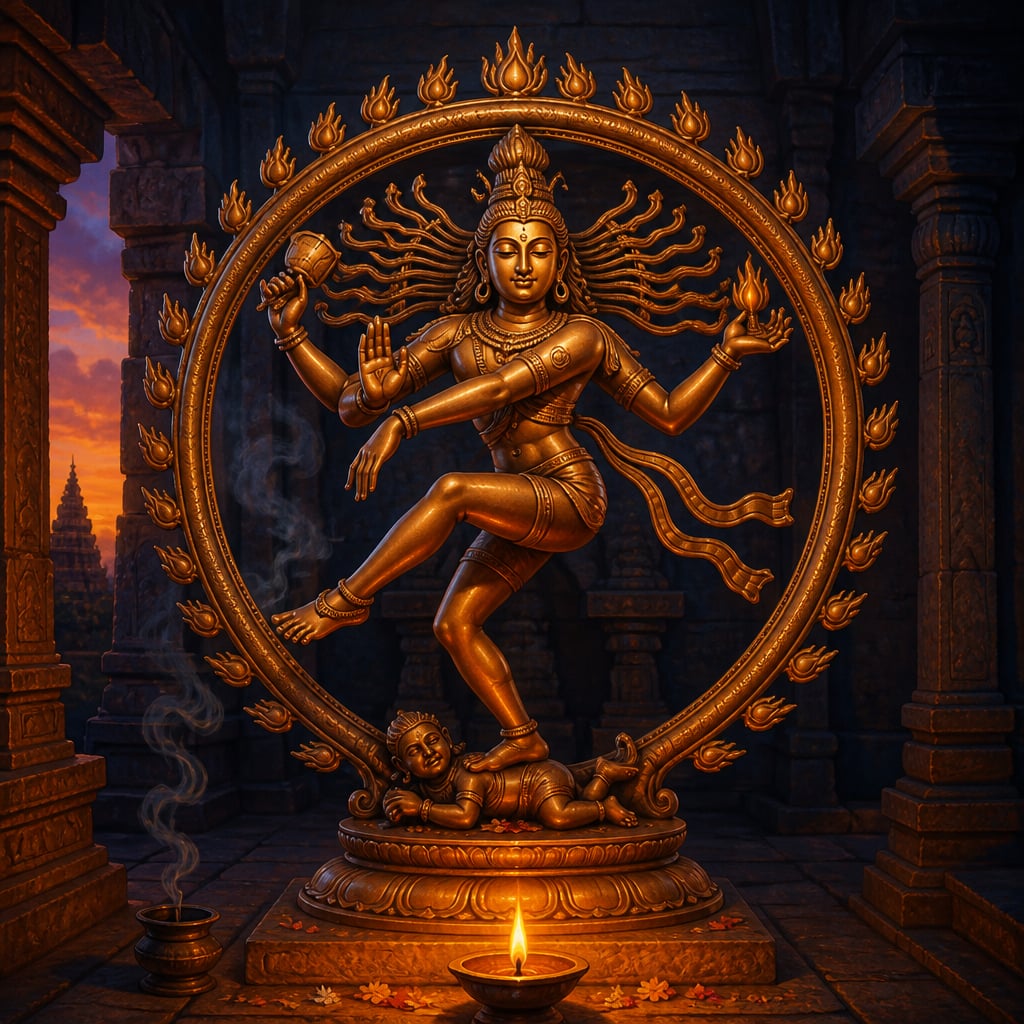
The Chola bronzes represent the pinnacle of a metallurgical tradition that had been developing in South India for over two millennia. The lost-wax casting technique (madhucchistha vidhāna), combined with precise control of alloy composition, produced sculptures of such technical perfection that they remain unsurpassed.
The Lost-Wax Miracle
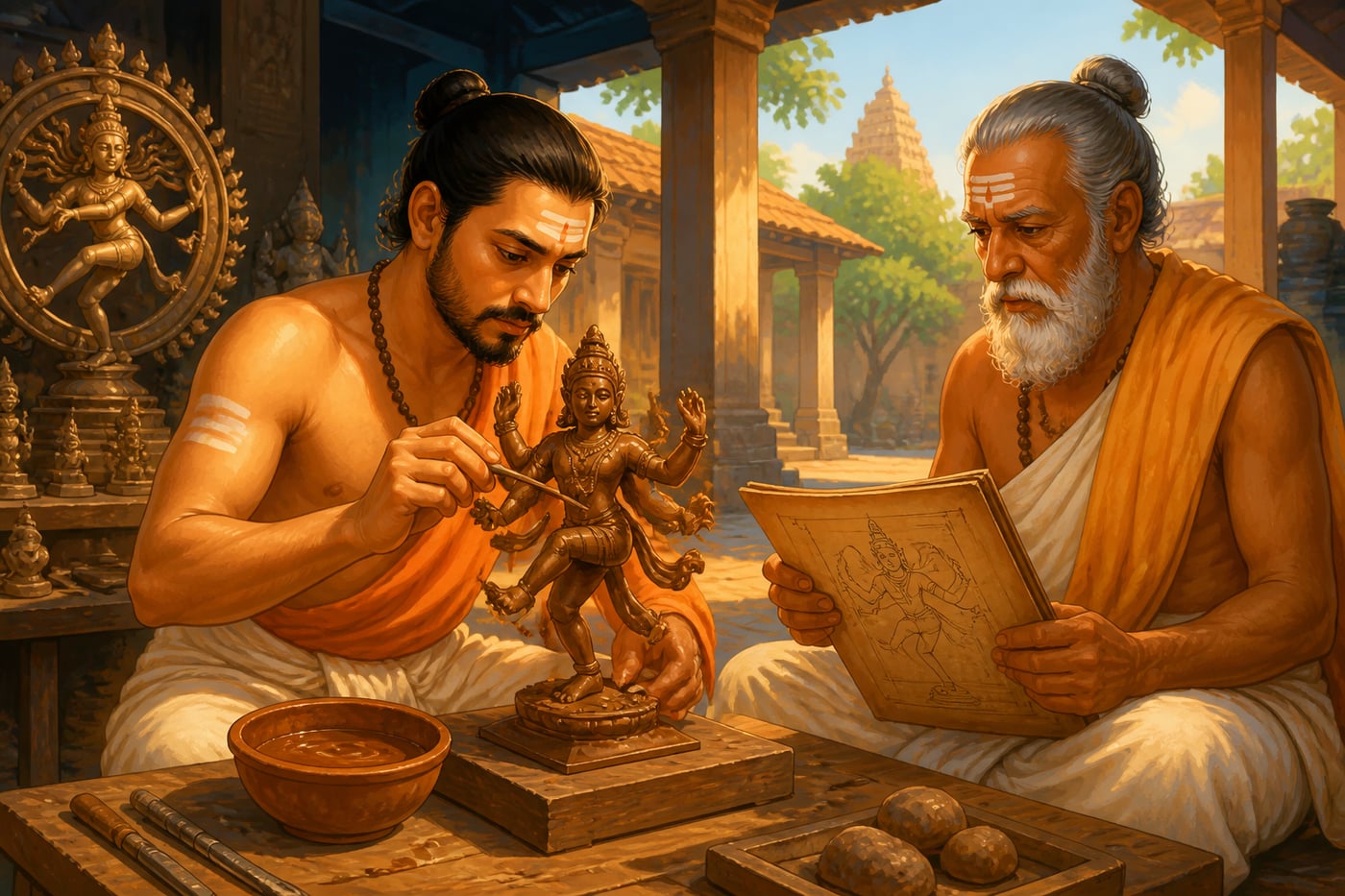
Lost-wax casting (known in French as cire perdue) is conceptually simple but demands extraordinary skill to execute well. The basic process:
1. The Wax Model: The sculptor creates a detailed model in beeswax mixed with natural resins. Every detail of the final sculpture, every fold of clothing, every strand of hair, every finger position, must be perfectly formed in wax.
2. The Core: For hollow sculptures (which use less metal and are lighter), a clay core is first formed in the rough shape of the figure. The wax is applied over this core, with the wax thickness determining the final bronze wall thickness.
3. The Mold: The wax model is coated with successive layers of fine clay, building up a thick outer mold. Channels (sprues) are created for metal to flow in and gases to escape.
4. The Burnout: The entire assembly is heated in a kiln. The wax melts and drains out (hence "lost wax"), leaving a cavity between the core and the outer mold that exactly replicates the original wax model.
5. The Pour: Molten bronze is poured into the cavity. The metal fills every detail of the space where wax once was.
6. The Reveal: After cooling, the outer mold is broken away, revealing the bronze sculpture. The core may be left inside or partially removed.
7. The Finishing: Surface imperfections are chased (refined with tools), and the sculpture is polished and sometimes gilded.
The process allows only one casting per wax model, if anything goes wrong, the wax cannot be recovered. Every successful casting destroys the original. This makes each bronze unique, even when following the same design.
Chola Bronze Mastery
The Chola dynasty (9th-13th century CE) elevated bronze casting to unprecedented heights. Their sculptures combined religious iconography with technical perfection:
Scale: Chola bronzes range from small processional images (2-3 feet) to monumental temple figures. The famous Nataraja at the Met is about 4 feet tall, casting at this scale requires sophisticated engineering.
Detail: Hair, jewelry, clothing folds, facial expressions, all rendered with extraordinary precision. The metalwork captures textures that seem impossible in cast metal.
Proportion: Chola sculptors followed śilpaśāstra (texts on proportion) but transcended mere rules to create figures of perfect grace. The tribhaṅga (triple-bend) poses feel natural despite their geometric precision.
Composition: The alloy composition of Chola bronzes is remarkably consistent: approximately 88% copper, 8-10% tin, with small amounts of lead, zinc, and other elements. This "Chola bronze" alloy flows well when molten, captures fine detail, and develops a beautiful patina over centuries.
The Nataraja: Technical Analysis
The Shiva Nataraja (Lord of Dance) represents the apex of Chola bronze achievement. Technical studies of these sculptures reveal:
Structural Engineering: The figure balances on one foot within a ring of flames, with extended arms holding attributes. This pose creates severe engineering challenges, the center of gravity must align with the single support point, and the metal must be distributed to prevent stress fractures.
Wall Thickness: X-ray analysis shows carefully controlled wall thickness, thicker in load-bearing areas, thinner in decorative elements. This wasn't guesswork but planned engineering.
Alloy Precision: The copper-tin ratio (around 88:10) places the alloy in the optimal zone for casting: fluid enough to capture detail, strong enough to support the structure, and workable for post-casting refinement.
Joint-Free Casting: Most Nataraja figures are cast in a single pour, without separate pieces joined later. This requires extraordinary skill in mold design and metal flow calculation.
The Sthapati Lineages
Chola bronze-making was not anonymous craft but a hereditary profession practiced by specific families:
The Sthapatis: Master craftsmen who combined artistic vision with technical expertise. They designed sculptures following iconographic requirements while solving engineering problems.
Guild Organization: Bronze makers belonged to organized guilds with apprenticeship systems, quality standards, and trade secrets. Knowledge passed from father to son across generations.
Royal Patronage: Chola kings commissioned bronzes for major temples and ceremonies. Royal workshops had resources for the highest quality materials and could support extended training.
Living Tradition: The Swamimalai sthapatis trace their lineages back to Chola times. When India's government needed craftsmen to create bronze replicas for museums, they turned to these traditional families.
The Chemistry of Bronze
Bronze is an alloy, a mixture of metals that combines their properties. The "bronze" used for Indian sculptures is actually a family of related alloys:
Copper Base: Copper provides ductility (the ability to bend without breaking) and a reddish-gold color. Pure copper is too soft for sculpture.
Tin Addition: Tin (up to 10%) increases hardness and improves casting properties. Higher tin content makes the alloy more brittle.
Minor Elements: Small amounts of lead improve machinability (ease of chasing and finishing). Zinc, iron, and other elements may enter from ore impurities.
The Chola bronzes' consistent composition across centuries suggests standardized recipes, careful material sourcing, or both. Artisans knew which proportions produced the best results, even without modern chemistry.
Trade Networks: From Mines to Temples
The raw materials for bronze came from across the subcontinent:
Copper: Major sources included the Khetri mines in Rajasthan, deposits in Karnataka and Andhra Pradesh, and imported copper from the Malabar coast's trade networks.
Tin: India has limited tin deposits. Much tin was imported from Southeast Asia (Malaya, Thailand) or Afghanistan. This made tin expensive and motivated careful alloy control.
Beeswax: Required in large quantities for the lost-wax process. Local bee populations and wax trade supported the sculpture industry.
Clay: Specific clays with appropriate refractory properties were needed for molds and cores. The Swamimalai region's clay was particularly suitable.
The bronze industry thus connected Tamil Nadu to trading partners across Asia, making it dependent on stable trade routes.
The Sangam Tradition: Pre-Chola Foundations
Chola bronzes didn't emerge from nothing. They built on centuries of earlier development:
Sangam Period (300 BCE - 300 CE): Tamil literature mentions bronze-workers (kannan, kollan) as respected professionals. Archaeological finds confirm sophisticated metalworking.
Pallava Period (6th-9th century CE): The Pallavas, who preceded and overlapped with the early Cholas, produced excellent bronze images. Chola techniques refined Pallava innovations.
Pan-Indian Connections: Bronze casting techniques were shared across India. The Chola achievement synthesized influences from multiple traditions into a distinctive Tamil style.
Comparison: Indian vs. Other Bronze Traditions
Bronze casting developed independently in multiple civilizations. How does Indian practice compare?
Greek/Roman: Mediterranean bronze sculptures were typically assembled from separately cast pieces. The Greeks developed elaborate armatures (internal support structures). Indian techniques emphasizing single-pour casting differ fundamentally.
Chinese: Chinese bronze casting used piece-molds (multi-part reusable molds) rather than lost wax for most of their tradition. The techniques produce different textures and details.
African (Benin): West African bronzes from Benin show remarkable technical sophistication using lost-wax methods. Whether techniques developed independently or spread through trans-oceanic contact remains debated.
Indian lost-wax casting represents one of several independent developments of this technology, refined over millennia for religious sculpture.
Conservation Challenges
Chola bronzes face specific preservation challenges:
Bronze Disease: In humid environments, chloride compounds can form "bronze disease", a self-perpetuating corrosion that slowly destroys the metal. Many temple bronzes are now displayed in climate-controlled environments.
Handling Damage: Processional images were carried in festivals for centuries. Repeated handling, especially at balance points, caused wear and stress.
Theft and Dispersal: Colonialism and the international art market scattered Chola bronzes worldwide. Some of India's finest bronzes are in foreign museums, raising repatriation debates.
Restoration vs. Preservation: Should corroded bronzes be restored to "original" appearance, or should centuries of patina be preserved? Different conservation philosophies produce different approaches.
The Living Tradition: Swamimalai Today

The village of Swamimalai, about 7 km from Kumbakonam, remains India's premier center for traditional bronze casting:
Family Workshops: Several sthapati families maintain workshops where traditional techniques continue. Sons learn from fathers, maintaining lineages that claim Chola-era origins.
Government Support: The Indian government has designated Swamimalai bronzes as Geographical Indication (GI) products, protecting the traditional craft from counterfeits.
Contemporary Commissions: Temples, museums, and collectors worldwide commission Swamimalai bronzes. The craftsmen can produce both traditional religious images and contemporary artistic works.
Tourism and Education: Some workshops offer demonstrations and short courses, sharing knowledge that was once closely guarded.
The tradition's survival demonstrates that some ancient technologies are not merely of historical interest but remain economically and culturally viable.
The Spiritual Dimension
For the sthapatis, bronze casting is not merely technical work but spiritual practice:
Ritual Preparation: Major castings begin with prayers and rituals. The craftsman may fast or follow specific observances.
Iconographic Precision: The proportions of divine images follow śilpaśāstra texts precisely. An incorrect measurement doesn't just look wrong, it renders the image spiritually ineffective.
The Pour as Offering: Pouring molten metal into the mold is accompanied by prayers. The moment of transformation, liquid metal becoming solid form, has ritual significance.
Prāṇa Pratiṣṭhā: After creation, sculptures destined for worship undergo consecration ceremonies that "install" divine presence. The physical bronze becomes a vessel for the divine.
This spiritual framework motivates the extreme care that produced Chola masterpieces. Technical excellence served religious purpose.
Key figures
The Chola Sthapatis
9th-13th Century CE
Rajaraja Chola I
985-1014 CE
The Swamimalai Sthapatis
12th Century CE to Present
Case studies
Engineering the Nataraja: Solving Impossible Balance
[10th-11th Century CE] You are a Chola sthapati commissioned to cast a Nataraja - Shiva as Lord of Dance. The figure must stand on one foot within a ring of flames, with arms extended holding fire, drum, and making gestures. The pose is deliberately asymmetric, with the center of gravity far from the supporting foot. Cast this wrong, and the bronze will topple or the supporting leg will fracture under stress.
The sthapatis solved this through careful engineering: the flame ring provides additional support points; wall thickness varies to distribute weight appropriately; the raised foot connects to drapery that adds structural reinforcement. The figure appears to defy gravity through art while secretly obeying it through engineering.
Modern architects face similar challenges when designing cantilevered structures or sculptures that appear to defy physics. The Sydney Opera House's "sails" required engineering as sophisticated as the Nataraja's balance - making the impossible appear effortless.
The greatest art often hides the greatest engineering. The Nataraja's apparent lightness and movement result from precise calculation of forces and materials. Beauty and function are not opposites.
Modern engineering continues to hide complexity behind beauty. A smartphone's seamless glass surface conceals thermal management, antenna placement, and structural engineering challenges as complex as balancing a Nataraja on one foot. The best engineering makes the difficult look effortless.
The Delhi Iron Pillar has resisted corrosion for over 1,600 years, demonstrating advanced metallurgical knowledge.
The Tin Problem: When Supply Chains Span Continents
[9th-12th Century CE] You manage bronze production for a major Chola temple. You need tin for your bronze alloy, but India has almost no tin deposits. Your tin comes from Malaya, transported by sea through straits controlled by the Srivijaya kingdom. Political tensions have disrupted the trade route. You have enough tin for current projects but must plan for future uncertainty.
The Cholas' naval power (they famously raided Srivijaya in 1025 CE) was partly motivated by securing trade routes for strategic materials including tin. Military and metallurgical considerations intertwined. The bronzes we admire today required not just artistic skill but control of international supply chains.
Modern electronics manufacturing faces similar dependencies. Rare earth elements, specialized chemicals, and precision components come from specific global sources. Trade disruptions (whether from politics, pandemics, or logistics failures) can halt production of sophisticated products.
Advanced manufacturing requires advanced logistics. The Chola bronze industry depended on trade networks spanning thousands of kilometers. Disruption anywhere in the chain affected production everywhere.
Global supply chain disruptions during COVID-19 showed how dependent modern manufacturing is on far-flung inputs. A chip shortage in Taiwan halted car production in Detroit. The Chola bronze industry's dependence on Malayan tin is a 1,000-year-old version of the same vulnerability that supply chain managers face today.
1025 CE - referenced in the context of The Tin Problem: When Supply Chains Span Continents.
The Nataraja Returns: Repatriation and Cultural Heritage
In 2015, India successfully negotiated the return of a Chola Nataraja bronze from Australia's National Gallery. The sculpture had been looted from a Tamil Nadu temple in 2006 and sold through an international art dealer. The return required years of diplomatic effort, legal proceedings, and provenance research.
The Chola bronze repatriation case illustrates the global market for Indian heritage objects and the challenges of recovery. The sculptures have religious significance (they were actively worshipped), cultural significance (they represent Tamil artistic achievement), and financial value (they sell for millions at auction). These different values create different stakeholders with different interests.
Debates over the Elgin Marbles, Benin Bronzes, and other contested artifacts raise similar questions. How should heritage be protected? Who should possess it? How do colonial-era acquisitions affect modern ownership claims? The Chola bronze case offers one model for resolving such disputes.
Cultural heritage exists in complex webs of meaning. A bronze is simultaneously a religious object, an artwork, historical evidence, national heritage, and a commodity. Protecting heritage requires navigating all these dimensions.
Stolen cultural artifacts remain a billion-dollar illicit market. India's Art Recovery Initiative and international cooperation through INTERPOL work to return looted heritage. The legal and ethical frameworks for cultural property protection continue to evolve as the scale of the problem becomes clearer.
The Delhi Iron Pillar has resisted corrosion for over 1,600 years, demonstrating advanced metallurgical knowledge.
Historical context
Chola Dynasty Golden Age (9th-13th Century CE)
Living traditions
Swamimalai bronzes receive Geographical Indication (GI) protection, recognizing their traditional production methods. Contemporary sthapatis produce both religious images for temples and artistic works for collectors worldwide. The Government of India commissions Swamimalai craftsmen for state gifts and diplomatic presents. Conservation science increasingly involves traditional craftsmen in restoration projects, recognizing that their knowledge complements modern analysis. The Chola bronze tradition demonstrates that ancient technologies can remain economically viable and culturally meaningful in the modern world.
- Swamimalai Village: India's premier center for traditional bronze casting. Multiple sthapati families maintain workshops where visitors can observe the lost-wax process. Some workshops offer demonstrations and short courses.
- Thanjavur Art Gallery (Rajaraja Museum): Houses an excellent collection of Chola bronzes from temples across the region. The Brihadeshwara Temple complex nearby contains bronzes in their original ritual context.
- Government Museum, Chennai: The Bronze Gallery contains one of India's finest collections of South Indian bronzes spanning multiple centuries. Comparative study across periods illuminates how techniques developed.
- The Metropolitan Museum of Art: Houses the famous Nataraja bronze and other significant Chola pieces. The collection is controversial due to provenance concerns but offers opportunities to see masterworks.
Reflection
- The Chola bronzes served both religious and artistic purposes, they were objects of worship and aesthetic masterpieces. How does combining spiritual and aesthetic goals affect creative work differently than pursuing either alone?
- The Swamimalai sthapatis have maintained their tradition for over a thousand years. What allows some traditions to survive while others die out? What would it take to create traditions that could last similarly long?
- Many Chola bronzes are now in foreign museums. Should they be returned to India? To temples? To museums? Who has the best claim to cultural heritage, the place of origin, the place of current residence, or the international community?