Loha Śāstra: Mining and Extraction Science
Arthaśāstra's mining regulations, ore identification, and smelting
Explore Arthaśāstra's mining regulations, traditional ore identification methods, and regional smelting technologies across ancient India.
Loha Śāstra: Mining and Extraction Science
The Arthaśāstra, composed around the 3rd century BCE, contains something remarkable for its time: systematic regulations for mining operations, ore identification procedures, and quality control standards for metal production. These weren't abstract philosophical principles but practical administrative guidelines for running what we would today call a state mining enterprise.
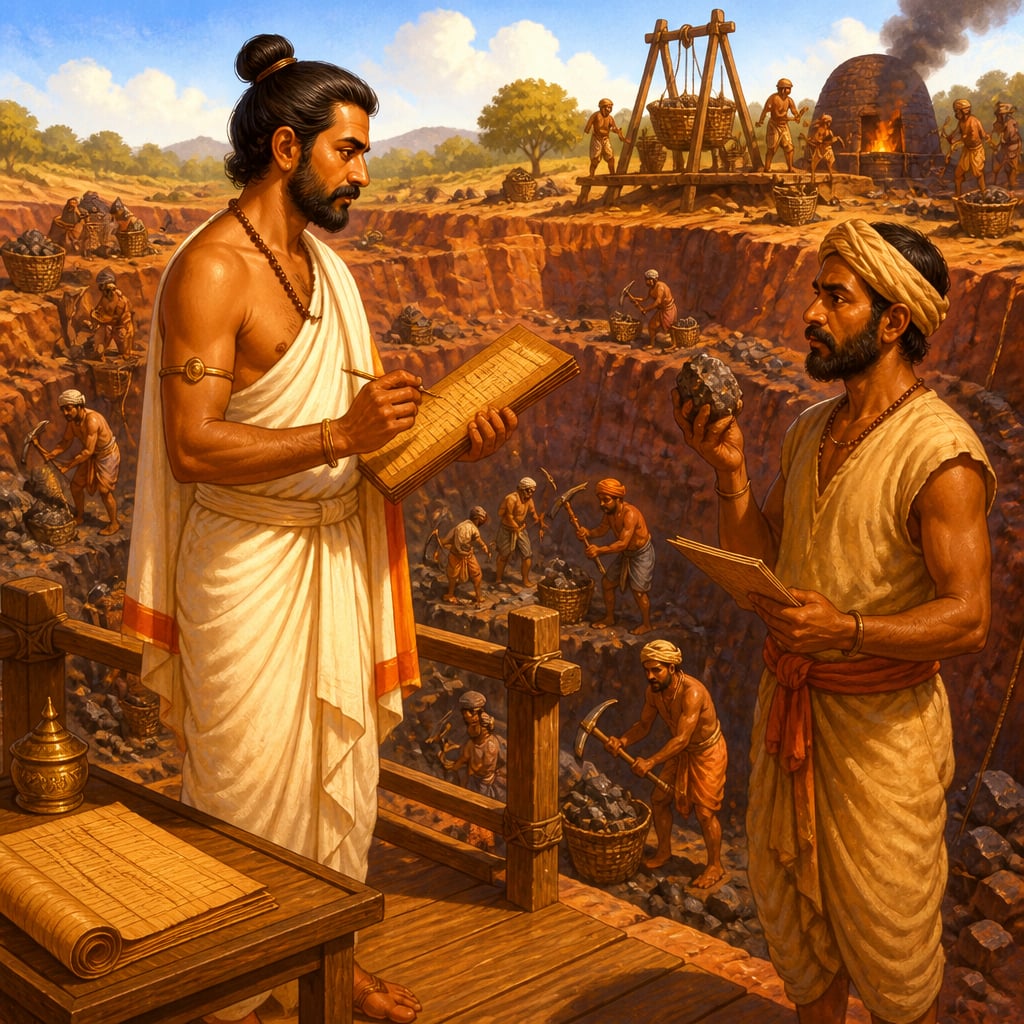
When modern archaeologists excavate ancient Indian mining sites, they find evidence consistent with these textual descriptions, organized extraction operations, slag deposits indicating specific smelting techniques, and the remains of furnaces adapted to local conditions. The Arthaśāstra provides a window into how ancient Indians thought about extracting wealth from the earth.
The Arthaśāstra Framework
Kauṭilya's Arthaśāstra dedicates substantial attention to mining (khani) and metallurgy (dhātu-śodhan). The text addresses:
Administrative Organization:
- The ākaradhyakṣa (superintendent of mines) had responsibility for exploration, extraction, and processing
- Mines were state property, with private operators working under license
- Revenue sharing between the state and operators was specified
- Quality standards and inspection procedures were mandated
Ore Identification: The text describes how to identify ore-bearing areas through surface indicators:
- Color changes in soil and rock
- Vegetation patterns (certain plants indicating specific minerals)
- Water taste and color from springs
- Animal behavior near mineral deposits
Processing Requirements:
- Specifications for furnace construction
- Fuel requirements and sources
- Flux materials for different ores
- Expected yields and quality standards
This systematic approach, combining empirical observation with administrative regulation, represents sophisticated thinking about resource extraction.
Regional Mining Traditions
India's diverse geology supported metallurgical traditions adapted to local resources:
The Deccan Plateau: The iron-ore-rich regions of Karnataka, Telangana, and northern Andhra Pradesh supported extensive iron production. The laterite soils contained readily smelted iron oxides. Communities developed specialized bloomery furnaces suited to local ore characteristics.
Rajasthan: The Aravalli range contained deposits of zinc, lead, silver, and copper. The Zawar zinc mines (discussed in Lesson 3) were part of a larger mining complex. Copper from Khetri and other sites supplied bronze-makers across northern India.
Singhbhum (Jharkhand): This region's iron and copper deposits were exploited from at least the 2nd millennium BCE. Archaeological evidence shows continuous mining activity across historical periods.
Tamil Nadu: The iron-producing regions around Salem and the crucible steel centers of Kodumanal drew on specific ore bodies suited for high-quality steel production.
Each region developed techniques optimized for local ores, fuels, and conditions. Knowledge was transmitted through practitioner communities who understood their specific resources intimately.
Ore Identification: Traditional Methods
Ancient miners couldn't analyze ores chemically, but they developed sophisticated empirical methods:
Visual Indicators:
- Ore color, luster, and crystal structure
- Weight (density) of samples
- Streak color when rubbed on rough surfaces
- Fracture patterns
Fire Testing: Heating samples and observing behavior:
- Color changes during heating
- Smoke color and odor
- Residue characteristics
- Whether samples fused, crumbled, or remained unchanged
Botanical Indicators: Certain plants were associated with specific mineral deposits:
- Vegetation patterns over ore bodies differ from surrounding areas
- Some plants accumulate specific metals, changing their appearance
- Traditional knowledge connected particular plant associations with metal-bearing areas
Water Analysis:
- Springs near mineral deposits often have distinctive taste or color
- Residue from evaporating spring water indicated dissolved minerals
- Fish and aquatic life patterns in streams
These methods, refined over generations, allowed miners to locate and evaluate deposits without modern analytical tools.
Furnace Technologies
Indian metallurgists developed various furnace designs for different purposes:

The Bloomery Furnace: The basic iron-smelting furnace, used across India with regional variations:
- A vertical shaft lined with refractory clay
- Tuyeres (air pipes) at the base, often connected to bellows
- Ore and charcoal layered within
- Produces a spongy mass of iron (bloom) mixed with slag
Bloomery furnaces couldn't achieve melting temperatures for iron but could reduce ore to workable metal. Regional variations adapted to available materials: different clay compositions, bellows designs, and shaft heights.
The Crucible Furnace: For steel and high-temperature work:
- Small, sealed clay crucibles containing the charge
- Multiple crucibles heated together in a pit furnace
- Higher temperatures achieved through forced air and careful insulation
- Used for wootz steel production and other high-carbon work
The Cupellation Furnace: For refining precious metals:
- Shallow cups (cupels) of bone ash or similar material
- Air blast to oxidize base metals
- Gold and silver remain while lead and other metals are absorbed into the cupel
The Reverberatory Furnace: For some brass-making and other processes:
- Heat reflected from a curved roof onto the charge
- Fuel separated from the material being processed
- Allowed control of atmosphere (oxidizing vs. reducing)
Fuel and Flux
Metallurgy required substantial fuel resources:
Charcoal: The primary metallurgical fuel:
- Specific woods preferred for different purposes
- Hardwoods for iron smelting (higher heat, longer burn)
- Softer woods sometimes preferred for controlled heating
- Charcoal production itself was a specialized industry
The fuel requirements of metallurgy significantly impacted forests. The Arthaśāstra mentions regulations for forest management related to metallurgical fuel needs.
Flux Materials: Substances added to assist smelting:
- Limestone (calcium carbite) to lower melting temperatures and remove impurities
- Quartz sand for some applications
- Various plant materials whose ash provided beneficial components
- Different regions developed flux recipes suited to local ores
Quality Control
The Arthaśāstra demonstrates concern with metal quality:

Testing Methods:
- Weight/density comparison with standards
- Hardness testing through cutting and bending
- Color and luster evaluation
- Sound when struck (bell metals especially)
- Behavior when heated or worked
Fraud Prevention: The text describes methods used to adulterate metals and how to detect them:
- Mixing base metals with precious ones
- Surface treatments to simulate higher quality
- Weight manipulation
Inspectors (adhyakṣas) were expected to catch such deceptions, with penalties specified for fraudulent producers.
Labor Organization
Mining and metallurgy required organized labor:
Specialist Communities: Particular communities (jātis) specialized in mining and metalworking:
- Lohakāra (ironsmiths)
- Swarṇakāra (goldsmiths)
- Tāmrakāra (coppersmiths)
- Mining communities with hereditary knowledge
Organization:
- Family-based workshops for small-scale production
- Guild structures for urban metalworkers
- State-organized operations for large mines
- Seasonal labor for fuel collection (charcoal-making)
Knowledge Transmission: Metallurgical knowledge passed through:
- Family apprenticeship (father to son)
- Guild training
- In some cases, textual instruction (though most knowledge was oral)
Environmental Impact
Ancient metallurgy left measurable environmental traces:
Deforestation: The charcoal demands of metal production cleared substantial forest areas. Archaeological evidence shows vegetation changes around major smelting centers.
Slag Deposits: Metal extraction produces slag, the waste material from smelting. Ancient slag heaps at sites like Zawar, in the iron-producing regions, and near copper smelting areas total millions of tonnes, documenting the scale of historical production.
Pollution: Heavy metal contamination around ancient mining sites remains detectable today. Lead, arsenic, and other toxic materials concentrated in soils near smelting operations.
These impacts, though less than modern industrial mining, were significant at the regional level. Some ancient mining regions show permanent ecological changes.
Trade in Raw Materials
Raw materials moved through trade networks:
Ore Trade: Not all metal was smelted where ore was mined:
- High-quality ores were sometimes transported to specialized smelting centers
- Trade routes connected ore regions to processing areas
- Some ores (especially tin) were imported from distant sources
Semi-Processed Materials:
- Iron blooms traded before final working
- Copper ingots moved to bronze-making centers
- Lead for brass-making shipped from Rajasthan
The International Dimension: Indian metals entered international trade:
- Wootz steel to Damascus and beyond
- Zinc to Europe and Asia
- Iron and copper products throughout the Indian Ocean world
Modern Archaeological Studies
Contemporary research illuminates ancient practices:
Slag Analysis: Metallurgical slag contains information about ancient processes:
- Chemical composition reveals ore types and smelting conditions
- Microscopic examination shows temperature profiles and techniques
- Isotope analysis can trace ore sources
Furnace Reconstruction: Experimental archaeology tests ancient techniques:
- Reconstructing furnaces from archaeological remains
- Running test smelts using traditional methods
- Comparing products with historical artifacts
Survey and Excavation: Systematic documentation of mining sites:
- Mapping ancient workings
- Dating activities through associated materials
- Understanding the scale and duration of operations
Key figures
Kauṭilya (in the Context of Mining)
c. 350-275 BCE
The Regional Smelting Communities
Ancient to Modern
Case studies
Running a Mauryan Mine: The ākaradhyakṣa's Challenge
[c. 3rd Century BCE] You are appointed ākaradhyakṣa (mine superintendent) for a copper-mining region under the Maurya empire. You must balance multiple demands: maintaining production quotas for the royal treasury, ensuring worker safety and welfare, managing fuel supplies (charcoal from increasingly distant forests), controlling quality to prevent fraud, and paying appropriate revenues to the central government. How do you organize this operation?
The Arthaśāstra's mining provisions address exactly these challenges: administrative hierarchy, production standards, fraud prevention, forest management for fuel, and revenue collection. The superintendent needed technical knowledge (to evaluate ore quality, furnace performance, and worker competence) as well as administrative skill.
Modern mining companies face the same coordination challenges: geology, engineering, labor management, environmental compliance, and financial performance must all align. The Arthaśāstra anticipated integrated mine management.
Large-scale resource extraction requires integrated management. Technical operations, labor relations, environmental impacts, and economic considerations must be coordinated. The Mauryan approach combined expertise with bureaucratic oversight.
Modern mining operations face identical coordination challenges across technical, labor, environmental, and economic dimensions. ESG (Environmental, Social, Governance) reporting frameworks that mining companies use today formalize the same integrated management approach that the Arthashastra prescribed for the akaradhyaksha.
The Delhi Iron Pillar has resisted corrosion for over 1,600 years, demonstrating advanced metallurgical knowledge.
Finding Metal Without Chemistry: Traditional Prospecting
[Traditional practice] You are a prospector searching for iron ore in an unfamiliar region. You have no chemical tests, no drilling equipment, no geological maps. What you have: your eyes, your knowledge of vegetation patterns, your experience with soil and water, and the accumulated wisdom of your community. How do you find a viable deposit?
Traditional prospectors combined multiple observation types: soil color changes (red or rusty coloration often indicating iron oxides), vegetation patterns (certain plants concentrate metals, changing their appearance), water quality (mineral-rich springs), and rock exposures. No single indicator was reliable alone; the skill was in synthesizing multiple data points.
Modern exploration combines satellite imagery, geophysical surveys, and drilling with traditional on-the-ground observation. Experienced geologists still note vegetation anomalies and soil colors that instruments might miss. The old methods supplement rather than oppose modern technology.
Expertise without instruments requires acute observation and pattern recognition. Traditional prospectors developed sophisticated empirical methods that, while less precise than modern analysis, could reliably locate workable deposits.
Geologists today combine satellite imagery, soil chemistry, and geological mapping with local knowledge from indigenous communities. Traditional prospecting methods based on plant indicators and terrain reading complement high-tech surveys, especially in remote areas where laboratory access is limited.
The Delhi Iron Pillar has resisted corrosion for over 1,600 years, demonstrating advanced metallurgical knowledge.
When the Trees Run Out: Metallurgy and Deforestation
Your iron-smelting operation has worked successfully for three generations. But there's a problem: the forests that supplied charcoal are now distant. Charcoal transport costs more each year. Quality declines as you're forced to use inferior wood species. Do you relocate the operation, develop new fuel sources, or accept declining production?
This scenario, while hypothetical, represents real historical patterns. Many ancient smelting centers declined when local fuel supplies were exhausted. Some operations relocated; some innovated (better furnace efficiency, different fuel sources); some simply ended. The fuel constraint was often more limiting than ore availability.
Modern industry faces analogous challenges with energy sources, water supplies, and environmental limits. The transition away from coal, concerns about water-intensive processes, and carbon emission constraints echo ancient fuel limitations.
Industrial operations depend on supporting resource systems. Metallurgical success required not just ore and skill but sustainable fuel supplies. Managing the entire resource chain - not just the core process - determined long-term viability.
Deforestation driven by industrial demand continues to collapse supply chains worldwide. Palm oil plantations destroying Borneo's forests, lithium mining depleting South American aquifers, and cobalt extraction degrading Congolese ecosystems all repeat the same pattern: extractive industries consuming the resource base that sustains them.
The Delhi Iron Pillar has resisted corrosion for over 1,600 years, demonstrating advanced metallurgical knowledge.
Historical context
Ancient to Medieval Period
Living traditions
Modern Indian mining draws on historical precedents while employing contemporary technology. Some traditional smelting communities maintained their practices into the 20th century before economic pressures ended most traditional operations. Archaeological and ethnographic studies have documented these traditions, preserving knowledge that might otherwise have been lost. Contemporary geology and mining engineering build on historical understanding of Indian mineral resources.
- Singhbhum Mining Region: One of India's oldest mining regions, with evidence of copper and iron extraction from the 2nd millennium BCE. Traditional Agaria iron-smelting communities maintained their craft into the modern period.
- Deccan Iron-Working Sites: Multiple sites across the Deccan plateau show evidence of ancient iron production. Some areas retain slag heaps from historical smelting operations.
Reflection
- The Arthaśāstra treats mining as a state enterprise requiring systematic oversight. What are the advantages and disadvantages of state versus private control of mineral resources? How should this balance be struck?
- Traditional prospecting methods, observing vegetation, soil, and water, worked without modern instruments. What valuable observation skills might we be losing as we rely more on technology? When might traditional methods still have advantages?
- Ancient metallurgy caused measurable environmental damage, deforestation, slag pollution, soil contamination. Should we judge these impacts by modern standards, or does historical context matter? How do ancient impacts compare to modern industrial mining?