Dhātu Rasa: Alchemy to Chemistry Bridge

Nāgārjuna's Rasaratnākara and mercury processing

Explore Nāgārjuna's Rasaratnākara, mercury processing and detoxification, and the preparation of sulfides, oxides, and chemical compounds that bridged alchemy and chemistry.

Dhātu Rasa: Alchemy to Chemistry Bridge

Introduction: Where Magic Meets Method

In the ancient laboratories of India, a remarkable transformation was taking place. What began as mystical pursuits, transmuting base metals into gold, creating elixirs of immortality, gradually evolved into systematic chemical knowledge. This bridge between rasa-vidyā (alchemical science) and modern chemistry represents one of India's most significant scientific contributions.

Nāgārjuna: The Father of Rasa Śāstra

Nāgārjuna (c. 2nd-8th century CE, dates debated) stands as the towering figure in Indian alchemical history. His Rasaratnākara ("Ocean of Mercury and Gems") became the foundational text for all subsequent work in rasa śāstra.
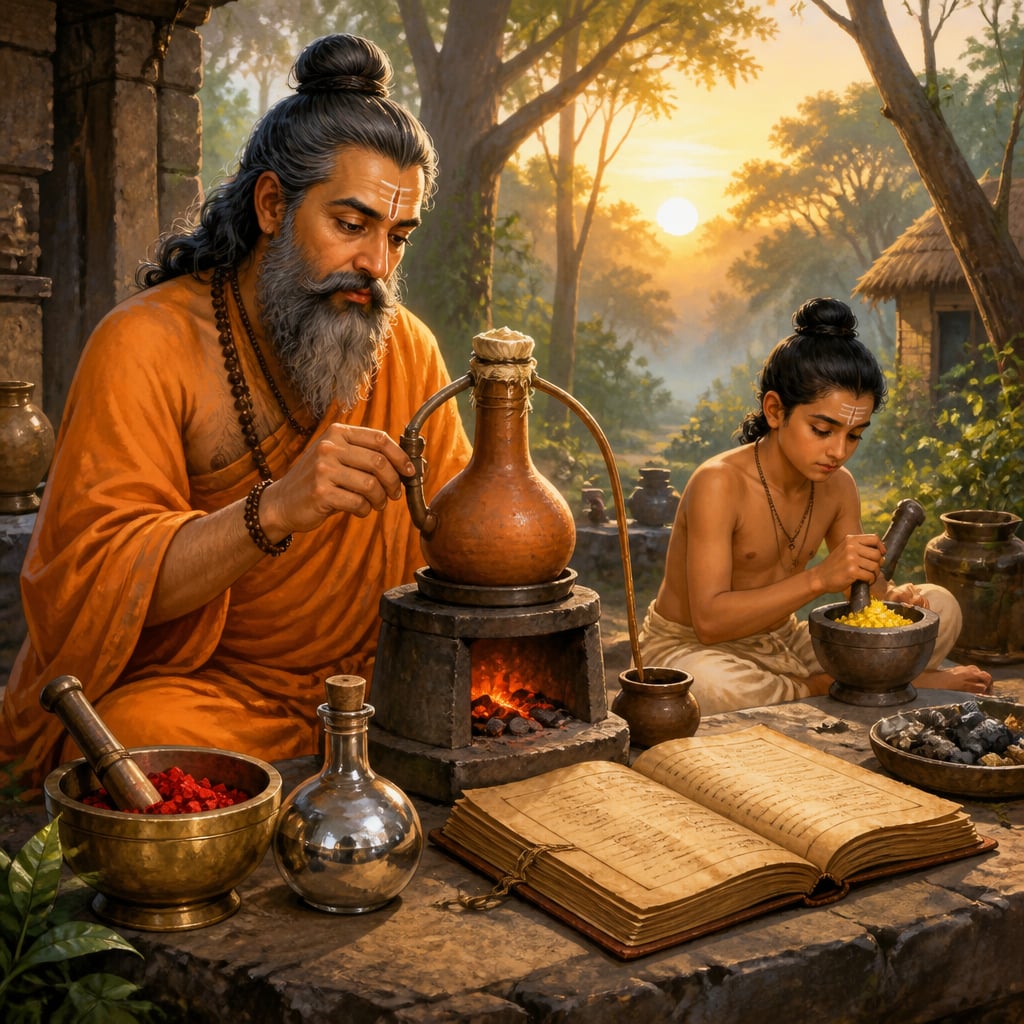
Sage-alchemist Nagarjuna at his stone laboratory bench with a patana distillation yantra at dawn

The Rasaratnākara's Revolutionary Contents

Unlike mystical alchemical texts elsewhere, the Rasaratnākara contains remarkably practical information:

  1. Systematic Classification

    • Mahārasa (great substances): Mercury, sulfur, mica, etc.
    • Uparasa (secondary substances): Pyrites, bitumen, orpiment
    • Sādhāraṇa rasa (common substances): Salts, alkalis, acids
  2. Equipment Descriptions

    • Pātana yantra (distillation apparatus)
    • Dhūpa yantra (sublimation device)
    • Dola yantra (swing apparatus for gentle heating)
    • Bālukā yantra (sand bath for controlled heating)
  3. Process Documentation

    • Precise measurements using karṣa, pala, tolā
    • Temperature indicators using color changes
    • Time durations for reactions

Mercury: The King of Metals

Pārada (mercury) held central importance in Indian alchemy. The texts called it Śiva-bīja (seed of Śiva), believing it contained transformative power.

Mercury Purification: The Śodhana Process

Raw mercury from cinnabar ore was considered toxic and impure. The aṣṭa-saṃskāra (eight-fold purification) rendered it safe:

  1. Svedana (sweating): Heating with herbal decoctions
  2. Mardana (grinding): Trituration with specific plants
  3. Mūrchana (swooning): Treatment causing temporary solidification
  4. Utthāpana (raising): Reviving mercury's fluidity
  5. Pātana (distillation): Multiple redistillations
  6. Rodhana (arresting): Stopping mercury's movement temporarily
  7. Niyamana (restraining): Controlling its properties
  8. Dīpana (kindling): Activating its therapeutic potential

Modern analysis reveals these processes removed arsenic, lead, and other toxic impurities, empirical toxicology disguised as ritual.

The Chemistry of Sulfides and Oxides

Kajjalī: Mercury-Sulfur Compound
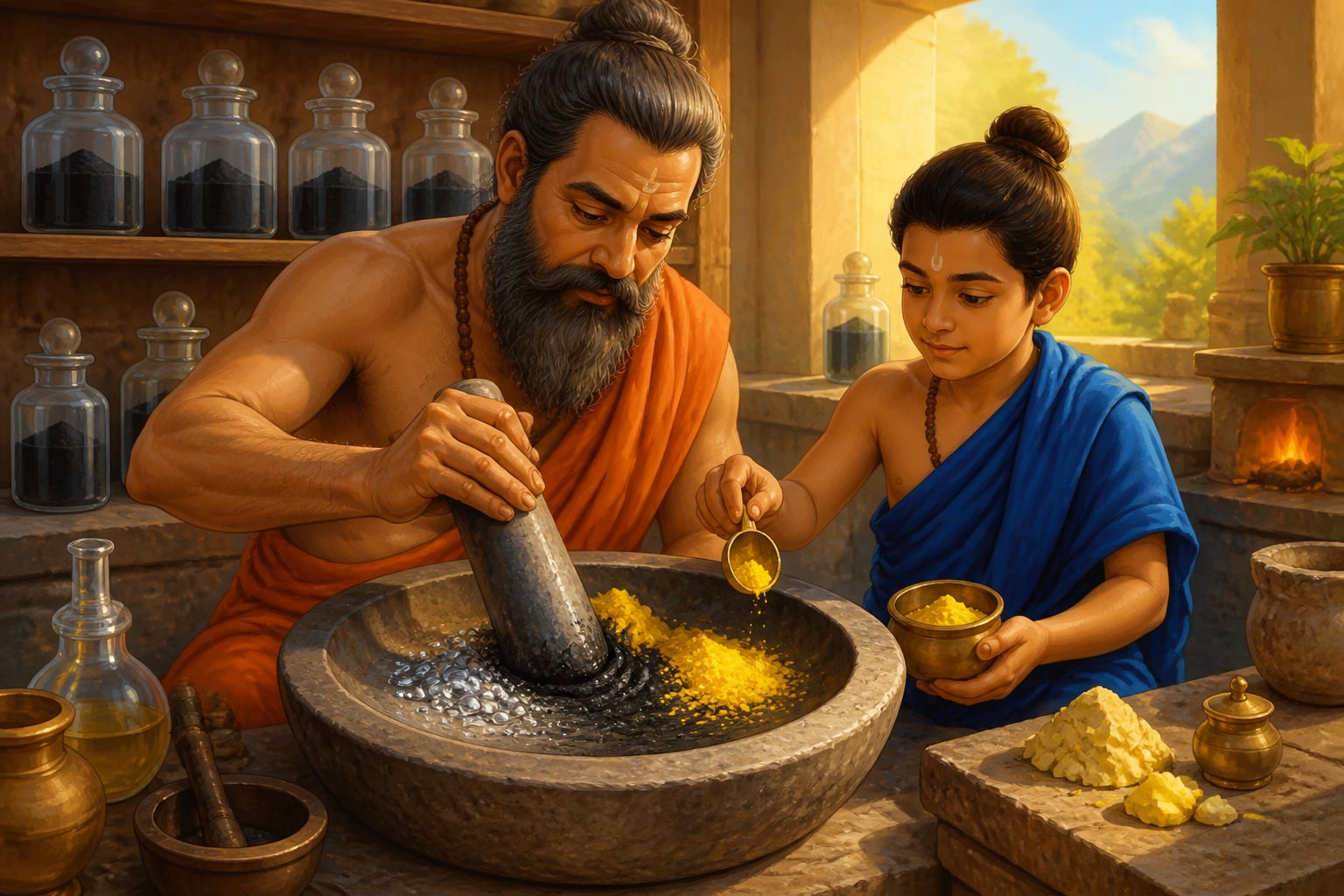
Alchemist preparing kajjali by grinding mercury with sulfur

The preparation of Kajjalī (black mercuric sulfide, HgS) demonstrates sophisticated chemistry:

Process:

  1. Equal parts purified mercury and sulfur
  2. Trituration in mortar for hours until mixture turns black
  3. No external heat applied, mechanochemistry in action

This produces meta-cinnabar (β-HgS), different from naturally occurring cinnabar (α-HgS). The ancient practitioners unknowingly performed solid-state synthesis.

Rasa Sindūra: Red Mercuric Sulfide

Converting black kajjalī to red sindūra required:

  1. Sealing kajjalī in earthen pot (śarāva sampuṭa)
  2. Controlled heating in cow-dung fire
  3. Gradual temperature increase over days
  4. Final product: vermillion red powder

This transformation (β-HgS → α-HgS) requires precise temperature control between 300-400°C, achieved through empirical observation.

Calcination: The Māraṇa Process

The māraṇa (killing) of metals transformed them into bhasma (ash/calx), bioavailable metallic compounds used in medicine.

Iron Bhasma: Loha Bhasma

Traditional Process:

  1. Iron sheets treated with takra (buttermilk)
  2. Coated with herbal paste (bhāvanā)
  3. Placed in sealed earthen crucible
  4. Subjected to gaja-puṭa (elephant-fire, ~800°C)
  5. Process repeated 7-100 times

Modern Analysis: The resulting powder contains:

Regional Centers of Rasa Śāstra

South Indian Contributions

Tamil Nadu developed its own alchemical tradition (siddha maruthuvam) with distinctive features:

Eighteen Siddhas: The Patiṉeṇ Siddhargal (18 accomplished ones) including:

Palani Murugan navapashana idol receiving abhishekam

Bogar's Nava Pāṣāṇa: The Palani Murugan temple's idol allegedly contains nine toxic substances rendered harmless:

  1. Mercury
  2. Sulfur
  3. Gold
  4. Silver
  5. Copper
  6. Lead
  7. Zinc
  8. Iron
  9. Tin

Modern XRF analysis has confirmed the presence of multiple metals in specific ratios.

The Deccan Connection

The Deccan plateau, rich in mineral resources, became a hub for alchemical research:

Hyderabad's Unani-Rasa Synthesis: Under the Qutb Shahi and Asaf Jahi rulers, Indian and Persian alchemical traditions merged, creating unique pharmaceutical preparations.

Golconda's Role: The diamond mines at Golconda also produced secondary minerals used in alchemical preparations, bitumen, sulfur compounds, and metallic ores.

Trade Routes and Knowledge Exchange

The Silk Road Connection

Indian alchemical knowledge traveled extensively:

Westward:

Eastward:

Maritime Trade in Alchemical Substances

South Indian ports exported:

The Proto-Chemistry of Acids and Alkalis

Acid Preparations

Indian alchemists prepared several acids:

Drāvaka (Acids):

Mineral Acids: Texts describe preparation of corrosive liquids:

Alkali Chemistry

The kṣāra (alkali) preparations were sophisticated:

Plant-based Alkalis:

Applications:

Sublimation and Distillation

The Gandhaka Druti

Sulfur distillation (gandhaka śodhana) produced pure elemental sulfur:

  1. Raw sulfur mixed with ghee
  2. Heated in sealed apparatus
  3. Sulfur vapor rises and condenses
  4. Pure yellow crystals collected

Mercury Distillation

The pātana yantra for mercury was a sophisticated still:

This mirrors modern retort distillation, invented in India centuries before its European documentation.

From Transmutation to Medicine

The Shift in Purpose

Over centuries, the goal shifted from:

To:

This pragmatic turn distinguished Indian alchemy from purely mystical pursuits elsewhere.

Rasa Śāstra as Iatrochemistry

Indian alchemists became early iatrochemists, using chemical preparations for medicine:

Examples:

Modern Validation and Concerns

What Science Confirms

  1. Nanoparticle Formation: Traditional bhasmas contain metal nanoparticles with enhanced bioavailability
  2. Detoxification Works: The śodhana processes do remove toxic impurities
  3. Specific Compounds: The chemical reactions described produce identified compounds

Contemporary Debate

Modern research grapples with:

Legacy: Chemistry's Indian Roots

The contributions of rasa śāstra to world chemistry include:

  1. Laboratory Equipment: Distillation apparatus, sublimation devices
  2. Process Documentation: Systematic recording of procedures
  3. Compound Preparation: Sulfides, oxides, chlorides
  4. Pharmaceutical Chemistry: Metal-based medicines
  5. Quality Standards: Purity tests and specifications

Conclusion: The Alchemist's Gift

The practitioners of rasa śāstra began with mystical goals but developed practical chemistry. Their careful observations, systematic documentation, and empirical methods laid groundwork that modern science now validates.

The bridge from alchemy to chemistry was built not by abandoning ancient knowledge but by transforming it, exactly as the alchemists sought to transform base metals into gold.


"That which transforms also preserves; the fire that burns the dross reveals the gold within."

Key figures

Nāgārjuna (Alchemist)

Bogar

Agastya

Vararuci

Govinda Bhagavatpāda

Case studies

The Palani Nava-Pāṣāṇa Idol

The Murugan idol at Palani temple in Tamil Nadu presents one of Indian alchemy's greatest mysteries. According to tradition, the Siddha Bogar created this idol using **nava-pāṣāṇa** - nine toxic substances combined through alchemical processes to create a stable, non-toxic alloy. **The Traditional Account:** Bogar selected nine substances: 1. Mercury (pārada) 2. Sulfur (gandhaka) 3. Gold (svarna) 4. Silver (rajata) 5. Copper (tāmra) 6. Lead (nāga) 7. Zinc (yasada) 8. Iron (loha) 9. Tin (vanga) Through processes described in his texts, these were combined at specific ratios and temperatures to create a unified material. **Modern Scientific Analysis:** XRF (X-ray fluorescence) studies have confirmed: - Multiple metallic elements present - Unusual alloy composition - No single natural ore matches the composition - Mercury is present in bound form **The Abhisheka Mystery:** Daily, the idol receives abhisheka (ritual bathing) with various substances including milk, sandalwood paste, and honey. Remarkably: - The surface has not corroded over centuries - The alloy remains stable - Devotees report the idol 'sweats' before rain **Chemical Interpretation:** The stability may result from: - Intermetallic compounds forming protective layers - Mercury amalgamation creating corrosion-resistant surface - Sulfide formation passivating reactive metals **What This Reveals:** Whether Bogar achieved true transmutation or not, the idol demonstrates sophisticated metallurgical knowledge - combining toxic substances into a stable, durable material that has survived centuries of daily ritual use.

This case reflects the deep knowledge tradition of Indian metallurgy (Dhatu Vidya), where empirical observation and systematic methods were developed centuries before similar Western discoveries.

The knowledge demonstrated in this case study contributed to the broader legacy of Indian metallurgy (Dhatu Vidya), influencing developments across Asia and eventually the world.

Complex metallurgical achievements can emerge from seemingly mystical traditions when practitioners carefully observe and document results over generations. How might ancient practitioners have discovered compatible metal combinations? What does the idol's longevity tell us about empirical material science? How do we evaluate traditional claims when partial scientific validation exists?

Sacred objects worldwide undergo scientific analysis today. The Shroud of Turin has been carbon-dated and chemically analyzed. Ancient Egyptian pigments are studied with X-ray spectroscopy. Non-invasive analytical techniques allow researchers to study sacred objects without desecrating them, bridging devotional and scientific frameworks.

The Delhi Iron Pillar has resisted corrosion for over 1,600 years, demonstrating advanced metallurgical knowledge.

Makaradhwaja: Ancient Nanomedicine?

**Makaradhwaja** is a classical Ayurvedic preparation containing mercury, sulfur, and gold. Modern research has revealed surprising parallels with contemporary nanomedicine. **Traditional Preparation:** 1. Pure gold foil added to kajjalī (HgS) 2. Mixture heated in specific apparatus 3. Multiple calcination cycles (puṭa) 4. Final product: red-orange powder **Modern Analysis Findings:** *Particle Size:* - TEM imaging reveals particles 20-50 nanometers - This is within the range considered 'nanomedicine' - Such small particles have enhanced bioavailability *Chemical Form:* - Gold present as nanoparticles - Mercury bound in sulfide matrix - Not as toxic metallic mercury *Therapeutic Claims vs. Evidence:* Traditional uses: - Rejuvenation (rasāyana) - Immune enhancement - Treatment of chronic conditions Modern observations: - Anti-inflammatory effects documented - Immunomodulatory activity noted - Antioxidant properties measured **The Safety Question:** Despite nanoparticle formation: - Mercury toxicity concerns remain valid - Modern medicine cautions against use - Traditional dosing was extremely small - Long-term effects unknown **Contemporary Parallels:** Modern nanomedicine research explores: - Gold nanoparticles for cancer treatment - Metal sulfides for drug delivery - Size-dependent therapeutic effects **What This Teaches:** Ancient practitioners achieved nanoscale preparations through empirical methods - grinding, heating cycles, specific ratios - without understanding the science behind it. This doesn't validate unsafe mercury use but reveals sophisticated material manipulation.

This case reflects the deep knowledge tradition of Indian metallurgy (Dhatu Vidya), where empirical observation and systematic methods were developed centuries before similar Western discoveries.

The knowledge demonstrated in this case study contributed to the broader legacy of Indian metallurgy (Dhatu Vidya), influencing developments across Asia and eventually the world.

Ancient alchemical preparations achieved nanoparticle-scale materials through empirical methods, offering insights for modern nanomedicine while requiring careful safety evaluation. How should we evaluate traditional medicines that contain potentially toxic substances? What can modern drug delivery research learn from traditional preparation methods? How do we balance respect for traditional knowledge with modern safety standards?

Nanomedicine is now a $300+ billion field, with gold nanoparticles used in cancer diagnostics and targeted drug delivery. The discovery that ancient Ayurvedic preparations contain nanoparticles suggests that empirical optimization over centuries can converge on solutions that modern labs pursue through theoretical design.

The Delhi Iron Pillar has resisted corrosion for over 1,600 years, demonstrating advanced metallurgical knowledge.

What If Rasa Śāstra Had Continued Developing?

**Scenario:** Imagine Indian alchemical traditions had continued developing without disruption through the 18th-19th centuries, maintaining their empirical approach while incorporating new knowledge. **What Rasa Śāstra Already Had:** *Systematic Method:* - Documented procedures with measurements - Quality control tests (bhasma parīkṣā) - Standardized equipment - Classification systems *Chemical Operations:* - Distillation (pātana) - Calcination (māraṇa) - Sublimation (ūrdhva-pātana) - Precipitation - Acid-base reactions *What Was Missing:* - Atomic theory - Element concept (as understood today) - Quantitative measurement of reactions - Understanding of molecular structure **Possible Developments:** *If connected to global chemistry:* - Indian apparatus designs might have influenced European equipment - Classification systems could have merged - Nanoparticle preparations might have been studied earlier - Toxic substances might have been replaced sooner *If developed independently:* - Different theoretical framework possible - Might have developed organic chemistry from herbal preparations - Pharmaceutical chemistry could have been primary focus - Material science applications from metallurgical knowledge **Historical Barriers:** - Colonial disruption of patronage systems - Dismissal of traditional knowledge as 'superstition' - Loss of transmission lineages - Shift to Western scientific frameworks **What This Thought Experiment Reveals:** The question isn't 'was rasa śāstra scientific?' but 'how do different knowledge traditions develop?' Indian alchemy had empirical methods, documentation, and practical results - the foundations for scientific development - but historical circumstances altered its trajectory.

This case reflects the deep knowledge tradition of Indian metallurgy (Dhatu Vidya), where empirical observation and systematic methods were developed centuries before similar Western discoveries.

The knowledge demonstrated in this case study contributed to the broader legacy of Indian metallurgy (Dhatu Vidya), influencing developments across Asia and eventually the world.

Scientific development depends not just on methods but on social and historical conditions that allow knowledge traditions to evolve and interact. What elements of traditional knowledge systems enable scientific development? How might chemistry have developed differently with different cultural foundations? What traditional knowledge might still offer insights for modern research?

The counterfactual question of what happens when knowledge traditions are disrupted applies directly to modern concerns about brain drain, defunding of basic research, or collapse of apprenticeship systems. Knowledge ecosystems are fragile, and the conditions that allow them to flourish require active protection.

The Delhi Iron Pillar has resisted corrosion for over 1,600 years, demonstrating advanced metallurgical knowledge.

Historical context

Classical to Medieval Period (2nd-16th century CE)

Living traditions

Rasa śāstra continues through: **Ayurvedic Pharmaceuticals:** Companies like Dabur, Baidyanath, and Arya Vaidya Sala still produce classical bhasma preparations following traditional methods, though with modern quality controls. **Siddha Medicine:** Tamil Nadu's government-supported Siddha hospitals use mercury and metal preparations based on texts attributed to the eighteen Siddhas. **Research Initiatives:** Institutions like CCRAS (Central Council for Research in Ayurvedic Sciences) and IIT studies investigate traditional preparations using modern analytical methods. **Academic Revival:** Scholarly interest in documenting and understanding rasa śāstra has increased, with critical editions of classical texts being published. **Safety Debates:** The tradition faces legitimate questions about heavy metal toxicity, prompting efforts to develop safer alternatives while preserving effective preparations. **Global Interest:** Western researchers studying nanomedicine and green chemistry have shown interest in traditional Indian preparation methods as sources of new ideas.

Reflection

More in Dhātu: Metallurgy That Defied Time

All lessons in Dhātu: Metallurgy That Defied Time · Bharatiya Vigyan: Inventions & Discoveries course