Suvarṇa: Gold Processing and Gilding
Mercury amalgamation and temple gilding that survives centuries
Explore ancient techniques for gold extraction, purification, and gilding including mercury amalgamation, fire gilding, and the metallurgy behind temple golden covers that have survived for centuries.
Suvarṇa: Gold Processing and Gilding
Stand before the golden vimāna (tower) of the Srirangam temple or the gilded Brihadeshwara, and you see gold that has shone for a thousand years. These surfaces aren't merely gold-plated in the modern sense, they're gilded using ancient techniques that bond gold to base metal with such permanence that centuries of tropical weather, monsoon rains, and millions of hands pressing in worship haven't worn them away.

The Indians who perfected these techniques understood gold at a fundamental level. They could extract it from river sands, purify it to remarkable standards, work it into impossibly thin sheets, and bond it to other metals with techniques that remain partly mysterious even today. Gold (suvarṇa, "having beautiful color") held both material and spiritual significance: it was wealth, certainly, but also purity, divinity, and immortality made visible.
Gold in Indian Geology and History
Unlike some regions where gold appeared only through trade, India had its own gold sources:
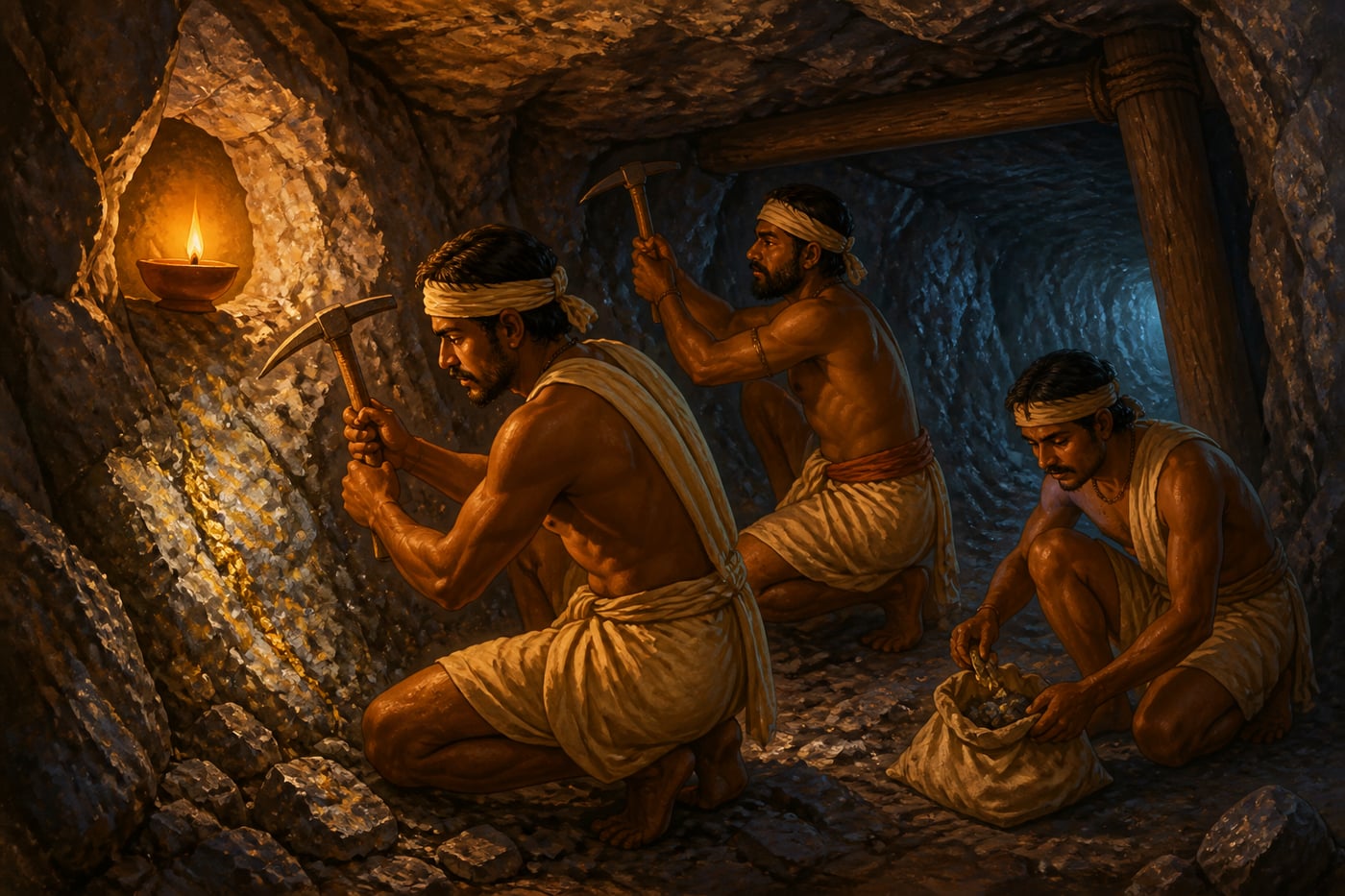
The Kolar Gold Fields: Karnataka's Kolar district contains some of the world's deepest gold mines, worked since at least 2nd century BCE. The Kolar mines supplied South Indian empires for over two millennia, finally closing in 2001 after exhausting economically viable deposits.
River Gold: The rivers draining the Deccan plateau, particularly the Karnataka and Andhra Pradesh regions, carried alluvial gold. Panning and sluicing techniques extracted this river gold since prehistoric times.
The Hutti Mines: Raichur district in Karnataka has gold deposits that were worked in ancient times and continue operation today under modern management.
Archaeological gold artifacts from the Indus Valley Civilization (c. 2600-1900 BCE) demonstrate sophisticated goldworking by the Bronze Age. By the Gupta period (4th-6th century CE), Indian goldsmiths had mastered virtually every technique known before modern electrochemistry.
Extraction: From Ore to Metal
Extracting gold from ore involved several techniques:
Placer Mining: Gold's high density (19.3 g/cm³, nearly twice that of lead) allows it to be concentrated by washing away lighter materials. River sands were sluiced, allowing gold to settle while lighter particles washed away. This simple technique provided most of the world's gold before industrial mining.
Mercury Amalgamation: Mercury has a unique property: it dissolves gold at room temperature, forming an amalgam. Crushed ore was mixed with mercury, which picked up the gold. The mercury was then heated, vaporizing away (to be collected and reused) and leaving pure gold behind.
This technique, mentioned in Indian texts as pārada-bandha (mercury binding), was known by at least the early centuries CE. It allowed extraction of gold from ores where placer techniques wouldn't work.
Cupellation: To purify gold containing silver (as most natural gold does), the alloy was heated with lead in a porous cup (cupel) with an air blast. The lead oxidized and absorbed the silver, leaving behind purer gold. Repeated cupellation could achieve very high purity.
Purification: The Quest for Purity
Ancient Indians distinguished gold by purity and developed techniques to achieve ever-higher standards:
Touch Testing: Rubbing gold on a touchstone (a dark, fine-grained stone) leaves a streak whose color indicates purity. Experienced goldsmiths could estimate gold content to remarkable precision by comparing streaks.
Parting: To separate gold from silver, parting techniques used acids or salts. Nitric acid (which dissolves silver but not gold) was one method; cementation with salt and brick dust at high temperature was another.
Cementation: Gold alloyed with base metals could be purified by heating with salt (sodium chloride) and iron sulfate. The salt chlorinated the base metals, volatilizing them and leaving purer gold.
The Arthaśāstra (c. 3rd century BCE) describes goldsmiths' work and the treasury's concern with gold purity, indicating that systematic assaying was standard practice in Mauryan India.
Working Gold: The Goldsmith's Art
Once purified, gold could be worked in multiple ways:
Beating: Gold's extraordinary malleability allows it to be beaten into leaf thinner than any other metal. One gram of gold can be beaten into a sheet covering one square meter, about 100 nanometers thick. This gold leaf (varak) was used for gilding and even consumed in foods.
Drawing: Gold can be drawn into wire finer than human hair. Gold wire was used in textile weaving (zari), jewelry, and decorative work.
Casting: Though gold was too precious for large castings, small objects (jewelry, religious figurines) were cast using lost-wax techniques similar to bronze casting.
Granulation: Tiny gold spheres could be arranged in patterns and fused to surfaces without melting the base, a technique requiring precise temperature control. Granulated gold jewelry appears in Indian contexts from at least the 1st millennium BCE.
Filigree: Fine gold wire twisted and soldered into intricate patterns. Odisha (Cuttack) and Andhra Pradesh remain centers for gold filigree work.
Fire Gilding: The Permanent Golden Surface

The gilding of temple towers and religious images used fire gilding (also called mercury gilding or amalgam gilding), one of the most durable surface treatments ever developed:
The Process:
- Gold was dissolved in mercury, forming a paste-like amalgam
- This amalgam was spread on the surface to be gilded (bronze, copper, or prepared iron)
- The object was heated, vaporizing the mercury
- The gold remained, bonded at the atomic level to the base metal
- The surface was burnished to achieve a lustrous finish
Why It Lasts: Fire gilding doesn't just coat a surface, it creates an intermetallic bond. Gold atoms diffuse into the base metal, creating a transition zone that anchors the gold layer. This bonding is far more durable than mechanical adhesion or electroplating.
The Mercury Problem: Fire gilding releases toxic mercury vapor. Traditional gilders worked outdoors or in well-ventilated spaces, but the health hazards were significant. The technique's decline in modern times relates partly to occupational health concerns.
Temple Gilding: Case Studies
Several major temples demonstrate gilded surfaces that have survived centuries:
Srirangam Ranganathaswamy Temple: The golden vimāna over the sanctum has been re-gilded periodically but retains gilding from multiple historical periods. The temple's records document gilding donations and maintenance across centuries.
Brihadeshwara Temple, Thanjavur: Rajaraja Chola's great temple includes gilded elements that have survived since the 11th century. The gilding's durability testifies to Chola-era craftsmanship.
Tirumala Venkateswara Temple: The Ānandasāyana vimāna was most recently re-gilded in 1958 using traditional techniques. The temple maintains detailed records of gold donations and usage.
The Golden Temple, Amritsar: The gilding of the Harmandir Sahib by Maharaja Ranjit Singh (1830s) used traditional fire gilding techniques. The distinctive gold covering has survived nearly two centuries of Punjab's climate.
Gold Leaf: Varak and Its Applications
Gold leaf (varak or varakh) production is itself a specialized craft:
Production: Gold is alloyed with small amounts of silver or copper for workability, cast into thin bars, and beaten repeatedly between leather sheets. Each beating stage thins the gold further, with intermediate annealing (heating) to restore malleability.
Thickness: Traditional gold leaf reaches about 0.1 micrometers, so thin that it transmits light with a greenish tinge. At this thickness, gold becomes surprisingly fragile despite the metal's durability.
Application: Gold leaf is applied to prepared surfaces using size (adhesive). On flat surfaces, this is relatively straightforward; on complex sculptures, the gilder must navigate every fold and undercut.
Consumption: Unlike silver leaf (which is toxic), gold leaf is biologically inert and has been used in foods and medicines since ancient times. Varakh on sweets and pān continues as a culinary tradition, though modern production often substitutes aluminum for cost reasons.
The South Indian Goldsmith Tradition
South India developed distinctive goldworking traditions:
Temple Jewelry: Elaborate gold ornaments for temple deities required specialized skills. The Tirumala deity's jewelry collection includes pieces of extraordinary complexity and antiquity.
Antique Finish: The "antique" or "matte" finish traditional to South Indian gold is achieved through careful oxidation and burnishing, different from the high polish preferred elsewhere.
Regional Styles: Tamil Nadu (Thanjavur work), Kerala (Thrissur work), and Karnataka each developed distinctive approaches to goldwork, recognizable by trained eyes.
Community Organization: Goldsmith communities (Āchāri in Tamil Nadu, Swarnakār elsewhere) maintained hereditary traditions, guild organization, and often temple connections that gave them both economic and social standing.
Gold in Trade: The Indian Ocean Network
India's position in gold trade was complex:
Import: Despite local sources, India was historically a net importer of gold. Roman writers complained that India drained the empire of gold; similar complaints appear in medieval European and Arabic sources.
Re-export: Indian goldsmiths added value through craftsmanship, exporting finished jewelry and gilded objects.
Currency: Gold coins (suvarṇa, niṣka, later mohur) circulated as high-value currency. The consistency of gold coinage required reliable assaying and minting standards.
The persistent flow of gold into India (and its relative non-return) reflects both the demand for Indian goods (spices, textiles, steel) and Indian society's tendency to accumulate gold as savings rather than circulating it.
Modern Continuation
Traditional goldworking continues alongside modern methods:
Temple Restoration: When ancient gilding requires repair or renewal, traditional techniques often prove superior to modern alternatives. The Archaeological Survey of India sometimes employs traditional craftsmen for conservation work.
Jewelry Production: While mass production has captured much of the market, high-end South Indian jewelry still uses traditional techniques, hand-beaten gold, traditional soldering, ancient designs.
Living Craftsmen: Goldsmiths in Kumbakonam, Swamimalai, and other traditional centers maintain skills passed down through generations. Some have adapted to tourist markets; others serve temple and wedding requirements.
Key figures
Kauṭilya (in the Context of Gold)
c. 350-275 BCE
The Temple Gilders
Historical to Present
The Kolar Gold Field Workers
c. 2nd Century BCE - 2001 CE
Case studies
Gilding the Vimāna: A Century-Long Commitment
[11th Century CE onwards] You are responsible for gilding the vimāna (tower) of a major temple. The surface area is hundreds of square meters. You need gold, mercury, skilled gilders, scaffolding, and months of work. The gilding must last for centuries, through monsoons, tropical heat, and millions of devotional touches. How do you plan and execute this massive undertaking?
Historical gilding projects required careful logistics: accumulating sufficient gold (often through donations over years), preparing the bronze or copper substrate, mixing amalgam in the right proportions, and applying it section by section while managing mercury vapor hazards. The durability of surviving gilding testifies to the care taken.
Modern restoration projects face similar challenges: matching historical techniques, sourcing appropriate materials, training craftsmen in forgotten skills, and planning for multi-decade timeframes. The conservation of historic buildings shares much with ancient temple maintenance.
Major projects require major planning. Temple gilding was not a single campaign but an ongoing commitment - initial gilding, periodic renewal, and continuous care across generations.
Cathedral maintenance funds, endowment models for universities, and long-term infrastructure bonds all address the same challenge: how to fund ongoing maintenance of assets that must last centuries. The temple gilding model of perpetual stewardship anticipated modern institutional endowment structures.
The Delhi Iron Pillar has resisted corrosion for over 1,600 years, demonstrating advanced metallurgical knowledge.
The Roman Gold Drain: When Trade Unbalances Empires
[1st Century BCE - 3rd Century CE] You are a Roman administrator watching gold flow eastward. Roman consumers demand Indian spices, textiles, and gems. Indian sellers accept only gold - Roman coins or bullion. Indian goods are consumed; gold is hoarded. Over decades, significant portions of Rome's gold reserves have migrated to India, where they become jewelry, temple gilding, and buried treasure. Pliny the Elder estimates 100 million sesterces annually.
The Roman gold drain to India (and through India to Southeast Asia and China) was a persistent pattern that survived the Roman Empire itself. India's trade surplus resulted from producing goods that other regions wanted, combined with cultural preferences for accumulating gold rather than spending it.
Similar dynamics appear in modern trade: countries with persistent surpluses accumulate reserves while deficit countries become indebted. Gold's role has shifted to currency reserves and institutional holdings, but the pattern of wealth flowing toward production and savings persists.
Trade balances matter over the long term. Rome's outflow of gold weakened its economy; India's inflow built the accumulated golden wealth visible in temples and jewelry today.
The US-China trade deficit and debates about currency manipulation echo the same dynamics. Persistent trade imbalances drain wealth from deficit nations over decades. Rome's experience shows that even the most powerful empires can be weakened by structural trade imbalances they fail to correct.
100 million - referenced in the context of The Roman Gold Drain: When Trade Unbalances Empires.
The Gilder's Curse: When Traditional Knowledge Includes Danger
You are a traditional gilder, trained by your father and grandfather. Your family has gilded temple images for generations. But you've noticed something: gilders in your community often develop tremors, memory problems, and other ailments in middle age. Your grandfather died showing these symptoms. Modern doctors tell you mercury vapor causes neurological damage. Do you continue the family tradition?
Fire gilding's mercury vapor exposure caused significant occupational health problems that traditional communities may not have fully understood. The technique's decline in modern times reflects both the availability of alternatives (electroplating, gold leaf) and recognition of health hazards.
Many traditional industries involve health hazards that weren't fully understood when practices developed. Lead glazes in pottery, benzene in various processes, asbestos in construction - modern recognition of these hazards has driven technical change, though sometimes at the cost of traditional skills.
Traditional knowledge includes risks as well as benefits. Understanding why traditional practices worked doesn't mean ignoring their dangers. Modern alternatives may be safer even if they're not identical.
Occupational health regulations now mandate protection from mercury, lead, and other toxic substances in manufacturing. Industries from battery recycling to semiconductor fabrication face the same tension between traditional methods and worker safety. Acknowledging historical risks is not a critique of traditional knowledge but an essential part of its honest assessment.
The Delhi Iron Pillar has resisted corrosion for over 1,600 years, demonstrating advanced metallurgical knowledge.
Historical context
Bronze Age to Modern Period
Living traditions
India remains one of the world's largest gold consumers, with traditional jewelry styles persisting alongside modern designs. Some temple gilding still uses traditional fire gilding techniques, though gold leaf has become more common. The Swarnakāra (goldsmith) communities maintain hereditary traditions, though industrialization has changed the industry significantly. Gold's cultural significance, for weddings, temples, savings, ensures continuing demand for traditional skills even as production methods evolve.
- Srirangam Temple: The golden vimāna over the sanctum represents centuries of gilding and renewal. The temple complex, one of India's largest, demonstrates the integration of gold with religious architecture.
- Kolar Gold Fields Heritage Site: The now-closed Kolar gold mines include heritage displays documenting over two millennia of gold extraction. The deepest workings reach over 3 km, among the world's deepest mines.
- Tirumala Venkateswara Temple: The gilded vimāna and the deity's extensive gold jewelry collection demonstrate traditional goldworking at its most elaborate. The temple's treasury maintains records of gold donations across centuries.
Reflection
- Gold's value seems partly intrinsic (it doesn't tarnish, it's beautiful) and partly cultural (societies choose to value it). What proportion of gold's worth comes from each source? Could a society successfully reject gold's value?
- Fire gilding produces durable results but creates health hazards from mercury vapor. How should we balance preserving traditional techniques against protecting craftsmen's health? Is there a responsible way to maintain dangerous traditional crafts?
- India accumulated gold for millennia through trade surpluses. Is accumulating wealth (rather than spending it) a virtue, a flaw, or simply a cultural preference? What does a society's relationship with gold say about its values?