Ukku: Wootz Steel's Global Fame
High-carbon crucible steel with carbon nanotubes, 2,300 years ago
Explore Wootz (Ukku) steel production from 300 BCE onwards, its transformation into legendary Damascus sword blades, and recent microscopy findings revealing carbon nanotube structures.
Ukku: Wootz Steel's Global Fame
In the workshops of medieval Damascus, sword-smiths performed what seemed like magic. They took ingots of steel imported from India and forged them into blades of legendary sharpness, blades that could slice a floating silk scarf, cut through European swords, and displayed a mesmerizing watered pattern on their surface. These were the famed Damascus swords, whose reputation spread from the crusades to the courts of European kings.
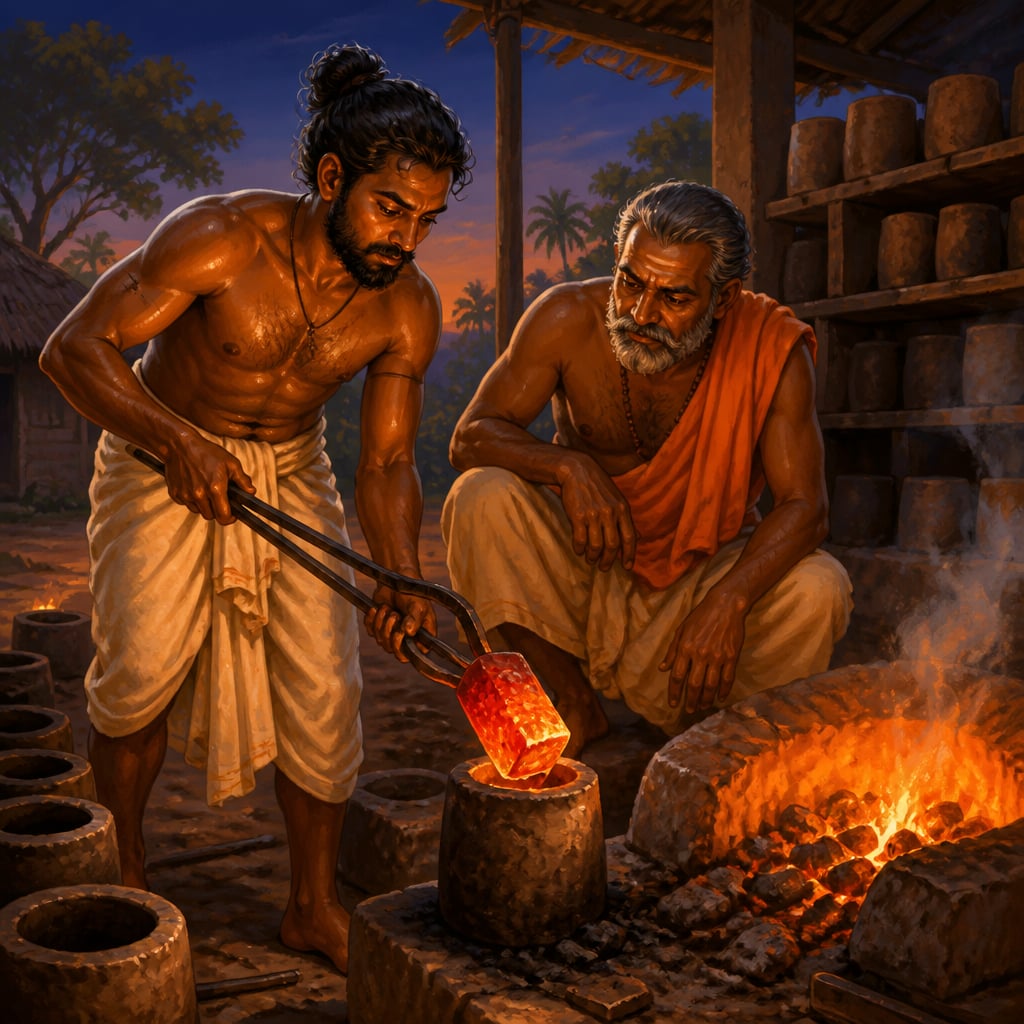
But the magic wasn't in Damascus. It was in the steel itself, a product of South Indian metallurgists who had perfected the art of crucible steel production over two millennia ago. The Europeans called it "wootz," a corruption of the Tamil-Kannada word ukku (ఉక్కు / उक्कू), meaning simply "steel." What the ancient smiths of the Deccan achieved would not be matched by European metallurgy until the industrial revolution, and in some respects, not even then.
The Birth of Crucible Steel
Most ancient iron was made by the "bloomery" process, heating ore with charcoal to produce a spongy mass of iron mixed with slag. This wrought iron was soft, containing very little carbon. To make steel, smiths had to laboriously add carbon through repeated heating in charcoal, a process called carburization.
South Indian metallurgists took a different approach. They sealed iron with carbon sources (wood, leaves, or rice husks) in small clay crucibles, then heated these crucibles to temperatures exceeding 1,400°C, hot enough to melt the iron completely. As the molten iron absorbed carbon from its surroundings, it transformed into high-carbon steel.
When cooled slowly, this steel developed a distinctive crystalline structure with bands of cementite (iron carbide) distributed through a matrix of pearlite. This banded microstructure gave the steel remarkable properties: it was hard enough to hold an edge yet tough enough not to shatter, and when polished and etched with acid, it revealed the famous "watered" pattern.
The Tamil Crucible: A Technical Marvel
The crucibles themselves were engineering achievements. Made from refractory clay mixed with rice husk ash and other materials, they could withstand temperatures that would destroy ordinary pottery. Each crucible was small, typically holding only 300-400 grams of iron, because larger volumes couldn't be heated evenly.
The process required precise control:
Charge Composition: Iron pieces were mixed with carbon sources in specific proportions. Too little carbon produced soft steel; too much made it brittle. The smiths achieved carbon contents of 1.5-2%, ideal for blade-making.
Temperature Control: The crucibles were heated in pit furnaces using charcoal and forced air from bellows. Achieving and maintaining melting temperature (around 1,400-1,500°C) for hours required skill and experience.
Cooling Rate: After melting, the crucibles were cooled slowly, allowing the characteristic banded structure to develop. Rapid cooling would produce a different (and less useful) microstructure.
Selection: Not every crucible produced perfect steel. Master smiths could identify superior ingots by their surface texture, sound when struck, and fracture pattern.
The Trade Routes: From Kodumanal to Damascus
Archaeological evidence places crucible steel production in South India as early as 300 BCE, with major production centers in:
Kodumanal (Tamil Nadu): Excavations have revealed crucible fragments, iron slag, and production debris dating to the early centuries BCE. This site, in the Kongu region, was a major manufacturing center.
Mel-siruvalur (Tamil Nadu): Another significant production site with evidence of large-scale steel making from the early centuries CE.
Telangana and Karnataka: The Deccan plateau's iron ore deposits and forests (for charcoal) supported multiple production centers. The region's steel was famous enough to attract traders from across the Indian Ocean.
From these production centers, steel ingots traveled remarkable distances:

The Western Route: Through ports like Muziris (modern Kodungallur) and Arikamedu, wootz reached Roman Egypt. The Greek author Ktesias (5th century BCE) mentions Indian steel. The Periplus of the Erythraean Sea (1st century CE) specifically lists iron and steel among Indian exports.
The Eastern Route: Wootz reached Southeast Asia, where it was highly valued. Indonesian and Malay kris daggers often incorporated Indian steel in their blades.
The Northern Route: Through overland trade, Indian steel reached Persia and Central Asia. Arab traders eventually carried it to Damascus, where Syrian smiths developed the forging techniques that created legendary swords.
The Damascus Connection

Damascus smiths didn't make wootz, they worked it. The ingots arrived as small cakes (called "gawhar" in Persian, meaning "essence" or "jewel"), and Syrian smiths developed specialized techniques to forge these into blades without destroying the steel's unique properties.
The challenge was significant: high-carbon steel is notoriously difficult to forge. Heat it too much, and the carbon burns off; heat it too little, and it cracks. Work it at the wrong temperature, and the banded structure that gives Damascus blades their properties disappears.
Damascene smiths developed techniques transmitted through guild secrecy:
- Forging at relatively low temperatures (compared to ordinary steel work)
- Repeated folding to refine the pattern without losing carbon
- Careful heat treatment to optimize hardness
- Etching with acidic solutions to reveal the watered pattern
The resulting blades combined Indian materials science with Syrian craftsmanship, a collaboration across cultures that produced weapons unmatched in the medieval world.
The Lost Secret
By the late 18th century, wootz production had declined dramatically. Multiple factors contributed:
British colonial policies: The East India Company's revenue policies disrupted traditional production networks. Iron import tariffs and taxation schemes made local production uneconomical.
Deforestation: Crucible steel required enormous quantities of charcoal. As forests were cleared for agriculture and timber export, fuel became scarce and expensive.
Market disruption: European industrial steel, though inferior for blades, was cheaper and more readily available for construction and tools, eliminating the mass market that had sustained the industry.
By 1838, the last known wootz-making centers in South India had closed. European scientists who had become fascinated by the material, including Michael Faraday, attempted to recreate it but failed. The precise combination of ore composition, carbon sources, temperature profiles, and cooling rates that South Indian smiths had maintained for over two millennia proved impossible to reverse-engineer from finished products alone.
The Nanotube Discovery
In 2006, materials scientists at the Technical University of Dresden made a startling discovery. Using transmission electron microscopy on samples from genuine Damascus blades, they found carbon nanotubes and nanowires embedded in the steel matrix.
Carbon nanotubes, cylindrical structures of carbon atoms, were considered a late 20th-century discovery, first definitively characterized in 1991. Yet here they were in steel made centuries ago.
The formation mechanism appears to be:
- During the lengthy high-temperature heating, carbon from plant materials dissolved into the molten iron
- Trace elements in the Indian ore (particularly vanadium and molybdenum) acted as catalysts
- During slow cooling, some carbon precipitated as nanotubes rather than conventional graphite or cementite
- These nanotubes became encapsulated in cementite particles, contributing to the steel's remarkable properties
The ancient smiths weren't deliberately making nanotubes, they were following procedures refined over generations to produce the best steel. But their empirical optimization had stumbled onto nanoscale phenomena that modern science only recently learned to create deliberately.
Recreating Wootz
Modern metallurgists have attempted to recreate wootz steel with mixed success. The challenges include:
Ore Variation: The specific iron ores used (and their trace element content) significantly affected the final product. Modern high-purity iron doesn't produce the same results.
Carbon Source: The particular woods, leaves, or rice husks used contributed more than just carbon. Their ash chemistry affected slag formation and trace element distribution.
Firing Conditions: Small variations in temperature profile, atmosphere (oxidizing vs. reducing), and timing affected the steel's microstructure in ways that are still being understood.
Some modern smiths, particularly J.D. Verhoeven and Alfred Pendray, have achieved partial success by studying historical blades and experimenting with different ore sources and processes. Their work suggests that the "recipe" wasn't a single procedure but a family of related techniques adapted to local materials.
The Chera, Chola, and Pandya Contribution
The three great Tamil dynasties all patronized metallurgical industries:
The Cheras: Controlled the western ports through which wootz reached Roman markets. Muziris was a Chera port, and the kingdom's merchants grew wealthy on the steel trade.
The Cholas: Developed both military applications (the Chola navy used steel for weapons and ship fittings) and artistic ones (bronze casting techniques related to crucible technology).
The Pandyas: Their territories included significant iron-producing regions. Greek sources mention the Pandyas as suppliers of "Indian iron" to Mediterranean markets.
The competition among these kingdoms likely drove innovation, as each sought to produce superior steel for military advantage and trade profits.
Modern Legacy
Wootz's influence extends into contemporary materials science:
Pattern-Welded Steel: Modern bladesmiths create "Damascus pattern" steel by forge-welding layers of different steels, producing decorative patterns. While not true wootz, this technique was partly inspired by attempting to recreate Damascus blades.
Carbon Nanotube Research: The discovery of nanotubes in ancient steel has prompted research into whether similar self-assembly processes could be harnessed for modern nanomaterial production.
Ultra-High-Carbon Steels: Modern steels with 1-2% carbon are now being developed for specific applications, revisiting the compositional range that wootz occupied.
The story of wootz reminds us that "high technology" isn't uniquely modern. Two thousand years ago, South Indian metallurgists achieved results that integrated chemistry, materials science, and manufacturing in ways we're still working to understand and replicate.
Key figures
The Yavana Merchants
1st-3rd Century CE
John D. Verhoeven
Contemporary (b. 1936)
The Smiths of Kodumanal
300 BCE - 300 CE
Case studies
The Crusader's Shock: Encountering Damascus Steel
[1099-1291 CE] You are a European knight arriving in the Holy Land during the Crusades. Your sword - the finest Toledo steel - served well in Europe. But against Saracen warriors wielding Damascus blades, you notice something disturbing: their swords cut through yours. The watered patterns on their blades seem almost magical. You try to acquire such a sword, learning it comes from distant 'Hindustan' by way of Persian merchants. The steel itself cannot be made in Europe.
The technological gap was real. European smiths could not achieve the temperatures needed for crucible steel, and their iron ores lacked the trace elements that catalyzed wootz's unique properties. Damascus swords were expensive but highly sought by returning Crusaders, creating demand that enriched the India-Persia-Syria trade network.
Today's military technology gaps drive similar dynamics. Nations seek advanced materials (carbon fiber, titanium alloys, semiconductor technologies) that they cannot produce domestically. Strategic materials trade shapes international relations just as wootz did in medieval times.
Military technology has always been a driver of trade and cultural exchange. The Crusades, despite their religious motivations, became a conduit for technological transfer between civilizations.
Technology transfer through military contact continues today. Military drones, satellite communications, and cybersecurity tools developed for defense regularly migrate to civilian use. The pattern of encountering superior technology in conflict and then seeking to acquire or replicate it is as old as the Crusades.
The Delhi Iron Pillar has resisted corrosion for over 1,600 years, demonstrating advanced metallurgical knowledge.
Ancient Nanotechnology: What the Microscope Revealed
In 2006, researchers at the Technical University of Dresden prepare ultra-thin samples of an authentic Damascus sword blade for electron microscopy. At magnifications that reveal individual atoms, they find something unexpected: carbon nanotubes - cylindrical structures only nanometers wide - embedded in the steel. These structures, first synthesized in laboratories in 1991, exist in steel made centuries ago.
The ancient smiths weren't trying to make nanotubes. They were following procedures optimized over generations to produce the best steel. But their process - the specific ores with their trace elements, the carbon-rich atmosphere, the slow cooling - happened to create conditions where carbon atoms self-assembled into nanotube structures. This is an example of 'emergence' - complex outcomes arising from simpler processes.
Materials scientists now study whether wootz-like processes could be used for intentional nanotube production. If the traditional process can be precisely replicated and controlled, it might offer an alternative to current high-tech synthesis methods.
Empirical optimization can achieve results that theoretical understanding would not predict. The smiths found what worked without knowing why. Modern science explains the why but took centuries to rediscover the what.
Carbon nanotubes discovered in wootz steel predate modern nanotechnology by over a millennium. Materials scientists now use electron microscopy and computational modeling to understand what ancient smiths achieved through empirical refinement. The field of archaeometallurgy increasingly reveals that 'ancient' and 'nanotechnology' are not contradictions.
The Delhi Iron Pillar has resisted corrosion for over 1,600 years, demonstrating advanced metallurgical knowledge.
The Death of an Industry: Wootz's Colonial-Era Decline
[1750-1850 CE] You are a wootz smith in early 19th century South India. Your family has made crucible steel for generations. But times have changed: the British have imposed new taxes on your furnaces, charcoal has become expensive as forests are cleared, and cheap European iron floods the market. Your customers - sword makers, tool makers - are switching to imported materials. By 1838, you and the last remaining wootz smiths have ceased production. The knowledge dies with you.
Wootz's disappearance wasn't due to inferior quality - it remained superior for blades. Colonial economic policies disrupted the networks that sustained production: ore supply chains, charcoal markets, skilled labor systems, and customer bases. The technique was knowledge-intensive and required intact communities of practice to transmit. Once the economics made production unviable, the knowledge dissipated within a generation.
Today we face similar risks with traditional crafts and knowledge systems. Indigenous agricultural practices, traditional medicine, artisanal manufacturing - all are vulnerable to economic disruption. Documentation and support for traditional practitioners has become a recognized conservation priority.
Technological knowledge can be fragile. Skills that take centuries to develop can be lost in decades if the economic and social conditions that support them collapse.
Traditional craft knowledge worldwide faces similar threats from economic disruption. Japanese sword-making, Murano glassblowing, and handloom weaving all risk extinction when market conditions shift. UNESCO's Intangible Cultural Heritage program exists precisely because skills that take centuries to develop can vanish within a generation.
19th century - referenced in the context of The Death of an Industry: Wootz's Colonial-Era Decline.
Historical context
Early Historic to Medieval Period (300 BCE - 1800 CE)
Living traditions
Modern bladesmiths worldwide attempt to recreate wootz and Damascus steel patterns. 'Pattern-welded' Damascus (made by forge-welding layers of different steels) is popular among knife makers, though it differs from true crucible steel. The discovery of carbon nanotubes in authentic blades has sparked materials science research into whether ancient processes could inform modern nanomaterial production. South Indian state governments have shown interest in reviving traditional metallurgy as cultural heritage, though true wootz production remains elusive.
- Kodumanal Archaeological Site: One of the earliest known wootz production sites. Excavations have revealed crucible fragments, iron slag, semi-processed steel, and furnace remains dating to 300 BCE or earlier. The site is being developed for heritage tourism.
- Government Museum, Chennai: Houses artifacts from South Indian metallurgical sites, including crucible fragments, iron implements, and weaponry. The Bronze Gallery provides context for the broader metalworking tradition.
- Victoria and Albert Museum: Houses one of the world's finest collections of Islamic metalwork, including Damascus swords made from South Indian wootz. The Asian galleries contextualize Indian metallurgy within global trade networks.
Reflection
- Wootz steel production involved trade networks connecting South India to Rome, Persia, and beyond. What modern supply chains might seem similarly remarkable to historians a thousand years from now?
- The wootz technique was lost when economic conditions made production unviable. What valuable knowledge or skills in your own community might be at risk of similar loss? What would it take to preserve them?
- Ancient smiths achieved nanoscale engineering without knowing it. What might we be achieving today that future scientists will understand better than we do?