Yana
Marching and Advancing
Taking decisive action. When to march forward and seize opportunities.
The March That Made an Empire
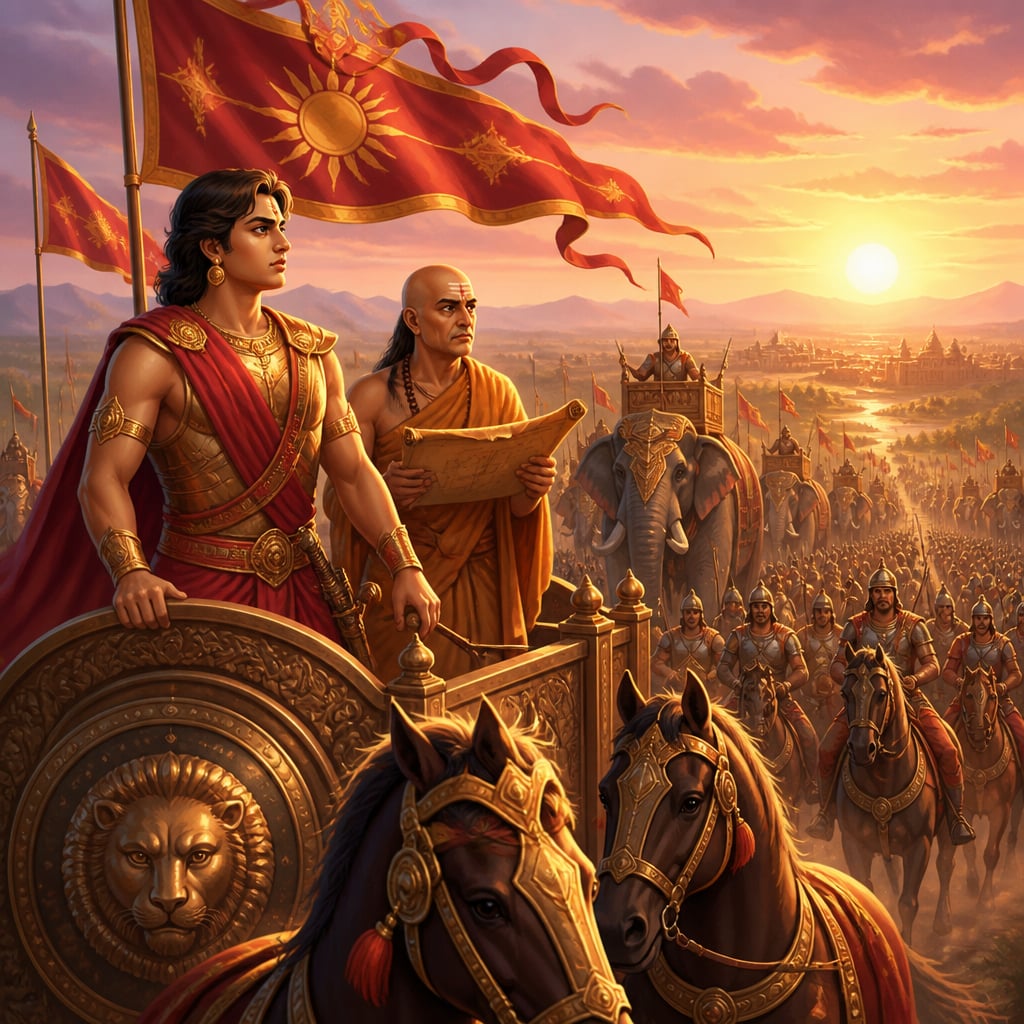
In 322 BCE, Chandragupta Maurya faced a decision that would define Indian history. The Nanda Empire, the largest power the subcontinent had ever seen, was weakening. The king was unpopular. The army was distracted by distant campaigns. The treasury, though vast, was strained.
Kautilya had spent years preparing for this moment. Networks of spies were in place. Alliances had been cultivated. The army was trained and equipped. But still he waited. Until one morning, intelligence arrived: a rebellion had broken out in the Nanda heartland.
"Now," Kautilya said. "We march."
This was Yana, the fourth measure of statecraft, the policy of strategic advance. Not just war declared (Vigraha), but war enacted. The moment when strategy becomes movement, when plans become action, when theory meets reality on the march.
The Logic of Advance
"बलवान् यायात्" "He who is superior in strength should advance."
Yana is the most consequential of the six measures because it's irreversible. A king can think about war indefinitely without cost. But once armies move, resources are committed, positions are exposed, and retreat becomes expensive in treasure, lives, and reputation.
Kautilya therefore demanded rigorous assessment before Yana:
Military superiority: Not just numbers, but quality. Training, morale, leadership, equipment. Chandragupta's forces were smaller than the Nanda army, but better prepared, more motivated, and led by a general who had studied Alexander's tactics firsthand.
Treasury depth: Campaigns consume wealth at terrifying rates. Soldiers need pay, animals need fodder, equipment needs replacement. The advance that exhausts the treasury before achieving victory becomes disaster.
Geographic advantage: The terrain of advance matters enormously. Chandragupta chose his route carefully, moving through territories whose rulers had reason to welcome Nanda's fall, avoiding terrain that favored defenders.
Alliance security: Before marching forward, secure what's behind. Chandragupta neutralized potential rear threats through diplomacy and demonstration of strength. The advance with an exposed rear invites catastrophe.
Windows of Opportunity

Mukesh Ambani understands Yana in corporate terms. Reliance's entry into telecom wasn't gradual exploration, it was strategic advance. Years of preparation, infrastructure investment, and market analysis preceded the moment. Then, when conditions aligned, competitors distracted by debt, customers hungry for data, technology mature enough for disruption, Jio launched with overwhelming force.
"We didn't enter the market," an executive later said. "We invaded it."
Kautilya would recognize the pattern. Strategic opportunities are rarely permanent:
Enemy weakness: The Nanda rebellion created a window. Had Chandragupta waited, the rebellion might have been crushed, the regime consolidated, the opportunity closed.
Resource peaks: After good harvests, when treasuries are full, when training is complete, these represent peaks of capability that justify action.
Ally readiness: Potential allies have their own concerns. When they're prepared to support your advance, conditions favor movement. Their readiness fluctuates.
External distraction: When enemies focus elsewhere, managing crises, fighting other wars, absorbed by internal affairs, they cannot concentrate against your advance.
"कालः कारयिता भवति" "Time is the true agent of action."
The same army advancing at different moments achieves radically different results. Kautilya's genius lay in reading when conditions aligned, and having the courage to move when they did.
Types of Advance
Yana isn't uniform. Kautilya distinguished strategic variants:
Prakashya Yana (Open March): Visible advance with clear intent. Chandragupta's march toward Pataliputra was deliberately public. The point was as much psychological as military, each city that fell, each army that defected, weakened Nanda before the final battle.
Gudha Yana (Secret March): Concealed movement for surprise. When Chandragupta's forces appeared where the Nanda generals didn't expect them, the advantage multiplied. Intelligence and operational security enabled strikes before defenses could form.
Kutila Yana (Crooked March): Advance that feints one direction while striking another. The army that appears headed for one city actually aims elsewhere. This demands discipline and coordination, but multiplies impact when executed.
The Dangers of Advance

Samudragupta, three centuries after Chandragupta, exemplified Yana at its most ambitious. His digvijaya swept across India, victory after victory, conquest after conquest. The Allahabad inscription lists dozens of defeated kings.
But even Samudragupta knew when to stop. He didn't try to hold every territory he conquered. Some defeated kings were reinstated as tributaries. The march had limits, not from lack of capability but from strategic wisdom.
Kautilya warned of Yana's risks:
Overextension: The advance that goes too far loses connection with its base. Supply lines stretch. Reinforcements lag. Chandragupta didn't try to conquer all India at once, he secured the Gangetic heartland, consolidated, then expanded methodically.
Exhaustion: Long marches deplete armies physically and psychologically. Alexander's veterans, who had conquered Persia, mutinied at the Beas, they simply couldn't march anymore. The army that arrives exhausted loses battles it should win.
Counter-attack: While you advance forward, enemies may strike behind. Chandragupta left forces to secure his rear. The advance that exposes the homeland to counter-attack achieves nothing.
Diplomatic isolation: Aggressive advance alarms neutral powers. If your advance pushes them toward your enemies, strategic gains become diplomatic losses.
Knowing When to Stop
"यानं फलप्राप्तौ कार्यम्" "Marching should be undertaken for the attainment of results."
Perhaps Yana's most crucial element is knowing when to halt. Kautilya warned against the hubris of unlimited conquest:
Define objectives before advancing. What does success look like? When Chandragupta took Pataliputra and the Nanda treasury fell into his hands, the campaign's core objective was achieved. Further advance could wait.
Recognize diminishing returns. Early gains come easily. Later gains require disproportionate effort. The first hundred miles often cost less than the last ten.
Account for consolidation. Conquered territory requires administration, garrison, integration. The king who conquers faster than he can consolidate holds nothing securely. Chandragupta spent years building administrative systems in each region before moving to the next.
Yana in Modern Life
N. R. Narayana Murthy practiced corporate Yana when Infosys expanded internationally. Years of preparation, building capabilities, developing methodologies, establishing reputation, preceded the advance. Then, when opportunity aligned, the company moved decisively into global markets.
"We prepared for fifteen years," Murthy reflected. "Then we moved in three."
The principle applies across domains:
In careers: There comes a moment when preparation is complete and advancement requires movement. The job change that demands risk. The venture that requires commitment. The opportunity that won't wait for perfect readiness.
In business: Market entry, product launch, competitive attack, each represents corporate Yana. Preparation matters, but so does recognizing when to move. Companies that wait for perfect conditions watch competitors claim the territory.
In personal life: Proposals, relocations, major commitments, life's advances require leaving secure positions for uncertain gains. The principles remain: prepare thoroughly, move when conditions favor, know when to stop.
The Moment of Truth
Chandragupta's march took months. City after city fell. Army after army defected or was defeated. The Nanda king, increasingly isolated, watched his empire crumble from the walls of Pataliputra.
When the capital finally surrendered, Chandragupta entered the throne room where generations of Nanda kings had ruled. The advance was complete. An empire had been won.
But Kautilya understood something many conquerors forget: the march that wins the throne is easier than the administration that keeps it. Yana had succeeded. Now came the harder work of consolidation, turning military victory into lasting rule.
That transition, from advance to establishment, from conquest to governance, would consume the rest of both their lives. The advance, brilliant as it was, was only the beginning.
Yana (marching) is the fourth measure in Shadgunya, representing the transition from strategy to action. Unlike Vigraha (declaring war), Yana is war enacted, armies moving, resources committed, positions exposed. It is the most consequential measure because it is irreversible. Once forces march, retreat becomes costly in treasure, lives, and reputation.
Clausewitz's 'friction of war' describes challenges once armies move, but Kautilya's Yana is more comprehensive, it includes the decision calculus before movement (assess strength, timing, objectives) and the types of advance (open, secret, deceptive). Napoleon understood momentum but Kautilya understood when to create it and when to withhold it.
Kautilya's unique insight is that how you advance matters as much as whether you advance. Prakashya Yana (open march) serves psychological purposes, each visible success weakens enemy morale. Gudha Yana (secret march) achieves surprise. Kutila Yana (deceptive march) multiplies impact through misdirection. The strategic choice of advance type is itself a weapon.
Chandragupta Maurya's 322 BCE march against the Nanda Empire exemplifies Yana perfectly. He waited years while Kautilya prepared, building networks, training forces, cultivating alliances. When internal Nanda rebellion created the window, Chandragupta advanced decisively. His route was calculated to pass through territories whose rulers welcomed Nanda's fall, avoiding defensive terrain. The advance succeeded because preparation preceded movement.
Yana's central challenge is recognizing strategic windows. Opportunities are rarely permanent: enemy weakness may be temporary, resource peaks decline, allies shift focus, external distractions resolve. The ruler who waits for perfect conditions waits forever. The ruler who moves at favorable conditions creates advantage from timing itself.
Machiavelli wrote that fortune favors the bold, but Kautilya is more precise, fortune favors the prepared who move boldly when conditions favor them. Steve Jobs' 2007 iPhone launch exemplified this: he didn't invent smartphones, but he recognized when technology, carriers, and consumer readiness aligned. Movement at the right moment multiplies impact.
Verses
बलवान् यायात्
balavān yāyāt
He who is superior in strength should advance
This foundational principle establishes that Yana requires clear superiority. The decision to march is not based on hope or courage but on calculated assessment of relative strength. Advance when you are stronger; wait when you are weaker.
कालः कारयिता भवति
kālaḥ kārayitā bhavati
Time is the true agent of action
Timing determines outcome. The same army advancing at the right moment achieves what it could never achieve at the wrong moment. Strategic patience waits for favorable timing; strategic courage acts when that moment arrives.
यानं फलप्राप्तौ कार्यम्
yānaṃ phala-prāptau kāryam
Marching should be undertaken for the attainment of results
Yana is purposive action, not mere movement. Every advance must aim at concrete objectives. The king who marches without clear goals wastes resources on motion without achievement.
Case studies
The Startup Launch Decision
A software developer has been building a product in her spare time for two years. She has a working prototype, some beta users, and growing confidence. A competitor has just raised funding and announced they're entering the same space. She faces a choice: quit her stable job and advance into full-time startup mode, or continue building slowly while maintaining financial security. Her savings could sustain her for about 18 months without income.
This case illustrates personal Yana at a career inflection point. Strength assessment must include not just financial resources (18 months runway) but also product readiness, market validation, and personal resilience. The competitor's entry creates time pressure, waiting may allow them to capture the market, but also validates the opportunity. Clear objectives might include specific user/revenue milestones at 6, 12, and 18 months. Risk mitigation could include maintaining consulting work, raising outside capital, or defining clear 'retreat' conditions that would trigger return to employment. The decision embodies Kautilya's core Yana question: Is now the moment when strength, timing, and opportunity align?
The decision hinges on timing and resource assessment. Launching prematurely risks running out of runway before achieving product-market fit, while waiting too long allows the funded competitor to capture the market. The optimal Yana timing considers savings duration (18 months), competitor progress, beta user feedback strength, and whether the prototype can compete for early customers without full-time development effort.
Yana is not about courage or caution alone. It requires honest assessment of resources, timing, and competitive dynamics. The best march forward is one where your reserves match the distance to your objective.
Timing market entry is one of the hardest decisions founders face. Companies like Zoom existed for years before the pandemic created perfect conditions for explosive growth. The lesson applies to career moves and product launches alike: honest resource assessment and environmental timing matter more than raw ambition. Moving too early burns resources; moving too late cedes ground.
Studies show that 42% of startups fail because they mistime their market entry. The difference between launching too early and too late can be measured in months, not years.
Reflection
- Think of a time when you advanced (took decisive action) at the right moment. What conditions made the timing favorable? What might have happened if you had waited?
- Consider an opportunity you missed because you waited too long. What were you waiting for? Was that caution justified, or did you let fear of action override strategic judgment?