Asana
Staying Neutral
Sometimes the wisest choice is neither peace nor war but staying out entirely. Learn when and why neutrality becomes the optimal strategy - preserving resources, watching rivals exhaust each other, and waiting for the right moment to act.
The King Who Watched
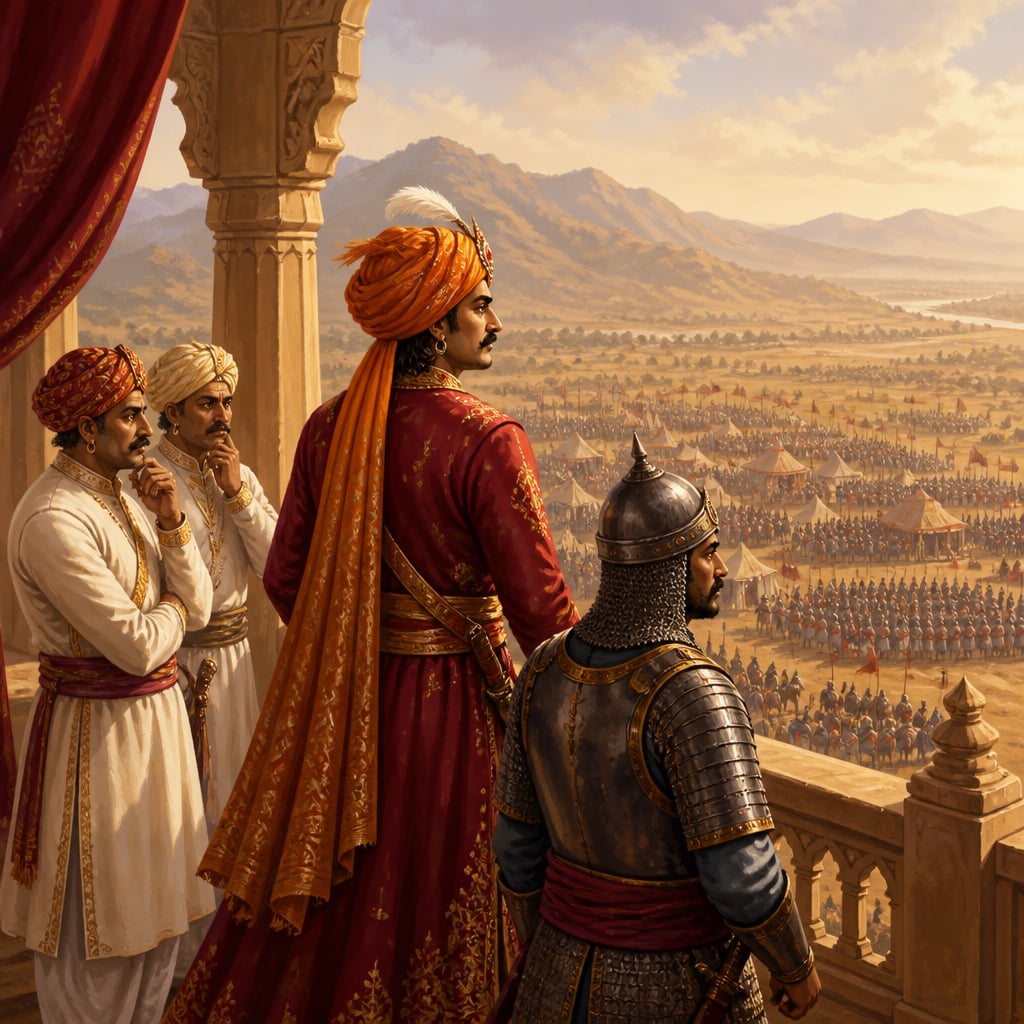
In 1526, while Babur and Ibrahim Lodi prepared for the battle that would decide Delhi's fate, Rana Sanga of Mewar did something remarkable: nothing.
The Rajput king commanded the most formidable army in India. His warriors had never been defeated. Ibrahim Lodi, the Sultan of Delhi, had requested his alliance against the Central Asian invader. Babur, the newcomer, had hinted at partnership against their common enemy.
Sanga chose neither. He waited.
His courtiers were puzzled. Here was an opportunity to join the winning side, to gain territory, to shape the subcontinent's future. Why sit idle while history was being made at Panipat?
Sanga's calculation was coldly strategic: Let them exhaust each other. Whoever won would be weakened. Whoever lost would be destroyed. And then the fresh forces of Mewar would face not a powerful enemy but a depleted victor.
This was Asana, Kautilya's third measure, the strategic choice of staying neutral.
The Wisdom of Stillness
"उभयोः क्षये आसनम्" "When both sides are declining, stay neutral."
Asana literally means "sitting", the same word yoga uses for its postures. But in strategic context, it means far more than passivity. It means watchful stillness. Active waiting. The discipline to not act when action would waste more than it gains.
Kautilya placed Asana third, after Sandhi (peace) and Vigraha (war). This positioning reveals his insight: sometimes neither peace nor war serves your interests. Sometimes the wisest choice is to stay out entirely while others fight.
Sanga understood this. Panipat was not his battle. The outcome, whether Lodi held Delhi or Babur took it, mattered less than preserving Mewar's strength. Intervening would cost Rajput lives for uncertain gain. Waiting cost nothing and might yield everything.
When Neutrality Serves
Kautilya identified specific conditions favoring Asana:
When both sides are enemies. If two rivals fight, why help either win? Let them exhaust each other. The victor emerges weakened. Your strength, preserved, becomes relatively greater.
When you're not ready. Sometimes intervention is impossible regardless of desire. Your army needs rebuilding. Your treasury is depleted. Internal problems demand attention. Entering conflict from weakness is worse than staying out.
When the timing isn't right. The strategic moment matters. Wait for enemies to weaken further. Wait for allies to commit. Wait for better intelligence. Strategic patience often yields what hasty action cannot.
When involvement would create new enemies. Taking sides converts neutral parties into opponents. Even the side you help may resent your involvement. Neutrality preserves options with everyone.
Asana from Strength

Warren Buffett practices corporate Asana. When markets panic, when other investors rush to act, Berkshire Hathaway often sits still. "Our favorite holding period," Buffett famously said, "is forever."
This isn't passivity, it's discipline. While competitors chase trends, Buffett watches. While others exhaust capital on frantic trades, Berkshire accumulates. When the moment finally comes, Buffett acts from strength others have spent.
The key is that Asana must be practiced from power, not weakness:
Maintain capability. Sanga's army remained ready throughout his neutrality. He could intervene if circumstances demanded. Neutrality without capacity is just helplessness with a dignified name.
Watch actively. Use the time others spend fighting to gather intelligence. Observe strengths and weaknesses. Understand strategies and intentions. Learn from others' mistakes without paying for your own.
Preserve options. Neutrality maintains flexibility. Keep relationships with all sides. Avoid commitments that limit future choices. Position yourself to join whichever side serves your interests, when and if you choose.
The Dangers of Waiting
Sanga's story has a second act. After Panipat, he did engage Babur, at the Battle of Khanwa in 1527. But the calculations that had been so shrewd became tragic.
Babur hadn't been weakened as much as Sanga expected. The Mughal's victory over Lodi had consolidated his position, attracted Indian allies, and given his army battlefield confidence. The fresh Rajput forces faced not a depleted victor but a strengthened one.
Sanga lost. Mewar never fully recovered.
Asana carries risks:
The winner may turn on you. The side you allowed to win may prove stronger than anticipated, and see you as the next target.
You may miss the moment. Early involvement shapes outcomes. Waiting too long forfeits influence. The right time to act passes.
Neutrality may become impossible. Events can force involvement regardless of preference. Geography, alliances, economics, external factors may drag you in.
Kautilya taught:
"कालः कार्यं साधयति" "Time accomplishes the task."
But time is double-edged. It can weaken your enemies, or strengthen them. It can create opportunities, or close them. The art of Asana lies in knowing when to wait and when waiting has become procrastination.
Asana in Modern Life
Azim Premji transformed Wipro by practicing strategic Asana during India's IT boom of the 1990s. While competitors rushed into every new technology trend, Premji often waited. Let others discover which trends were real and which were hype. Let competitors spend resources on failures. Then move decisively into validated opportunities with full commitment.
"We were not the first mover," Premji observed. "We were the smart mover."
The same logic applies to personal and professional decisions:
In organizations: Factional battles erupt constantly. Senior leaders clash. Departments compete for resources. The colleague who takes sides in every dispute accumulates enemies. The one who maintains relationships across divisions, practicing office Asana, preserves options and influence.
In careers: Not every opportunity deserves pursuit. Not every conflict deserves engagement. Sometimes the promotion isn't worth the political capital. Sometimes the project isn't worth the risk. Strategic selectivity, knowing when to stay out, often serves careers better than frantic involvement in everything.
In personal life: Family conflicts, friend disputes, social drama, the pressure to take sides is constant. But many conflicts resolve themselves if you simply wait. Others exhaust themselves. The person who stayed neutral emerges with relationships intact on all sides.
The Discipline of Not Acting
Asana may be the hardest of the six measures because it fights human instinct. We want to act. We feel pressure to do something. Inaction feels like weakness, like missing out, like surrendering initiative.
Kautilya understood this:
"स्थानेन स्थाने तिष्ठेत्" "By understanding one's position, one should stay in place."
The discipline is in the assessment. Before every potential involvement, ask:
- Does this conflict actually affect my core interests?
- Would involvement improve my position or just deplete resources?
- What happens if I simply wait?
- Is this the right moment, or will a better one come?
Sanga asked these questions at Panipat and got the answers right. He asked them again before Khanwa and got them wrong. Strategic judgment isn't a formula, it's an art that requires constant recalibration.
Freedom Through Restraint
The ruler who enters every conflict loses freedom. Resources deplete. Enemies multiply. Options narrow. The one who can choose when to fight, and when to watch, preserves the most precious strategic asset: the ability to act when action truly matters.
This is Asana's deepest lesson. It's not about avoiding all conflict. It's about reserving your strength for the conflicts that matter. Not every battle is worth fighting. Not every opportunity is worth seizing. The wisdom lies in distinguishing, and in having the discipline to stay still when stillness serves better than motion.
Rana Sanga understood this at Panipat, when his patience gave him options. He forgot it before Khanwa, when his patience had turned to hesitation. The line between strategic waiting and fatal delay is thin.
Kautilya would say: know which side of that line you stand on. And when in doubt, watch a little longer.
Asana (neutrality) represents the third measure in Shadgunya, the strategic choice to neither make peace nor wage war. It is active non-involvement, watching while preserving capability, waiting while gathering intelligence, appearing inactive while actually positioning for eventual advantage.
Warren Buffett's investment philosophy embodies corporate Asana: 'Our favorite holding period is forever.' While others frantically trade, Berkshire Hathaway watches. This echoes Kautilya but lacks the mandala context, Buffett operates in markets, while Kautilya operated in a circle of neighboring kingdoms where neutrality had immediate geographic and military implications.
Kautilya's unique insight is that neutrality must be practiced from strength, not weakness. Swiss neutrality survives because of military capability; helpless nations have no neutrality, only irrelevance. Asana preserves options precisely because the neutral power could intervene if it chose, the threat of potential involvement is itself strategic leverage.
In 1526, Rana Sanga of Mewar practiced Asana during the Battle of Panipat between Babur and Ibrahim Lodi. While two great armies clashed, Sanga's fresh forces waited, letting rivals exhaust themselves. Though his later engagement at Khanwa failed, his initial neutrality demonstrated strategic calculation, let others bleed while you watch, then act from strength.
Asana requires understanding the difference between stillness and stagnation. The neutral power must maintain military readiness, economic vitality, diplomatic connections, and intelligence networks. Neutrality is the choice of a capable state that could act but chooses to wait, not the helplessness of a state that cannot act at all.

Switzerland's armed neutrality since 1815 parallels Kautilyan Asana, staying out of European wars while maintaining strong defense. However, Swiss neutrality emerged from exhaustion after the Napoleonic Wars, while Kautilya's Asana is a deliberate choice among six strategic measures, selected based on situational analysis rather than permanent policy.
Verses
उभयोः क्षये आसनम्।
ubhayoḥ kṣaye āsanam |
When both [rivals] are declining/exhausting themselves, neutrality [is advised].
When enemies are fighting each other and both growing weaker, the wise choice is to stay out. Let them exhaust themselves; you preserve strength while they deplete theirs.
Book 7, Chapter 1, Verse 15 (R.P. Kangle)
स्थानेन स्थाने तिष्ठेत्।
sthānena sthāne tiṣṭhet |
By [understanding one's] position, one should stay in place.
Neutrality should be based on clear-eyed assessment of your position. If your situation favors waiting - if you're not ready, if involvement would cost more than gain, if time works for you - then stay in place.
Book 7, Chapter 1, Verse 18 (R. Shamasastry)
कालः कार्यं साधयति।
kālaḥ kāryaṃ sādhayati |
Time accomplishes the task.
Strategic patience recognizes that time itself can achieve objectives. Enemies who seem invincible may weaken.
Book 7, Chapter 4, Verse 5 (L.N. Rangarajan)
Case studies
Swiss Neutrality: Centuries of Asana
Since 1815, Switzerland has maintained armed neutrality, staying out of Europe's wars while building prosperity. During World Wars I and II, while neighboring countries were devastated, Switzerland preserved its independence through strategic non-involvement combined with strong defense.
Swiss policy exemplifies key asana principles: neutrality from strength (capable military deters attack), active non-involvement (trading with all sides, serving as diplomatic center), and consistent positioning (predictable neutrality builds credibility). Switzerland demonstrates that asana can be sustainable long-term strategy.
Switzerland avoided the destruction that consumed its neighbors, built prosperity as a banking and diplomatic center, and maintained independence while empires rose and fell around it. Its neutrality became valuable to all parties.
Strategic neutrality works best when practiced from strength, consistently maintained, and valuable to all sides. Switzerland shows that asana can be a sustainable position for those who can maintain it - but it requires ongoing investment in defensive capability and diplomatic skill.
Singapore practices a modern version of Swiss-style strategic neutrality, positioning itself as a neutral financial and trade hub while maintaining strong defensive capabilities. In the corporate world, companies like Stripe and Twilio have grown by remaining platform-neutral, serving all sides without favoring any single ecosystem. Strategic neutrality, when backed by genuine value, can be the most profitable position of all.
Switzerland's GDP per capita consistently ranks among the world's top five despite having no natural resources, no coastline, and being surrounded by countries that fought devastating wars throughout the 20th century.
Historical context
c. 4th century BCE to Present
Ancient India's numerous kingdoms often faced choices about involvement in others' conflicts. Some practiced asana successfully - staying out while neighbors fought, then emerging relatively stronger. Others were drawn in despite preferring neutrality. The Arthashastra helped rulers think systematically about these choices.
The ability to choose non-involvement is itself strategic power. States and individuals who are drawn into every conflict exhaust themselves. Those who can distinguish relevant from irrelevant conflicts, who can wait for the right moment, often achieve more with less.
Reflection
- Think of a conflict you joined that, in retrospect, didn't really concern you. What drew you in? What did involvement cost you? What would staying neutral have preserved?
- When is neutrality wisdom and when is it cowardice or complicity? If others are being harmed, does staying neutral make you responsible for the outcome?