Dvaidhibhava

The Double Strategy

Playing both sides. The sophisticated art of dual policies with different parties.

The Emperor Who Spoke in Two Voices
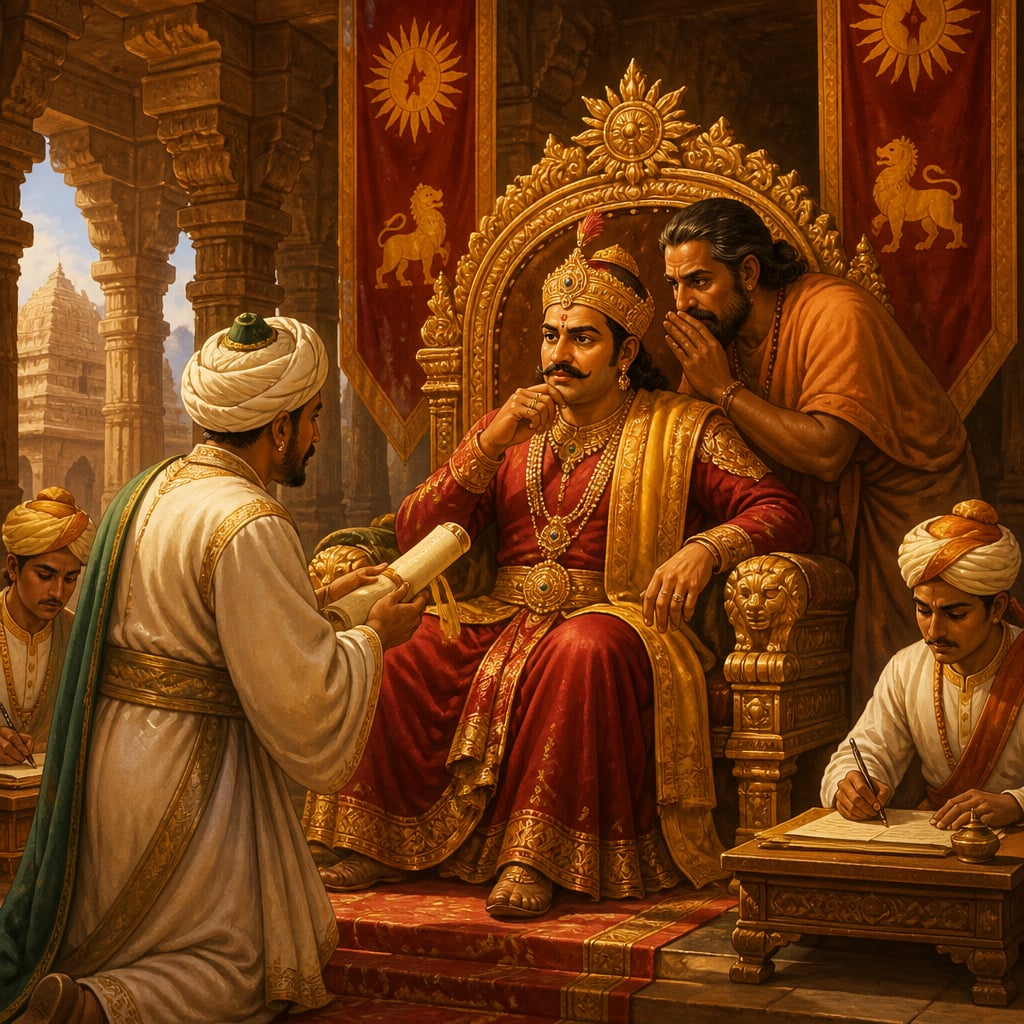
Krishnadevaraya receiving the Bijapur embassy while his advisor whispers opposing counsel

Krishnadevaraya ruled the Vijayanagara Empire at its zenith. His enemies were legion, the Bahmani successor states surrounded him, each hungry for Hindu gold. A straightforward policy would have united them against him. A single alliance would have made enemies of all others.

Instead, Krishnadevaraya practiced Dvaidhibhava, the double policy.

To the Sultan of Bijapur, he sent ambassadors speaking of friendship and trade. To Bijapur's rival in Golconda, he sent different ambassadors with similar messages. To the nobles within Bijapur who chafed under their sultan, he sent gold and promises. To the sultan's enemies among the Deccan powers, he offered alliance.

No one knew his true position. Everyone believed they had his favor. When his enemies finally realized they'd been played against each other, Krishnadevaraya's armies had already achieved what diplomatic confusion had prepared.

"He speaks with many tongues," a frustrated Deccani chronicler wrote, "and each tongue tells what the listener wishes to hear."

This was the sixth measure of statecraft, the most sophisticated and dangerous of them all.

The Art of Ambiguity

"द्वैधीभावेन संरक्षेत्" "Through double policy, one protects oneself."

Dvaidhibhava means "dual state" or "double disposition." It's the deliberate maintenance of contradictory policies with different parties simultaneously, peace with one while preparing war with another, friendship publicly while undermining secretly, commitment to no one while appearing committed to everyone.

Where the other five measures represent clear choices, Dvaidhibhava represents the strategic use of unclear choices. It recognizes that in complex environments, ambiguity itself becomes power.

Kautilya placed it last among the Shadgunya because it's the most difficult to execute. It requires:

The Logic of Contradiction

Why would a ruler adopt contradictory policies? Several strategic logics apply:

Hedging against uncertainty. The future is unknowable. Today's ally may become tomorrow's enemy. By maintaining relationships with opposing parties, you preserve flexibility when circumstances shift.

Managing multiple threats. Krishnadevaraya faced five sultanates. A single alliance with one made enemies of the others. Dvaidhibhava let him manage all relationships without committing irrevocably to any.

Exploiting others' conflicts. When enemies fight each other, the wise ruler might support both, enough to keep the conflict going, depleting both, while positioning to gain regardless of outcome.

Creating confusion. Enemies who can't predict your intentions can't prepare against you. Strategic ambiguity keeps adversaries off-balance.

Types of Double Policy

Sandhi-Vigraha Dvaidhibhava: Peace with one party while war with another. Krishnadevaraya maintained cordial relations with Bijapur while actively fighting Golconda, then reversed these positions when circumstances changed.

Open-Secret Dvaidhibhava: Public friendship with hidden hostility. The ambassador brings gifts while the spy undermines. The treaty is signed while preparations for its violation continue.

Temporal Dvaidhibhava: Friendship today, enmity tomorrow, sequential contradiction that appears consistent moment to moment but forms an inconsistent pattern over time.

"एकं ज्ञात्वा परं रक्षेत्" "Knowing one, protect from the other."

Dvaidhibhava in Modern India

Dhirubhai Ambani working two telephone lines simultaneously at his Bombay office

Dhirubhai Ambani built Reliance Industries through corporate Dvaidhibhava that his critics called ruthless and his admirers called strategic. He maintained relationships with competing political factions, invested in media outlets across the spectrum, cultivated regulators while fighting regulations, and kept competitors uncertain about his true intentions until his moves were complete.

"Dhirubhai never had enemies," a contemporary observed. "He had people who hadn't yet realized they were helping him."

The principles remain relevant across domains:

In business: Companies negotiate with multiple partners simultaneously, maintain relationships with competitors in some markets while fighting them in others, signal different intentions to different stakeholders. Strategic ambiguity preserves options until commitment becomes necessary.

In careers: The professional who maintains relationships across competing organizations, who keeps options open without premature commitment, who cultivates opportunities in multiple directions, this is personal Dvaidhibhava. The danger lies in being discovered; the reward lies in flexibility.

In negotiation: Revealing your true position weakens bargaining leverage. Strategic ambiguity about priorities, alternatives, and walk-away points strengthens your hand. The negotiator who seems committed to multiple outcomes can choose among them.

The Ethics of Deception

Dvaidhibhava raises questions the other measures don't. Isn't this simply lying? Is strategic deception compatible with dharma?

Kautilya's response was characteristically pragmatic:

Different domains, different rules. Personal relationships require honesty. Interstate relations, where survival is at stake and trust cannot be guaranteed, may require strategic ambiguity. The ruler who protects his people through Dvaidhibhava may be more virtuous than one whose rigid honesty precipitates war.

Consequences matter. If deception prevents conflict that would kill thousands, is it justified? Kautilya would say results must be weighed. The means serve the ends.

But limits exist. Even Kautilya acknowledged boundaries. Sacred oaths carry greater weight. Some forms of betrayal violate dharmic limits. Dvaidhibhava should serve strategic purpose, not become mere treachery.

Reputation constrains. The ruler known for constant deception loses the ability to make credible commitments. Dvaidhibhava works when used selectively. The ruler who sometimes practices it retains credibility when he commits clearly. The ruler who always practices it is trusted by no one.

Implementing Double Policy

Compartmentalize information. Different agents handling different policies shouldn't know each other's activities. The ambassador maintaining friendship shouldn't know about the spies fomenting rebellion. Leaks destroy Dvaidhibhava.

Maintain consistency within each relationship. The party you're befriending should see only friendship. The party you're undermining shouldn't see the connection to your friendly overtures elsewhere. Each audience must receive a coherent message.

Plan the transition. Dvaidhibhava is inherently temporary. Eventually, ambiguity resolves into clarity, secrets are discovered, circumstances force commitment, objectives are achieved. Plan how the double policy ends and what configuration follows.

Accept the risks. Discovery before you're ready can be catastrophic. The sultanates eventually understood Krishnadevaraya's game, but by then, his position was secure enough to withstand their belated alliance. Timing matters enormously.

"अनेकत्र भावः शक्तिः" "Multiple positions are power."

The Limits of Ambiguity

Krishnadevaraya's successors couldn't maintain his strategic sophistication. The Dvaidhibhava that protected the empire under his skilled management became mere inconsistency under lesser rulers. Enemies learned to discount Vijayanagara's commitments. Allies stopped trusting its promises. The strategic ambiguity that had been strength became weakness that invited the coalition that destroyed the empire at Talikota.

This illustrates Dvaidhibhava's fundamental danger: it requires exceptional skill to maintain. The ruler who practices it must:

Not every situation calls for Dvaidhibhava. Not every ruler can execute it. Used poorly, it destroys the trust that makes any policy effective.

Chapter Conclusion

You've now completed the Shadgunya, Kautilya's six measures of foreign policy:

Sandhi (Peace): When agreement serves better than conflict Vigraha (War): When fighting becomes necessary Asana (Neutrality): When staying out preserves strength Yana (Advance): When the moment demands movement Samsraya (Protection): When shelter enables survival Dvaidhibhava (Double Policy): When ambiguity becomes strategic asset

These aren't mutually exclusive choices but tools in a toolkit. The wise ruler, or the wise individual navigating complex environments, knows when each applies, how to combine them, and how to transition between them.

Krishnadevaraya used all six during his reign. He made peace when it served, war when it served, waited when waiting served, advanced when opportunity demanded, sought powerful allies when needed, and maintained strategic ambiguity throughout. His greatness lay not in any single measure but in knowing which to apply when.

"षाड्गुण्यचिन्तया नित्यं राज्यवृद्धिः प्रजायते" "Through constant reflection on the six measures, the kingdom prospers."

In our next chapter, we'll explore what makes a state powerful enough to choose among these measures, the seven Prakritis that determine a kingdom's strength and a ruler's options.

Dvaidhibhava (double policy) is the sixth and most sophisticated measure in Shadgunya. It means maintaining contradictory policies with different parties simultaneously, peace with one while preparing war with another, public friendship with hidden hostility, commitment to no one while appearing committed to everyone. Where the other five measures represent clear choices, Dvaidhibhava represents strategic use of unclear choices.

Machiavelli advised princes to appear virtuous while acting pragmatically, but Kautilya goes further, actively maintaining contradictory positions with different parties. Modern 'strategic ambiguity' (like US policy toward Taiwan) resembles Dvaidhibhava but lacks its systematic integration into a complete strategic framework. Kissinger's triangular diplomacy (balancing China and USSR) exemplifies Western Dvaidhibhava.

Kautilya's unique insight is that ambiguity itself becomes power: अनेकत्र भावः शक्तिः (anekatra bhāvaḥ śaktiḥ) - 'Multiple positions are power.' The ruler with only one policy, one ally, one approach is vulnerable. The ruler maintaining multiple positions, even contradictory ones, possesses the power of choice. Enemies who cannot predict your intentions cannot prepare against you.

Krishnadevaraya of Vijayanagara mastered Dvaidhibhava with the Bahmani successor states. To Bijapur he sent ambassadors speaking friendship; to Golconda he sent similar messages; to nobles within both sultanates he sent gold and promises. No one knew his true position. Everyone believed they had his favor. By the time enemies realized they'd been played against each other, his armies had achieved what diplomatic confusion prepared.

Implementing Dvaidhibhava requires exceptional operational skill: compartmentalize information (different agents handling different policies shouldn't know each other's activities), maintain consistency within each relationship (each party should see only coherent messages), plan the transition (ambiguity is inherently temporary), and accept the risks (discovery before you're ready can be catastrophic).

A modern intelligence agency situation room running dual operations at midnight

Intelligence agencies inherently practice Dvaidhibhava, maintaining relationships with parties on opposite sides of conflicts, running agents with contradictory loyalties. However, modern intelligence work is specialized function, while Kautilya treats Dvaidhibhava as one of six measures available to any ruler. The sophistication lies in integrating double policy into normal statecraft rather than segregating it as specialized deception.

Verses

द्वैधीभावेन संरक्षेत्

dvaidhibhāvena saṃrakṣet

Through double policy, one protects oneself

This sutra establishes the protective function of Dvaidhibhava. In a world of multiple threats and uncertain alliances, maintaining flexibility through strategic ambiguity provides security that rigid commitment cannot. The ruler who keeps options open can respond to changing circumstances.

एकं ज्ञात्वा परं रक्षेत्

ekaṃ jñātvā paraṃ rakṣet

Knowing one, protect from the other

Dvaidhibhava often involves using knowledge gained from one relationship to protect against threats from another. The intelligence gathered through friendly relations informs preparation against enemies. Information flows through both channels to the strategic center.

अनेकत्र भावः शक्तिः

anekatra bhāvaḥ śaktiḥ

Multiple positions are power

Strategic power comes from maintaining multiple options simultaneously. The ruler with only one policy, one ally, one approach is vulnerable. The ruler who maintains multiple positions, even contradictory ones, possesses the power of choice and the strength of flexibility.

Case studies

The Venture Capital Decision

A startup founder has received term sheets from two venture capital firms that compete intensely with each other. VC Firm A offers better financial terms but is known for heavy involvement in portfolio companies. VC Firm B offers less money but more operational freedom. Both firms have asked for exclusivity while conducting due diligence. The founder suspects that revealing either offer to the other could improve terms, but also knows that playing the firms against each other could alienate both. The startup needs funding within 60 days.

This case illustrates business Dvaidhibhava at a critical juncture. The founder faces classic double-policy dynamics: maintaining relationships with competing parties who would prefer exclusivity. Effective application of Dvaidhibhava might involve: (1) avoiding explicit lies while not volunteering complete information; (2) using the existence of alternatives to improve terms without poisoning relationships; (3) maintaining genuine openness to either outcome; (4) planning the transition, whichever firm is not selected must be handled with grace for future relationship preservation. The key insight is that Dvaidhibhava serves transition, it creates conditions for eventual clear commitment. The founder should work toward a decision timeline that preserves options while moving toward resolution.

The founder faces a classic Dvaidhibhava scenario: maintaining relationships with two competing powers while extracting value from each. Playing them against each other risks alienating both. Choosing one transparently risks leaving money on the table. The optimal strategy is to maintain genuine parallel negotiations, make each firm feel valued for distinct reasons, and use the 60-day deadline as natural urgency rather than manufactured pressure.

Dvaidhibhava works best when you offer genuine value to each party rather than simply playing them off each other. Dual engagement must be honest enough to sustain trust if either party discovers the full picture.

Founders routinely manage relationships with competing investors, clients, or partners. The key is offering genuine, differentiated value to each side. Companies like ARM license chip designs to Apple, Samsung, and Qualcomm simultaneously, maintaining trust with competitors by ensuring each relationship delivers unique benefits. Playing multiple sides only works when each side gets something real.

Research shows that startups playing two VC firms against each other during negotiations fail to close funding 23% more often than those who negotiate transparently with a preferred partner.

Reflection

More in Shadgunya

All lessons in Shadgunya · Arthashastra: Art of Strategy course