Sandhi

Making Peace

Peace is not weakness - it's strategy. Learn the first of Kautilya's six measures of foreign policy: when to make peace, how to negotiate from strength, and why the wisest rulers consider peace before war.

The Peace That Built an Empire
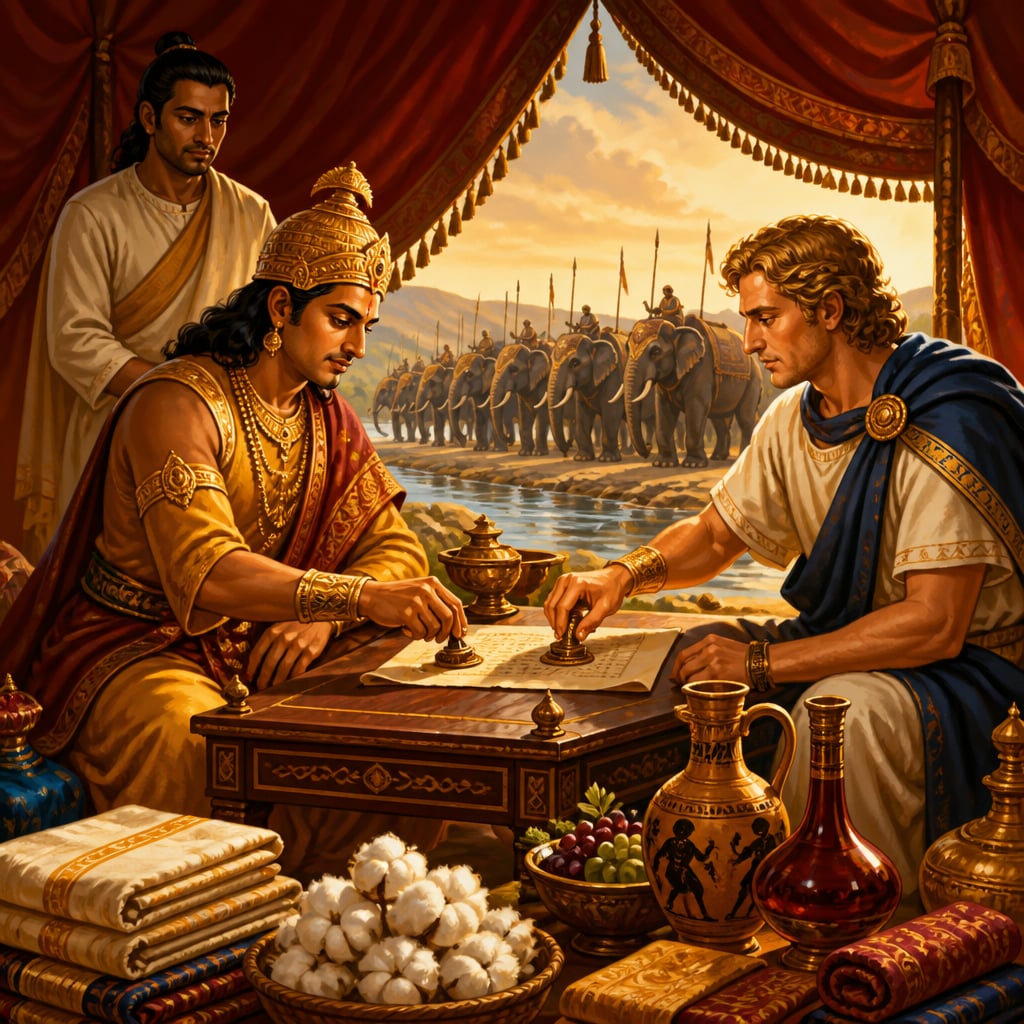
Chandragupta and Seleucus signing the peace treaty at the Indus, 303 BCE

Seleucus Nicator had crushed armies from Egypt to Persia. His Macedonian veterans had conquered half the known world under Alexander. Now, in 305 BCE, he marched toward India with elephants, cavalry, and the confidence of a man who had never lost.

Chandragupta Maurya waited at the frontier. His own army was formidable, but more important was the message he sent ahead: "Let us talk."

The Greek generals scoffed. Why negotiate when you could conquer? But Seleucus was shrewder than his subordinates. He'd seen the Mauryan forces at the Indus. He'd calculated the distance from his base in Babylon. He understood something his officers didn't: winning this war might cost more than losing it.

What emerged was one of history's most consequential peace treaties. Seleucus withdrew from the Hindu Kush, ceding territories Alexander had conquered. In exchange, he received 500 war elephants, animals that would later win him the Battle of Ipsus and secure his entire western empire. A marriage alliance sealed the arrangement.

"Both kings," the Greek historian Strabo later wrote, "gained more from peace than either could have won from war."

This was Sandhi, Kautilya's first principle of statecraft.

The Strategic Priority of Peace

When Kautilya enumerated the six measures of foreign policy, the Shadgunya, he placed Sandhi first. Not second, not equal to war, but first.

"षाड्गुण्यमिति संधिविग्रहासनयानसंश्रयद्वैधीभावाः" "The sixfold policy consists of: peace, war, staying neutral, marching, seeking shelter, and dual policy."

This ordering wasn't arbitrary. It reflected hard-won wisdom: war is easy to start and hard to end; peace is hard to make and easy to break, but the wise ruler seeks it anyway.

Why? Because Kautilya understood costs. Armies consume treasury. Campaigns kill farmers who should be growing food. Victory often costs more than defeat would have. And even success creates new problems, conquered territories require garrisons, resentful populations require suppression, extended borders require defense.

Peace avoids all this. If you can achieve your objectives through negotiation, every soldier who doesn't die, every rupee not spent, every field not burned represents pure strategic gain.

The Logic of Sandhi

Consider the calculus Chandragupta and his minister Kautilya must have made facing Seleucus:

Option A: War

Option B: Peace

The choice was obvious, once ego was set aside.

Kautilya taught:

"समशक्तयोः संधिः श्रेयान् विग्रहात्" "Between equals in power, peace is better than war."

When neither side has decisive advantage, conflict becomes a costly gamble. The resources spent fighting could be invested in growth. The casualties suffered could be citizens producing wealth. The time consumed could be used building strength.

The Art of Making Peace

Ratan Tata closing the Jaguar Land Rover acquisition with Ford in 2008

Ratan Tata understood Sandhi when he negotiated the Jaguar Land Rover acquisition in 2008. Ford, the seller, was desperate, the global financial crisis was crushing American automakers. Tata could have driven a brutal bargain.

Instead, he offered fair terms. He retained existing management. He committed to British manufacturing. He treated the acquisition as partnership, not conquest.

The result? A grateful workforce, cooperative unions, and a brand that thrived under Tata ownership. Competitors who had driven harder bargains on similar acquisitions found themselves managing hostile employees and declining brands.

This exemplifies what Kautilya called Sama-Sandhi, peace between equals, where both parties maintain dignity and both benefit. It's the most stable form of peace because both sides want it to continue.

Contrast this with Hina-Sandhi, peace from weakness. When you're the weaker party, you accept unfavorable terms to survive. This is harder but sometimes necessary. The key is preserving core interests and future options. Accept today's losses to ensure tomorrow's survival.

When to Seek Peace

Kautilya identified specific conditions favoring Sandhi:

When you're gaining strength. If your trajectory is upward, economy growing, army strengthening, alliances forming, peace locks in gains while you continue improving. Time works for you; don't gamble what you're building.

When victory would cost too much. Some wars can be won but shouldn't be fought. If defeating an enemy would exhaust your treasury, alienate allies, or leave you vulnerable elsewhere, peace at acceptable terms is wiser than Pyrrhic victory.

When the enemy is temporarily weak. Counterintuitively, this is often the best moment for generous peace. A weakened enemy who receives fair terms becomes grateful. One who faces destruction fights with desperation, and remembers the humiliation forever.

When larger threats loom. If a greater danger approaches, make peace with smaller adversaries. Don't fight every battle. Save your strength for what matters.

The Negotiator's Toolkit

N. R. Narayana Murthy, co-founder of Infosys, once described negotiation as "finding the overlap between what you need and what they can give." This captures Kautilya's insight that sustainable peace requires mutual benefit.

Before any negotiation, know:

Then understand the other side equally well. What do they need? What pressures do they face? What would they consider acceptable? The best agreements serve both parties' core interests, because only those agreements last.

Kautilya warned against agreements that humiliate the other party. Even if you have the power to impose crushing terms, restraint serves you better. The enemy forced into degrading peace waits for revenge. The enemy who received fair terms might become tomorrow's ally.

Trust and Verification

Can peace agreements be trusted? Kautilya was realistic: trust must be earned, not assumed.

"परस्य वृद्धौ संधिं कुर्वीत" "One should make peace when the enemy is prospering."

This seems backward, shouldn't you make peace when you're strong? But Kautilya understood that peace with a strengthening enemy locks in acceptable terms before they become unacceptable. Waiting for perfect conditions means waiting forever.

Yet he also taught: prepare for failure. Even good agreements break down. Maintain the capabilities that deter betrayal. Have contingency plans. Don't become so dependent on any single agreement that its collapse destroys you.

The Mauryan-Seleucid peace lasted because both sides benefited from maintaining it. Seleucus got elephants and a secure eastern frontier. Chandragupta got freedom to consolidate his empire. Neither needed to break the agreement because neither wanted to.

Sandhi Beyond Statecraft

The logic of Sandhi operates wherever conflict might occur.

Two business executives reaching settlement in a Mumbai mediation chamber

In business: The litigation that drags on for years, consuming legal fees that exceed any possible judgment. The price war that destroys both companies' margins. The hostile acquisition that poisons the acquired company's culture. In each case, negotiated settlement, Sandhi, often serves both parties better than fighting to the end.

In careers: The colleague you could undermine but instead accommodate, creating an ally for future battles. The negotiation you could "win" but instead structure as mutual benefit, building a relationship that outlasts any single deal.

In families: The inheritance dispute that could tear siblings apart, or the mediated settlement that preserves relationships. The divorce that could become warfare, or the negotiation that protects children's interests.

In every domain, the Sandhi question applies: Is fighting for this outcome worth more than negotiating for an acceptable one?

The Deeper Wisdom

Kautilya's placement of Sandhi first teaches something profound about power and freedom.

The ruler who defaults to war surrenders freedom. Once committed to conflict, options narrow. Resources deplete. Enemies multiply. The war you could have avoided consumes the strength you needed for the war you couldn't.

The ruler who considers peace first preserves freedom. Negotiation maintains options. Settlement preserves resources. Today's enemy, fairly treated, might become tomorrow's ally.

This isn't pacifism, Kautilya dedicates extensive chapters to war. It's strategic wisdom. Fight when you must. But first, genuinely ask: Can peace achieve what war would cost far more to win?

Seleucus asked that question at the Indus. His answer built an empire. The question awaits you in your next conflict.

Sandhi is the first measure of the Shadgunya, representing strategic accommodation. It recognizes that peace often preserves resources and achieves objectives more efficiently than conflict. The decision to seek peace is not weakness but calculated assessment that negotiated outcomes serve better than fought ones.

This parallels game theory's concept of positive-sum outcomes and Thomas Schelling's work on bargaining. Like Schelling, Kautilya understood that conflict is costly for all parties and that negotiated settlements often yield better results than zero-sum battles. Modern diplomatic theory emphasizes 'win-win' solutions, essentially the sama-sandhi (peace between equals) Kautilya described 2,300 years earlier.

Kautilya's unique insight is the systematic prioritization: peace comes first not from pacifism but from strategic calculation. Western just war theory focuses on when war is justified; Kautilya focuses on when war is necessary, a subtle but crucial distinction. He provides concrete criteria for choosing peace: when you're gaining strength, when victory would cost too much, when the enemy is temporarily weak (counter-intuitive but strategic), or when larger threats loom.

The Mauryan-Seleucid peace treaty (303 BCE) exemplifies strategic Sandhi. After military stalemate, Chandragupta negotiated from strength, exchanging territory for 500 war elephants, establishing marriage alliance, and securing his northwest frontier. Both empires benefited: Seleucus gained elephants that won him the Battle of Ipsus (301 BCE); Chandragupta gained freedom to consolidate his empire. This peace lasted generations because both parties gained more from maintaining it than breaking it.

Sama-sandhi (peace between equals) represents the most stable form of diplomatic settlement. Both parties come from positions of strength, both have alternatives to agreement, and both shape terms that protect core interests. This contrasts with hina-sandhi (peace from weakness) where the weaker party accepts unfavorable terms to survive. The strategic lesson: build capability before negotiating.

This aligns with realist international relations theory, particularly Kenneth Waltz's emphasis on the balance of power as a source of stability. It also reflects Roger Fisher and William Ury's concept of BATNA (Best Alternative to a Negotiated Agreement) from 'Getting to Yes', the party with better alternatives negotiates better terms. Cold War 'Mutual Assured Destruction' created a brutal form of sama-sandhi: neither superpower could win decisively, so both negotiated.

Verses

षाड्गुण्यमिति संधिविग्रहासनयानसंश्रयद्वैधीभावाः।

ṣāḍguṇyam iti saṃdhi-vigraha-āsana-yāna-saṃśraya-dvaidhībhāvāḥ |

The sixfold policy consists of: peace, war, staying neutral, marching, seeking shelter, and dual policy.

This foundational sutra establishes the six tools available to any ruler. Significantly, peace (sandhi) is listed first - not as the only option, but as the first to consider.

Book 7, Chapter 1, Verse 1 (R.P. Kangle)

समशक्तयोः संधिः श्रेयान् विग्रहात्।

sama-śaktayoḥ saṃdhiḥ śreyān vigrahāt |

Between equals in power, peace is better than war.

When neither side has decisive advantage, war becomes a costly gamble with uncertain outcomes. Peace preserves resources that war would consume.

Book 7, Chapter 2, Verse 1 (R. Shamasastry)

परस्य वृद्धौ संधिं कुर्वीत।

parasya vṛddhau saṃdhiṃ kurvīta |

One should make peace when the enemy is prospering/growing stronger.

Counter-intuitive wisdom: make peace when your enemy is strong, not when they're weak. Fighting a strengthening enemy is costly; accommodating them while building your own strength is wiser.

Book 7, Chapter 2, Verse 6 (L.N. Rangarajan)

Case studies

The Camp David Accords: Modern Sandhi

In 1978, Egyptian President Anwar Sadat and Israeli Prime Minister Menachem Begin, bitter enemies who had fought multiple wars, negotiated a peace agreement at Camp David. Both faced domestic opposition; both took enormous political risks; both calculated that peace served their interests better than continued conflict.

This exemplifies strategic Sandhi. Both parties negotiated from positions of strength - Egypt had performed better than expected in the 1973 war; Israel maintained military superiority but faced unsustainable costs. Both calculated that peace yielded better outcomes than continued conflict. The agreement included concrete terms (territorial adjustments, recognition, normalization) and external guarantees (US commitment).

The peace has held for over 45 years despite regional turbulence. Egypt recovered the Sinai; Israel gained recognition and secure border. Both freed resources for other priorities. Sadat paid with his life (assassinated by opponents), but the strategic logic proved sound.

Even the bitterest enemies can find Sandhi when both parties calculate that peace serves interests better than war. The key factors: negotiation from strength, concrete terms, mutual benefit, and external guarantees. Strategic peace doesn't require friendship - just aligned interests.

Corporate settlements follow the same Sandhi logic. Apple and Qualcomm fought bitterly over patent royalties until both realized the cost of continued conflict exceeded the cost of peace. Their 2019 settlement, reached from positions of mutual strength, mirrors how lasting peace agreements work: both sides must calculate that cooperation yields more than confrontation.

The Camp David Accords have held for over 45 years, making the Egypt-Israel peace one of the most durable treaties in modern Middle Eastern history. Egypt has received over $50 billion in U.S. military aid since signing.

Historical context

c. 4th century BCE

Ancient India's numerous kingdoms required constant diplomatic management. The Mauryan success came partly from sophisticated peace-making - converting enemies to allies, subordinating rivals through accommodation rather than destruction, and building networks of tributary relationships.

The Mauryan-Seleucid peace demonstrates Sandhi's value. After military confrontation, both parties chose accommodation. The result: decades of stable relations, cultural exchange, trade, and freedom to pursue other priorities. Conflict would have consumed resources and created lasting enmity.

Reflection

More in Shadgunya

All lessons in Shadgunya · Arthashastra: Art of Strategy course