Vigraha

Making War

Sometimes peace is not possible. Learn when and why war becomes the necessary strategic choice - not from aggression but from calculated assessment that conflict serves your interests better than alternatives.

The Night Before Tarain
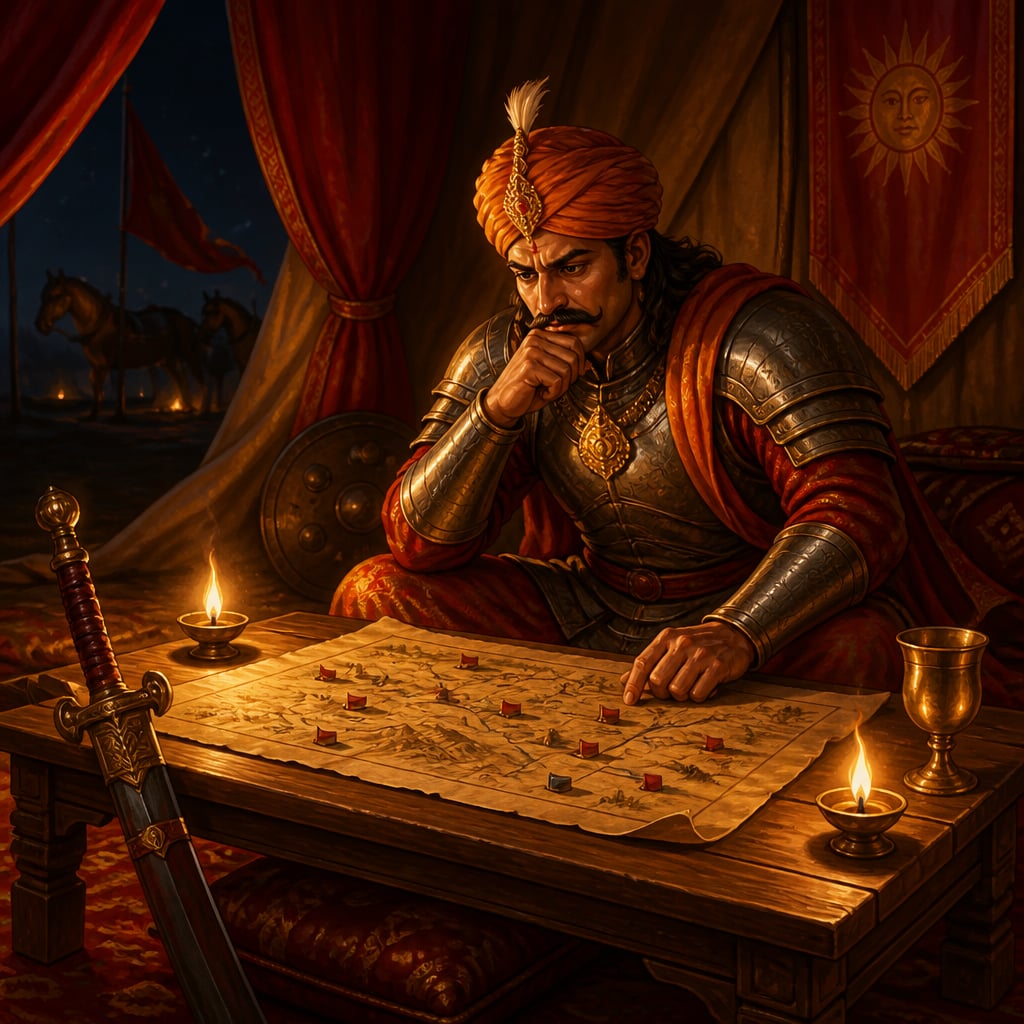
Prithviraj Chauhan in his command tent the night before the second battle of Tarain, 1192

Prithviraj Chauhan had defeated Muhammad of Ghor just a year earlier. The Rajput king had shown mercy, releasing the wounded Afghan general rather than executing him. His nobles celebrated the chivalry. His bards composed songs of honor.

Now, in 1192 CE, Muhammad was back. This time with fresh cavalry, bitter memory, and no intention of fighting the same battle twice.

Prithviraj faced a choice. His spies reported the Afghan army. His generals urged preemptive action, strike while Muhammad's forces were tired from the march, before they could properly deploy. But the Rajput king hesitated. Attacking unprepared enemies violated his code of war. Battle should be announced, formations set, honor satisfied.

By morning, it was too late. Muhammad's cavalry struck at dawn, using tactics the Rajputs hadn't prepared for. By noon, Prithviraj was captured. Within weeks, he was dead. Within years, northern India had changed forever.

Kautilya would have wept. Not at the defeat, but at the strategic blindness that caused it. Prithviraj understood honor. He didn't understand Vigraha.

The Second Measure

Vigraha, war, hostility, conflict, is the second of Kautilya's six measures. He placed it after Sandhi (peace) for a reason: peace is preferred when it achieves objectives. But he placed it second for an equally important reason: sometimes peace cannot achieve objectives, and war becomes necessary.

"स्वाभ्युदयो विग्रहः" "War is [justified by] one's own rise."

This isn't warmongering. It's strategic realism. The ruler who never fights eventually faces an enemy who knows he won't fight, and exploits that certainty. The kingdom that cannot make war loses the ability to keep peace.

When Vigraha Becomes Necessary

Kautilya identified specific conditions where war serves better than alternatives:

When the enemy won't negotiate acceptable terms. Prithviraj tried diplomacy with Muhammad of Ghor. Muhammad used the time to rebuild his army. Some enemies don't want peace, they want victory. Against such adversaries, negotiation is just delay disguised as strategy.

When you're stronger and the gap may close. If you have advantage now but the enemy grows stronger, waiting makes the eventual conflict harder. Chandragupta struck the Nandas while their empire faced internal rebellion. Waiting would have let them consolidate.

When vital interests are threatened. Some things cannot be negotiated away. Core territories, essential resources, commitments to allies, principles of legitimacy, when these are at stake, fighting may be necessary regardless of cost.

When reputation requires response. Prithviraj's mercy to Muhammad looked like honor from Pataliputra. From Ghazni, it looked like weakness that invited return. Sometimes failing to respond to aggression invites more aggression.

The War Calculus

Dhirubhai Ambani understood Vigraha in business terms. When Bombay Dyeing's Nusli Wadia attacked Reliance in the press and courts during the 1980s, Ambani didn't seek accommodation. He calculated: What would peace cost? What would fighting cost? Which path better served his company's future?

The calculus favored fighting. Ambani committed fully, legal battles, political connections, market competition. The conflict consumed years and fortunes. But Reliance emerged stronger, and competitors learned that attacking Ambani carried costs.

This is Vigraha logic:

Expected gains: What do you achieve through victory? Market position, eliminated threats, enhanced reputation, secured resources.

Expected costs: What do you spend to win? Treasury, casualties, opportunities foregone, new enemies created.

Probability of success: Can you actually win? Strength, leadership, alliances, terrain.

Costs of alternatives: What happens if you don't fight? Does the threat grow? Do allies lose confidence? Does weakness invite more aggression?

Only when the full calculation favors war should Vigraha be chosen. And even then, Kautilya warned:

"दुर्बलेन विग्रहः कार्यः" "War should be made with the weak."

This sounds ruthless. But it reflects strategic reality: fight when you can win. Against stronger enemies, seek alternatives. Against weaker threats, resolve them before they grow dangerous.

General Schwarzkopf briefing coalition commanders during Desert Storm, 1991

Types of Warfare

Vigraha doesn't mean only pitched battle. Kautilya distinguished three forms:

Prakasha-Vigraha (Open War): Declared conflict with armies in the field. Sieges, battles, territorial invasion. This is what most people imagine when they think of war, and often the most costly form.

Kuta-Vigraha (Concealed War): Indirect conflict through subversion, economic pressure, support for rebels, intelligence operations. The enemy feels pressure but can't clearly attribute it. This often achieves objectives at lower cost.

Combined warfare: Most effective strategies blend both. Military pressure creates urgency while subversion weakens from within. Diplomacy offers off-ramps while battles demonstrate capability.

The Mauryas excelled at this combination. Against the Nandas, they didn't just march an army, they cultivated defectors, spread rumors, disrupted supply lines, and created the conditions where military victory became almost automatic.

Conducting War Wisely

If Vigraha is chosen, conduct it strategically:

Define clear objectives. What does victory look like? The war that expands beyond its original purpose consumes the resources it was meant to secure. Chandragupta sought control of the Gangetic plain, not conquest of all India. He stopped when objectives were achieved.

Secure the rear. Before advancing, ensure no threat emerges behind you. The Mauryan genius included neutralizing or accommodating rear positions before confronting primary enemies. The campaign that leaves the homeland exposed has already failed.

Build alliances. Fight with friends when possible. The coalition that defeated the Nandas included kingdoms that had little love for Chandragupta, but shared hatred of the Nandas. Shared enemies create powerful alliances.

Maintain options for peace. Even in war, keep negotiation possible. Don't commit atrocities that make settlement impossible. Remember that today's enemy may be tomorrow's ally. The goal is achieving objectives, not endless conflict.

Know when to stop. Perhaps most important:

"विजयं प्राप्य संधिमागच्छेत्" "Having obtained victory, one should make peace."

Many victories were thrown away by failure to stop. Alexander conquered Persia, then kept marching until his army mutinied at the Beas. Overreach destroys what fighting secured.

Vigraha Beyond Battlefields

The logic of strategic conflict operates wherever serious competition exists.

In business: The price war that breaks a competitor, the patent battle that secures market position, the aggressive acquisition that preempts a threat. Companies that never fight eventually face competitors who know they won't, and exploit that certainty.

In careers: The direct challenge to a rival blocking advancement, the political battle for a position, the confrontation with someone taking credit for your work. Some professional situations require fighting, not accommodation.

In personal life: Standing firm against those who wrong you, fighting for custody of children, defending property against encroachment. The person who never fights loses the ability to deter aggression.

In each domain, Vigraha principles apply: calculate carefully, exhaust alternatives first, fight effectively if you must, and know when to stop.

The Price of Not Fighting

Prithviraj Chauhan's story illustrates the cost of avoiding necessary conflict. His mercy to Muhammad wasn't wisdom, it was blindness to strategic reality. The enemy who wouldn't negotiate acceptable peace required Vigraha. Refusing it cost a kingdom.

Chandragupta storming the gates of Pataliputra against the Nanda dynasty, 322 BCE

Contrast with Chandragupta, who chose Vigraha against the Nandas when analysis showed it necessary, fought effectively, and stopped when objectives were achieved. His war created an empire. Prithviraj's peace, or failure to fight, destroyed one.

Kautilya taught neither pacifism nor warmongering. He taught strategic clarity: Peace when peace serves. War when war serves. And the wisdom to distinguish between them.

The ruler who understands Vigraha doesn't seek conflict. But he's prepared for it when it comes, and capable of winning when it does.

Vigraha (war) is the second measure of the Shadgunya, employed when peace cannot achieve objectives. The decision requires rigorous cost-benefit analysis: expected gains versus expected costs, probability of success versus risk of failure, opportunity costs of conflict versus alternatives. War consumes treasury, casualties, and time, resources that could be invested elsewhere. It's justified only when the calculation clearly favors fighting over all alternatives.

This parallels Carl von Clausewitz's famous dictum that 'war is the continuation of politics by other means.' Like Clausewitz, Kautilya sees war as instrumental, a tool serving strategic objectives, not an end in itself. It also reflects modern cost-benefit analysis in defense economics and strategic studies. Thomas Schelling's work on conflict and bargaining similarly emphasizes rational calculation in decisions about when to fight. The difference: Kautilya provides more detailed criteria for the calculation.

Kautilya's unique contribution is the systematic enumeration of conditions favoring Vigraha: when the enemy won't negotiate acceptable terms, when you're stronger and the gap may close, when vital interests are threatened, when reputation requires response. He also distinguishes types of warfare (open versus concealed, direct versus indirect) and provides guidance on when each serves best. His calculus includes not just military factors but economic, diplomatic, and reputational considerations, a genuinely comprehensive strategic framework.

Chandragupta Maurya's war against the Nanda dynasty (321 BCE) exemplifies calculated Vigraha. The decision to fight wasn't impulsive, it came after years of preparation, cultivation of allies, intelligence gathering, and waiting for the right moment (internal Nanda rebellion). The war had clear objectives (control of the Gangetic plain), defined costs (the treasury and army Chandragupta had built), and realistic probability of success (given Nanda weakness and Mauryan preparation). Most importantly, it had clear endpoints, having achieved the core objective (taking Pataliputra), Chandragupta consolidated rather than pursuing endless expansion.

Preemptive action against emerging threats is often more effective and less costly than waiting for those threats to fully develop. The startup that could be acquired or out-competed today may be an unbeatable giant tomorrow. The internal opposition that could be accommodated or neutralized now may overthrow you later. The geopolitical threat that could be contained today may be uncontainable tomorrow. Strategic wisdom involves assessing threat trajectories and acting when conditions favor success.

This reflects realist international relations theory's emphasis on preventive action and the 'Thucydides Trap', the dangerous dynamic when a rising power threatens an established one. It parallels corporate strategy literature on disruption: incumbents often fail because they don't address new competitors until those competitors have grown too strong. It also connects to deterrence theory: demonstrating willingness to address threats early deters others from emerging. The ethical debates about preemptive war in international law grapple with exactly this tension between waiting for aggression and addressing threats before they fully materialize.

Verses

स्वाभ्युदयो विग्रहः।

svābhyudayo vigrahaḥ |

War is [justified by] one's own rise/prosperity.

Vigraha serves strategic self-interest. War is justified not by abstract principles but by whether it advances your position.

Book 7, Chapter 3, Verse 1 (R.P. Kangle)

दुर्बलेन विग्रहः कार्यः।

durbalena vigrahaḥ kāryaḥ |

War should be made with the weak.

This sounds harsh but reflects strategic reality. Fighting powerful enemies is costly and uncertain; fighting weak ones yields better outcomes.

Book 7, Chapter 3, Verse 8 (R. Shamasastry)

विजयं प्राप्य संधिमागच्छेत्।

vijayaṃ prāpya saṃdhim āgacchet |

Having obtained victory, one should make peace.

War is a means, not an end. Once objectives are achieved, transition back to peace.

Book 7, Chapter 13, Verse 1 (L.N. Rangarajan)

Case studies

The Gulf War: Calculated Vigraha

In 1990, Iraq invaded Kuwait. The US-led coalition faced a choice: accept Iraqi aggression or respond with force. After diplomatic efforts failed, coalition forces launched a campaign that achieved objectives in 100 hours of ground combat, then stopped.

This exemplifies strategic Vigraha. The coalition had clear objectives (liberate Kuwait), decisive advantage, and alliance support. When alternatives (sanctions, diplomacy) failed, war was chosen. Crucially, the coalition stopped when objectives were achieved rather than marching to Baghdad.

Kuwait was liberated; coalition casualties were minimal; Saddam Hussein remained in power but contained. Critics later questioned whether stopping was wise, but the decision reflected Kautilyan principle: achieve objectives, then stop.

Effective Vigraha requires clear objectives, decisive advantage, exhausted alternatives, and disciplined termination. The Gulf War showed both the power of calculated conflict and the importance of knowing when to transition back to containment.

The Gulf War's decisive and limited approach contrasts sharply with prolonged conflicts like the War on Terror. In business, the parallel is clear: hostile takeovers and aggressive market entries work when objectives are defined and exit criteria are set in advance. Companies that start competitive wars without clear victory conditions often find themselves trapped in costly stalemates.

The Gulf War coalition deployed over 700,000 troops from 35 nations. The 100-hour ground campaign achieved objectives that many analysts had predicted would take months.

Historical context

c. 4th century BCE

Ancient India saw constant warfare between kingdoms. The Arthashastra emerged from this environment - not as a manual for pacifism but as a guide for waging war effectively and knowing when to stop.

Mauryan success required effective Vigraha. Chandragupta couldn't have built the empire through peace alone - the Nandas wouldn't yield. But the Mauryan wars were calculated, not endless. They served objectives and transitioned to consolidation.

Reflection

More in Shadgunya

All lessons in Shadgunya · Arthashastra: Art of Strategy course