When War is Justified

Dharma-Yuddha vs Kutayuddha

War should be the last resort, not the first impulse. Kautilya distinguished between righteous warfare and covert operations, and more importantly, between war as aggression and war as defense of freedom. Learn when force is justified and when it betrays the very values it claims to protect.

The Reluctant General

Bhadrasena had served as commander of the northern garrison for twelve years. He knew every mountain pass, every river crossing, every village that could supply grain or shelter an army. When King Chandragupta summoned him to the capital in the spring of 303 BCE, he assumed it concerned routine border patrols.
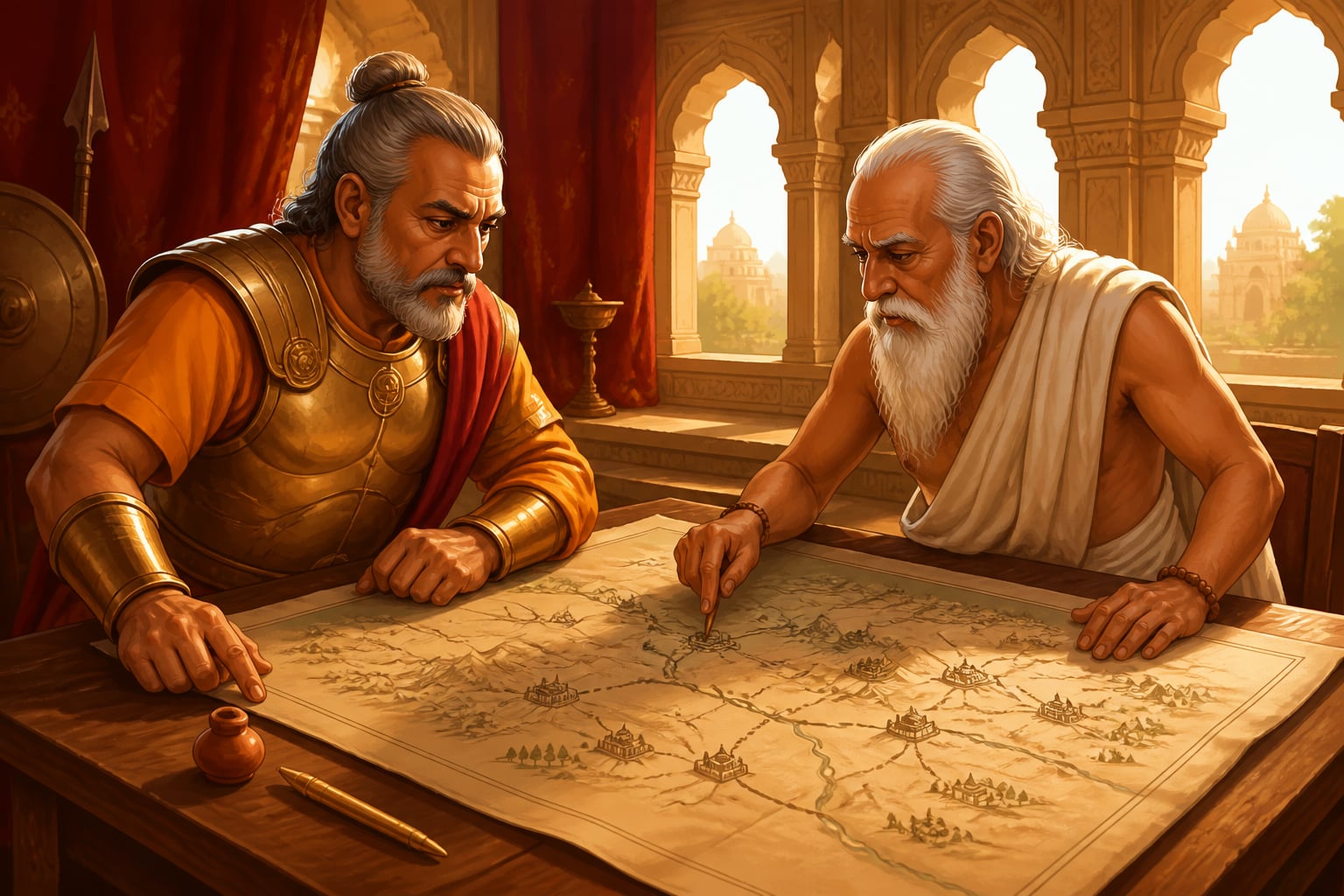
General Bhadrasena and Kautilya studying campaign maps in a Mauryan chamber

Instead, Kautilya greeted him with maps spread across a teak table. "Seleucus Nicator is assembling forces at Kabul," the aged advisor said without preamble. "Forty thousand infantry, cavalry, and war elephants. He intends to reclaim Alexander's Indian territories."

Bhadrasena studied the maps. The Mauryan positions were strong, better terrain, interior supply lines, knowledge of the ground. "We can defeat him," he said.

"That is not the question," Kautilya replied. "The question is: should we fight him?"

Bhadrasena looked up, surprised. Here was the man who had engineered the overthrow of the Nanda dynasty, who had written exhaustively about military strategy, asking whether to use military force. "He is invading our territory," Bhadrasena said. "What choice do we have?"

Kautilya's eyes were hard. "There is always a choice between the sword and the word. Sama, dana, bheda, danda, conciliation, gifts, dissension, force. Force is the fourth resort, not the first. War is justified only when all other methods have failed, or when defending freedom that cannot be preserved by other means."

This conversation, preserved in Mauryan records, reveals something essential about Kautilya's strategic philosophy. He was not a pacifist, the Arthashastra contains extensive military doctrine. But neither was he a militarist. War, in his framework, was a tool to be used when appropriate, not an ideology to be glorified.

The Two Kinds of War

Kautilya distinguished between two fundamentally different types of warfare: dharma-yuddha (righteous war) and kutayuddha (covert warfare). Understanding this distinction is essential to grasping his ethics of force.

Dharma-yuddha followed strict rules. Enemies of equal status fought at designated times and places. Civilians were not targeted. Retreating soldiers were not pursued. Wounded enemies were not killed. The goal was to defeat the opposing army, not to destroy the opposing society.

These rules weren't merely ceremonial. They reflected the principle that war should resolve disputes while preserving the possibility of peace afterward. If you massacre your enemy's population, poison their wells, and burn their crops, you may win, but you create hatreds that last generations. The cost of victory becomes permanent war.

Kutayuddha, by contrast, operated through deception, infiltration, and subversion. It was covert warfare, using spies to sow dissension, assassins to eliminate key leaders, propaganda to undermine enemy morale. There were fewer rules because kutayuddha didn't look like war.

Kautilya advocated both, but in different circumstances. Dharma-yuddha was appropriate between kingdoms of roughly equal power, where both sides could afford to follow rules and expect reciprocity. Kutayuddha was for asymmetric conflicts, when a weaker power faced a stronger one, or when facing an enemy who didn't follow dharmic rules.

The crucial insight is that the type of warfare should match the nature of the threat and the goal of the conflict. Rules-based warfare when preserving long-term peace. Covert warfare when survival demands it.

This isn't moral relativism, it's strategic realism. As Kautilya wrote: "Dharmārthaṃ yuddhaṃ, na krodhārthaṃ, war should serve righteous purpose, not anger." The distinction between legitimate defense and aggressive revenge determines whether force is justified.

The Costs That Must Be Counted

Before any war, Kautilya mandated systematic analysis of costs versus benefits. This wasn't about cowardice, it was about responsibility. A king who leads his people into war without counting costs is a gambler, not a leader.

The Arthashastra specifies what must be calculated:

Only if the expected gains exceeded these comprehensive costs should war be considered. And even then, only if non-violent methods, diplomacy, economic incentives, strategic alliances, had been exhausted.

This calculation wasn't abstract. Kautilya provided specific metrics. A war that would cost more than the treasury could sustain was unjustified. A war that would depopulate agricultural regions and cause famine was unjustified. A war fought for prestige rather than security was unjustified.

Compare this to modern military adventurism. The United States spent over two trillion dollars on the Iraq War, money that could have rebuilt American infrastructure, funded education, or developed clean energy. The human cost exceeded four thousand American deaths and hundreds of thousands of Iraqi deaths. The political cost included regional destabilization that persists decades later.

Was the threat so severe, the goal so essential, the alternatives so exhausted that these costs were justified? Kautilya would have demanded these questions be answered before the first soldier deployed, not debated afterward.

War as Defense of Freedom

Kautilya's most libertarian insight about war is this: the only ultimately justified war is defensive war, war fought to preserve freedom that cannot be maintained by other means.

He wrote: "Svarakṣārthaṃ yuddhaṃ dharmataḥ, war for self-preservation is righteous." When an aggressor threatens your kingdom's independence, when subjugation is the alternative to resistance, then force is not merely permitted but required.

This connects to his broader political philosophy. Freedom, svatantrya, was not merely the absence of foreign rule but the presence of self-governance. A people who surrender freedom without resistance have chosen slavery. The defense of freedom, therefore, is the defense of human dignity itself.

But, and this is crucial, the war must actually defend freedom, not merely claim to. Kautilya was deeply skeptical of wars fought under the banner of liberation that resulted in conquest. If your "defensive" war ends with you ruling the territory you "liberated," you weren't defending freedom, you were practicing imperialism with better marketing.

The test is simple: Does the conflict aim to restore the status quo ante (returning to the state before aggression) or to change it in your favor? Defensive war seeks restoration. Aggressive war seeks acquisition.

Chandragupta and Seleucus clasping hands at the 303 BCE Mauryan-Seleucid treaty pavilion

When Chandragupta ultimately negotiated with Seleucus rather than fighting him, the treaty reflected this principle. The Mauryans gained recognition of their western territories, lands they already controlled. Seleucus gained five hundred war elephants and a stable frontier. Neither side conquered the other. Both preserved their core interests.

Kautilya considered this outcome superior to military victory. The objective, securing the western frontier, was achieved. Mauryan independence was preserved. The cost was trade goods rather than blood. This was strategy, not cowardice.

The Modern Parallel: Just War Theory

Western philosophy developed "just war theory" primarily through Christian theologians, Augustine in the 4th century CE, Aquinas in the 13th century. But Kautilya articulated similar principles eight hundred years before Augustine.

Modern just war theory distinguishes between jus ad bellum (justice of going to war) and jus in bello (justice in conducting war). Kautilya's distinction between justified warfare and the conduct of warfare maps precisely onto this framework.

Jus ad bellum requires:

Every one of these criteria appears in the Arthashastra's analysis of when war is justified. Kautilya required just cause, right intention, proper authority, cost-benefit analysis, and preference for diplomatic solutions. The framework is identical; only the terminology differs.

The difference is that Kautilya grounded his theory in strategic realism rather than theological doctrine. War wasn't sinful or sacred, it was a tool whose use required justification through outcomes. This makes his analysis more accessible to secular modern readers while preserving the ethical constraints.

When Peace is Surrender

Kautilya's philosophy also recognizes a dangerous truth: not all peace is equal. A peace that preserves freedom differs fundamentally from a peace that accepts subjugation.

He wrote: "Saṃdhir api yuddham, yuddham api saṃdhiḥ, even peace can be a form of war, and war a path to peace." A treaty signed under duress, accepting unequal terms, surrendering sovereignty, this is not peace but disguised conquest.

Conversely, a war fought to end aggression, restore balance, and enable genuine peace serves peaceful ends despite violent means.

The practical implication is that pacifism, refusing violence under all circumstances, can paradoxically enable greater violence. If aggressors know their victims will never resist, aggression becomes cost-free. The result is more war, not less.

Kautilya would have understood Neville Chamberlain's 1938 Munich Agreement as a case study in this error. Chamberlain believed he was preserving peace by allowing Hitler to annex Czechoslovakia. In fact, he was enabling aggression that led to World War II. Had Britain and France drawn a line earlier, demonstrated willingness to fight for principle, Hitler might have calculated differently.

The lesson isn't that war is always preferable to negotiation. It's that credible deterrence, the demonstrated capacity and willingness to fight if necessary, often prevents war. The posture that makes war possible makes war less likely.

This is the paradox at the heart of Kautilya's military philosophy: preparing for war thoroughly is how you avoid fighting wars unnecessarily.

Your Turn: When Would You Fight?

Kautilya's framework transforms an emotional question, when is violence justified?, into an analytical one. Ask yourself:

  1. Is this truly defense? Am I protecting freedom/security/survival, or am I pursuing gain?
  2. Have I exhausted alternatives? Can negotiation, incentives, or deterrence achieve the goal?
  3. Have I counted costs? Do I understand what this conflict will actually cost, not just hope it will be cheap?
  4. Can I win? Is success achievable, or am I choosing symbolic gesture over practical outcome?
  5. What comes after? Does victory lead to sustainable peace, or merely to the next conflict?

These questions apply far beyond literal warfare. They apply to business competition, political conflict, personal confrontation, any situation where force (economic, social, legal) might be employed.

The executive considering a hostile takeover, the politician choosing between negotiation and confrontation, the individual deciding whether to fight or compromise, all face Kautilya's question: Is this conflict necessary, or merely emotionally satisfying?

Bhadrasena, the general from our opening scene, eventually led successful campaigns against Greek incursions. But he also negotiated numerous peaceful settlements. He understood what Kautilya taught: the best general is not the one who wins the most battles, but the one who achieves objectives while fighting the fewest.

That remains the standard by which we should judge the use of force: not by its glory, but by its necessity.

Graduated Response and Escalation Ladders - The principle of trying less costly, less destructive methods before resorting to more extreme measures.

Modern conflict resolution theory emphasizes escalation ladders, starting with negotiation, moving through mediation and arbitration, resorting to litigation or force only when necessary. International relations theory similarly advocates diplomacy before sanctions, sanctions before military action. The principle is identical: preserve options, minimize costs, escalate only when required.

Kautilya specified the sequence explicitly and grounded it in cost-benefit logic rather than moral sentiment. His framework works for pragmatists who don't accept pacifist premises but recognize that force is expensive. This makes the doctrine more robust, it doesn't depend on everyone sharing the same values, only recognizing the same economics.

President Kennedy in the Cabinet Room during the Cuban Missile Crisis of 1962

The Cuban Missile Crisis (1962) followed Kautilyan escalation logic. Kennedy began with private diplomacy, moved to public demands backed by naval quarantine, prepared military options but held them in reserve. This graduated approach allowed Khrushchev to back down while saving face, achieving American objectives without war. Had Kennedy started with airstrikes, the result might have been nuclear war.

Cost-Benefit Analysis and Opportunity Cost - The discipline of comprehensively evaluating what you're spending versus what you're gaining, including what you're giving up by spending resources here rather than elsewhere.

Modern strategic planning emphasizes similar analysis. Military planning includes not just operational costs but economic impact, diplomatic consequences, and long-term commitments. Business strategy distinguishes between sunk costs and future returns. Public policy evaluation compares program costs against benefits and alternatives. All apply Kautilyan logic: count everything, including what you're not doing because you're doing this.

Verses

धर्मार्थं युद्धं न क्रोधार्थम्।

dharmārthaṃ yuddhaṃ na krodhārtham |

War should serve righteous purpose, not anger or vengeance.

This foundational sutra establishes that warfare must be justified by legitimate defensive or protective aims, not by emotion, pride, or desire for revenge. Kautilya distinguishes between rational strategic necessity and irrational emotional impulse.

Book 7, Chapter 1, Verse 1-3 (R.P. Kangle)

स्वरक्षार्थं युद्धं धर्मतः।

svarakṣārthaṃ yuddhaṃ dharmataḥ |

War for self-preservation is righteous.

Defensive warfare, fighting to preserve one's kingdom, people, or freedom from aggression, is inherently justified in Kautilya's framework. This isn't merely permitted; it's required.

Book 7, Chapter 14, Verse 2 (Patrick Olivelle)

सम दान भेद दण्डे समाश्रित्य युक्तः।

sāma dāna bheda daṇḍe samāśritya yuktaḥ |

One should resort to conciliation, incentives, creating dissension, and finally force, in that order.

This sutra establishes the hierarchy of statecraft methods. Force is the fourth option, not the first.

Book 7, Chapter 6, Verse 42-43 (R. Shamasastry)

Case studies

The Mauryan-Seleucid Treaty (303 BCE)

After Alexander's death, his general Seleucus I Nicator established the Seleucid Empire controlling territories from Anatolia to Afghanistan. In 305 BCE, Seleucus invaded India, attempting to reclaim Alexander's eastern conquests. Chandragupta Maurya commanded forces to resist the invasion. Both sides possessed powerful armies and could have fought for years.

This situation tested Kautilyan just war principles. The Mauryans had just cause, defensive war against invasion. They had reasonable chance of success, strong positions, interior lines, local support. But Kautilya's framework also required asking: would the benefits of total military victory exceed the costs of achieving it? Both rulers recognized that prolonged warfare would devastate border regions, disrupt trade, and drain treasuries while likely ending in stalemate. Diplomacy offered an alternative.

Chandragupta and Seleucus negotiated a treaty. The Mauryans gained recognition of their control over territories west to Kabul. Seleucus received 500 war elephants and established marriage alliance. Both rulers achieved core objectives, secure borders for both empires, without the massive costs of prolonged war. The treaty held for generations, enabling peaceful trade and cultural exchange.

Kautilyan just war theory isn't about avoiding warfare at any cost, it's about achieving strategic objectives at minimum necessary cost. Fighting was justified (defensive war against aggression), but so was negotiating when both sides could achieve objectives diplomatically. The wisdom is knowing when each approach serves your interests better. Chandragupta demonstrated that choosing peace doesn't signal weakness when you've proven you *could* fight.

Corporate litigation follows the same cost-benefit logic. Companies like Apple and Samsung spent years in patent wars before realizing that settlement achieved more than continued fighting. The best legal strategists, like the best military ones, know when to fight and when to negotiate. Victory through settlement often preserves more value than victory through prolonged combat.

The Maurya-Seleucid treaty included a marriage alliance and an exchange of 500 war elephants. Those elephants later helped Seleucus win the Battle of Ipsus in 301 BCE, reshaping the entire Hellenistic world.

The Iraq War (2003-2011)

In 2003, the United States invaded Iraq, claiming Saddam Hussein possessed weapons of mass destruction and posed imminent threat. The invasion quickly toppled Hussein's government, but occupation lasted eight years. Final cost exceeded two trillion dollars, over 4,000 American military deaths, hundreds of thousands of Iraqi deaths, and regional destabilization persisting decades later.

Applying Kautilyan analysis to this war reveals multiple failures. Just cause: the WMD claims proved false, no imminent threat existed. Last resort: diplomatic options including continued weapons inspections weren't exhausted. Cost-benefit analysis: planners dramatically underestimated costs while overestimating benefits. Defensive vs aggressive: regime change is inherently aggressive, not defensive warfare. By every criterion in Kautilya's framework, this war failed justification tests.

The invasion achieved military objectives quickly but strategic objectives never. Iraq didn't become a stable democracy. Regional stability decreased rather than increased. American credibility suffered. The financial and human costs far exceeded any benefits. Veterans and Iraqi civilians bear consequences decades later.

Kautilya's comprehensive cost-benefit analysis and requirement for just cause aren't mere philosophical niceties, they're practical safeguards against catastrophic errors. Had American leadership applied Kautilyan discipline, demanding verified intelligence, calculating comprehensive costs, exhausting diplomatic alternatives, this disaster might have been avoided. The lesson applies beyond warfare: emotional decision-making, inadequate analysis, and ignoring costs leads to failure in any domain.

The Iraq War's lessons apply directly to aggressive corporate strategies. Companies that launch market entries without clear objectives, realistic cost assessments, or exit plans often find themselves trapped in costly campaigns with no path to profitable resolution. The discipline of defining what victory looks like before the fight begins remains as relevant in boardrooms as on battlefields.

The Iraq War cost an estimated $2.4 trillion and resulted in over 4,400 American and hundreds of thousands of Iraqi deaths. A 2019 study estimated the total long-term cost including veteran care at over $6 trillion.

Historical context

c. 4th-3rd century BCE

Kautilya wrote during an era of constant warfare among competing kingdoms. The Mahajanapadas (great kingdoms) fought for resources, territory, and dominance. In this environment, completely avoiding war was impossible, but choosing *when* and *how* to fight could determine survival. Kautilya's doctrine provided framework for making these choices strategically rather than emotionally.

Kautilya's just war theory predates Western development of similar ideas by centuries. More importantly, it grounds ethical constraints on warfare in strategic realism rather than religious doctrine. This makes it accessible to secular modern audiences while preserving the moral framework. The principles remain relevant to contemporary debates about military intervention, self-defense, and the ethics of force.

Reflection

More in Chaturanga: The Four-fold Army

All lessons in Chaturanga: The Four-fold Army · Arthashastra: Art of Strategy course