Military Organization

Senapati and Command Structure

Clear command is essential to military effectiveness. Kautilya established detailed doctrine for military organization, the Senapati (general) at the apex, clear hierarchy below, distributed authority at every level, and defined accountability for outcomes. Supply, logistics, and the critical relationship between civilian and military authority all received systematic treatment. Organization determines whether forces succeed or fail.

The Crisis of Command

Bhuvanasena commanded thirty thousand infantry, five thousand cavalry, and two hundred war elephants. On paper, his force was formidable. In practice, it was a disaster waiting to happen.

The Senapati (general) Kalidasa watched the army's morning assembly from the command platform. Units arrived late. Formation was sloppy. Officers shouted contradictory orders. The cavalry commander and infantry commander were feuding, refusing to coordinate. Supply wagons sat unguarded while quartermasters argued about distribution procedures.

"This is why we're losing," Kalidasa said quietly to his aide Pushpamitra. "Look at them. Individually brave. Collectively useless."

"Sir, you have authority, "

"Authority means nothing without organization," Kalidasa interrupted. "I can order a cavalry charge. But if the cavalry commander doesn't know how many horses are fit for battle, if the supply officers haven't positioned fodder correctly, if the infantry doesn't know to advance when cavalry breaks through, my order accomplishes nothing."

He pulled out a scroll, Kautilya's organizational directives from the Arthashastra. "The master wrote: 'Vyavasthā vinā balaṃ vyartham', without organization, strength is useless. Time we learned that lesson."
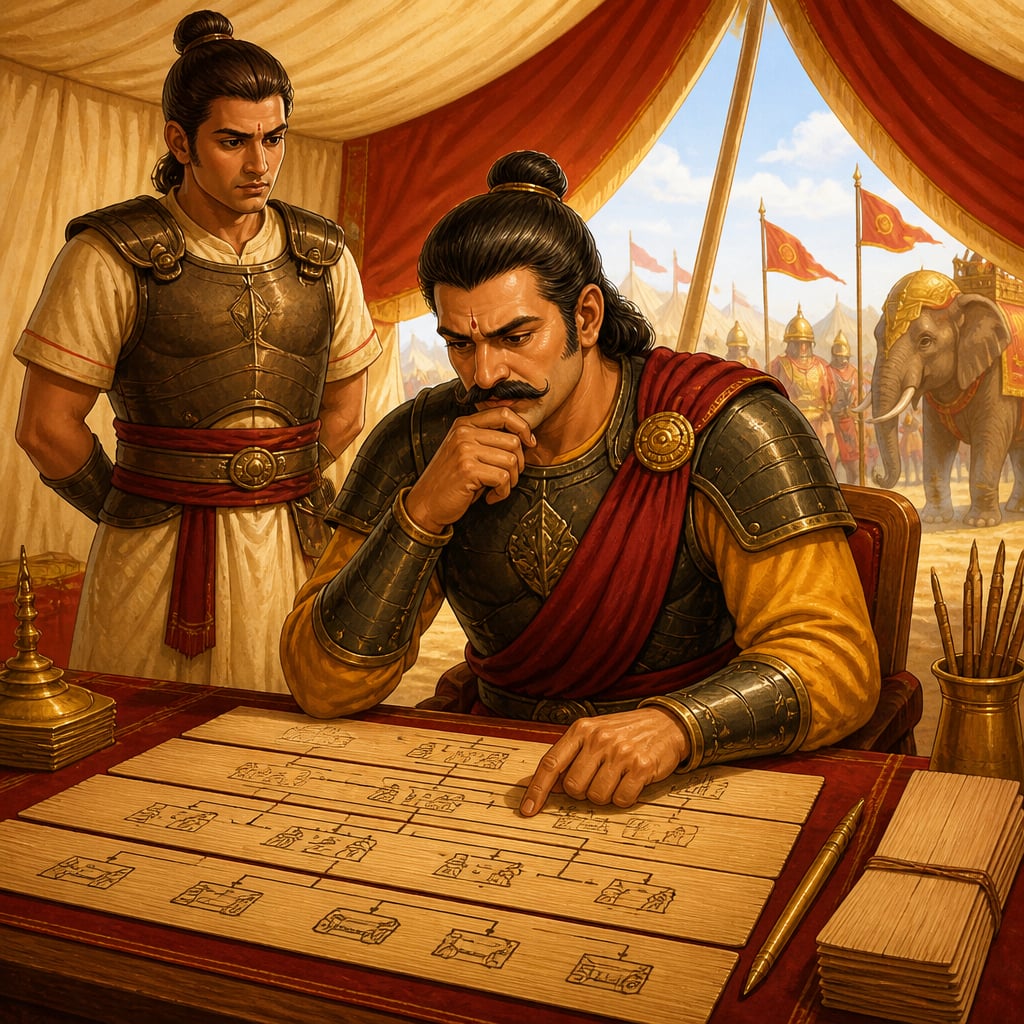
Senapati Kalidasa in his command tent restructuring the Mauryan army's organisation

Over the next month, Kalidasa restructured the entire army. He created clear command hierarchy: ten soldiers under a senāpati (squad leader), ten squads under a patākādhyakṣa (platoon commander), ten platoons under a nāyaka (company commander). Each level had defined authority and responsibility.

He separated logistics into specialized functions: grain supply, weapons maintenance, medical care, animal care, each with its own chain of command reporting to him but operating autonomously within their domain.

Most radically, he instituted daily accountability reports. Every commander, from squad leader to cavalry chief, reported their unit's strength, readiness, supplies, and issues. Information flowed up; orders flowed down. The fog of organizational confusion lifted.

When Bhuvanasena's army next took the field, they moved with precision unknown before. The same soldiers, the same equipment, but organized effectively, they became a different force entirely.

Kalidasa understood what modern organizations still struggle to learn: structure determines function. All the talent in the world means nothing without organization to employ it.

The Senapati: Authority and Limits

Kautilya devoted extensive analysis to the role of the Senapati, the supreme military commander. But his treatment is subtle. The Senapati has great authority yet also faces clear limits. Understanding this balance reveals Kautilya's sophisticated thinking about leadership.

The Senapati's authority includes:

Operational command: The Senapati determines how forces deploy, when to attack, when to withdraw, which routes to take. Field commanders must obey operational orders promptly and completely. Hesitation in battle is fatal; hierarchy enables decision-making speed.

Tactical doctrine: The Senapati establishes how units fight, formations, signals, coordination procedures. Standardization allows different units to work together seamlessly. Without common doctrine, each unit fights its own private battle.

Discipline: The Senapati enforces military law, punishes desertion and cowardice, rewards valor and obedience. Authority without enforcement becomes suggestion. Armies that don't maintain discipline disintegrate under pressure.

Resource allocation: The Senapati assigns units to missions, allocates supplies among divisions, prioritizes objectives. Someone must make trade-offs between competing needs. That someone is the general.

But the Senapati also faces strict limits:

Strategic objectives come from civilian authority: The king determines whether to fight and what to achieve. The Senapati determines how to fight. This separation prevents military power from dictating political ends. The general serves policy; he doesn't make it.

Budget constraints: The treasury determines how much the military can spend. The Senapati cannot exceed appropriations. This prevents military ambition from bankrupting the kingdom.

Legal restraints: The Senapati cannot violate dharma (righteous conduct) even in war. Rules of engagement, treatment of prisoners, protection of civilians, these are not optional. Victory achieved through atrocities is defeat in disguise.

Accountability: The Senapati must explain failures, justify decisions, and accept consequences for defeats. Authority without accountability invites recklessness.

This structure creates productive tension. The Senapati has enough authority to lead effectively but not enough to threaten civilian control. Military efficiency is preserved while military dictatorship is prevented.

Modern democracies struggle with this same balance. Civilian control of military (the president as commander-in-chief) establishes political primacy. But operational independence (generals determine tactics without political interference) preserves military effectiveness. Kautilya articulated this balance 2,300 years ago.

Command Hierarchy: Distributed Authority

Kautilya specified detailed command structure. This wasn't bureaucratic overhead, it was functional necessity. Large organizations cannot operate through single-point control. Authority must be distributed to work.

The basic unit was the pattika, a squad of ten soldiers under a senāpati (squad leader). Why ten? Small enough that one person knows each member personally. Large enough to accomplish basic tasks. The squad leader had complete authority over his ten, where they sleep, when they eat, how they fight. But he reported to the platoon commander.

Ten squads (100 soldiers) formed a patākā (platoon) under a patākādhyakṣa. The platoon commander coordinated squad actions, allocated resources among squads, and implemented company-level orders. He knew his hundred soldiers by reputation if not personally.

Ten platoons (1,000 soldiers) formed a senā (company) under a nāyaka (company commander). The company commander focused on coordination, ensuring platoons supported each other, managing logistics at scale, and executing division-level strategy.

The hierarchy continued: battalions, divisions, up to the Senapati commanding the entire army. Each level had clear span of control (typically 10:1 ratio), defined authority, and specific responsibilities.

What made this system revolutionary was distributed decision-making. The Senapati didn't micromanage squads. He issued objectives to division commanders. Division commanders issued objectives to battalion commanders. Orders cascaded down, translated at each level into specific actions.

Simultaneously, information cascaded up. Squad leaders reported to platoon commanders. Platoon commanders aggregated reports for company commanders. Company commanders synthesized information for division commanders. The Senapati received summary intelligence, not raw data.

This structure solved the fundamental problem of organizational scale: how to coordinate thousands while remaining responsive. Centralized strategy, distributed execution. Upward information flow, downward command flow.

General Stanley McChrystal in the Baghdad Joint Special Operations centre in 2006

General Stanley McChrystal independently rediscovered these principles commanding special operations forces in Iraq. His book "Team of Teams" describes creating small autonomous units (squads) that share information horizontally while receiving mission objectives (not detailed orders) from higher command. McChrystal thought he was innovating. Kautilya had systematized the same structure millennia earlier.

Logistics: The Unglamorous Essential

Kautilya devoted more space to logistics than to tactics. This priority seems strange, supply wagons are less exciting than elephant charges. But it reflects strategic realism: armies march on their stomachs, not their courage.

The Arthashastra specifies detailed logistics systems:

Food supply: Each soldier requires specific grain rations (rice, wheat, barley depending on region and season). The army needs mobile granaries, protected supply trains, and advance depots positioned along march routes. Running out of food doesn't just weaken soldiers, it creates mutiny.

Fodder: Horses and elephants consume enormous quantities. A cavalry unit of 1,000 horses needs roughly 10,000 pounds of fodder daily. War elephants eat even more. Logistics officers must calculate consumption rates, arrange fodder collection, and coordinate with local suppliers. Starved horses can't charge.

Weapons maintenance: Swords dull, bows crack, armor breaks. Each division needs smiths, carpenters, and leather-workers maintaining equipment. The Arthashastra specifies ratios, one smith per 100 infantry, additional specialists for cavalry and elephants. Broken equipment is as useless as absent equipment.

Medical care: Wounded soldiers need treatment, disease requires quarantine, injuries need recovery time. Field hospitals, medical supplies, trained physicians, all must accompany the army. Untreated wounds kill as surely as enemy weapons. Disease epidemics can destroy armies faster than battles.

Transport: All these supplies require wagons, draft animals, drivers, guards, and routes. Transport capacity limits operational tempo, you can only move as fast as your slowest supply wagon. Logistics determines what's possible.

Kautilya understood what amateur strategists forget: logistics constrains everything. The brilliant tactical maneuver that outstrips supply lines fails. The aggressive campaign that exceeds transport capacity stalls. The siege that outlasts food reserves surrenders.

Napoleon retreating with the Grande Armée through the Russian winter of 1812

Napoleon famously said "an army marches on its stomach." He was 2,000 years late to Kautilya's insight.

Modern military logistics is vastly more complex, fuel, ammunition, spare parts, communications equipment, computer systems. But the principle remains identical: operational capability depends absolutely on logistical support. The U.S. military maintains roughly 10 support personnel for every combat soldier. This ratio would not surprise Kautilya.

Civilian-Military Relations: The Critical Balance

Perhaps Kautilya's most sophisticated organizational insight concerns civilian-military relations. Military effectiveness requires professional autonomy. But political legitimacy requires civilian supremacy. How do you preserve both?

Kautilya's answer involved institutional separation with defined interfaces:

The King determines strategic objectives. He decides whether to fight, what terms are acceptable, which alliances to form. These are political questions requiring political judgment. Military expertise doesn't qualify generals to make them.

The Senapati determines operational methods. He decides how to achieve strategic objectives, which routes, which tactics, which risks. These are military questions requiring military expertise. Political sensitivity doesn't qualify kings to make them.

The Treasury controls resources. The king's finance minister allocates budget. The military must operate within these constraints. This prevents military spending from consuming the kingdom's entire wealth. It also creates useful discipline, infinite resources enable infinite waste.

Victories belong to the King; defeats belong to the Senapati. This asymmetry isn't fair, but it's functional. Success reinforces civilian authority and political legitimacy. Failure creates accountability for military leadership without undermining political stability. A king can replace a failed general while maintaining continuity.

The Senapati cannot become King. Kautilya was emphatic: military commanders should not hold political office. The skills that make good generals, decisiveness under pressure, comfort with violence, hierarchical thinking, do not make good rulers. Mixing military and political power creates dictatorship risk.

This framework has profoundly influenced democratic governance. The U.S. Constitution makes the president (civilian) commander-in-chief. Military officers swear allegiance to the Constitution, not to military hierarchy. Generals testify to Congress but cannot make policy. Defense spending requires legislative appropriation. Officers must retire before holding political office.

All these principles echo Kautilyan doctrine: preserve military effectiveness through professional autonomy while preventing military dictatorship through institutional constraints.

Modern Parallels: Organizational Design

Kautilya's military organizational principles apply far beyond armies. Any large organization faces the same challenges: how to coordinate thousands of people, how to flow information efficiently, how to distribute authority without losing control, how to balance autonomy and accountability.

Consider modern corporate organization:

Clear hierarchy (like military rank structure): Everyone knows who reports to whom, who has authority over what, who is accountable for results. Ambiguous hierarchy creates turf battles and paralysis.

Span of control (Kautilya's 10:1 ratios): Managers should supervise 5-10 direct reports, not 50. This enables personal knowledge while preventing micromanagement. Organizations with too-wide spans lose coherence; too-narrow spans create excessive layers.

Distributed decision-making (squad leaders to division commanders): Decisions should be made at the lowest competent level. HQ sets strategy; divisions execute; teams adapt. Centralized decision-making creates bottlenecks; distributed authority enables speed.

Information flow (up) and command flow (down): Data must flow to decision-makers; decisions must flow to implementers. Organizations where information and commands both flow upward become paralyzed. Organizations where both flow downward become authoritarian.

Functional specialization (infantry, cavalry, logistics): Different functions require different expertise. Specialists should focus on their domain while coordinating with others. Generalists trying to do everything do nothing well.

Civilian control of military becomes board control of executive: Corporate governance separates ownership (shareholders, board) from management (executives). Board sets objectives and allocates capital. Executives determine operations. This prevents management from serving itself rather than owners, the corporate equivalent of preventing military dictatorship.

The parallels aren't coincidental. Organization is organization, whether you're coordinating armies or corporations. The principles Kautilya articulated for military effectiveness apply to any large-scale coordinated endeavor.

The Libertarian Dimension: Distributed Authority

Kautilya's organizational design embodies a libertarian principle: authority should be distributed to the lowest competent level, not centralized at the top.

Centralized command seems efficient, one mind directing everything. But it doesn't scale. The general cannot personally direct every squad. The CEO cannot make every decision. The bureaucrat cannot manage every case. Attempting centralized control of complex systems creates paralysis.

Distributed authority solves this problem but creates a new one: how to maintain coordination without central control? Kautilya's answer: clear objectives cascade down, information cascades up, authority operates at each level.

Squad leaders don't ask permission for every action, they achieve assigned objectives using their judgment. But they report results upward so higher command can adjust strategy. Platoon commanders coordinate squads without micromanaging them. Company commanders coordinate platoons. The system works through distributed initiative guided by shared objectives.

This organizational philosophy extends to governance. Centralized government attempting to manage everything, the economy, education, healthcare, culture, overwhelms itself. Distributed authority, markets making economic decisions, communities managing schools, families making healthcare choices, operates more efficiently because decisions are made by those with local knowledge.

The failure of Soviet central planning exemplified this. Moscow bureaucrats tried to manage thousands of factories, farms, and shops. But they lacked the information needed for good decisions, they didn't know local conditions, changing needs, or emerging problems. Distributed market decisions, despite their seeming chaos, coordinated economic activity far more effectively than central plans.

Kautilya's military organization demonstrates the same principle. The Senapati sets objectives and allocates resources. But execution distributes to commanders who understand local conditions. Information returns upward so strategy can adjust. The system works because authority distributes to those with relevant knowledge.

This is the organizational expression of libertarian philosophy: trust distributed decision-making over centralized control, coordinate through information-sharing rather than command, and evaluate results rather than micromanage methods.

Your Turn: Audit Your Organization

Kautilya's organizational principles provide diagnostic tools. Whether you're part of a company, team, academic department, or volunteer organization, ask:

Is hierarchy clear? Does everyone know who has authority over what? Or do people constantly fight about who's in charge? Ambiguous hierarchy wastes energy on internal conflict.

Is span of control appropriate? Are managers supervising a manageable number of reports? Or are some overwhelmed while others micromanage? Inappropriate spans create bottlenecks or bureaucracy.

Is authority distributed to the right level? Are decisions made by those with relevant knowledge? Or does everything require approval from distant executives who lack context? Centralized decision-making is slow decision-making.

Does information flow efficiently? Do decision-makers receive the information they need? Or is important data trapped at lower levels while leaders operate blindly? Information flow enables good decisions.

Is accountability clear? When things go wrong, is it obvious who's responsible? Or do failures disappear into diffused blame? Clear accountability creates discipline.

Are support functions properly resourced? Is logistics/operations/infrastructure adequately funded? Or does the organization invest only in glamorous front-line activities while support withers? Neglected support functions eventually cripple front-line effectiveness.

Is autonomy balanced with alignment? Do teams have freedom to execute while sharing common objectives? Or does autonomy create fragmentation, or alignment create micromanagement? The balance is difficult but essential.

Kalidasa, from our opening story, succeeded by systematically applying these principles. The same soldiers became effective through better organization. Your organization, whether it employs thousands or consists of just you, can benefit from the same discipline.

Good organization doesn't guarantee success. But poor organization guarantees eventual failure. Kautilya understood this 2,300 years ago. The principle remains valid today.

Organizational Capability as Force Multiplier - The principle that structure and coordination determine how effectively resources translate into results.

Management theory emphasizes 'organizational capability' as distinct from individual talent or financial resources. Companies fail not because they lack smart people or funding but because they can't coordinate effectively. Military analysis distinguishes between 'order of battle' (what forces exist) and 'organizational effectiveness' (how well they work together). Structure matters as much as resources.

Kautilya didn't just assert organization's importance, he specified how to create it. Clear hierarchy, appropriate spans of control, distributed authority, information flows, these concrete prescriptions transform the abstract principle into actionable practice.

The U.S. auto industry's decline (1970s-2000s) occurred despite talented engineers, ample capital, and advanced technology. Poor organization, siloed divisions, slow decision-making, unclear accountability, prevented effective use of these resources. Toyota, with arguably fewer resources, dominated through superior organization (lean manufacturing, distributed quality control, rapid iteration). Organization determined outcomes.

Civil-Military Relations and Governance-Management Separation - The principle that different types of authority should be separated to prevent both tyranny and incompetence.

Democratic governance separates civilian control (president/parliament sets policy) from military execution (generals implement operations). Corporate governance separates board oversight (strategy, resource allocation) from executive management (operations, execution). The principle is universal: different competencies require different authorities, but both must exist in proper relationship.

Verses

व्यवस्था विना बलं व्यर्थम्।

vyavasthā vinā balaṃ vyartham |

Without organization, strength is useless.

This foundational sutra establishes that raw capability, soldiers, weapons, resources, means nothing without organization to employ it effectively. The most powerful army collapses into a mob without command structure.

Book 10, Chapter 1, Verse 1-2 (R.P. Kangle)

सेनापतिः कर्मणि स्वतन्त्रः नीतौ परतन्त्रः।

senāpatiḥ karmaṇi svatantraḥ nītau paratantraḥ |

The general is independent in operations but subordinate in policy.

This sutra establishes the critical boundary between military and civilian authority. The Senapati has complete autonomy in how to fight, tactics, deployment, battlefield decisions.

Book 10, Chapter 2, Verse 1-4 (Patrick Olivelle)

अधिकारो ज्ञानवन्तम् अनुगच्छति।

adhikāro jñānavantam anugacchati |

Authority should follow knowledge.

Kautilya establishes that authority should be distributed to those with relevant knowledge, not merely those with high rank. The squad leader knows his ten soldiers better than the general does, he should have authority over immediate decisions.

Book 10, Chapter 5, Verse 8-10 (R. Shamasastry)

Case studies

McChrystal's Team of Teams in Iraq (2003-2008)

When General Stanley McChrystal took command of Joint Special Operations in Iraq, he inherited a organization designed for conventional warfare, hierarchical command, sequential planning, centralized authority. But the enemy (Al Qaeda in Iraq) operated as a network, distributed, adaptive, fast-moving. Traditional military organization couldn't keep pace. By the time headquarters approved an operation, the target had moved.

McChrystal restructured operations using principles remarkably similar to Kautilya's organizational doctrine. Small teams (squads) gained operational autonomy, they could act on intelligence immediately without seeking approval. Information was shared horizontally across teams, not just up the chain of command. Higher command provided objectives and resources but not detailed orders. Authority distributed to those with knowledge (frontline teams understanding local conditions). This created capability that centralized hierarchy couldn't match.

The reorganized force became dramatically more effective. Operations tempo increased from one mission per day to dozens. Intelligence became actionable in hours, not weeks. The enemy's network advantage was neutralized by creating a military network with superior resources. By 2008, Al Qaeda in Iraq was significantly degraded. The organizational transformation was as important as any tactical innovation.

McChrystal's reforms validated Kautilyan principles millennia after they were written: distribute authority to knowledge, coordinate through information-sharing, maintain command hierarchy while enabling distributed initiative. Modern technology changed the specifics, but the organizational principles remained identical. Structure determines capability regardless of era.

McChrystal's reorganization became the template for how tech companies structure themselves. Spotify's squad model, Amazon's two-pizza teams, and Netflix's distributed decision-making all push authority to those with the most relevant knowledge. The shift from hierarchical command to networked coordination is one of the defining organizational transformations of the 21st century.

Under McChrystal's reorganization, special operations missions increased from roughly 10 per month to over 300 per month. The same number of personnel achieved a 30x increase in operational tempo through structural reform.

Napoleon's Russian Campaign (1812)

Napoleon invaded Russia with the largest army Europe had ever seen, over 600,000 troops. His organizational excellence had won battles across Europe. But the Russian campaign stretched his army across vast distances, far from supply bases, in hostile climate. His logistics system, adequate for European campaigns, proved inadequate for Russian scale and conditions.

Napoleon's disaster exemplified failure to apply Kautilyan organizational principles comprehensively. His command structure was excellent, clear hierarchy, distributed authority, defined accountability. But his logistics planning violated Kautilya's emphasis on systematic supply. The army outstripped its supply lines, assumed they could forage in depopulated countryside, and lacked winter provisioning despite obvious seasonal challenges. Operational brilliance couldn't compensate for logistical failure.

Of the 600,000 troops who entered Russia, fewer than 100,000 returned. Most died not in battle but from starvation, disease, and exposure, logistics failures all. The Grand Army's destruction resulted from organizational inadequacy: supply systems that couldn't sustain the operational tempo, communication systems that couldn't coordinate across the distances, planning systems that didn't account for comprehensive costs.

Kautilya's holistic approach to military organization, command, logistics, accountability, civilian oversight, all matter simultaneously. Excellence in one area (command structure) doesn't compensate for failure in another (logistics). Organizations are systems where every component must function. Napoleon learned what Kautilya taught: vyavasthā vinā balaṃ vyartham, without complete organization, strength is useless.

Rapid-growth startups frequently fail the same way Napoleon did: brilliant front-line execution undermined by neglected infrastructure. Companies that scale revenue without scaling operations, hiring processes, or financial controls eventually collapse under their own success. Sustainable growth requires that every organizational system advances together, not just the most visible ones.

Napoleon's logistics failure meant that 80% of his 500,000 casualties in Russia died from starvation, disease, and cold rather than combat. The army lost more horses (roughly 200,000) than men killed in battle.

Historical context

c. 4th century BCE

Pre-Mauryan Indian armies often lacked systematic organization, command structures were informal, logistics were improvised, civilian-military relations were undefined. Kautilya's innovations created professional military organization that enabled the Mauryan empire's expansion and administration. His organizational principles influenced Indian military practice for centuries afterward.

Kautilya's organizational innovations transformed military practice from traditional customs into systematic science. His principles, clear hierarchy, distributed authority, logistics emphasis, civilian-military separation, remain foundational to modern military and organizational theory. The insights apply far beyond warfare to any large-scale coordinated endeavor.

Reflection

More in Chaturanga: The Four-fold Army

All lessons in Chaturanga: The Four-fold Army · Arthashastra: Art of Strategy course