During the Battle

Tactics and Formations

Adapt and respond. Tactical principles for managing the chaos of conflict.

The Changing Shape of Battle

The arrow hit Commander Bhadrasena's shield just as dawn broke over the valley. The battle he had prepared for three days had finally begun.

But nothing unfolds exactly as planned.

His scouts had reported enemy cavalry positioned on the eastern flank. Now they were attacking from the west. The marshy ground he'd counted on to slow their advance was firmer than expected, recent dry days had hardened the surface. And the enemy's first wave wasn't the aggressive charge his intelligence had predicted. They were probing, testing, searching for weaknesses.

Bhadrasena stood on the ridge, watching patterns emerge from chaos. This was the moment all preparation led to: when plans met reality and adaptation became everything.
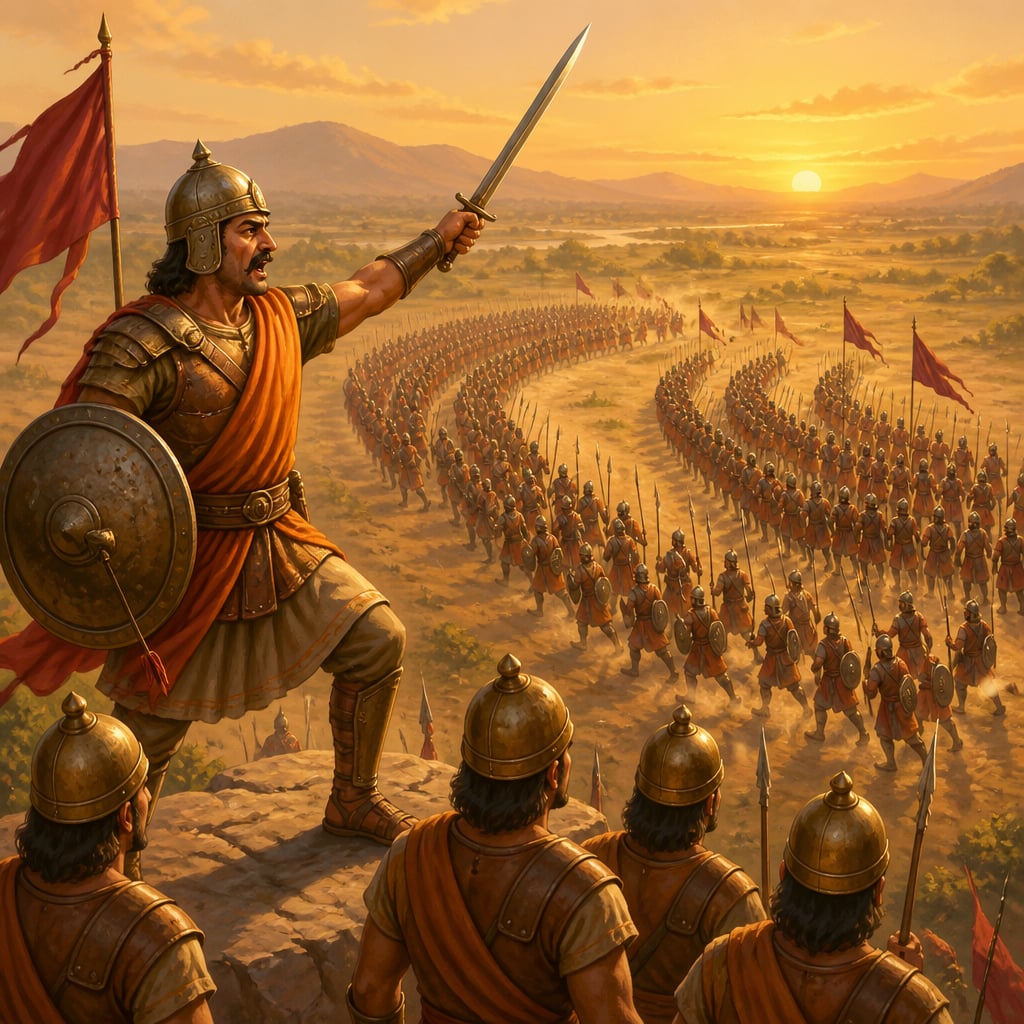
Bhadrasena ordering vyuha-parivartanam mid-battle as his infantry shifts formation

"Vyūha-parivartanam," Kautilya had taught him years ago. "Formation transformation, the art of changing shape while maintaining strength. An army that can only hold one formation is rigid. Rigid things break."

Bhadrasena signaled his officers. The formation began to shift.

The Nature of Combat

Kautilya understood something that separates amateur strategists from professionals: no plan survives contact with the enemy. Preparation creates potential, but tactical flexibility realizes it.

Consider the fundamental challenge of battle. You've gathered intelligence, chosen terrain, secured supplies, and positioned forces. But the moment fighting begins, everything changes:

The commander who rigidly follows the pre-battle plan ignores reality for theory. But the commander who abandons all structure for improvisation loses coherence and control.

The art is finding the balance: structure flexible enough to bend without breaking.

Modern military doctrine calls this "mission-type orders", giving subordinates clear objectives but freedom in execution. Business strategists call it "agile methodology", planning in detail but adapting continuously. Kautilya called it yukti, tactical intelligence that responds to conditions as they are, not as you wish they were.

Vyuha: Battle Formations

Kautilya systematized battle formations not as rigid templates but as flexible frameworks. Each vyuha (formation) provided structure while allowing adaptation.

The Arthashastra describes several core formations:

Danda-vyuha (Staff Formation) - A linear arrangement with strength in direct frontal engagement. Strong center, moderate flanks. Use when terrain constrains enemy maneuver or when your infantry quality exceeds theirs. Weakness: vulnerable to flanking if the line is thin.

Bhoga-vyuha (Serpent Formation) - A curved or crescent shape designed to envelop enemy forces. The center refuses while flanks advance, creating a pocket. Use when you have mobility advantage and want to surround numerically inferior enemies. Weakness: extended formation can be broken in the center.

Vajra-vyuha (Diamond Formation) - A compact arrangement with strength at all points. Use when surrounded or when fighting on multiple fronts simultaneously. The formation has no single vulnerable point. Weakness: reduced offensive capability.

Garuda-vyuha (Eagle Formation) - Wide wings with strong center, resembling an eagle in flight. Designed for envelopment and overwhelming enemy flanks while maintaining central strength. Use when you have both numerical and mobility advantages. Weakness: requires experienced coordination.

Chakra-vyuha (Wheel Formation) - Concentric circles of forces that can rotate and adapt. The inner circles provide reserves; outer circles engage. Use for defense against uncertain attack directions. Weakness: complexity requires highly trained forces.

But here's what matters most: these weren't rigid prescriptions. Kautilya emphasized that formations must transform during battle based on enemy actions, terrain changes, and emerging opportunities.

Bhadrasena's army began in Danda-vyuha, linear formation exploiting the ridge. When enemy cavalry appeared on his western flank, he transformed the western wing into Bhoga-vyuha, curving to envelop the cavalry while maintaining linear strength elsewhere. The formation changed shape like a living organism.

Hannibal directing the double envelopment of the Roman legions at Cannae in 216 BCE

Tactical Flexibility: Responding to Reality

The key to tactical success is reading the battle as it unfolds, not as you planned it.

Kautilya taught commanders to watch for specific indicators:

Enemy Morale - Are they advancing confidently or hesitantly? Do they maintain formation under pressure or begin to fragment? Confident enemies require different tactics than wavering ones.

Terrain Exploitation - Is the enemy using terrain intelligently or ignoring opportunities? If they're not exploiting an advantage, you might be able to seize it first.

Formation Integrity - Are their lines maintaining coherence or developing gaps? Gaps invite penetration; solid formations require different approaches.

Reserve Commitment - Has the enemy committed reserves or are they still holding forces back? If they've committed everything, they can't respond to new threats. If they're holding reserves, your breakthrough might trigger counterstrike.

Timing - Is this the moment to press advantage or consolidate position? Premature aggression wastes strength; delayed exploitation wastes opportunity.

The tactical commander processes these observations constantly, adjusting formation, shifting reserves, pressing where the enemy weakens, refusing where they strengthen.

Colonel John Boyd lecturing the OODA Loop at a Pentagon chalkboard in the 1980s

Boyd's OODA Loop, developed by U.S. Air Force Colonel John Boyd, rediscovered Kautilya's insight 2,300 years later: Observe, Orient, Decide, Act. The side that cycles through this loop faster, adapting more quickly to changing conditions, wins. Speed of adaptation beats size of force.

Command in Chaos

Battle creates what Prussian military theorist Carl von Clausewitz called "fog of war", the confusion, uncertainty, and incomplete information that characterizes combat.

Kautilya's approach to command in chaos emphasized several principles:

Decentralized Execution - Senior commanders set objectives; junior officers determine methods. Bhadrasena told his cavalry commander: "Prevent enemy cavalry from reaching our archers." He didn't specify how. Trust subordinates to solve tactical problems within your strategic framework.

Clear Signals - Establish simple, unmistakable signals for key maneuvers. In the noise of battle, complex orders fail. Flags, drums, and horns communicated basic commands: advance, retreat, wheel left, wheel right, commit reserves.

Position for Vision - The commander must see the battle's shape. Bhadrasena positioned himself on the ridge not for safety but for visibility. The general who fights in the front line can't see the whole field. Situational awareness requires perspective.

Decision Speed - In chaos, timely good decisions beat delayed perfect ones. Kautilya emphasized kshipra-nirnaya, swift determination. Waiting for complete information means deciding too late. Act on sufficient information, then adapt.

Maintain Reserve - We discussed this in preparation, but it's crucial during battle too. The commander who commits all forces loses the ability to respond to unexpected developments. Keep strength uncommitted until the decisive moment reveals itself.

Modern organizational theory has finally caught up. General Stanley McChrystal's "Team of Teams" approach emphasizes empowered subordinates, rapid information sharing, and decentralized execution, exactly what Kautilya advocated for battlefield command.

Pursuit and Retreat: The Hardest Decisions

By midday, Bhadrasena's transformation of formation had worked. Enemy cavalry, caught in the envelopment, had broken. Their infantry, seeing the cavalry flee, began to waver.

This was the moment of truth: pursuit or consolidation?

Kautilya taught that both pursuit and retreat require more discipline than standing and fighting.

The Case for Pursuit - A retreating enemy is vulnerable and demoralized. Vigorous pursuit can transform tactical victory into strategic collapse. Let them escape intact, and they'll regroup to fight again.

The Case for Caution - Pursuit extends your lines, separates forces, and creates opportunity for ambush. The enemy retreating might be baiting you into disadvantageous terrain. Overextended pursuers become pursued.

Kautilya's guidance: "Parājitaṃ tāḍayet yuktitaḥ, Strike the defeated one with tactical intelligence, not blind aggression." Pursue when you have clear advantage and secure routes. Consolidate when pursuit risks dispersing strength.

Bhadrasena chose limited pursuit: cavalry harried the fleeing enemy while infantry secured the field and prepared for regrouping. This middle path exploited victory without creating new vulnerabilities.

Retreat requires even more discipline. A panicked retreat becomes a rout, disorganized flight that invites massacre. A disciplined retreat preserves the army for future engagement.

Kautilya specified that retreat should be:

Orderly - Maintain formation even while withdrawing Covered - Use terrain, rearguard, and obstacles to slow pursuit Purposeful - Retreat toward prepared positions, not random directions Measured - Fast enough to escape, slow enough to maintain control

The general who can't retreat well can't fight well. Knowing when to disengage preserves strength for better opportunities.

Adaptation in Modern Context

Most readers won't command armies, but everyone navigates conflict and competition requiring tactical adaptation.

Consider a difficult business negotiation. You've prepared thoroughly: researched the other party, understood your alternatives, planned your approach. Then the meeting begins and nothing goes as expected:

The negotiator who rigidly follows the plan ignores these signals. But the negotiator who abandons all structure loses coherence. The art is Kautilyam tactical flexibility: clear objectives with adaptive methods.

What are your "formations" in business conflict?

Like Bhadrasena, you shift formations mid-engagement based on how the other party responds.

The Libertarian Insight

Kautilya's emphasis on tactical flexibility connects to a deeper political philosophy: decentralized decision-making produces better outcomes than rigid central control.

Consider two armies:

Army A: Centralized command. Every decision flows through the general. Junior officers wait for orders. The plan is detailed and must be followed precisely.

Army B: Decentralized command. The general sets objectives; officers determine methods. Initiative is encouraged. The plan is a framework, not a script.

Which wins?

History consistently favors Army B. Why? Because battlefield conditions change faster than centralized decision-making can process. The officer facing immediate tactical reality makes better local decisions than the distant general relying on delayed information.

This principle extends far beyond military conflict. Friedrich Hayek argued that centrally planned economies fail because central planners can't process the distributed knowledge that markets aggregate automatically. Local actors responding to local information produce better outcomes than distant controllers imposing one-size-fits-all solutions.

Kautilya understood this 2,000 years before Hayek. His tactical doctrine emphasized empowered subordinates precisely because distributed intelligence beats centralized control when conditions are dynamic and uncertain.

The best governance, whether of armies, organizations, or societies, provides structure while preserving adaptive capacity at the edges.

Your Tactical Flexibility

Kautilya's lessons on tactical adaptation apply whenever you face dynamic, uncertain situations:

In Career - Your career plan is a framework, not destiny. When unexpected opportunities or setbacks emerge, adapt. The professional who can only follow one script is fragile.

In Projects - Agile methodology is Kautilyam tactical doctrine applied to software development: plan in iterations, adapt continuously, maintain working product (like maintaining formation integrity). Structure provides direction; flexibility provides resilience.

In Relationships - Conflict with partners, colleagues, or friends requires reading the situation and adapting. The person who can only respond one way to all disagreements lacks tactical flexibility. Match your approach to the actual situation, not your preferred script.

In Learning - Academic plans change: courses differ from catalog descriptions, interests evolve, opportunities appear. The student with tactical flexibility adjusts while maintaining strategic direction toward meaningful skills and knowledge.

The common thread: prepare thoroughly, then adapt intelligently. Structure isn't rigidity. Flexibility isn't chaos. The synthesis is tactical intelligence, responding to reality as it unfolds.

Kautilya's teaching on battlefield tactics is ultimately about something deeper: how to act effectively in complex, changing, uncertain environments. Which is to say: how to act effectively in reality.

Structured Flexibility - Providing clear frameworks that can adapt to changing conditions without losing coherence.

Agile software methodology embodies this principle: organize in sprints (structure) while adapting continuously to user feedback and changing requirements (flexibility). Mission-type orders in modern militaries: clear objectives (structure) with freedom in execution (flexibility). The pattern is universal: rigid systems break, chaotic systems collapse, flexible-within-structure systems thrive.

Kautilya systematized the principle across all aspects of battle: formations that transform, plans that adapt, command that decentralizes. Modern organizations often choose between structure (hierarchical, planned) or flexibility (flat, improvisational). Kautilya integrated both, structure provides direction, flexibility provides resilience.

The German Blitzkrieg (1939-1941) succeeded through structured flexibility: clear operational objectives combined with decentralized tactical execution. Junior officers adapted to local conditions without waiting for central orders. This 'Auftragstaktik' (mission-type tactics) enabled rapid advances despite incomplete information and changing circumstances, exactly what Kautilya's vyuha-parivartanam doctrine prescribed.

Tempo Advantage - Gaining competitive advantage through faster decision-making and adaptation cycles.

John Boyd's OODA Loop emphasizes that the side that observes, orients, decides, and acts faster wins, regardless of other advantages. Tech startups practice 'move fast and break things', preferring rapid iteration to perfect planning. Military doctrine emphasizes initiative and tempo. The common insight: in uncertain environments, decision speed is decision quality.

Verses

व्यूह-परिवर्तनं युक्तितः।

vyūha-parivartanaṃ yuktitaḥ |

Formation transformation should be done with tactical intelligence.

This sutra establishes that battle formations aren't rigid templates but flexible frameworks. The skilled commander transforms formation continuously during battle, responding to enemy actions, terrain features, and emerging opportunities.

Book 10, Chapter 2, Verse 8 (R.P. Kangle)

पराजितं ताडयेत् युक्तितः।

parājitaṃ tāḍayet yuktitaḥ |

Strike the defeated enemy with tactical intelligence, not blind aggression.

Kautilya warns against two extremes in victory: failing to pursue defeated enemies (allowing them to regroup) and pursuing recklessly (overextending and creating new vulnerabilities). The emphasis on yukti, tactical intelligence, means pursuit must be calculated.

Book 10, Chapter 3, Verse 14 (R. Shamasastry)

क्षिप्र-निर्णयो बल-वर्धनम्।

kshipra-nirṇayo bala-vardhanam |

Swift decision-making increases strength.

In the chaos of battle, timely good decisions beat delayed perfect ones. Kautilya recognized that waiting for complete information means deciding too late, conditions will have changed by the time you act.

Book 10, Chapter 2, Verse 19 (Patrick Olivelle)

Case studies

Battle of Cannae: Tactical Transformation in Action

In 216 BCE, Carthaginian general Hannibal faced a Roman army nearly twice his size, perhaps 86,000 Romans versus 50,000 Carthaginians. Rather than accepting defeat, Hannibal deployed a crescent formation that deliberately weakened his center while strengthening his wings. As Romans pressed the center (which Hannibal allowed to bow backward), Carthaginian cavalry swept around the flanks and struck the Roman rear. The formation transformed from defensive crescent to complete envelopment.

Hannibal's tactics embodied vyuha-parivartanam, formation transformation with tactical intelligence. His initial crescent (Bhoga-vyuha) lured Romans into a position where transformation could occur. The key wasn't the initial formation but its purposeful transformation during battle. He adapted structure to enemy behavior, exactly as Kautilya prescribed.

One of history's most devastating defeats: perhaps 50,000-70,000 Roman casualties versus 6,000 Carthaginian. The outcome was determined not by size or courage but by tactical flexibility, Hannibal's formation adapted during battle while the Romans rigidly pressed forward into the trap.

Kautilya's principle applies: structure enables flexibility, and transformation must be purposeful (yuktitaḥ). Hannibal didn't improvise randomly, he executed a planned transformation triggered by Roman behavior. This is the essence of tactical intelligence: structured responses to actual conditions.

Agile methodology in software development follows the same principle: structured flexibility. Teams work within defined sprint frameworks but adapt their approach based on real-time feedback. Companies like Spotify and Netflix have built entire engineering cultures around this balance, enabling rapid adaptation without losing organizational coherence. The best systems are rigid enough to coordinate and flexible enough to adapt.

At Cannae, Hannibal's forces killed or captured approximately 70,000 Romans in a single day. It remains one of the deadliest single days of combat in recorded history.

Toyota Production System: Structured Flexibility

Toyota developed a manufacturing system that seemed paradoxical: highly standardized processes that encouraged continuous adaptation. Every process was documented in detail (structure), but frontline workers were empowered and expected to suggest improvements (flexibility). The famous 'andon cord' allowed any worker to stop the production line if problems emerged, decentralized decision authority in action.

Toyota embodied Kautilya's vyuha-parivartanam principle in manufacturing: clear formations (standardized processes) with continuous transformation capability (kaizen improvement, worker empowerment). The system provided structure while preserving adaptive capacity at the edges, exactly what Kautilya's battle formations did.

Toyota became the world's largest automaker and defined modern manufacturing excellence. Competitors who chose between rigid standardization (American mass production) or chaotic flexibility (craft production) couldn't match Toyota's synthesis of structure and adaptation.

Kautilya's tactical principle applies beyond warfare: provide clear structure while empowering distributed intelligence to adapt. This produces better outcomes than either rigid centralization or chaotic decentralization. Structure provides direction; flexibility provides optimization.

Toyota's structured flexibility model has been adopted across industries, from healthcare (Virginia Mason Medical Center) to software development (Lean startup methodology). The principle that standardized processes and continuous adaptation are complementary rather than contradictory now drives operational excellence worldwide. The companies that master this balance consistently outperform those that choose either rigid control or chaotic innovation.

Toyota's production system reduced defect rates to fewer than 0.5 per vehicle while competitors averaged 3-5 defects. The structured flexibility model enabled Toyota to become the world's largest automaker by 2008.

Historical context

c. 4th century BCE

Mauryan military success depended not just on preparation but tactical execution. Indian warfare featured diverse troops types, infantry, cavalry, chariots, elephants, requiring sophisticated formation coordination. Kautilya's vyuha system provided frameworks for organizing and transforming these complex forces during battle.

Kautilya's tactical doctrine emphasized adaptation over rigidity at a time when many military theorists prescribed fixed formations and plans. This flexibility-within-structure approach influenced how Indian kingdoms approached warfare for centuries and anticipates modern military doctrine on decentralized execution and mission-type orders.

Reflection

More in Chaturanga: The Four-fold Army

All lessons in Chaturanga: The Four-fold Army · Arthashastra: Art of Strategy course