The Four Branches of Army
Chaturanga - Infantry, Cavalry, Elephants, Chariots
The original 'chess', understanding the four divisions of ancient Indian military organization. Kautilya's doctrine of chaturanga combined infantry, cavalry, elephants, and chariots into integrated force. Each arm had unique strengths and weaknesses. Only through combination could an army achieve flexibility and power. This principle of combined arms remains fundamental to modern military doctrine.
The General's Dilemma
Rudradaman stood on the ridge overlooking the valley where tomorrow's battle would unfold. As commander of the Mauryan western army, he had led campaigns for fifteen years. But this enemy was different.
The Yavana forces, Greek remnants still holding territories near the Indus, had deployed in their characteristic phalanx formation. Thousands of infantry with overlapping shields and eighteen-foot spears created an almost impenetrable wall. Rudradaman had faced phalanxes before. Direct infantry assault was suicide. Cavalry couldn't penetrate the spear hedge. But committing his entire force to flanking maneuvers risked being outflanked himself.
His aide, Devadatta, pointed to the enemy formation. "Sir, their flanks are anchored on broken ground. Our cavalry can't operate there. Our chariots would be useless. We'll have to meet them with infantry, and..."
"And we'll be slaughtered," Rudradaman finished. He had read Kautilya's tactical treatises. The Arthashastra emphasized chaturanga, the four-branched army. Infantry, cavalry, elephants, chariots. Not because tradition demanded it, but because warfare required combined capabilities.
"Caturangabalena yudhyeta," Rudradaman quoted. "One fights with a four-limbed force." He smiled. "We don't need to break the phalanx. We need to make it irrelevant."
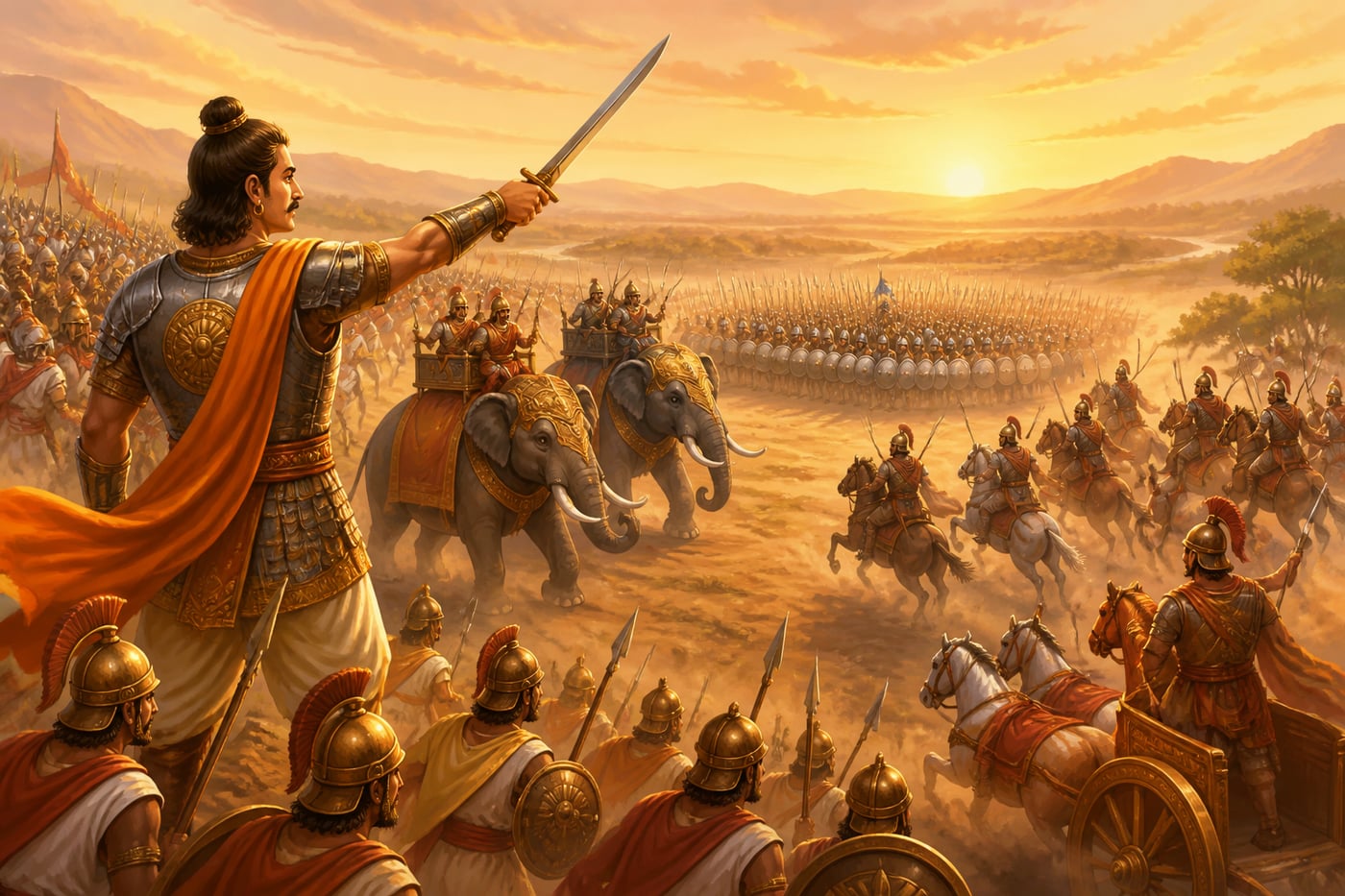
By dawn, Rudradaman had positioned his forces. Infantry engaged the phalanx frontally, not to break it, but to pin it in place. Cavalry swept wide around both flanks, cutting supply lines and threatening the Greek camp. But the decisive move came from his war elephants.
Each elephant, carrying archers and javelin-throwers on its back, advanced on the phalanx's edges. The Greek infantry could hold against human attackers. But facing three-ton animals that could scatter their formation, trample their ranks, and create gaps for cavalry to exploit, their nerve broke. The phalanx, invincible when intact, dissolved into fleeing groups once disrupted.
Rudradaman won not because any single arm of his force was superior, but because he used all four in coordination. This was the essence of chaturanga, combined arms warfare that Kautilya had systematized centuries before European armies rediscovered the concept.
The Four Limbs of Power
Kautilya's military doctrine centered on chaturanga, literally "four-limbed" or "four-membered." An army, he argued, was like a body. It required four essential components, each serving distinct functions:
Patti (Infantry) formed the backbone. Foot soldiers could operate in any terrain, hold positions, occupy territory, and engage in extended campaigns. They were the most numerous, the most flexible, and the most sustainable component. Infantry won wars by controlling ground.
But infantry alone moved slowly and lacked striking power. Thus the need for Ashva (Cavalry). Mounted warriors provided speed, mobility, and shock. They could scout enemy positions, screen friendly movements, pursue broken enemies, and strike unexpected blows. Cavalry didn't win battles, they exploited victories won by other arms.
Gaja (Elephants) were the ancient equivalent of armored vehicles. Each war elephant carried archers and spear-throwers on its back, creating a mobile fighting platform. More importantly, elephants terrified horses and could break infantry formations. Their psychological impact often exceeded their physical power. A well-placed elephant charge could shatter enemy morale.
Ratha (Chariots) completed the system. Swift two-horse chariots carrying archer-warrior teams provided mobile firepower. They could rapidly redeploy, strike vulnerable points, and withdraw before counterattack. By Kautilya's era, chariots were declining in importance, cavalry was replacing them. But the principle remained: armies needed mobile striking power.
The genius of chaturanga wasn't the specific mix of forces, that varied by era and region. It was the recognition that no single type of force suffices. Each arm had strengths and weaknesses. Combined properly, strengths multiplied while weaknesses canceled.
Infantry held position but couldn't pursue. Cavalry pursued but couldn't hold. Elephants broke formations but couldn't operate everywhere. Chariots provided firepower but were vulnerable. Together, they created capability no single arm could match.
From Battlefield to Board Game
The concept of chaturanga was so fundamental to Indian military thinking that it became a game, the ancestor of modern chess.

Early Indian chess, called chaturanga, represented the four arms of the military. Pawns were infantry. Knights were cavalry. Bishops (originally elephants) represented gaja. Rooks (originally chariots) represented ratha. The king and counselor (queen) completed the representation of military command.
Players learned strategic principles through gameplay. Combined arms tactics, using different pieces in coordination, reflected battlefield reality. The weakness of individual pieces demonstrated why no single type sufficed. The importance of positioning, timing, and mutual support all translated from warfare to the game board.
This wasn't mere entertainment, it was training. Young nobles learned to think in terms of combined capabilities, mutual support, and coordinated action. The abstraction of the game made principles clearer than battlefield chaos could.
The game spread west along trade routes, evolving as it traveled. Persians adopted it as chatrang. Arabs modified it to shatranj. Europeans eventually transformed it into modern chess, with castles replacing chariots and elephants becoming bishops. But the core insight remained: power comes from combination.
Garry Kasparov, the chess grandmaster, once observed that modern chess strategy still reflects ancient combined arms doctrine, pieces must work together, each covering others' weaknesses. The game Kasparov mastered had preserved lessons Kautilya taught 2,300 years earlier.
Strengths and Weaknesses
Kautilya didn't just list the four arms, he analyzed their capabilities systematically. Understanding what each arm could and couldn't do was essential to deploying them effectively.
Infantry advantages:
- Operate in all terrain, including forests, mountains, and urban areas
- Sustain long campaigns with minimal logistics
- Hold defensive positions indefinitely
- Garrison cities and forts
- Outnumber other arms significantly
Infantry limitations:
- Slow movement, vulnerable during march
- Limited striking power against armored enemies
- Vulnerable to cavalry charges in open terrain
- Difficult to rapidly redeploy
Cavalry advantages:
- Speed and mobility for reconnaissance and pursuit
- Shock value in charges against unprepared enemies
- Ability to exploit breakthroughs and threaten flanks
- Rapid response to changing battlefield conditions
Cavalry limitations:
- Can't hold terrain, must keep moving
- Ineffective in forests, mountains, or broken ground
- Expensive to maintain (horses, fodder, training)
- Vulnerable to prepared infantry positions
- Useless in siege warfare
Elephant advantages:
- Psychological terror, enemies fear them
- Can break infantry formations through physical force
- Mobile archer platform providing elevated firing position
- Transport heavy equipment and supplies
- Single elephant worth multiple infantry units
Elephant limitations:
- Difficult to control in battle
- If panicked, dangerous to own army
- Expensive to maintain and train
- Vulnerable to fire and certain terrain
- Limited numbers, can't mass elephants like infantry
Chariot advantages:
- Mobile firepower platform
- Speed approaching cavalry but carrying archers
- Prestige value for command and control
- Rapid redeployment on flat terrain
Chariot limitations:
- Require flat, open terrain
- Vulnerable to obstacles and broken ground
- Expensive and complex (horses, vehicle, crew)
- Declining effectiveness by Kautilya's era
The key insight is that advantages in one area create vulnerabilities in another. The fastest forces can't hold position. The strongest defensive forces can't pursue. The most terrifying weapons are hardest to control.
Modern military organizations rediscovered these principles. Infantry, armor, artillery, and air power form a contemporary chaturanga. Each has distinct capabilities; none suffices alone. Armies that overinvest in one arm, however impressive that arm is individually, create exploitable vulnerabilities.
The Modern Parallel: Combined Arms
Modern military doctrine calls Kautilya's insight "combined arms warfare", the coordination of different military units to achieve effects impossible for any single type alone.
World War I demonstrated the cost of ignoring this principle. Armies initially employed mass infantry assaults against machine gun positions, the equivalent of sending patti against an impregnable formation. Hundreds of thousands died because commanders hadn't integrated infantry, artillery, armor, and aircraft into coordinated operations.
By World War II, militaries had relearned chaturanga principles. The German Blitzkrieg combined tanks (mobile striking power), infantry (holding ground), artillery (breaking defenses), and aircraft (reconnaissance and air superiority). No single element could have achieved their rapid victories, combination created breakthrough capability.
The U.S. military's AirLand Battle doctrine (1980s) further developed combined arms concepts. Ground forces, air power, electronic warfare, and special operations coordinated to achieve objectives no single service could accomplish. This isn't different in principle from Rudradaman coordinating elephants, cavalry, and infantry against the Greek phalanx.

General Norman Schwarzkopf's Gulf War strategy (1991) exemplified modern chaturanga. Air power degraded Iraqi defenses. Armor provided mobile striking power. Infantry held liberated territory. Special forces gathered intelligence and disabled key targets. The hundred-hour ground campaign succeeded because all arms worked together.
The lesson remains constant: diversify your capabilities, understand their strengths and limits, and employ them in coordination. This applies far beyond literal warfare.
Chaturanga for Organizations
The principle of combined arms extends to any complex endeavor requiring diverse capabilities working together.
A business, for instance, needs its own form of chaturanga:
- Sales (cavalry), mobile, aggressive, pursuing opportunities
- Operations (infantry), steady, reliable, holding existing business
- Innovation (elephants), high-impact but risky, creating breakthroughs
- Finance (chariots/command), mobile support enabling all other functions
Companies that over-invest in any single function create vulnerability. Pure sales organizations without operational capacity can't fulfill what they sell. Pure operations organizations without sales eventually lose market share. Pure innovation without execution creates patents nobody uses.
Successful organizations balance these functions and coordinate their efforts, the business equivalent of combined arms.
Similarly, personal development requires balanced capabilities. Technical skill (infantry, your foundation), networking (cavalry, creating opportunities), creativity (elephants, breakthrough ideas), and judgment (command, allocating your efforts). Over-developing one while neglecting others creates brittleness.
The programmer who can code brilliantly but can't communicate with clients has powerful infantry but no cavalry. The entrepreneur with vision but no operational discipline has elephants but no infantry to hold territory. The strategist who plans brilliantly but can't execute lacks the connection between command and forces.
Kautilya's military principle is actually an organizational one: complex challenges require diverse, coordinated capabilities.
The Libertarian Dimension: Diversity as Strength
Chaturanga embodies a libertarian insight: centralized uniformity is weaker than decentralized diversity.
A military that enforces complete standardization, one type of weapon, one tactical doctrine, one organizational structure, is optimized for one scenario and vulnerable to all others. The Soviet military exemplified this error. Its massive tank armies were formidable on European plains but struggled in Afghanistan's mountains. Optimizing for one threat created vulnerability to different ones.
Contrast this with the Mauryan chaturanga approach. Different arms, different capabilities, different organizations, coordinated but not uniform. This diversity created adaptability. Facing enemy cavalry? Infantry and elephants countered them. Facing fortifications? Different tactics, different force mix. The same army could adapt because it contained diverse capabilities.
This principle extends to free societies versus controlled ones. A society that permits, even encourages, diversity in occupation, organization, and innovation creates resilience. No single crisis can destroy varied capabilities. Contrast this with planned economies where centralized decisions create uniform vulnerabilities (everyone depending on the same crops, same industries, same supply chains).
The American military's joint operations structure reflects this principle. Army, Navy, Air Force, Marines, each has distinct culture, doctrine, and capabilities. This seems inefficient compared to a unified force. But the diversity means different perspectives, different solutions, different innovations. Coordination is harder but capability is greater.
Kautilya understood: the whole can be stronger than the sum of its parts, but only if the parts are genuinely different and genuinely coordinated. Forced uniformity creates apparent efficiency but actual brittleness.
Your Turn: What's Your Chaturanga?
Ask yourself: What are the distinct capabilities you need to achieve your goals? Don't assume you need to be good at everything. Instead, identify what functions must be performed and how they might work together.
For a career:
- What's your infantry (reliable income, foundational skills)?
- What's your cavalry (opportunities, networking, mobility)?
- What's your elephants (high-impact projects that can breakthrough)?
- What's your command (strategic judgment, resource allocation)?
For a project:
- What capabilities are essential?
- Which are you strongest in?
- Which are you weakest in?
- How might you coordinate with others whose strengths complement yours?
For a team you lead:
- What diverse roles need to be filled?
- Is your team balanced, or over-invested in one type?
- How do different team members' strengths coordinate?
- Are you trying to make everyone the same, or leveraging their differences?
Rudradaman won his battle not by having the strongest single arm but by coordinating all four. The question isn't whether you're the best at something, it's whether you've assembled the capabilities needed and coordinated their employment.
That's the enduring lesson of chaturanga: power comes not from uniformity but from diversity properly coordinated.
Combined Arms Warfare and Synergistic Integration - The principle that diverse capabilities, properly coordinated, create effects impossible for any single capability.
Modern military doctrine calls this 'combined arms', coordinating infantry, armor, artillery, and air power to achieve objectives no single service can accomplish. Business strategy similarly emphasizes 'core competencies' working together. Systems thinking recognizes that integration matters as much as components. The principle is universal: combination multiplies capability.
Kautilya didn't just advocate combination, he systematized it. He specified which arms perform which functions, how they support each other, and what vulnerabilities emerge without proper balance. This level of analysis transformed vague advice ('work together') into actionable doctrine.
The German Blitzkrieg (1939-1941) succeeded through combined arms coordination. Tanks provided mobile striking power, infantry consolidated gains, artillery broke defenses, and aircraft provided reconnaissance and air superiority. No single element could have achieved the rapid victories, combination created breakthrough capability. When Germany later overextended, losing this coordination, the advantage disappeared.
Capability Gaps and Structural Vulnerability - The recognition that organizations optimized for one scenario become vulnerable to all others.
Business literature warns against 'core competency trap', becoming so specialized that you can't adapt when markets shift. Military history shows that armies optimized for the last war lose the next one. Evolutionary biology demonstrates that overspecialization creates extinction risk. The pattern recurs: single-dimension optimization creates brittleness.
Verses
चतुरङ्गबलेन युध्येत।
caturaṅgabalena yudhyeta |
One should fight with a four-limbed force.
This sutra establishes that a complete army requires four distinct components, infantry, cavalry, elephants, and chariots. The term 'four-limbed' (chaturanga) isn't metaphorical; it's prescriptive.
Book 10, Chapter 1, Verse 4-6 (R.P. Kangle)
पत्त्यश्वगजरथानां सङ्घातः बलम्।
patty-aśva-gaja-rathānāṃ saṅghātaḥ balam |
The combination of infantry, cavalry, elephants, and chariots is strength.
This sutra emphasizes that military power emerges from *combination* (sanghatah), not mere accumulation. Having all four arms separately doesn't create strength, coordinating them does.
Book 10, Chapter 3, Verse 1-3 (Patrick Olivelle)
एकाङ्गबलो न विजयते।
ekāṅgabalo na vijayate |
A force with only one component cannot achieve victory.
Kautilya states bluntly that single-dimension capability, however strong, is insufficient. An army of only infantry, however numerous, cannot defeat a properly balanced force.
Book 10, Chapter 4, Verse 12-14 (R. Shamasastry)
Case studies
The Gulf War and Combined Arms Mastery (1991)
When Iraq invaded Kuwait in August 1990, the U.S.-led coalition faced a formidable opponent. Iraq possessed the fourth-largest army in the world, over 500,000 troops in Kuwait, extensive armor, chemical weapons capability, and hardened defenses. Many analysts predicted tens of thousands of coalition casualties in the ground campaign to liberate Kuwait.
General Norman Schwarzkopf's strategy exemplified chaturanga principles at modern scale. Rather than relying on a single capability, the coalition coordinated multiple arms: Air power conducted six weeks of preparatory strikes (like elephants, breaking formations and creating shock). Special forces gathered intelligence and disabled key targets (reconnaissance function). Ground armor conducted the 'left hook' flanking maneuver (cavalry, mobile striking power). Infantry held defensive positions and occupied liberated territory (patti, holding ground). Each arm performed roles suited to its capabilities; together they created overwhelming advantage.
The ground campaign lasted 100 hours. Coalition casualties were minimal, roughly 300 killed versus predictions of tens of thousands. Iraqi forces, despite their size and defenses, were defeated decisively. The rapid victory resulted not from superiority in any single domain but from coordinated employment of all capabilities. Air superiority enabled ground maneuver. Intelligence identified weak points. Armor exploited breakthroughs. Infantry consolidated gains.
Schwarzkopf's Gulf War strategy validated Kautilya's ancient principle: combination creates capability no single arm can match. The coalition didn't have four times Iraq's forces, they had forces coordinated four times better. Modern military doctrine still teaches this campaign as exemplar of combined arms warfare. The 2,300-year-old chaturanga principle proved as relevant in 1991 as in 300 BCE.
Modern business competition rewards the same combined-arms thinking. Companies that integrate product, marketing, distribution, customer service, and data analytics into coordinated strategies consistently outperform specialists who excel in just one dimension. Amazon's dominance comes not from being best at logistics, technology, or retail individually, but from integrating all three into something competitors cannot replicate.
The Gulf War coalition achieved a 1,000-to-1 kill ratio during the ground campaign. Air power destroyed roughly 40% of Iraqi armor before ground forces even crossed the border.
Apple's Product Ecosystem Integration
By the early 2000s, Apple was a struggling computer company with less than 5% market share. Microsoft dominated personal computing. Nokia led mobile phones. Sony owned consumer electronics. Apple possessed no single dominant capability that could defeat these giants in their respective domains. Yet by 2010, Apple became one of the world's most valuable companies.
Apple's strategy embodied chaturanga, combining distinct capabilities that competitors had kept separate. Hardware design (infantry, reliable foundation) established premium quality. Software integration (cavalry, mobility and flexibility) created seamless user experience. Media ecosystem (elephants, breakthrough value through iTunes, App Store) generated network effects. Brand and retail (command) coordinated customer experience. Each element was good; together they became unstoppable. Competitors had better music players (Zune), better phones individually (Nokia, Blackberry), better computers by specs (Dell, HP). But nobody coordinated hardware, software, media, and retail like Apple.
iPhone, introduced in 2007, demonstrated the power of integration. It wasn't the best phone by any single metric, worse camera than Nokia, worse keyboard than Blackberry, worse network than Motorola. But it integrated phone, computer, media player, and internet device into coordinated whole. This combination created entirely new category. Within five years, Apple dominated mobile while previous leaders (Nokia, Blackberry, Motorola) collapsed.
Apple succeeded not by being best at any single capability but by integrating multiple capabilities better than anyone. This is chaturanga for business: distinct strengths, properly coordinated, defeat superior single capabilities. The lesson applies broadly, don't compete on single dimensions where others are stronger. Compete on integration where combination creates unique value. Coordination can beat capability.
Apple's ecosystem strategy is now the standard playbook for platform companies. Tesla integrates hardware, software, energy, and services. Amazon combines retail, cloud, logistics, and entertainment. The companies that dominate their industries are those that build integrated capability systems where each component reinforces the others, making the whole far greater than the sum of its parts.
Apple's iPhone combined a phone, music player, camera, and internet browser into one device. Within five years of its 2007 launch, it generated more revenue than all of Microsoft's products combined.
Historical context
c. 4th century BCE
Ancient Indian warfare had long employed diverse military forces, but Kautilya systematized their organization and employment. The four-fold division (chaturanga) became standard across Indian kingdoms. This organizational structure influenced not just military practice but culture, eventually producing the game of chess that spread worldwide.
Chaturanga doctrine established principles that remain fundamental to military science. Combined arms warfare, understanding capability limits, and coordinated employment of diverse forces, these concepts originated or were systematized in the Arthashastra. The evolution of chaturanga into chess also created a training tool that spread globally, carrying strategic principles far beyond their military origin.
Reflection
- Kautilya argued that armies need four distinct capabilities working together. What are the four distinct capabilities you bring to your work or studies? Are they complementary (covering each other's weaknesses) or redundant (all doing similar things)?
- Kautilya warned that single-capability forces, however strong, are vulnerable. Can you identify areas where you or your organization have over-optimized for one scenario at the expense of flexibility? What would happen if conditions changed?