Ethics of Warfare

Rules of Engagement

Even war has rules. The ethical constraints that separate warriors from murderers.

The Prisoner

Commander Bhadrasena stood in his tent as guards brought in a captured enemy officer. The man's armor was torn, his face bloodied, but his eyes showed no fear, only exhaustion.

"Your forces have surrendered," Bhadrasena said quietly. "The battle is over."

The officer nodded. "What happens now?"
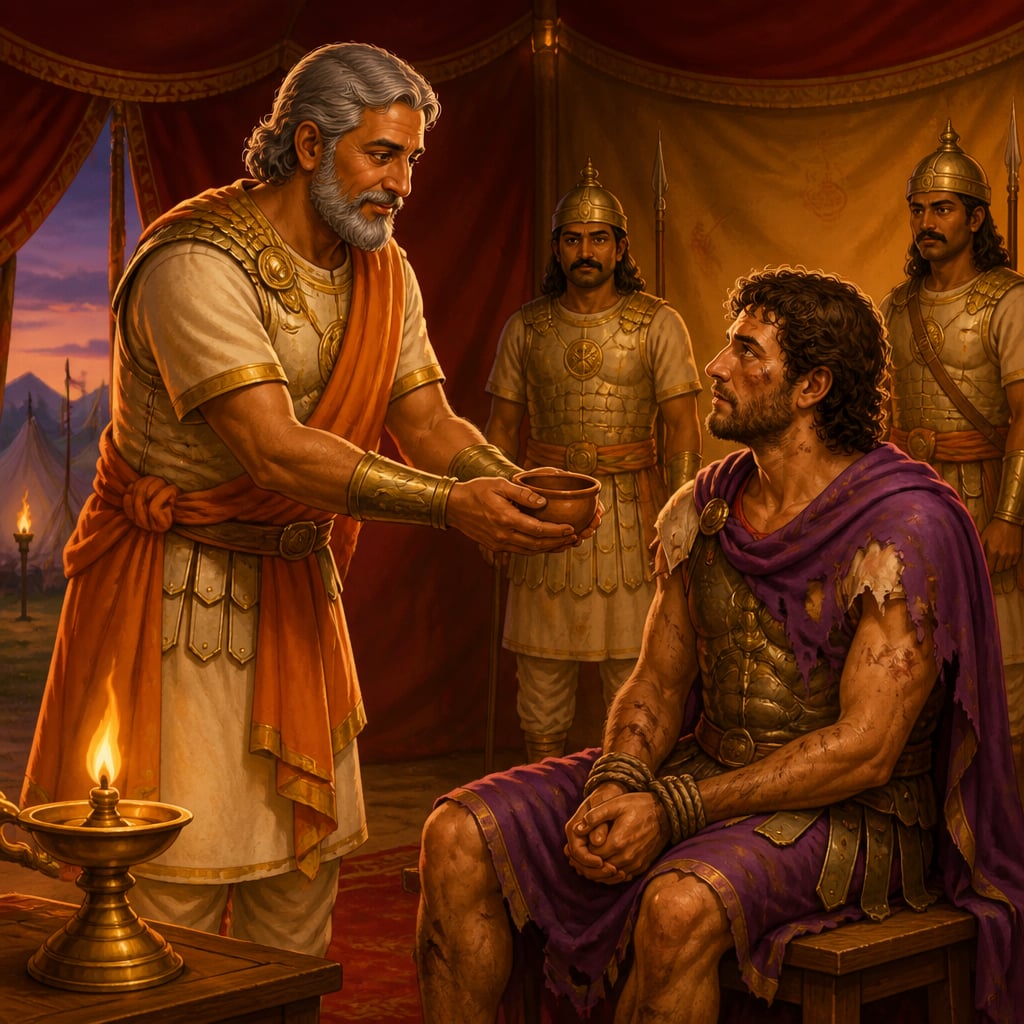
Commander Bhadrasena offering water to a captured enemy officer in his command tent

Bhadrasena poured water into two cups, offering one to his prisoner. "You'll be treated according to dharma. Your wounds will be tended. You'll receive food and shelter. When negotiations conclude, you'll likely be returned to your king."

The officer looked surprised. "You're... not executing prisoners?"

"Why would I?" Bhadrasena asked. "We fought as warriors, not butchers. The battle is over. The yuddha-dharma, the warrior's code, applies even in victory. Especially in victory."

This wasn't sentiment. It was Kautilya's explicit teaching: victory without ethics is not victory; it is savagery wearing military dress. Wars have purposes beyond destruction. Those purposes require limits, rules, and restraint, even when passion screams for revenge.

Why Ethics in War?

The question seems paradoxical. War is organized violence. Why should violence have rules? If the goal is victory, why constrain the means?

Kautilya's answer was multifaceted, practical, and profound.

First: Practical sustainability. Wars end. Enemies become neighbors, sometimes allies. The kingdom that practices unlimited brutality creates permanent enemies. Massacring prisoners, destroying cities, targeting civilians, these actions might win immediate battles but lose future peace. Cruelty in war guarantees perpetual war.

An American GI delivering Marshall Plan wheat to a German farmer in 1948 Bavaria

Consider post-war reconstruction. A defeated population that was treated honorably can be integrated, governed, even made prosperous. A population that suffered atrocities will resist forever, requiring permanent occupation and creating endless insurgency. Ethical restraint isn't weakness, it's investment in governable outcomes.

Second: Moral legitimacy. Kingdoms claimed to fight for dharma, righteous order. But dharma doesn't vanish during conflict. The king who violates fundamental ethical principles while claiming to defend civilization reveals himself as a hypocrite and tyrant. His own people lose faith; allies question their support; enemies gain moral authority.

As Kautilya wrote: "Dharmeṇa vijayaḥ śāśvataḥ, Victory through dharma is lasting." Military success built on atrocity is temporary. Ethical victory creates stable outcomes.

Third: Civilizational preservation. Unlimited war destroys the very things worth fighting for, prosperity, culture, order, life itself. If war knows no limits, it consumes everything. Rules of engagement preserve civilization through conflict. They ensure that victory is worth achieving.

This is the libertarian core of Kautilya's ethics: the point of order is to enable flourishing, not to enable destruction. War is sometimes necessary to preserve order, but war that destroys order defeats its own purpose.

The Code of the Warrior

Kautilya articulated specific ethical constraints on how wars should be fought. These weren't vague ideals but concrete rules.

Who May Be Targeted:

Combatants only - Soldiers actively engaged in fighting may be attacked. Those who surrender, are wounded and can't fight, or are fleeing should not be killed. The Arthashastra explicitly states: "Nirayudhaṃ na hanyāt, Do not kill one who has laid down weapons."

Non-combatants protected - Farmers, merchants, priests, women, children, and elderly should not be targeted. They are not the war's participants. Attacking them is murder, not warfare. The kingdom's prosperity depends on these people; destroying them is destroying your own potential future.

Wounded and sick - Those unable to fight due to injury or illness should be cared for, not killed. This includes enemy wounded. The physician treating soldiers makes no distinction between friend and enemy, suffering deserves care regardless of allegiance.

Prohibited Weapons and Tactics:

Kautilya prohibited certain weapons and methods as incompatible with dharma:

Treatment of Prisoners:

Captured enemies should be:

This wasn't mercy, it was strategic rationality. Soldiers who know surrender means honorable treatment surrender more readily. Those who expect massacre fight to the death, maximizing your casualties.

Conduct in Victory:

Perhaps most importantly, Kautilya emphasized restraint after victory:

The victorious king should present himself as bringing order and dharma, not conquest and plunder. "Vijitaṃ rakṣayet, Protect that which is conquered," Kautilya taught. You've won the battle; now win the peace.

Modern Parallels: The Geneva Conventions

Kautilya's ethics of warfare anticipated modern international humanitarian law by more than two millennia.

Henry Dunant tending wounded soldiers on the field after the 1859 Battle of Solferino

The Geneva Conventions (1949) and their Additional Protocols codified rules strikingly similar to Kautilya's:

Distinction - Combatants must be distinguished from civilians. Deliberate attacks on civilians are war crimes. This mirrors Kautilya's prohibition on targeting non-combatants.

Proportionality - Military action must be proportional to legitimate military objectives. Excessive destruction relative to military advantage gained is prohibited. Kautilya's restrictions on burning food supplies and homes embody the same principle.

Humanity - Wounded, sick, and prisoners must be treated humanely. Torture, cruel treatment, and medical experimentation are forbidden. This directly parallels Kautilya's requirements for prisoner treatment.

Necessity - Force may only be used when necessary for legitimate military objectives. Wanton destruction or cruelty serves no military purpose and is prohibited. Kautilya's framework assumed the same: violence must serve strategic ends, not satisfy sadism.

The convergence is remarkable. Despite vast cultural and temporal differences, the fundamental principles are identical: war must have limits to remain compatible with civilization.

Modern violations, deliberately targeting civilians in Syria, using chemical weapons, torturing prisoners at Abu Ghraib, would have appalled Kautilya as much as they horrify us. They represent not strength but civilizational failure.

The Warrior's Dilemma

But ethics in war creates genuine dilemmas. What if the enemy doesn't follow the same rules? What if ethical restraint costs you victory and endangers your people?

Kautilya acknowledged these tensions. His response was nuanced:

Reciprocity matters, but doesn't eliminate obligation - If the enemy uses prohibited tactics, you may respond proportionally to protect your forces. But this doesn't justify wholesale abandonment of ethics. You may counter their poison with better intelligence, not with massacre of their civilians.

Strategic context determines application - Rules are strictest in conventional warfare between kingdoms operating under shared norms. They're more flexible when facing existential threats or enemies who reject all constraints. But flexibility doesn't mean absence, even desperate circumstances don't justify unlimited brutality.

The goal remains civilized victory - However difficult the conflict, the purpose is achieving stable outcomes that enable governance and prosperity. Victory through atrocity defeats this purpose. Short-term military advantage gained through war crimes creates long-term strategic disaster.

Kautilya's framework wasn't absolute pacifism or rigid legalism. It was strategic ethics: rules that generally apply, flexibly interpreted based on context, but never entirely abandoned.

The modern parallel is the doctrine of "supreme emergency" in just war theory, articulated by philosopher Michael Walzer. In genuine existential threats, when civilization itself faces annihilation, some normally prohibited actions might become permissible. But the threshold is extraordinarily high, and the burden of proof falls on those claiming exception.

Libertarian Ethics: Rights Even in War

Kautilya's warfare ethics connect to his broader political philosophy in a profound way: individuals retain basic rights even during conflict.

Consider what this means. The farmer tilling fields near a battlefield isn't a military asset to be destroyed or a resource to be consumed. He's a person pursuing his livelihood, and war doesn't erase his fundamental right to do so unmolested.

The merchant traveling between kingdoms isn't automatically a spy or combatant. Trade is productive activity that benefits everyone. Disrupting trade punishes the innocent and impoverishes both sides.

Even enemy soldiers, once they surrender, return to being individuals with rights, to life, to basic dignity, to eventual freedom. Their combatant status was temporary and contextual, not essential.

This is radically different from viewing war as total mobilization where everything and everyone becomes a military resource. That totalitarian vision, which dominated 20th-century warfare, leads to Dresden, Hiroshima, and total war.

Kautilya's alternative: war is a dispute between sovereigns over specific issues. It should be resolved by those sovereigns and their armed forces, not by destroying populations, economies, and civilizations.

Modern libertarian ethics emphasizes individual rights, property rights, and limited government. These don't disappear during conflict. If anything, they become more important precisely because conflict tempts us toward unlimited violence.

The kingdom that respects property even in war, that protects non-combatants, that restrains its forces, that kingdom demonstrates that its order is worth defending. The kingdom that massacres, plunders, and terrorizes demonstrates only that its victory would be indistinguishable from its defeat.

Just Conduct vs. Just Cause

Classical just war theory distinguishes jus ad bellum (justice of going to war) from jus in bello (justice in conducting war). Kautilya's ethics focus primarily on the latter.

You might fight for a just cause, but if you fight unjustly, massacring civilians, using prohibited weapons, violating truces, you forfeit moral legitimacy. Conversely, even if your cause is questionable, fighting ethically partially preserves honor and leaves room for better peace.

This matters because it provides common ground even between enemies. We may disagree on whether this territory belongs to you or me. But we can agree that neither of us should poison the river that runs through it. We can agree that priests and children aren't combatants. We can agree that prisoners deserve basic treatment.

These shared rules create the possibility of limiting war's scope and eventually ending it. Without shared ethics, war becomes existential, total victory or total defeat, with no middle ground and no resolution short of annihilation.

The Hague and Geneva Conventions work because they codify shared rules that belligerents can follow even while fighting. This doesn't end wars, but it limits them, making eventual peace possible.

When Rules Break Down

Kautilya wasn't naive. He knew that some enemies would violate every rule, that desperate circumstances would test commitments, that passion would tempt soldiers toward atrocity.

His response was institutional: make ethics structural, not just aspirational.

Training - Soldiers should be trained in dharma-yuddha (ethical warfare) as rigorously as in combat tactics. The warrior who understands why rules exist follows them better than one who only knows what they are.

Command responsibility - Officers are responsible for their troops' conduct. Atrocities committed under their command reflect on them, even if they didn't order them explicitly. This creates incentive for enforcement.

Post-war accountability - Violations should be investigated and punished, even in victory. The king who overlooks his own forces' war crimes signals that rules are optional, undermining future compliance.

Cultural reinforcement - Stories, honors, and social status should reward ethical conduct in war. The general remembered for honorable victory inspires imitation; the general remembered for atrocity inspires shame.

Modern military justice systems embody these principles: rules of engagement training, command responsibility doctrine, war crimes prosecution, and cultural emphasis on honor and professionalism.

But institutional mechanisms only work when supported by genuine conviction. The warrior who believes ethics are real constraints fights differently from one who views them as public relations.

Kautilya's framework assumed dharma was real, not just useful fiction but actual obligation. This is harder to maintain in a cynical age. Yet the alternative, unlimited war, is worse.

Your Ethics in Conflict

Most readers will never command armies. But everyone faces conflicts requiring ethical judgment under pressure.

Consider workplace competition. You're competing for promotion, resources, or recognition. Your competitor has weaknesses, personal information that could damage their reputation, mistakes they've made that could be exposed.

The question isn't whether you can use this information. The question is whether you should.

Kautilya's framework applies:

What's the purpose? - Is your goal better outcomes for the organization (analogous to stable governance), or is it personal advancement regardless of consequences (analogous to plunder)?

What are the limits? - Are certain tactics off-limits because they violate basic ethics (analogous to non-combatant protection)? Personal attacks, deliberate deception, sabotage?

What happens after? - When the competition ends, you'll still work with these people. Have you created permanent enemies through how you competed? (Analogous to post-war governance.)

What example are you setting? - Others watch how you compete. Are you establishing norms you want them to follow? (Analogous to cultural reinforcement.)

The professional who competes ruthlessly without ethical constraint might win immediate battles. But they create work environments where trust is impossible, cooperation fails, and everyone constantly watches their back. That's organizational dysfunction analogous to perpetual war.

The professional who competes vigorously but ethically, advancing on merit, respecting boundaries, maintaining relationships, creates environments where competition improves outcomes rather than destroying them.

The Paradox of Restraint

Kautilya's final insight on warfare ethics is paradoxical: restraint creates strength, not weakness.

The army that follows ethical rules appears to handicap itself. It doesn't target civilians, doesn't use certain weapons, treats prisoners well. Surely the unrestrained enemy gains advantage?

But consider the systemic effects:

Better discipline - Soldiers trained to follow rules fight more effectively. Armies that permit atrocities descend into undisciplined mobs. The rape of Nanking in 1937 didn't make the Japanese army stronger, it made them weaker, harder to command, more brutal to their own soldiers.

Easier surrender - Enemies who know they'll be treated well surrender more readily. This reduces your casualties and accelerates victory. Enemies who expect massacre fight desperately to the end.

Stable conquests - Territories conquered ethically are easier to govern. You're not managing permanent resistance from traumatized populations seeking revenge.

Sustained alliances - Allies prefer fighting alongside forces that share ethical constraints. The army known for atrocities fights alone.

Moral authority - Ethical conduct strengthens legitimacy domestically and internationally. This provides diplomatic advantages, economic support, and cultural influence that outlast military victories.

The restraint isn't weakness, it's strategic sophistication. It's recognizing that war is means to political ends, and those ends are better served by ethical conduct than unlimited violence.

Modern military forces increasingly recognize this. Counterinsurgency doctrine emphasizes protecting civilians, building legitimacy, and winning populations, not just destroying enemies. This isn't sentiment; it's hard-earned strategic wisdom.

Conclusion: Warriors and Murderers

Bhadrasena's decision to treat prisoners ethically wasn't complicated moral philosophy. It was recognition of a simple truth: the difference between warriors and murderers is ethics.

Both use violence. Both kill. But the warrior uses violence for legitimate purposes, constrained by rules, directed toward meaningful ends. The murderer uses violence for its own sake, unconstrained, serving only destruction.

Kautilya's teaching on warfare ethics comes down to this: if you must fight, fight as warriors, not murderers. Victory matters, but how you achieve victory matters more, because you must live with the world your methods create.

The kingdom that wins through atrocity inherits ruins, resentment, and perpetual conflict. The kingdom that wins through ethical force inherits opportunity, legitimacy, and sustainable order.

This is why dharma applies even in war. Especially in war. Because war tests whether your principles are real or merely convenient. And civilizations are built by those whose principles survive the test.

Ethical Sustainability - The principle that methods matter as much as outcomes because methods determine whether outcomes can be sustained.

Modern counterinsurgency doctrine emphasizes 'winning hearts and minds', establishing legitimacy through ethical conduct and protection of civilian populations. Business ethics recognizes that companies built on fraud, exploitation, or deception ultimately collapse (Enron, Theranos). Political legitimacy requires that power be exercised ethically. The common pattern: unethical success is temporary; ethical success builds sustainable foundation.

Kautilya integrated ethics and strategy systematically, not as separate domains. Modern thinking often treats ethics as constraint on strategy, something that limits what you can do. Kautilya recognized ethics as enabling strategy, making victories governable, conquests stable, and power legitimate. This integration is rarer and more sophisticated than treating them as competing concerns.

The Marshall Plan (1948-1952) rebuilt former enemies (Germany, Japan) after World War II rather than exploiting them. This ethical approach created stable allies, thriving economies, and lasting peace. Contrast with post-WWI treatment of Germany, harsh reparations and humiliation that contributed to WWII. Ethical victory (Marshall Plan) proved more strategically successful than punitive victory (Versailles Treaty).

Principle of Distinction - The requirement to distinguish between legitimate military targets and protected persons/objects.

Geneva Conventions and modern international humanitarian law establish the same principle: deliberate attacks on civilians constitute war crimes. Military forces must distinguish combatants from non-combatants and may only target the former. Violations undermine moral authority, create permanent resistance, and generate international consequences. The principle is universal across legal and ethical traditions.

Verses

निरायुधं न हन्यात्।

nirāyudhaṃ na hanyāt |

One should not kill an unarmed person.

This foundational ethical rule establishes that warfare has limits. The soldier who has surrendered, dropped weapons, or is otherwise unable to fight is no longer a legitimate target.

Book 10, Chapter 3, Verse 45 (R.P. Kangle)

धर्मेण विजयः शाश्वतः।

dharmeṇa vijayaḥ śāśvataḥ |

Victory achieved through dharma is lasting.

Kautilya distinguished between military success and sustainable victory. Conquests achieved through atrocity, betrayal, or unlimited violence may succeed temporarily but create permanent resistance, moral delegitimization, and unstable outcomes.

Book 13, Chapter 4, Verse 63 (R. Shamasastry)

विजितं रक्षयेत्।

vijitaṃ rakṣayet |

One should protect that which has been conquered.

Victory creates responsibility. The conquered territory, defeated population, and captured resources are now yours to govern, not exploit.

Book 13, Chapter 5, Verse 15 (Patrick Olivelle)

Case studies

The Marshall Plan: Protecting the Conquered

After World War II, the United States faced a choice about defeated enemies (Germany, Japan): exploit them through reparations and occupation, or invest in their reconstruction. Despite domestic pressure for punishment, the U.S. chose the Marshall Plan (1948-1952), providing $13 billion in economic assistance to rebuild European economies, including former enemies. Similar investment went to Japan. This represented a radical departure from post-WWI treatment of Germany.

The Marshall Plan embodied Kautilya's principle: 'Protect that which has been conquered' (vijitaṃ rakṣayet). Rather than plundering defeated enemies, the U.S. invested in their recovery. This wasn't sentiment, it was strategic recognition that stable, prosperous former enemies become allies while impoverished, resentful populations create perpetual conflict. The ethics served strategy; strategy required ethics.

Germany and Japan became stable democracies, strong economies, and reliable allies. European economic integration (eventual EU) created unprecedented peace. Contrast with post-WWI: harsh Versailles Treaty contributed to German resentment, economic collapse, and ultimately WWII. Ethical treatment of defeated enemies produced 75+ years of peace and prosperity; punitive treatment produced renewed conflict within 20 years.

Kautilya's principle validated: victory through dharma is lasting. How you treat defeated enemies determines whether victory creates stable peace or seeds future conflict. This applies beyond warfare, to business competition, professional rivalries, and any context where today's adversary might be tomorrow's partner.

Post-acquisition integration follows the same logic. Companies that invest in acquired teams, protect their culture, and focus on long-term value creation consistently outperform those that strip assets and cut costs. Microsoft's treatment of LinkedIn and GitHub, preserving autonomy while providing resources, demonstrates that the Marshall Plan principle applies in boardrooms: invest in the conquered, do not exploit them.

The Marshall Plan invested $13.3 billion (roughly $170 billion in today's dollars) over four years. By 1952, every participating country had exceeded its prewar economic output.

Abu Ghraib: The Cost of Ethical Violations

In 2004, photographs emerged showing U.S. military personnel abusing Iraqi prisoners at Abu Ghraib prison. The images showed torture, humiliation, and treatment violating Geneva Conventions and basic human dignity. Despite representing actions of relatively few individuals, the scandal became defining image of Iraq occupation.

Abu Ghraib violated Kautilya's explicit principles: humane prisoner treatment, prohibition on torture, and recognition that ethical conduct maintains legitimacy. The strategic consequences validated Kautilya's framework: the abuse undermined U.S. moral authority, fueled insurgent recruitment, damaged allied support, and complicated post-war reconstruction. Military advantage gained from intelligence was vastly outweighed by strategic costs.

The scandal damaged U.S. credibility globally, strengthened insurgent propaganda, made Iraqi cooperation more difficult, and complicated diplomatic relations. Multiple investigations, prosecutions, and policy changes followed. The strategic cost of ethical violations far exceeded any tactical intelligence benefit. As Kautilya would have predicted: victory through adharma (unrighteousness) creates unsustainable outcomes.

Kautilya's warning validated: ethical violations in pursuit of victory undermine the victory itself. Modern challenges may differ from ancient warfare, but the principle persists, how you fight matters as much as whether you win, because methods determine whether victory achieves its purposes.

Corporate scandals from Wells Fargo's fake accounts to Volkswagen's emissions fraud follow the same pattern: ethical violations that provided short-term gains ultimately destroyed far more value than they created. In the age of social media, where misconduct spreads globally within hours, the cost of ethical failure has only increased. Organizations that maintain ethical standards under pressure are not being idealistic. They are being strategic.

Abu Ghraib photographs were cited in recruitment propaganda by at least 12 militant organizations. Military analysts estimated the scandal generated more insurgent recruits than any single U.S. military operation in Iraq.

Historical context

c. 4th century BCE

Ancient Indian warfare operated under complex ethical frameworks. While often fierce, it included protections for non-combatants, prohibitions on certain weapons, and codes of honor. Kautilya systematized these traditions, grounding them in strategic rationality as much as moral idealism. Post-war, Ashoka's transformation after Kalinga demonstrated how warfare ethics influenced even successful conquerors.

Kautilya's warfare ethics influenced Indian military traditions for centuries and anticipated modern international humanitarian law by millennia. The principles, distinction, proportionality, humanity, necessity, are strikingly similar across traditions and eras, suggesting they reflect fundamental requirements for civilized conflict rather than arbitrary cultural preferences.

Reflection

More in Chaturanga: The Four-fold Army

All lessons in Chaturanga: The Four-fold Army · Arthashastra: Art of Strategy course