Why Humans Need Society

Beyond Individual Survival

Humans cannot thrive alone. Kautilya understood that cooperation, specialization, and trade create prosperity that no individual could achieve in isolation. Society is not a constraint on freedom but the very foundation that makes freedom meaningful.

The Hermit's Miscalculation
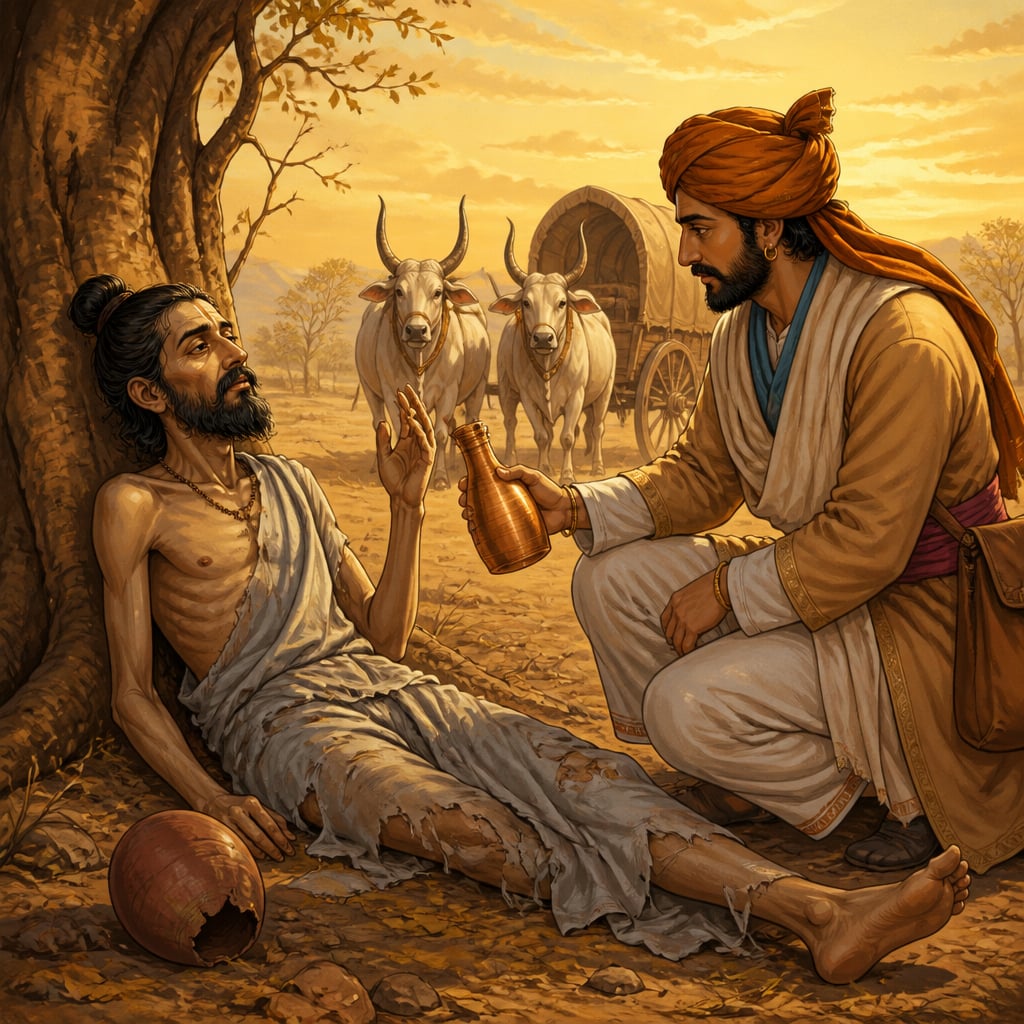
The hermit Sumedha rescued by a merchant caravan

Sumedha was the most brilliant scholar in Takshashila. Tired of politics, taxation, and what he called "the idiocy of kings," he retreated to the forest to live as a hermit.

For a month, he was happy. Solitude. Peace. No obligations.

Then the rains failed. His stored grain ran out. He didn't know which forest plants were edible, that knowledge belonged to tribal experts he had always dismissed. His roof leaked because he'd never learned carpentry. When he fell ill with fever, there was no physician, no medicine, no one to bring water.

A passing merchant caravan found him half-dead and carried him back to civilization.

"I thought I was escaping society," Sumedha admitted later. "I discovered I was escaping myself."

Kautilya heard this story and nodded. Humans are not designed for isolation. Not because we are weak, but because cooperation creates wealth and capability that individuals alone cannot.

The Economic Foundation

Kautilya understood something profound about prosperity:

"Kṛṣyaḥ paśu-pālyaṃ vāṇijyā ca vārtā."

"Agriculture, cattle-rearing, and trade constitute productive economic activity."

Notice what's missing from this list: no one person can do all three well. The farmer who excels at growing grain doesn't have time to master metalworking. The herder who breeds strong oxen can't simultaneously become an expert weaver.

Two thousand years before Adam Smith described the pin factory, Kautilya understood the principle we now call comparative advantage: everyone benefits when each person specializes in what they do best and trades for the rest.

The Division of Labor
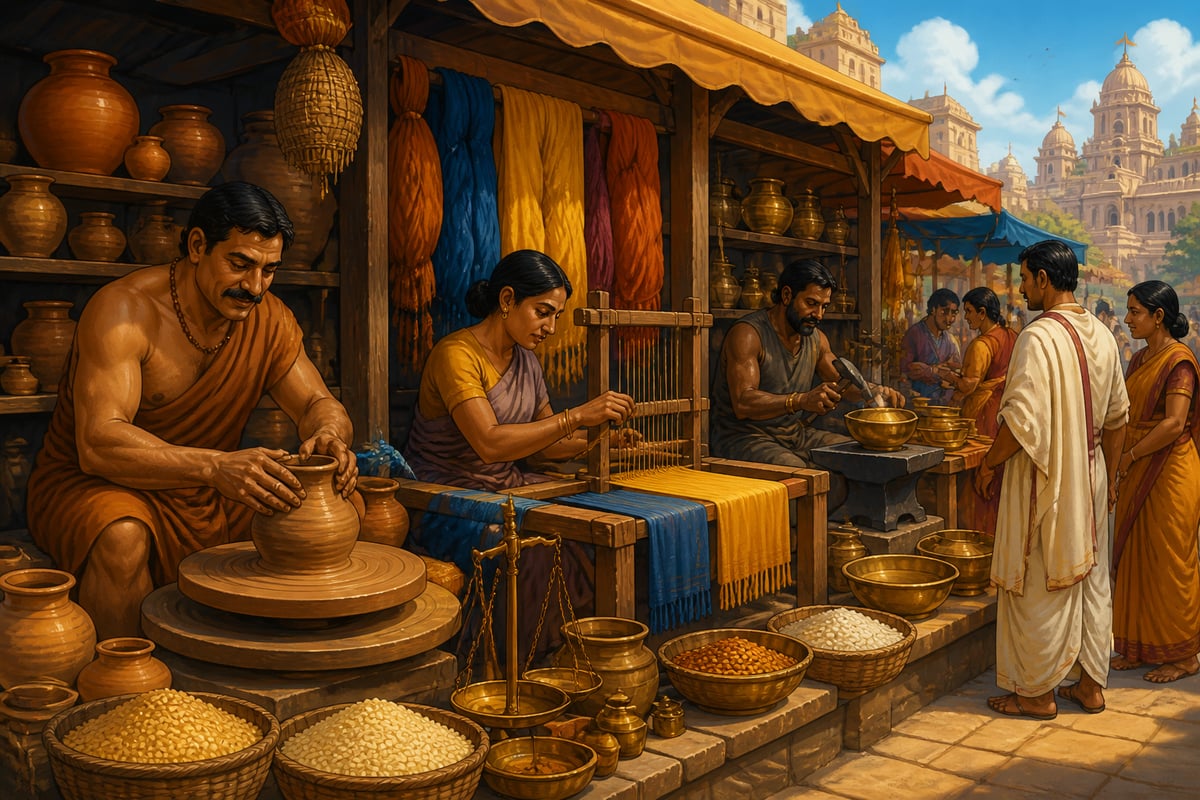
A bustling Mauryan marketplace of specialized craftsmen

The Arthashastra describes an economy with hundreds of specialized occupations:

Why so much specialization? Because someone who dedicates their life to mastering pottery will make better pots than someone who does pottery part-time while also farming, weaving, and defending themselves.

A modern iPhone contains components from over 40 countries, designed by specialists in dozens of fields. No individual human could make one from scratch. The device exists only because of cooperation across continents.

Trade as Mutual Creation

Kautilya saw trade not as exploitation but as mutual benefit:

"Kośa-mūlo daṇḍaḥ daṇḍa-mūlaṃ rāṣṭram."

"The treasury is the root of state power; state power is the root of the nation."

When the potter and farmer trade, both gain:

This is why Kautilya devoted extensive attention to:

Trade creates prosperity. Prosperity requires trust. Trust requires enforcement.

Security Through Numbers

Society isn't just about economics. It's also about survival.

A person alone is vulnerable:

A group provides mutual defense:

Israel's kibbutz system exemplified this: agricultural communities that also functioned as defensive units, where specialization and mutual protection reinforced each other.

Knowledge as Inheritance

Perhaps most importantly, society enables accumulation and transmission of knowledge.

One person, starting from scratch, would need to:

This would take multiple lifetimes, assuming survival.

But in society:

A Takshashila master teaching apprentices under a banyan tree

Each generation builds on the last. A medical student today inherits knowledge accumulated over thousands of years. Takshashila University in Kautilya's time offered courses in medicine, law, warfare, astronomy, and philosophy, knowledge no individual could develop alone.

The Social Contract

If humans naturally need society for prosperity, security, and knowledge, then the arrangements that make society function are not impositions but necessities:

All of these require organized authority. Not to oppress, but to coordinate the cooperation that makes prosperity possible.

Freedom Through Society

Here is the paradox Kautilya grasped:

True individual freedom is impossible without society.

The hermit in the wilderness is not free, he is enslaved to the endless demands of survival. Every waking hour is consumed by necessity.

But the person in a functioning society has:

Society doesn't constrain freedom, it creates the conditions for freedom.

Of course, this assumes the society is well-ordered. A tyrannical society can be worse than isolation. That's why Kautilya's entire project is about creating good governance, not just any governance.

The Modern Web

We see these principles everywhere today:

In business: Supply chains span continents. A single company doesn't make everything from raw materials to finished products, specialists cooperate across borders.

In communities: You depend on electricians, plumbers, doctors, teachers, specialists you could never become while mastering your own profession.

In technology: Modern innovations build on centuries of accumulated knowledge. Open-source software enables millions of developers to build on each other's work.

In security: We rely on police, militaries, and courts so we can pursue goals rather than constantly defending ourselves.

Your Turn

The question is never "society or no society", that choice doesn't exist. The question is: what kind of society?

Kautilya's answer:

  1. Maximize productive cooperation through trade, specialization, and security
  2. Minimize predation through law, justice, and limited but effective governance
  3. Enable human flourishing through property rights and protection of the weak

The state exists to serve society. Society exists to enable individual flourishing. Individual flourishing requires cooperation. Cooperation requires rules.

This chain of reasoning leads from "why humans need society" to "why society needs governance", which is where we turn next.

Adam Smith's pin factory example (1776) showed how division of labor multiplies productivity. David Ricardo's comparative advantage theory (1817) explained why trade benefits all parties. Both arrived millennia after Kautilya articulated the same principles embedded in varta.

Kautilya understood that specialization requires security and trust. Without protection from predation and reliable contract enforcement, no one dares specialize - you must do everything yourself to survive. Economic policy must therefore secure property rights and enable exchange.

The Chola Empire (9th-13th centuries) prospered through specialized production and extensive trade. Tamil merchants dominated Indian Ocean commerce while Chola farmers perfected wet-rice cultivation. Neither group attempted self-sufficiency; both prospered through specialization and exchange enabled by imperial security and standardized commerce.

Joseph's Biblical advice to Pharaoh - save during seven good years for seven lean years. Keynes' liquidity preference theory explains why people hold cash despite opportunity costs. Modern portfolio theory balances growth investments with liquid reserves.

Kautilya understood that kosha serves dual purpose: defensive (weathering crises) and offensive (seizing opportunities). Unlike modern focus on maximizing returns, Kautilyan approach balances growth with resilience, recognizing that survival requires slack resources.

The Maratha Empire's decline partly stemmed from depleting treasury on constant warfare without replenishing reserves. In contrast, Tipu Sultan of Mysore maintained substantial treasury reserves that enabled him to resist British expansion longer than wealthier but less prudent kingdoms.

Medieval merchant guilds enforced contract compliance through reputation - violators were excluded from future trade. Modern credit scores quantify trustworthiness. Robert Axelrod's 'Evolution of Cooperation' showed that reciprocity strategies outperform short-term exploitation.

Kautilya recognized that samvid requires both parties honoring agreements AND third-party enforcement for when parties don't. Trust emerges from combination of individual reputation and institutional enforcement. Neither alone suffices - both together enable large-scale cooperation.

Indian merchant communities (Chettiars, Marwaris, Gujarati traders) built commercial networks across Asia based on reputation for honoring agreements. Their word was their bond, backed by community enforcement. This enabled them to operate across vast distances without formal legal systems, conducting business worth millions on verbal commitments.

Verses

कृष्यः पशुपाल्यं वाणिज्या च वार्ता

kṛṣyaḥ paśu-pālyaṃ vāṇijyā ca vārtā

Agriculture, cattle-rearing, and trade constitute productive economic activity (varta).

Kautilya identifies the three fundamental economic activities that sustain civilization. Notice that none can be perfectly performed by a single individual - they require specialization and exchange.

Book 1, Chapter 4, Verse 1-3 (R.P. Kangle)

कोशमूलो दण्डः दण्डमूलं राष्ट्रम्

kośa-mūlo daṇḍaḥ daṇḍa-mūlaṃ rāṣṭram

The treasury is the foundation of the rod (state power); the rod is the foundation of the state.

This reveals Kautilya's economic understanding of governance. State authority (danda) requires resources (kosha), and resources come from a prosperous economy.

Book 2, Chapter 1, Verse 1-2 (L.N. Rangarajan)

मित्रलाभो ज्ञानतः

mitra-lābho jñānataḥ

The gaining of friends/allies comes from knowledge.

Kautilya recognizes that cooperation - whether in friendship, alliance, or trade - is built on mutual understanding and knowledge. You cannot cooperate with people you don't know or understand.

Book 1, Chapter 15, Verse 12 (Patrick Olivelle)

Case studies

The Mauryan Economic System

Under Chandragupta and Kautilya, the Mauryan Empire created one of antiquity's most sophisticated economies. Standardized weights and measures, protected trade routes, specialized state departments, extensive irrigation systems, regulated markets, and contract enforcement enabled unprecedented prosperity.

The Mauryan system embodied Kautilya's principles: the state provided infrastructure and security (enabling cooperation), enforced contracts (making trade reliable), standardized measures (preventing fraud), and protected producers (ensuring they kept fruits of labor). This created conditions where specialization and exchange could flourish.

Greek and Roman accounts describe the Mauryan Empire as extraordinarily prosperous. Cities thrived, trade expanded, arts flourished, and scientific knowledge advanced. This prosperity came not from natural resources but from the organized cooperation that Kautilya's system enabled.

Prosperity requires both freedom to cooperate (markets, trade, specialization) and systems that make cooperation safe and reliable (contract enforcement, security, standards). Neither markets nor states alone create wealth - it's the right combination that enables human flourishing.

Modern trade agreements like the EU single market and ASEAN economic community serve the same function Kautilya designed: standardized rules, protected trade corridors, and contract enforcement across borders. The WTO's dispute resolution mechanism is a direct descendant of ancient trade governance systems.

The Mauryan Empire under Chandragupta administered a population estimated at 50 million across 5 million square kilometers, making it one of the largest empires of the ancient world by both area and population.

The Internet as Global Cooperation

The internet enables unprecedented global cooperation - people in different countries collaborating on software, sharing knowledge, trading digital goods, and coordinating complex projects without ever meeting in person. This creates value impossible for isolated individuals or even single nations.

The internet demonstrates Kautilya's principles at global scale: extreme specialization (niche skills find markets worldwide), knowledge accumulation (Wikipedia, Stack Overflow, research databases), and trade across borders (digital goods, remote services). But it also shows the need for coordination systems - technical standards, payment systems, dispute resolution, security against predation.

Where the internet has reliable infrastructure, enforceable norms, and security (preventing fraud, spam, theft), cooperation flourishes and creates enormous value. Where these are absent, matsya nyaya emerges - scams, harassment, theft, and predatory behavior that destroys trust and prevents cooperation.

Even in the most modern technologies, Kautilya's ancient insights hold: cooperation creates prosperity, but cooperation requires security, and security requires coordination. The question is always how to enable cooperation while preventing predation - not whether we need systems to do this.

Blockchain and cryptocurrency represent the latest iteration of this challenge. Decentralized systems enable global cooperation without traditional authorities, but they still need governance, dispute resolution, and security. DeFi hacks that cost billions in 2022 and 2023 prove that cooperation without adequate security structures remains fragile.

Global internet commerce reached $5.8 trillion in 2023, up from effectively zero in 1990, with over 5.3 billion people connected across 190+ countries.

Historical context

c. 4th century BCE

The period when Kautilya wrote saw unprecedented economic sophistication in India. Cities were growing, trade routes expanding, specialization increasing. Kautilya wasn't theorizing in a vacuum - he was observing a complex economy with hundreds of occupations, extensive trade networks, sophisticated financial instruments, and specialized production. The Arthashastra reflects this reality.

Understanding that Kautilya wrote during an era of expanding trade and specialization explains why his economics are so sophisticated. He wasn't imagining ideal theory but describing and systematizing the functioning economy he observed. This makes his insights remarkably practical and applicable even today.

Reflection

More in Why States Exist

All lessons in Why States Exist · Arthashastra: Philosophy of Power course