Order vs Chaos

The Price of Anarchy

What happens when order breaks down? Historical examples of what matsya nyaya looks like in practice - and why it must be prevented. This lesson examines the stark human cost of chaos and why maintaining order is worth the price of organized authority.

The Last Days of Pataliputra
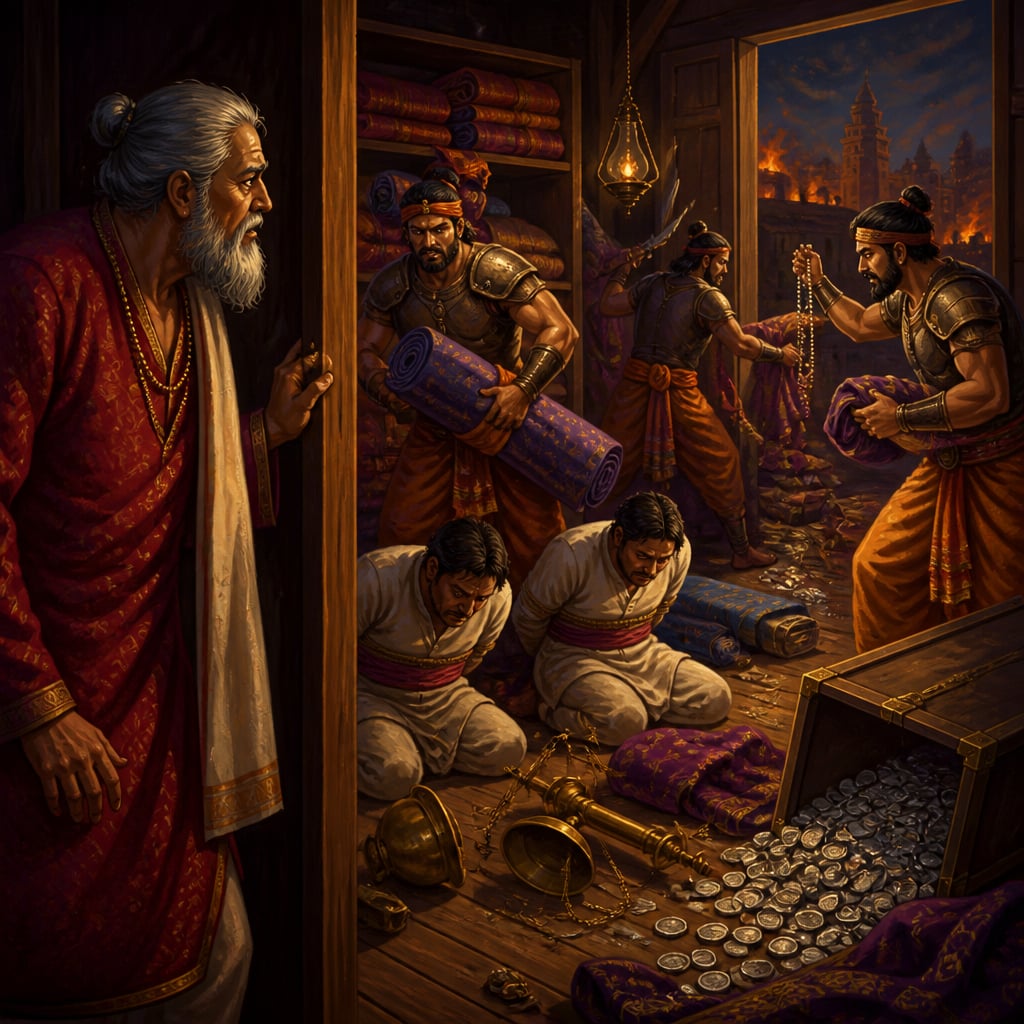
Devadatta watches his Pataliputra warehouse being raided

The merchant Devadatta had built his silk business over thirty years. His warehouse near Pataliputra's great market held treasures from across Asia. His family lived comfortably. His apprentices had apprentices.

Then the Nanda succession crisis came.

Week 1: Rumors spread of the king's illness. Shops closed early. Guards looked nervous.

Week 2: Prince Dhana declared himself king. Two brothers disputed. Officials stopped showing up. Courts closed.

Week 3: Armed gangs appeared, wearing the insignia of different princes. They demanded "protection" payments. There was no one to report them to.

Month 2: Devadatta's warehouse was raided. His guards fled. His inventory was taken. He moved his family to cousins in the countryside.
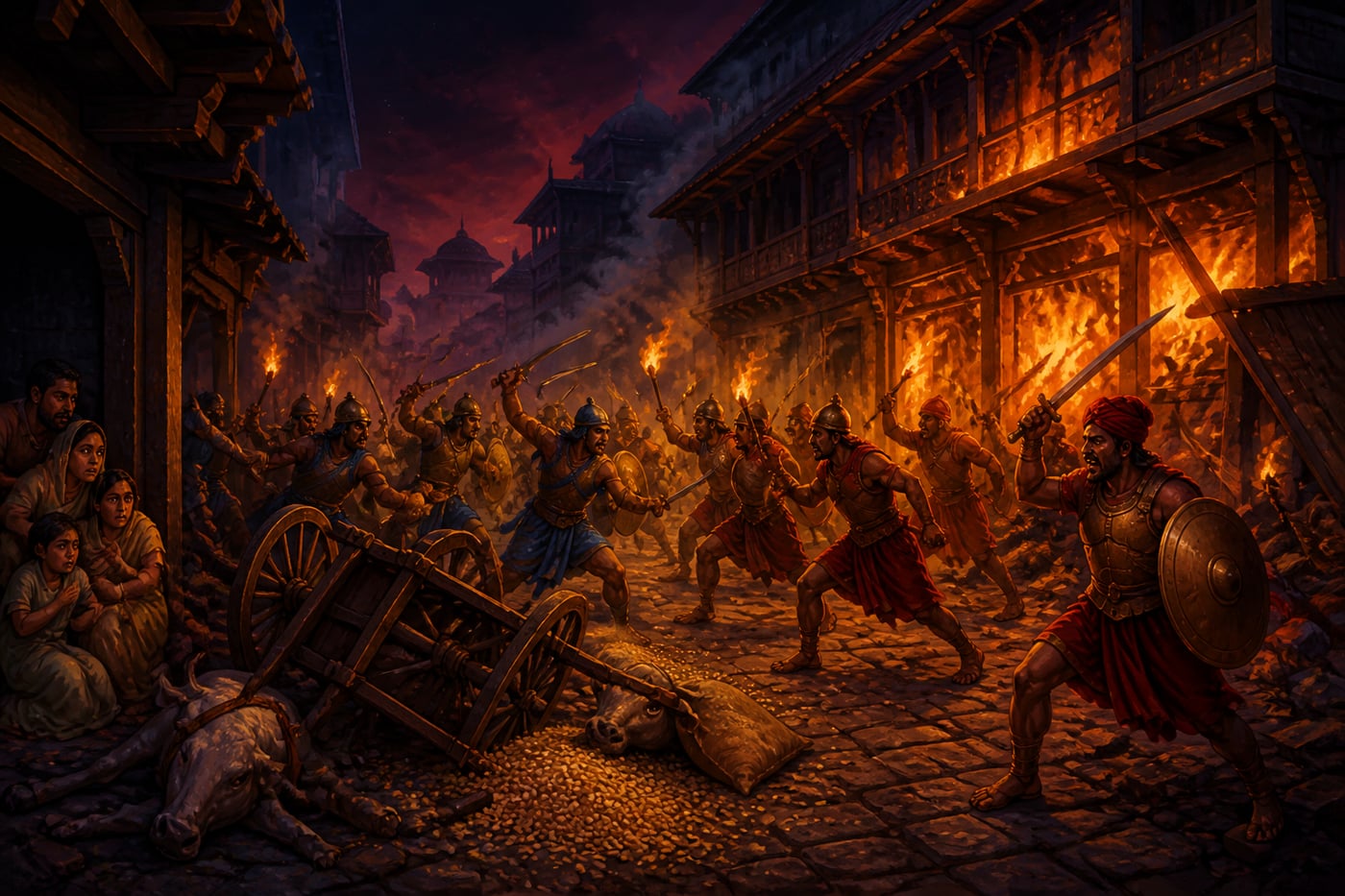
Pataliputra streets in anarchy during the Nanda succession crisis

Month 6: Pataliputra was a war zone. Different factions controlled different neighborhoods. Trade had stopped. His thirty years of work was ash.

This wasn't fiction. This was what Kautilya witnessed, the price of chaos when order collapses.

The Cascading Costs

When Kautilya warns of matsya nyaya, he describes a specific, observable process:

Stage 1: Immediate Predation

The moment enforcement stops:

Productive activity declines immediately. Why open your shop if it will be robbed?

Stage 2: Defensive Contraction

People prioritize survival:

Specialization collapses. Everyone must be their own security force.

Stage 3: Resource Depletion

The economy shifts from production to extraction. "What's left to take?" replaces "What can we create?"

Stage 4: Normalization of Violence

Stage 5: Population Collapse

This cascade validates Kautilya's core insight: order is not natural; chaos is natural. Order requires constant effort. When that effort stops, entropy increases rapidly.

Historical Examples

The Roman Collapse

Rome had provided order across vast territories for centuries. Roads were safe. Contracts were enforced. Trade connected Britain to India.

As Roman authority weakened (4th-5th century CE):

This wasn't primarily about barbarian invasions. It was about the collapse of order that made civilization possible. Recovery took centuries.

Yugoslavia (1990s)

A functioning multi-ethnic state with developed economy and educated population. Then political authority fractured.

Within years:

Civilization is thinner than we think. Advanced societies can descend into chaos quickly.

Syria (2011-present)

What began as political protests became civil war:

There's no "natural order" that emerges, just competing violence.

Why Order Is Fragile

Order requires:

All of these are stocks, not flows, accumulate slowly, deplete rapidly.

This is why prevention is vastly cheaper than recovery.

The Human Cost

Statistics don't capture the lived experience:

This is the price of anarchy. Not abstract, concrete, human, devastating.

The Paradox of Freedom

Here's Kautilya's crucial insight:

Order is necessary for freedom.

Without order:

Chaos doesn't create freedom. Chaos creates tyranny of the strongest.

The choice isn't between order (tyranny) and chaos (freedom). It's between:

Kautilya argues the first option is both possible and necessary. Minimize government to the level that prevents matsya nyaya, not below.

The Precautionary Principle

Given how catastrophic breakdown is, Kautilya adopts a precautionary approach:

Restored Pataliputra at dawn under early Mauryan order

This is why he built Chandragupta's alternative before destroying the Nandas. Criticism alone doesn't fix chaos, you need credible replacement.

Maintaining Order

Kautilya identifies key principles:

Legitimate authority: Power seen as rightful, not just strong, from serving people's welfare and following dharma.

Effective security: Capacity to deter predation through law enforcement, courts, military.

Economic prosperity: Prosperous people have more to lose from chaos.

Managed succession: Most breakdowns involve succession crises. Clear processes for transferring power are essential.

Inclusive governance: Order built on exclusion is fragile. The excluded may prefer chaos to oppressive order.

The underlying principle: maintaining order is constant work. Entropy is the default.

Your Turn

Anyone who advocates dramatic change should meditate on:

All began with people who thought they could manage the transition, who thought the old order was so bad that anything would be better.

Chaos is not theoretical. It's children starving. Families destroyed. Generations traumatized.

This doesn't mean accepting injustice. It means taking responsibility:

Kautilya's case for order isn't that it's ideal, it's that the alternative is catastrophic. Under the law of fish, no one is free except the strongest, and even they are free only until someone stronger comes.

Isaiah Berlin's 'Two Concepts of Liberty' distinguished freedom from interference vs. self-determination. Robert Nozick vs. John Rawls on whether unregulated markets create or destroy freedom. Hayek's recognition that liberty requires rule of law, not absence of rules.

Kautilya recognized 2,000 years before modern political philosophy that freedom and order are complements, not opposites. His framework avoids both naive libertarianism (all rules restrict freedom) and authoritarianism (any order serves freedom). Good rules enable freedom.

The post-Roman collapse in Europe demonstrated that absence of authority created local tyrannies, not freedom. Medieval serfdom was worse than Roman subjection. Only gradual rebuilding of limited but effective authority created space for individual liberty.

Nassim Taleb's 'Antifragile' distinguishes systems that benefit from disorder vs. those destroyed by it. Joseph Tainter's 'Collapse of Complex Societies' shows how civilizations fail when maintenance costs exceed capacity. Fukuyama's state-building work emphasizes difficulty of creating functioning institutions.

Kautilya's emphasis on preserving order - not just creating it - recognizes that maintenance is harder than destruction. His detailed attention to succession planning, institutional continuity, and crisis management reflects understanding that order is always under threat.

The Mughal Empire's decline after Aurangzeb shows rapid collapse: institutions built over centuries disintegrated within decades. Regional powers couldn't maintain order. The resulting chaos invited British intervention. Building order took generations; destroying it took years.

Edmund Burke's conservatism: reforms should preserve continuity while improving incrementally. Deng Xiaoping's 'crossing river by feeling stones' - gradual reform managing transition costs. Modern change management literature on stakeholder analysis and transition planning.

Kautilya built alternative before destroying Nandas. He didn't just criticize bad order - he created better order ready to fill vacuum. This responsible approach to change prevented chaos during transition. Revolutionary ends through evolutionary means.

The Mauryan transition from Nanda tyranny to Chandragupta's governance was relatively smooth because Kautilya prepared: alternative leadership, loyal forces, administrative systems ready to deploy. Compare to chaotic transitions when regimes fall without replacement ready.

Verses

राज्याभावे मात्स्यन्यायः प्रवर्तते

rājyābhāve mātsyanyāyaḥ pravartate

In the absence of governance, the law of fish prevails.

This sutra captures Kautilya's core warning: order is not the natural state. When authority fails, society doesn't default to peaceful cooperation - it defaults to predation.

Book 1, Chapter 4, Verse 3-5 (R.P. Kangle)

अराजके हि लोके बलवानबलं पीडयति

arājake hi loke balavān abalaṃ pīḍayati

Indeed, in a world without governance, the strong oppress the weak.

Kautilya is explicit: anarchy doesn't create equality or freedom. Without authority to protect them, the weak are victimized by the strong.

Book 8, Chapter 2, Verse 1-2 (Patrick Olivelle)

कण्टकशोधनं राज्ञः प्रथमं कर्तव्यम्

kaṇṭaka-śodhanaṃ rājñaḥ prathamaṃ kartavyam

The king's first duty is the removal of thorns (criminals and troublemakers).

Kautilya prioritizes security and order above all other state functions. The 'thorns' (kantaka-shodhana) include criminals, bandits, corrupt officials, and anyone who threatens social peace.

Book 1, Chapter 4, Verse 15 (L.N. Rangarajan)

Case studies

The Fall of the Nanda Dynasty and Rise of the Mauryas

The Nanda dynasty controlled much of northern India but lost legitimacy through tyranny and excessive taxation. When Alexander invaded (326 BCE), the empire was unable to mount effective resistance due to internal fragmentation. After Alexander's withdrawal, competing powers emerged, creating a period of chaos and uncertainty.

This was classic matsya nyaya - legitimate authority had collapsed, multiple powers competed, common people suffered. Kautilya observed this firsthand and concluded that illegitimate order tends toward chaos, and chaos demands new order. But the transition is dangerous and costly.

Kautilya and Chandragupta Maurya built an alternative - legitimate, effective authority that could replace Nanda chaos. They didn't just criticize the Nandas; they built a credible alternative. The Mauryan consolidation succeeded not primarily through military conquest but by offering order where there was chaos. People preferred Mauryan governance to anarchy.

Criticism alone doesn't fix chaos. You need a credible alternative. Kautilya succeeded because he didn't just tear down illegitimate order - he built legitimate order to replace it. The transition was managed carefully to minimize the period of chaos. This is responsible change: building the new before fully dismantling the old.

The Arab Spring demonstrated this principle repeatedly. In Egypt and Libya, removing dictators was comparatively quick, but building legitimate replacement institutions proved far harder. Tunisia succeeded partly because opposition leaders had prepared institutional alternatives, not just protest movements.

Chandragupta Maurya overthrew the Nanda dynasty in approximately 321 BCE and went on to build an empire spanning 5 million square kilometers, ruling for 24 years before voluntarily abdicating.

Somalia: A Modern Matsya Nyaya

Somalia's central government collapsed in 1991 after civil war. For decades afterward, no effective central authority existed. Warlords controlled territories, piracy became endemic, humanitarian catastrophes followed. What was once a functioning (if poor) state became a textbook example of failed state chaos.

This is Kautilya's nightmare scenario in practice: arājaka (anarchy) leading to exactly what he predicted - the strong preying on the weak, economic collapse, famine, mass suffering, warlordism. Without kantaka-shodhana (removal of thorns), thorns proliferated until they choked everything else.

Attempts to restore order have been partial and fragile. International interventions have had limited success. Decades later, Somalia remains unstable, with enormous human cost. Millions have died, fled, or grown up knowing only chaos. The economic cost is incalculable - generations of lost development.

Once order collapses, restoration is extremely difficult. The institutions, trust, and norms that enabled order were destroyed quickly but prove very difficult to rebuild. Prevention of collapse is vastly cheaper than recovery. This validates Kautilya's emphasis on maintaining order and addressing threats before they cascade into systemic failure.

Afghanistan after 2021 illustrates the same fragility. Twenty years of international institution-building collapsed within weeks once the supporting force withdrew. Rebuilding functioning governance from scratch is orders of magnitude harder than maintaining existing institutions, however imperfect.

Somalia went without a functioning central government for 21 years (1991-2012), the longest period of complete state collapse in modern history, affecting over 10 million people.

Historical context

c. 4th century BCE

Kautilya wrote in a period that had experienced both order and chaos. The earlier Mahajanapada period showed competing kingdoms but some stability. The Nanda period showed centralized but illegitimate authority. The post-Alexander period showed outright chaos. This gave Kautilya empirical data about different states of order and their consequences.

Kautilya's philosophy emerged from witnessing alternatives. He saw what worked and what didn't. His emphasis on order comes not from theory but from observing the catastrophic human cost when order fails. This makes his work empirically grounded rather than ideologically driven.

Reflection

More in Why States Exist

All lessons in Why States Exist · Arthashastra: Philosophy of Power course