Security as Foundation of Freedom

Order Enables Liberty

True freedom requires security. Kautilya understood that without protection from violence and theft, all other liberties become meaningless. Security isn't the enemy of freedom - it's the very foundation that makes freedom possible.

The Merchant Who Couldn't Sleep
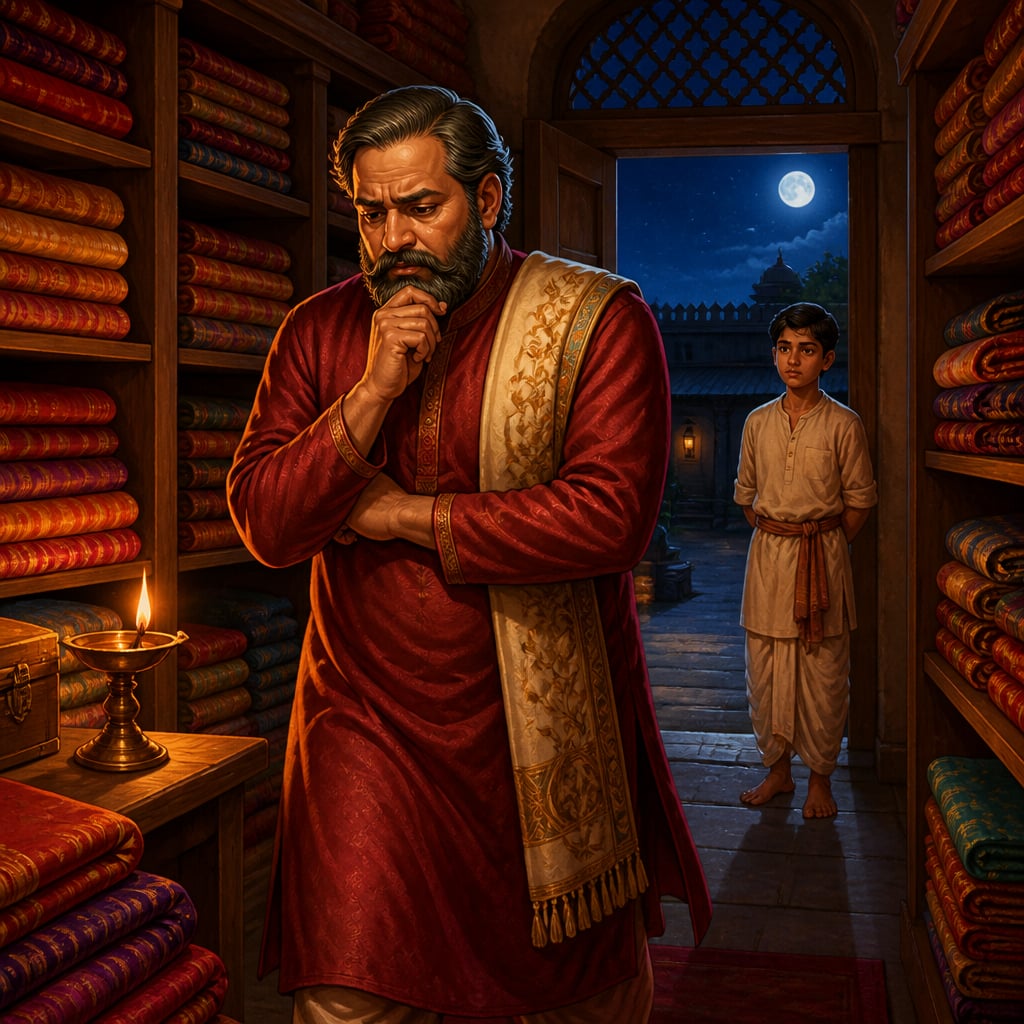
Vasudeva pacing in his Magadhan warehouse at night

Vasudeva was the wealthiest silk merchant in Magadha. His warehouses held treasures from across the known world, Chinese silk, Roman glass, Persian carpets. On paper, he was extraordinarily successful.

But Vasudeva hadn't slept properly in months.
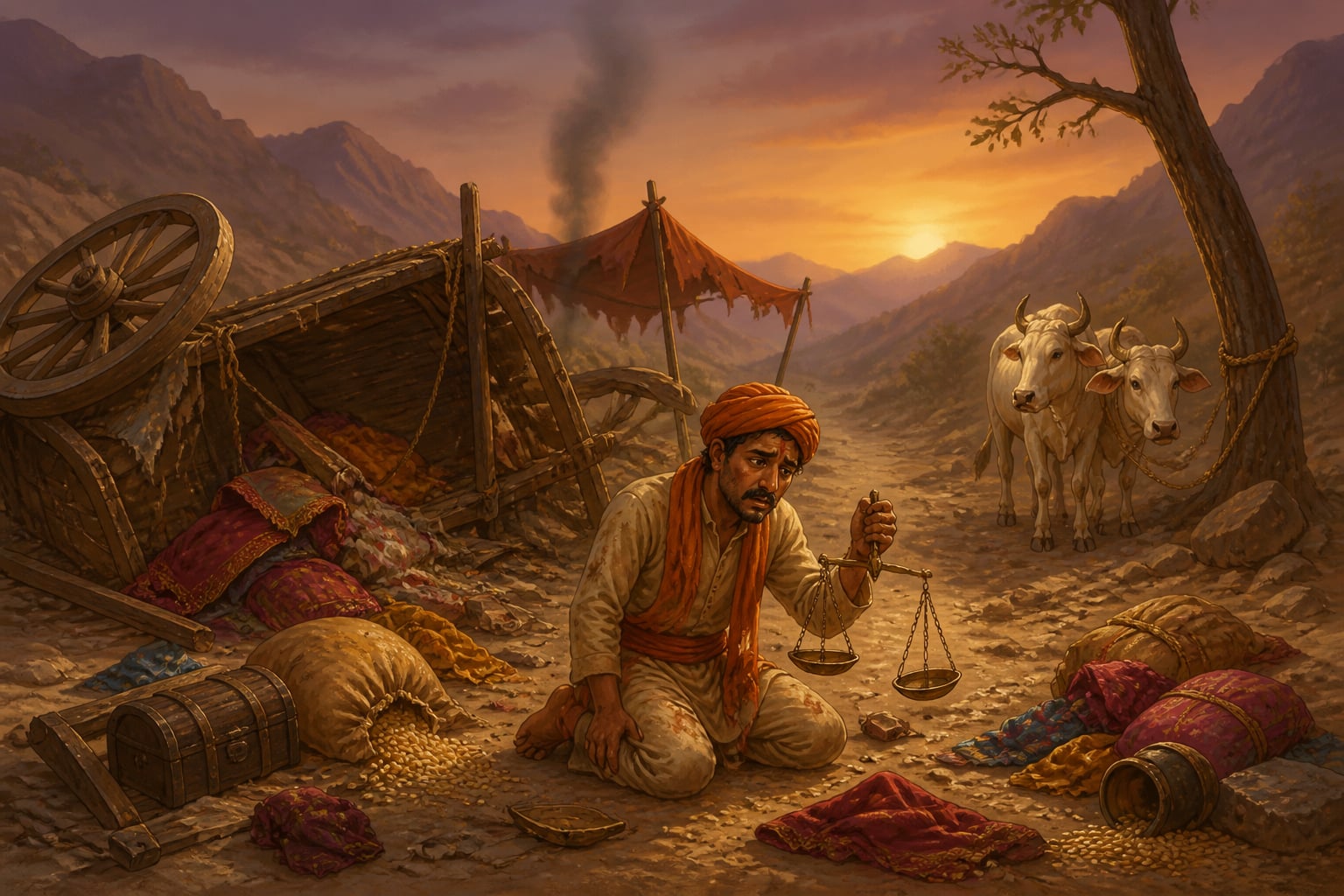
A robbed merchant caravan on a northern road at dusk

His last caravan had been robbed on the northern routes. Three of his agents had been murdered. Local strongmen demanded "protection" payments. When a buyer defaulted on a large contract, there was no court that would enforce Vasudeva's claim, the buyer was connected to powerful men.

His son asked him: "Father, you have wealth. Why are you not free?"

Vasudeva understood then what Kautilya had written:

"Aguptaṃ dhanaṃ nāsti."

"Unprotected wealth cannot endure."

He had property without protection. Rights without enforcement. Freedom without security. And freedom without security is an illusion.

The Security Hierarchy

Kautilya identifies multiple layers of security, each essential:

Personal Security

The most basic: protection from violence against your body.

Without this, you cannot sleep safely, walk freely, or reject demands backed by threats. Everything else becomes meaningless when your survival is at stake.

Property Security

The next layer: protection of what you own.

Hernando de Soto, the Peruvian economist, found that in countries with insecure property rights, people own assets they cannot use. Houses they cannot sell. Businesses they cannot leverage. Wealth exists but cannot grow because it isn't protected.

Commercial Security

The ability to trade safely and reliably.

A Mauryan caravan escorted by soldiers along a trade road at sunrise

The Mauryan Empire's prosperity came largely from commercial security. Merchants could travel from the northwest frontier to the Bay of Bengal knowing their goods were protected, their contracts enforceable, their weights standard.

Territorial Security

Finally: protection from external threats.

Alexander's invasion showed what happens when territorial security fails. Kingdoms that seemed stable collapsed overnight. All other securities became worthless when foreign armies arrived.

Each layer enables the next. Personal security lets you live. Property security lets you prosper. Commercial security lets you participate in complex cooperation. Territorial security protects the entire system.

Security as Public Good

Why does security require organized authority?

Security is what economists call a public good:

This creates the free-rider problem. Security is expensive to provide, but once provided, everyone benefits whether they paid or not. Individuals have incentive to let others pay while enjoying the benefits.

"Rakṣā dharmārtha-kāmānām."

"Protection is the foundation of righteousness, prosperity, and pleasure."

This is why security requires:

Not because collective action is inherently superior, but because the nature of security makes collective provision necessary.

The Costs of Insecurity

What happens when security fails? Cascading destruction:

Economic: Production declines, investment stops, trade contracts, innovation ceases.

Social: Trust breaks down, communities fragment, cooperation becomes impossible.

Moral: Violence normalizes, predation becomes rational, might becomes right.

Human: Constant fear, loss of life, trauma across generations.

Syria's civil war demonstrates the spiral. Insecurity created refugees, refugees created economic collapse, collapse created desperation, desperation created more violence. A prosperous nation became a wasteland within years.

The Paradox of Authority

Here's Kautilya's central challenge:

To provide security, the state must have power. But power itself can threaten security.

The Nanda dynasty exemplified this paradox. They had the most powerful army in India, and used it to oppress the very people they were meant to protect.

Kautilya's solution: the state must be strong enough to deter predation but limited enough not to become predatory itself.

"Prajā-sukhe sukhaṃ rājñaḥ."

"In the happiness of the people lies the king's happiness."

A ruler who preys on subjects destroys the prosperity that funds his own power. Self-interest, properly understood, restrains tyranny.

Layered Responsibility

Kautilya doesn't advocate passive dependence on the state:

Individual responsibility: Personal discipline, household protection, wise choices in transactions, reputation-building.

Community responsibility: Neighborhood watch, social norms against predation, shared infrastructure, collective intelligence about threats.

State responsibility: What individuals and communities cannot provide alone, large-scale defense, impartial law enforcement, coordination beyond local capability.

The state supplements, not replaces, individual and community efforts.

The Freedom Equation

Kautilya's insight:

Freedom = Security + Opportunity

Without security:

With security:

Security isn't a restriction on freedom, it's the foundation that makes freedom meaningful.

Modern Applications

Economic development: The World Bank's research confirms that countries with strong property rights and rule of law grow faster than those without, regardless of natural resources.

Business: Companies invest heavily in cybersecurity, legal protection, and reputation management, understanding that security enables everything else.

Technology: Blockchain, encryption, and digital rights management are attempts to create security where traditional authority is weak.

Personal finance: Insurance, legal services, security systems, protecting what you have is the foundation for building more.

Your Turn

Consider your own security situation:

Kautilya would tell you: don't take security for granted. It's invisible when it works and devastating when it fails. Invest in protection proportional to what you're protecting. Security isn't paranoia, it's the foundation of everything else.

John Locke's social contract: people form governments primarily to secure life, liberty, and property. Hobbes' Leviathan: the first duty of the state is protection from predation. Modern development economics: security and rule of law precede economic growth.

Kautilya integrates security into comprehensive framework for human flourishing. Unlike Western focus on security as negative (freedom from threats), he sees it as positive enabler of all pursuits. Security creates space for everything else worth doing.

The Vijayanagara Empire (1336-1646) prospered by providing security to Hindu kingdoms threatened by northern sultanates. Protected merchants and artisans created extraordinary wealth and culture. When security collapsed after Battle of Talikota (1565), prosperity and culture collapsed too.

Hernando de Soto: formal property rights transform dead capital into productive assets by providing security. Warren Buffett on 'moats': sustainable competitive advantage requires defensive barriers. Modern security industry: protection scales with asset value.

Kautilya recognized that security must be multi-layered and comprehensive - physical security, legal security, reputational security, information security. Medieval focus on walls and armies missed subtler forms of predation that threaten wealth.

Indian merchant communities (Chettiars, Marwaris, Multanis) developed sophisticated security systems: community enforcement of contracts, diversified assets across geography, coded communication, trusted agents. Their wealth endured because they invested systematically in protection.

Swiss cheese model of security: multiple layers with different holes, so nothing penetrates all layers. Military concept of defense in depth: forward defenses, main resistance, strategic reserves. Cybersecurity: firewall, encryption, backups, monitoring, incident response.

Kautilya's model integrates internal security (danda, kosha) with external security (mitra), economic security (kosha) with political security (svami). Holistic security thinking that Western approaches often fragment.

The Mughal Empire combined massive forts (durga), professional military (danda), substantial treasury (kosha), and shifting alliances with Rajput kingdoms (mitra). Multiple security layers enabled endurance despite succession crises and external threats.

Verses

रक्षा धर्मार्थकामानाम्

rakṣā dharmārtha-kāmānām

Protection is the foundation of dharma, artha, and kama (righteousness, prosperity, and pleasure).

Kautilya places security (raksha) as the prerequisite for all three goals of life. Without protection, you cannot pursue righteousness (you're too busy surviving), cannot build prosperity (what you create will be stolen), cannot enjoy legitimate pleasures (you're in constant fear).

Book 3, Chapter 1, Verse 1 (R.P. Kangle)

स्वामिकोशदण्डमित्राणि राज्यम्

svāmi-kośa-daṇḍa-mitrāṇi rājyam

The state consists of the sovereign, treasury, force, and allies.

Notice that danda (force/security apparatus) is one of the four essential elements of a state in Kautilya's framework. You cannot have a functioning state without the capacity to provide security.

Book 1, Chapter 4, Verse 3 (L.N. Rangarajan)

अगुप्तं धनं नास्ति अगुप्ता प्रजा नास्ति

aguptaṃ dhanaṃ nāsti aguptā prajā nāsti

Unprotected wealth cannot endure; unprotected people cannot survive.

A stark statement of reality: without protection, neither prosperity nor population can be maintained. This isn't a moral claim but an empirical observation.

Book 9, Chapter 7, Verse 1-3 (Patrick Olivelle)

Case studies

Mauryan Security System

The Mauryan Empire under Chandragupta established comprehensive security: fortified cities (durgas), professional military, police in towns, protected trade routes, standardized legal system, and intelligence networks. This created unprecedented stability.

This embodied Kautilya's multi-layered security framework: territorial security (military), commercial security (protected trade), property security (legal system), personal security (law enforcement). Each layer reinforced others, creating conditions for prosperity.

The Mauryan period saw remarkable economic growth. Trade expanded, cities flourished, arts and sciences advanced. Greek accounts describe the empire as extraordinarily prosperous. This prosperity wasn't despite security investments but because of them - security enabled productive cooperation.

Security isn't a cost to be minimized but an investment that enables everything else. Societies that provide comprehensive, effective security create conditions for prosperity. Those that neglect security see economic activity contract as people focus on defense rather than production.

Countries that invest in comprehensive, professional security forces while maintaining rule of law consistently attract more foreign investment and entrepreneurial activity. The World Bank's Ease of Doing Business index correlates strongly with security infrastructure quality, not just regulation.

Megasthenes, the Greek ambassador to the Mauryan court around 300 BCE, recorded that Pataliputra was protected by a wooden wall with 570 towers and 64 gates, surrounded by a moat 200 yards wide.

Property Rights and Development

Economist Hernando de Soto studied why some developing nations prosper while others with similar resources stagnate. He found the key difference: secure, formal property rights. In Peru, much wealth was 'dead capital' - people owned homes and businesses but lacked legal documentation, making them unable to use these assets as collateral or sell them reliably.

This confirms Kautilya's insight that unprotected wealth cannot endure or grow. Without legal security - clear ownership, enforceable contracts - people cannot leverage what they have. Property exists but cannot be used productively because it's not secure.

Countries that formalized and secured property rights saw dramatic economic growth. The same physical assets became productive capital when legal security was added. Nothing physical changed, but economic value multiplied when people could securely own, trade, and leverage their property.

Security - particularly legal security of property - multiplies the productive value of existing resources. Development isn't primarily about foreign aid or natural resources but about creating systems that secure what people already have, enabling them to use it productively.

This insight drives current land reform debates across Africa and South Asia. Rwanda's land titling program, launched in 2008, registered 10.3 million parcels by 2013 and triggered measurable increases in agricultural investment, confirming that formal property rights unlock economic value that informal ownership cannot.

Hernando de Soto estimated that informal property in developing nations totaled $9.3 trillion in value, more than 20 times all foreign aid to the developing world since 1945.

Historical context

c. 4th century BCE

The Mahajanapada period demonstrated both the costs of insecurity (constant warfare, economic disruption) and the benefits of security (kingdoms with strong defenses prospered). Kautilya observed how trade flourished in secure regions and withered in unstable ones. This empirical observation shaped his theory.

Kautilya's security framework emerged from observing what worked and what didn't. Regions with effective security mechanisms prospered; those without suffered. This makes his analysis practical rather than ideological - he describes security systems that demonstrably enabled human flourishing.

Reflection

More in Why States Exist

All lessons in Why States Exist · Arthashastra: Philosophy of Power course