The Case for Government
Why the State Exists
Kautilya's answer to why we need government: not to rule over people, but to protect them from those who would exploit them. The state exists to serve people by providing what they cannot provide alone - security that enables freedom.
The Question Kautilya Answered
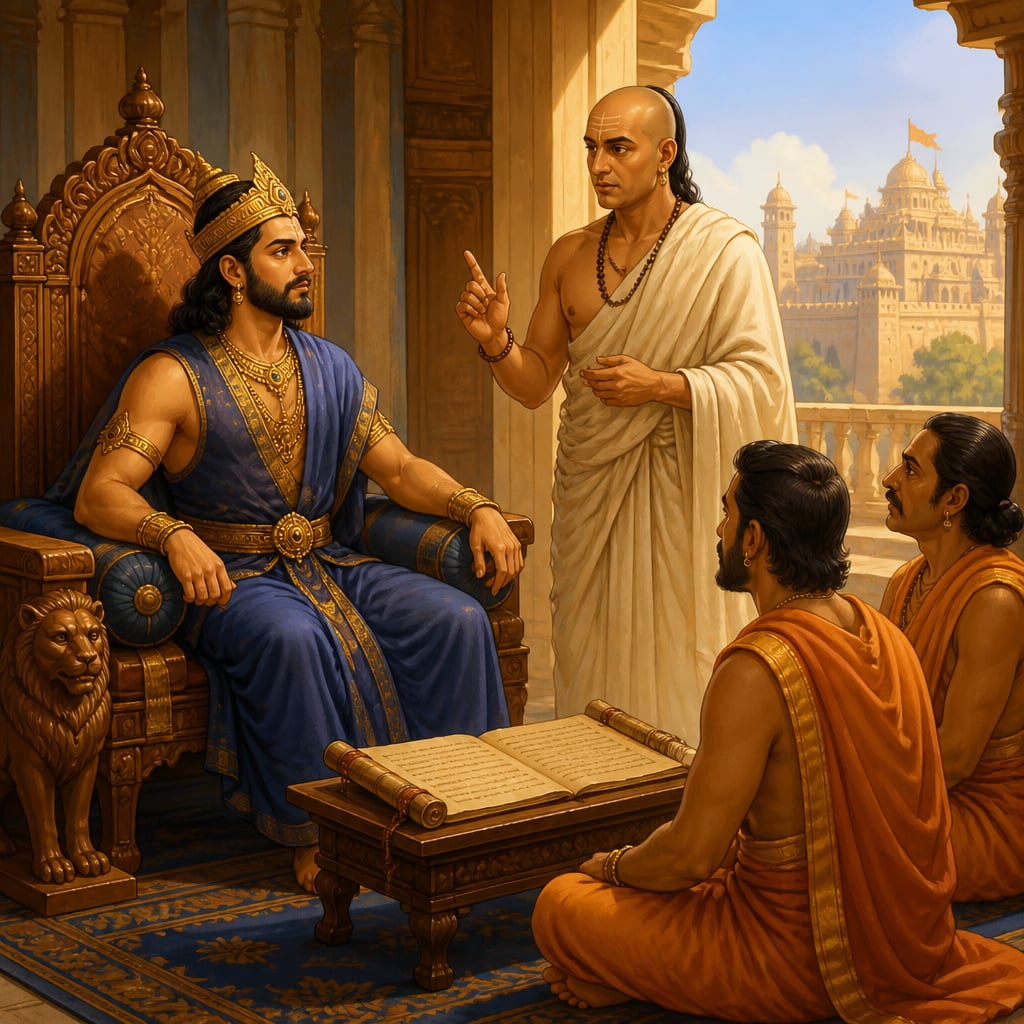
Chandragupta sat in the newly conquered palace of Pataliputra. The Nanda treasury was his. The army answered to him. Power, finally, was in his hands.
"Teacher," he asked Kautilya, "now that we have won, what is the purpose of ruling?"
Kautilya's answer defined his political philosophy:
"Prajā-sukhe sukhaṃ rājñaḥ prajānāṃ ca hite hitam."
"In the happiness of the people lies the king's happiness. In their welfare, his welfare."
This was revolutionary. Most ancient political thought treated power as an end in itself, divine right, glory, conquest. Kautilya argued something different:
The state exists to protect people from predation, not to rule over them.
Government is not an end. It is a means, perhaps the only means, by which people can escape matsya nyaya and create conditions for cooperation, prosperity, and freedom.
What Government Must Do
Kautilya identifies core functions that justify government's existence:
1. Prevent Predation
The most basic function: preventing the strong from exploiting the weak.
- Clear laws defining prohibited behavior
- Impartial enforcement for powerful and powerless alike
- Credible punishment that deters violation
- Accessible justice for those wronged
"Daṇḍo hi rakṣati prajāḥ."
"The rod indeed protects the people."
Without this, we're back to matsya nyaya.
2. Protect Property Rights
- Define ownership clearly
- Enable transfer through sale and trade
- Prevent seizure by private parties and government itself
- Adjudicate disputes
Secure property rights are the foundation of prosperity. If you can't keep what you produce, why produce at all?
3. Enforce Contracts
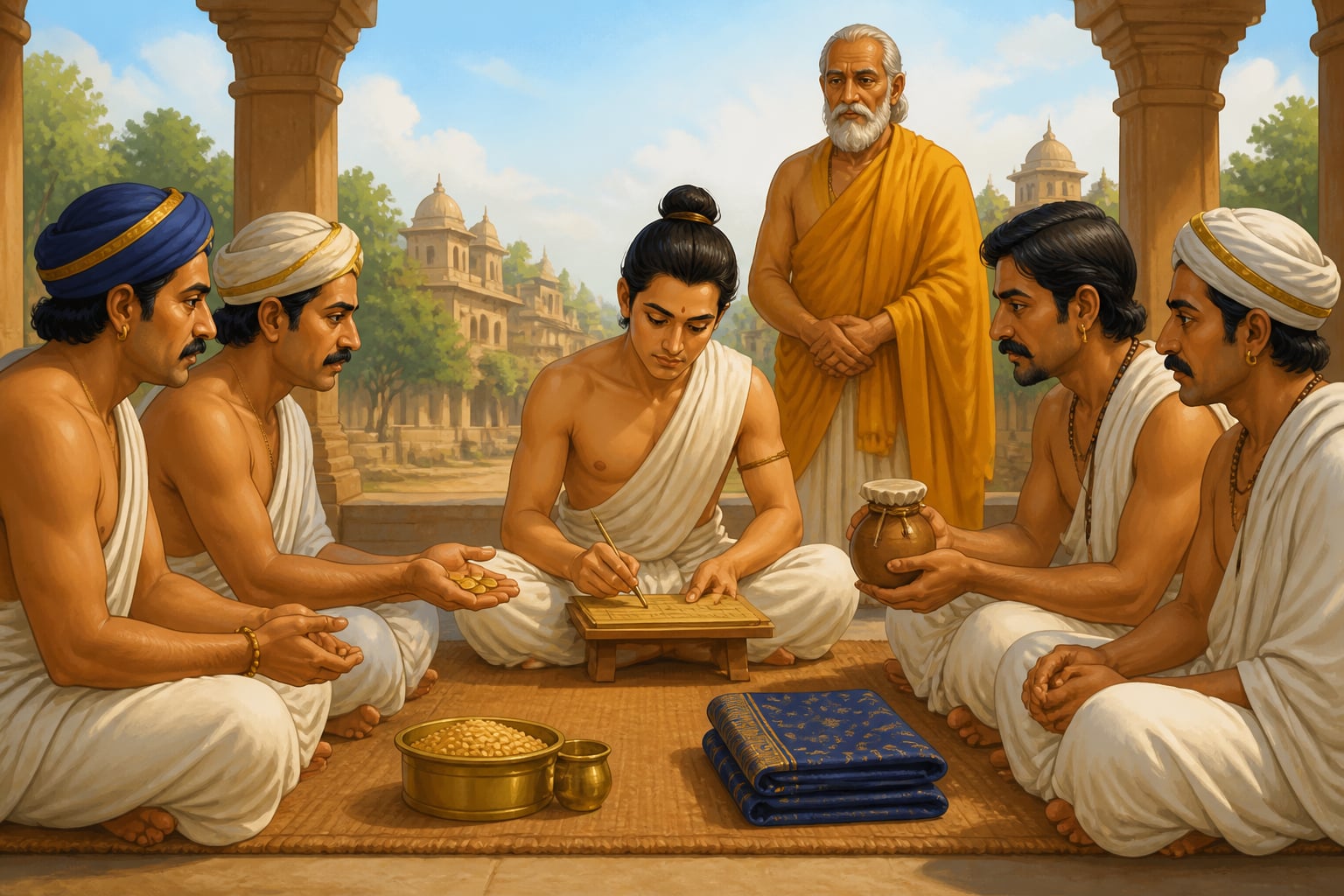
Agreements enable complex cooperation. But they only work if reliably enforced.
- Record agreements so terms are clear
- Punish breach to make violation costly
- Compensate victims when agreements fail
Contract enforcement transforms society from small-scale exchange to large-scale cooperation.
4. Provide Public Goods
Some goods are non-excludable (can't prevent people from benefiting) and non-rivalrous (one person's use doesn't diminish another's):
- Defense
- Legal system
- Infrastructure (roads, irrigation)
- Standards (weights, measures, currency)
These create free-rider problems. The state solves this through collective funding, taxation, and universal provision.
What Government Must NOT Do
Just as important: understanding limits.
Don't Become a Predator
The whole point is protection from predation. If the state becomes predatory, the cure is worse than the disease.

Dhana Nanda exemplified this failure, massive army, overflowing treasury, starving population. He had power without purpose. His people welcomed liberation.
Don't Overreach
Many activities are better handled by individuals, families, communities, and markets.
"Rājya-mūlaṃ vijigīṣor yoga-kṣema-karaṃ prajānām."
"The foundation of the state is securing the welfare of subjects."
The key: government should handle what only government can handle effectively. For everything else, leave space for voluntary action.
Don't Restrict Legitimate Freedom
The purpose is enabling freedom through security, not restricting freedom in its name.
Government properly restricts only actions that harm others, violence, theft, fraud, breach of contract. Everything else should be left to individual choice.
The Limited But Strong State
Kautilya's ideal sounds paradoxical: government should be both limited and strong.
Strong in its proper sphere:
- Effective at preventing predation
- Capable of enforcing laws impartially
- Powerful enough to defend against external threats
Limited in its scope:
- Doesn't try to do everything
- Stays within bounds of legitimate purpose
- Leaves maximum space for individual freedom
The analogy: a goalkeeper is strong at defending the goal but doesn't play every position. The state should be excellent at what only it can do, and leave everything else to others.
The Protection Racket Problem
To protect people from predators, you must give government power. But power itself is dangerous.
Kautilya's solution was multi-layered:
Dharma constraints: Rulers bound by moral and legal duties that outlast individuals.
Institutional checks: Power distributed among ministers, treasury, military, local governance, no single institution has all power.
Purpose limitation: Legitimacy derives from serving people. Rulers who forget this eventually lose rule.
Competition: Multiple kingdoms, trade networks, parallel institutions create de facto limits. Tyrannical rulers lose talent and trade to rivals.
Why Not Anarchy?
If government is dangerous, why not eliminate it entirely?
Because power vacuums don't stay vacant. Eliminate formal government and informal coercive hierarchies emerge, warlords, gangs, mafias, usually worse because they lack legitimacy, accountability, or restraint.
The choice isn't between government and freedom. It's between organized, limited, accountable authority and disorganized, unlimited, unaccountable predation.
Why Not Unlimited Government?
If government is necessary, why not unlimited power to solve all problems?
Because power corrupts and concentrates.
- Unlimited government attracts those who want power over others
- Even well-intentioned rulers abuse unchecked power
- Excessive control destroys the prosperity it claims to protect
Singapore's Lee Kuan Yew understood Kautilya's balance: strong at essential functions (security, rule of law, infrastructure), free in economic activity. The result was transformation from poverty to prosperity.
Modern Evaluation
Kautilya's framework helps evaluate governments:
Good signs:
- Low crime (protection from private predation)
- Secure property rights (can own and trade freely)
- Enforceable contracts (agreements are reliable)
- Rule of law (rules apply equally)
- Economic prosperity (security enables cooperation)
Warning signs:
- High crime or state violence (failing to protect or becoming predator)
- Arbitrary seizures (property insecurity)
- Corruption (law is unreliable)
- Rule by men not law (powerful are above rules)
- Stagnation despite resources (bad incentives)
The Case Summarized
Why government exists: To protect people from predation.
What justifies its power: Nothing else can solve the collective action problems that make protection possible.
What limits its power: Its purpose. When it exceeds protective bounds, it becomes the problem it was created to solve.
What makes it legitimate: Results. Government is judged by whether it actually protects people while respecting their freedom.
What enables flourishing: Security that allows people to cooperate freely, build for the future, and specialize according to their talents.
This is Kautilya's case: necessary given human nature, limited by its purpose, judged by its results.
Not a celebration of state power, but clear-eyed recognition that organized, limited, accountable authority is better than the alternatives, anarchy or tyranny.
Looking Ahead
We've established why the state exists. But states are run by actual human beings.
This raises new questions:
- What kind of person should rule?
- What qualifies someone for authority?
- How should rulers be selected and trained?
In Chapter 3, we turn to kingship itself, what makes a good leader, what virtues rulers must possess, and how personal character connects to political success. Kautilya's answer will challenge both ancient and modern assumptions about leadership.
Adam Smith's 'Wealth of Nations': government that protects property rights enables prosperity; government that violates them destroys it. Milton Friedman's 'Free to Choose': test government by results, not rhetoric. Public choice theory: government actors pursue self-interest like everyone else.
Kautilya's framework explicitly makes people's welfare the measure of good governance, not divine right, tradition, or ideology. This consequentialist standard - judge by results - is remarkably modern and empirically testable. Either people prosper or they don't.
Comparing Ashoka's reign to his grandfather Chandragupta shows evolution from strategic to ethical governance, but both measured success by prosperity and security of subjects. Contrast with Nanda dynasty where king's wealth grew while subjects suffered - textbook bad governance.
Max Weber's rational-legal authority: legitimacy comes from serving public purpose through impersonal rules. John Locke's social contract: government legitimate only while protecting rights. Modern development economics: state capacity measured by delivering public goods.
Kautilya's purpose test is clear and measurable: can people acquire prosperity and preserve it securely? This avoids both traditionalism (legitimate because ancestral) and majoritarianism (legitimate because popular). Legitimacy requires serving purpose, period.
British Raj justified colonial rule as bringing order and development. Kautilya's test exposes this: did it protect Indians' yoga-kshema or extract wealth to Britain? The drain of wealth and famines under British rule fail the purpose test, regardless of railways built.
Lord Acton: 'Power corrupts, absolute power corrupts absolutely.' Milton Friedman: 'Nothing is so permanent as a temporary government program.' James Madison's Federalist 51: 'Ambition must be made to counteract ambition.' Constitutional limits on power.
Kautilya designed systems assuming power will try to exceed bounds, not trusting rulers' virtue. His framework includes checks (ministers, councils), limits (dharma), and consequences (loss of legitimacy). Structural constraints on power, not just moral exhortations.
The evolution from Mauryan limited governance to later more absolute monarchies shows power's tendency to expand. The Arthashastra's careful limits were gradually eroded as dynasties forgot founding principles. Modern democracies must consciously maintain limits against same tendency.
Verses
प्रजासुखे सुखं राज्ञः प्रजानां च हिते हितम्। नात्मप्रियं हितं राज्ञः प्रजानां तु प्रियं हितम्॥
prajā-sukhe sukhaṃ rājñaḥ prajānāṃ ca hite hitam | nātma-priyaṃ hitaṃ rājñaḥ prajānāṃ tu priyaṃ hitam ||
In the happiness of his subjects lies the king's happiness; in their welfare, his welfare. What is pleasing to himself is not good for the
This is perhaps the most important verse in the Arthashastra for understanding Kautilya's view of government. The king's purpose isn't self-aggrandizement but serving subjects.
Book 1, Chapter 13, Verse 5 (Patrick Olivelle)
राज्यमूलं विजिगीषोर्योगक्षेमकरं प्रजानाम्
rājya-mūlaṃ vijigīṣor yoga-kṣema-karaṃ prajānām
The foundation of the state, for one who wishes to conquer, is securing the acquisition and preservation of the subjects' welfare.
Even for an ambitious king seeking to expand power (vijigishu - would-be conqueror), the foundation is protecting subjects' ability to acquire and preserve prosperity. Political power ultimately rests on economic prosperity, which rests on security.
Book 1, Chapter 4, Verse 3 (R.P. Kangle)
दण्डो हि रक्षति प्रजाः
daṇḍo hi rakṣati prajāḥ
The rod (force/law enforcement) indeed protects the people.
Danda - literally 'rod' or 'stick' - represents state authority to enforce laws and punish violations. Kautilya's point: this force protects people, it doesn't oppress them (when used properly).
Book 1, Chapter 19, Verse 34 (L.N. Rangarajan)
Case studies
The Mauryan State: Limited But Effective
The Mauryan Empire under Chandragupta and Ashoka exemplified Kautilyan principles at scale. The state provided: military defense, internal security, contract enforcement, infrastructure (roads, irrigation), standardized weights and measures. But it left most economic activity to private actors: production, trade, guilds managing their own affairs. The state protected; markets produced.
This embodied the limited-but-strong framework: government strong at essential functions (security, justice, infrastructure) but not attempting to control all economic activity. The state created conditions for prosperity through security and rule of law, then allowed voluntary cooperation to generate wealth.
The Mauryan period saw unprecedented prosperity. Trade flourished across the empire and with foreign nations. Cities grew. Arts and sciences advanced. Greek observers described India as fabulously wealthy. This prosperity wasn't despite limited economic control but because of it - security enabled production, property rights enabled investment, free trade enabled specialization.
Limited government that does its job well enables more prosperity than expansive government trying to manage everything. The state should create framework - security, justice, essential infrastructure - then let people cooperate voluntarily within that framework. Get the framework right and prosperity emerges spontaneously.
Switzerland and the Nordic countries demonstrate this model at work today. Their governments excel at core functions (rule of law, infrastructure, education) while maintaining strong property rights and economic freedom. The result is consistently high prosperity with low corruption.
The Mauryan road network, centered on the Uttarapatha (Northern Road), stretched over 2,600 kilometers from Pataliputra to Taxila, with rest houses every 9 miles and shade trees planted along the route.
Singapore: Modern Kautilyan State?
Modern Singapore offers interesting parallel to Kautilyan principles: strong government providing security, rule of law, infrastructure, and some public goods; but also protecting property rights, maintaining free markets, and enabling business. Government is powerful in its sphere but doesn't attempt to control all economic activity.
Singapore demonstrates limited-but-strong governance: very effective at preventing crime, enforcing contracts, providing infrastructure, maintaining stability. But also: very free markets, strong property rights, minimal regulation of business, openness to trade. Government creates secure framework; voluntary cooperation creates wealth.
Singapore transformed from poor to wealthy in one generation, achieving first-world prosperity. High trust, low corruption, reliable institutions. Economic freedom combined with security created conditions for remarkable growth. Critics note restrictions on some political freedoms, showing the ongoing tension between different conceptions of liberty.
Modern states can apply Kautilyan framework: be very good at core functions (security, justice, infrastructure) while leaving economic activity mostly free. The combination - effective authority in its proper sphere plus freedom in private sphere - generates prosperity. Singapore also shows the challenges: balancing different types of freedom, maintaining limits on authority over time.
Dubai and the UAE have adopted a remarkably similar approach since the 2000s: world-class infrastructure, aggressive anti-corruption enforcement, and business-friendly regulation, all under strong central authority. Their rapid economic transformation mirrors Singapore's path and validates the same Kautilyan principle.
Singapore ranks consistently in the top 3 globally on Transparency International's Corruption Perceptions Index, scoring 83/100 in 2023, while spending only 17% of GDP on government expenditure.
Historical context
c. 4th century BCE
The Mahajanapada period showed both the necessity and dangers of government. Small kingdoms that governed well prospered; tyrannical or weak kingdoms suffered. Kautilya observed these experiments in real time and synthesized principles: government must be strong enough to protect but limited enough not to oppress. The Mauryan success under Chandragupta validated this approach.
Kautilya's framework emerged from empirical observation of what worked. Unlike purely theoretical political philosophy, the Arthashastra reflects lessons learned from actual governance. This makes it simultaneously ancient wisdom and timeless principle - human nature hasn't changed, so the balance between order and freedom remains relevant.
Reflection
- Imagine you're behind a 'veil of ignorance' designing a government, not knowing whether you'll be strong or weak, rich or poor. What rules would you want? What powers would you grant government? What limits would you impose?
- Is Kautilya's case for limited government universal, or was it specific to his time and place? Can every society function with minimal government, or do some circumstances require more extensive state involvement?
- In your own life - at work, in organizations you're part of, in your community - where do you see the pattern of authority exceeding its purpose? Where do you see necessary functions going unfulfilled due to insufficient authority? What's the right balance in contexts you can influence?