The Origins of Conflict

Scarcity, Desire, and Competition

Why do humans fight? Kautilya offers a penetrating analysis of conflict's roots - scarcity of resources, competing desires, and the nature of power itself. Understanding these causes is the first step toward building systems that channel competition productively while preventing destructive violence.

Two Villages, One River
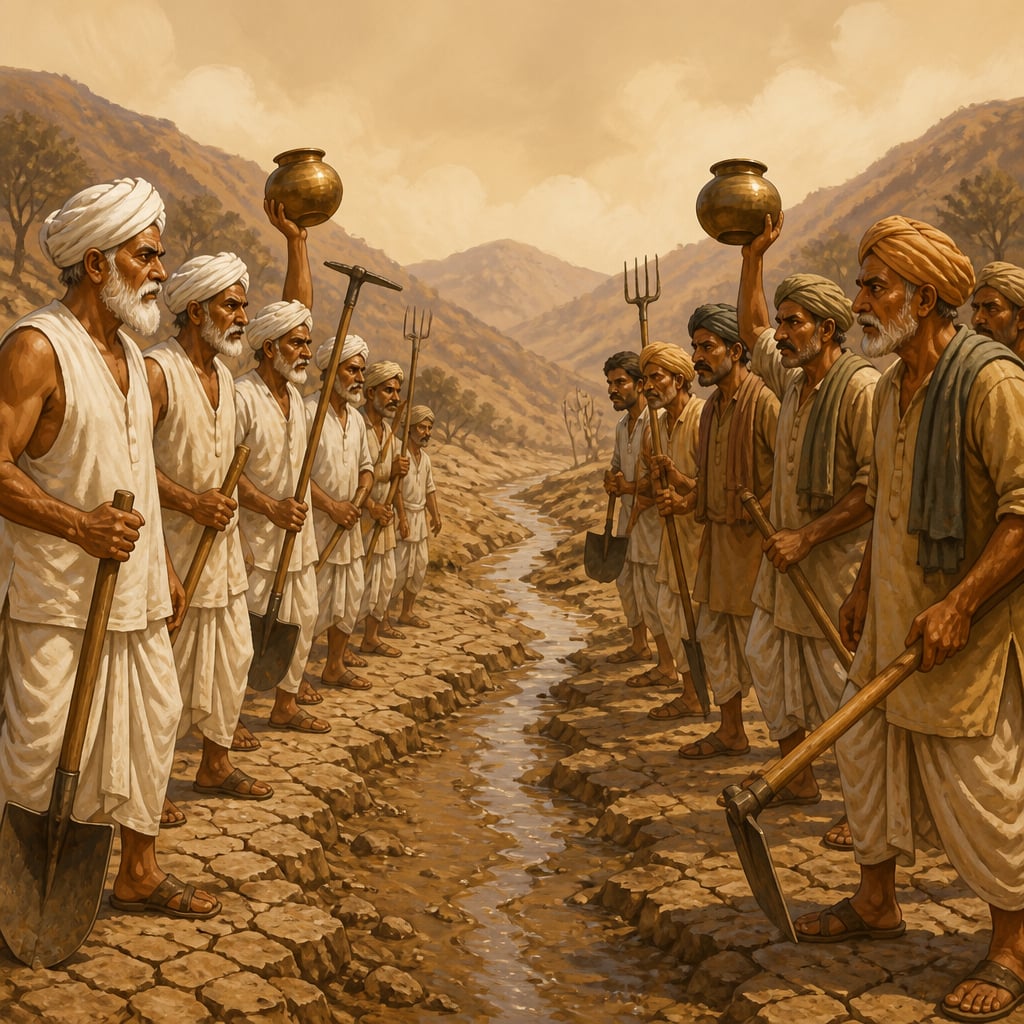
Village elders facing off across the shrunken Gandaki river

Pushpavati and Chandravati were prosperous villages along the Gandaki River. During monsoon, water was plentiful. Both villages thrived. Merchants traded, families intermarried, festivals were celebrated together.

Then came the drought of 312 BCE.

The river shrank to a trickle. Each village faced a choice: take more water upstream (and watch the other's crops die) or share equally (and watch both villages suffer).

The elders tried to negotiate. But when Chandravati's harvest failed, young men blamed Pushpavati. Raids began. Fields were burned. By the time the rains returned, decades of friendship had dissolved into blood feud.

This story, recorded in regional chronicles, captures Kautilya's understanding of conflict. Humans don't fight because they're evil. They fight because structural conditions make cooperation difficult and competition necessary.

The Three Roots

Kautilya identifies three fundamental causes of conflict:

"Lobhād vā dveṣād vā mohād vā vigrahaḥ."

"Conflict arises from greed, or from hatred, or from delusion."

Lobha (Greed): Scarcity of Resources

The most basic cause: there is not enough for everyone to have all they want.

In abundance, cooperation is easy. In scarcity, competition becomes inevitable. The question is whether competition will be peaceful (trade, law) or violent (force, predation).

Dvesha (Hatred): Past Grievances

Even when resources are sufficient, accumulated wrongs create conflict.
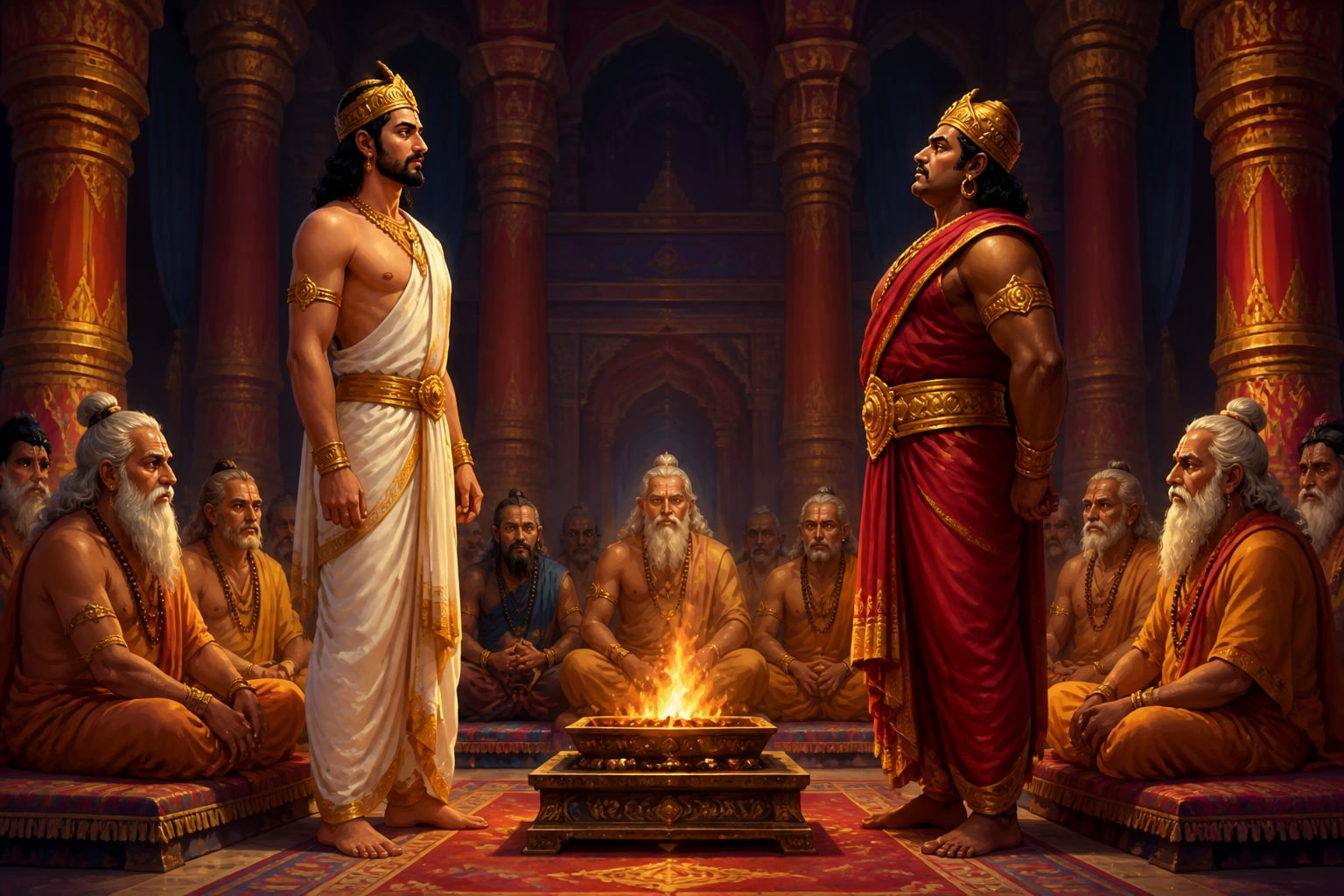
Yudhishthira and Duryodhana confronting each other in the Kuru sabha hall

The Pandavas and Kauravas fought over a kingdom that could have been shared. But insults, cheating, and humiliation had accumulated for years. By the time war came, it wasn't about land, it was about revenge.

Hatred requires different solutions than scarcity. More resources don't help when the wound is emotional. Justice, apology, and reconciliation address dvesha, not just material adjustment.

Moha (Delusion): Misunderstanding

Sometimes conflict arises from mistaken beliefs:

World War I began partly through moha, cascading misperceptions where each nation believed it was acting defensively while appearing aggressive to others. Better information might have prevented catastrophe.

The Cycle of Conflict

Conflict follows predictable patterns:

Stage 1: Grievance. One party believes another has wronged them.

Stage 2: Demand. The aggrieved party seeks redress.

Stage 3: Rejection. The other party refuses.

Stage 4: Escalation. Both sides prepare for confrontation, gathering allies, building forces, making threats.

Stage 5: Conflict. One side acts, seizing resources, attacking, imposing costs.

Stage 6: Resolution or Perpetuation. Either decisive victory (creating new grievances) or stalemate (perpetuating the cycle).

Intervention is easiest early. Once escalation begins, emotions harden, investments mount, and retreat becomes dishonor.

When Conflict Is Justified

Kautilya is no pacifist. He distinguishes:

Unjustified conflict:

Justified conflict:

"Sandhir vigrahaś ca kārya-siddhyartham."

"Both peace and conflict are for the purpose of accomplishing objectives."

Neither peace nor war is inherently right. Each is a means to legitimate ends. Sometimes preventing greater violence requires lesser violence. But such conflict must be necessary, proportionate, likely to succeed, and bounded.

The Economic Basis

Kautilya's economic understanding shapes his conflict analysis:

Poverty breeds conflict:

Prosperity reduces conflict:

Unequal prosperity increases conflict:

This is why Kautilya advocates moderate taxation, productive economy, fair justice, and secure property, reducing the conditions that breed conflict.

Preventing Destructive Conflict

Some conflict is inevitable. How do we keep it from becoming destructive?

1. Create systems for peaceful competition. Markets, courts, elections, sports, ways to compete without killing. Good institutions channel competitive energy productively.

2. Build mutual dependence. When attacking trading partners impoverishes you, conflict becomes expensive.

3. Establish clear rules. Ambiguity invites conflict. Clear property rights, defined borders, explicit agreements reduce disputes.

4. Maintain balance of power. No actor should dominate others without cost. Balance makes negotiation attractive.

5. Provide mechanisms for grievance. Courts, councils, arbitrators give alternatives to violence.

6. Demonstrate consequences. Predation must be deterred. Those who violate norms must face real costs.

The Paradox of Peace

A Mauryan war camp drawn up at first light

Kautilya understood a profound truth: lasting peace requires preparation for war.

This doesn't mean constant warfare. It means:

Switzerland has remained at peace for centuries, not despite its military preparedness, but because of it. No one attacks because everyone knows the cost would be prohibitive.

Modern Echoes

Kautilya's analysis remains relevant:

Geopolitics: Water conflicts between India and Pakistan, US-China power competition, Middle East resource wars, all follow patterns Kautilya identified.

Business: Companies compete for market share. The question is whether competition follows rules (law, ethics) or descends into predation (fraud, monopoly).

Organizations: Internal conflict over budgets, positions, credit is inevitable. Good management channels this productively.

Personal life: Conflicts arise from competing desires, scarce resources (time, money, attention), and power dynamics. Understanding roots helps address causes, not just symptoms.

Your Turn

Think of a conflict you've experienced or witnessed:

Kautilya's message is realistic: conflict is inevitable, destructive conflict is not. Understanding why humans fight is the first step to channeling competition productively.

Thomas Schelling's 'Strategy of Conflict' (1960) distinguished between coordination problems and pure conflict. John Burton's conflict resolution framework separates interest-based from identity-based disputes. Modern mediation practice emphasizes diagnostic phase before intervention.

Kautilya's three-fold classification (lobha, dvesha, moha) is more nuanced than simple friend/enemy binary. It recognizes that most conflicts are mixed - scarcity plus grievance plus misunderstanding - requiring multi-pronged approaches.

The Kalinga War (261 BCE) combined territorial ambition (lobha), past humiliations (dvesha), and mutual misperceptions of capability (moha). Ashoka's post-war dhamma policy addressed all three - economic integration, reconciliation, and improved communication - not just military occupation.

Machiavelli advised princes to maintain military capability even during peace. NATO's deterrence strategy prevented Soviet expansion through credible defensive capability. Switzerland's armed neutrality has preserved peace through centuries.

Kautilya balanced deterrence with diplomacy more subtly than pure power politics. His framework includes both military capability AND alliances, treaties, and economic interdependence. Strength enables choice, including choice to cooperate rather than dominate.

The Gupta Empire (4th-6th centuries CE) maintained peace through combination of military strength and diplomatic marriages. They could defeat rivals militarily but often chose alliance, precisely because their strength made alliance attractive to others. Peace from position of power, not weakness.

Clausewitz's dictum that war is politics by other means. Bismarck's realpolitik - choosing strategies based on national interest rather than ideology. Game theory's emphasis on backward induction - start with desired end state, work backward to determine optimal moves.

Kautilya's framework prevents both naive pacifism (refusing to fight when necessary) and reflexive aggression (fighting when negotiation would work). By grounding strategy in objectives rather than principles, he enables pragmatic flexibility while maintaining ethical constraints.

Shivaji Maharaj alternated between guerrilla warfare against Mughals and treaty negotiations, based on relative strength and strategic objectives. When weak, he avoided direct confrontation; when strong, he extracted favorable terms. Each tactic served overarching goal of Maratha independence.

Verses

लोभाद्वा द्वेषाद्वा मोहाद्वा विग्रहः

lobhād vā dveṣād vā mohād vā vigrahaḥ

Conflict arises from greed, or from hatred, or from delusion.

Kautilya identifies the psychological roots of conflict. Greed (lobha) - wanting more than your share; hatred (dvesha) - responding to past wrongs or perceived insults; delusion (moha) - misunderstanding your interests or others' intentions.

Book 7, Chapter 1, Verse 2-5 (R.P. Kangle)

षड्गुण्यं मण्डलम्

ṣaḍ-guṇyaṃ maṇḍalam

The circle of states operates through six policies (peace, war, neutrality, marching, alliance, dual policy).

Kautilya recognizes that conflict is one option among many in relations between powers. War (vigraha) is neither always right nor always wrong - it depends on circumstances.

Book 7, Chapter 3, Verse 1-3 (L.N. Rangarajan)

सन्धिर्विग्रहश्च कार्यसिद्ध्यर्थम्

sandhir vigrahaś ca kārya-siddhyartham

Both peace and conflict are for the purpose of accomplishing objectives.

A crucial insight: both peace and war are means to ends, not ends in themselves. You don't fight for the sake of fighting or make peace for the sake of peace.

Book 6, Chapter 2, Verse 1-3 (Patrick Olivelle)

Case studies

The Mauryan Conquest Strategy

Chandragupta Maurya faced the powerful Nanda Empire, which had larger armies and greater wealth. Direct confrontation would fail. Kautilya advised a strategy of alliance (with threatened kingdoms), neutrality (avoiding premature confrontation), and careful timing (attacking when the Nandas were weakened by internal dissent).

This exemplifies Kautilya's principle that vigraha (conflict) must serve clear objectives and be chosen strategically. Chandragupta didn't fight out of pride or impatience - he used sandhi (alliance) and waiting until conditions favored success. The conflict itself was brief because preparation was thorough.

The Mauryas overthrew the Nandas decisively, establishing a dynasty that would rule for over a century. The success came not from having superior force but from having superior strategy - understanding when and how to fight, and when to employ other policies.

Effective conflict requires strategic patience - building strength, choosing timing, creating favorable conditions before engaging. Rushing into conflict from emotion or pride leads to defeat. Careful preparation and strategic choice of when and how to engage leads to victory with minimal cost.

Modern military strategists study this exact principle. Ukraine's early resistance against Russia in 2022 succeeded partly through alliance-building (NATO support), intelligence preparation, and choosing favorable engagement conditions rather than meeting a larger force head-on.

The Nanda army reportedly numbered 200,000 infantry, 20,000 cavalry, 2,000 war chariots, and 3,000 war elephants, yet fell to Chandragupta's smaller but strategically coordinated forces around 321 BCE.

Water Conflicts in Modern India

Interstate water disputes in India - Karnataka vs. Tamil Nadu over Cauvery River, Punjab vs. Haryana over river waters - demonstrate Kautilya's scarcity-based conflict. Limited water, multiple users, competing needs for agriculture and cities. Each state has legitimate interests; not enough water for all to have what they want.

These conflicts arise from lobha (each state wanting maximum water) combined with scarcity (limited supply during drought). The solution cannot be eliminating desire or creating more water. Instead: clear allocation rules, enforcement mechanisms, infrastructure to reduce waste, and courts to resolve disputes without violence.

When legal frameworks and arbitration work, conflicts remain non-violent though intense. When these systems fail or are ignored, violence erupts - riots, destruction of property, political crisis. The difference isn't in the underlying scarcity but in the institutional capacity to manage it.

Scarcity-driven conflicts cannot be eliminated, only managed. Good institutions channel competition into legal/political processes rather than violence. Bad institutions - or no institutions - let scarcity erupt into destructive conflict. The challenge is building systems robust enough to handle stress without breaking down.

Water conflicts are intensifying globally as climate change alters rainfall patterns. The Nile basin dispute between Egypt, Sudan, and Ethiopia over the Grand Ethiopian Renaissance Dam follows identical dynamics: scarce resources, multiple claimants, and institutional frameworks struggling to contain competition.

The Cauvery water dispute between Karnataka and Tamil Nadu spans over 150 years, with the first arbitration in 1892 and the Supreme Court's final ruling in 2018 allocating 177.25 TMC feet to Tamil Nadu.

Historical context

c. 4th century BCE

The period when Kautilya wrote was extraordinarily violent. The Mahajanapadas warred constantly, borders shifted frequently, and the common people suffered under rapacious rulers and invading armies. This context shaped Kautilya's realism about conflict - he had witnessed its causes and consequences firsthand.

Kautilya's analysis of conflict emerged from lived experience of warfare and its consequences. This makes his insights practical rather than theoretical - he knew what worked and what didn't from observation, not speculation. Understanding this context helps us appreciate both his realism and his emphasis on preventing unnecessary conflict.

Reflection

More in Why States Exist

All lessons in Why States Exist · Arthashastra: Philosophy of Power course