Matsya Nyaya

The Law of the Fish

What happens when there is no government? Kautilya's answer is stark: matsya nyaya - the law of the fish, where the big devour the small. This ancient concept, predating Hobbes by 2,000 years, explains why humans create states and why freedom requires protection.

The Village That Had No King

Vaishali was supposed to be different. The wealthy merchant city prided itself on its republican governance, no king, just elected councils. They called themselves free.
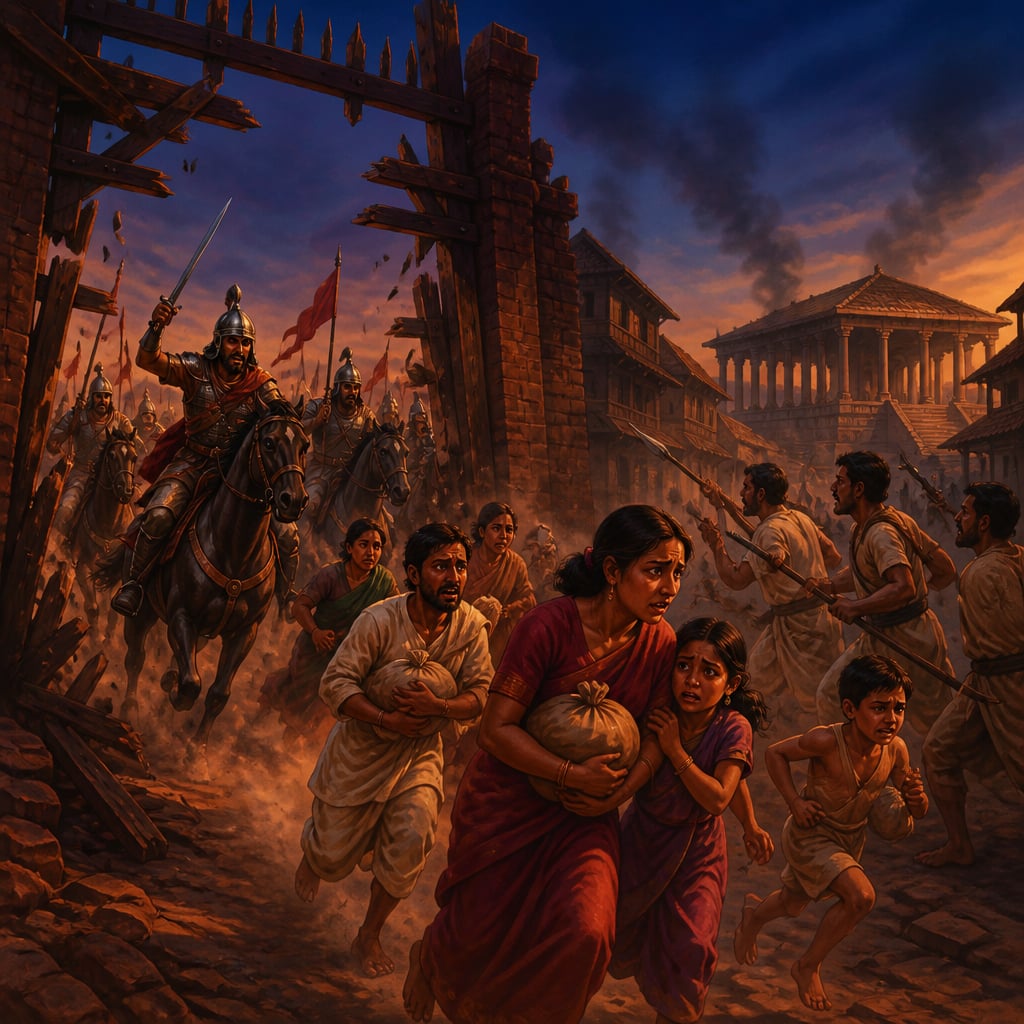
Vaishali's defenders overrun at the city gate at dusk

Then the armies came.

Without a standing army, without unified command, the city's defenses crumbled. Rival factions within the councils couldn't agree on strategy. By the time they organized, it was too late. Ajatashatru of Magadha absorbed their "free" city into his kingdom.

The merchants who had boasted of liberty found themselves subjects of a monarch, because their freedom had no protection.

Kautilya watched these events with cold attention. This was the lesson: freedom without defense is an invitation to predators.

The Law of the Fish

Kautilya had a name for what happens when there is no protector:

"Mātsya-nyāya-abhibhūtāḥ prajāḥ."

"The people are afflicted by the law of the fish."

The law of the fish, matsya nyaya, is brutally simple: big fish eat small fish. Not from malice. It's simply what happens when nothing stops them.

In a pond with no keeper, the large devour the small. The strong survive; the weak perish. And among humans without governance, the pattern repeats: the powerful prey on the powerless, the violent on the peaceful, the organized on the scattered.

Kautilya's State of Nature

Two thousand years before Thomas Hobbes described life without government as "solitary, poor, nasty, brutish, and short," Kautilya had already mapped the same terrain.

The era of the Mahajanapadas, the sixteen great kingdoms, was his laboratory. Borders shifted every season. Villages were raided, looted, burned. Merchants traveled in armed caravans or not at all. Justice meant whatever the local strongman decided.

A farmer in this world woke each morning uncertain whether he would harvest his own crops, whether his daughter would be taken as a slave, whether some passing army would conscript his sons.

This was not ancient history to Kautilya. This was the world he knew.

Why Fish Law is Not Freedom

Some might argue: no government means freedom. No rules, no restrictions, no one telling you what to do. Isn't that liberty?

Kautilya's answer devastates this fantasy:

A Mauryan magistrate holding the danda staff in open court

"Daṇḍo hi śāsti taṃ lokaṃ daṇḍo rakṣati sarvataḥ."

"It is the rod that governs the world; it is the rod that protects from all sides."

Without the rod of authority (danda), there is no freedom, only the freedom of the strong to oppress the weak.

In matsya nyaya:

This is not liberty. This is tyranny by whoever happens to be strongest.

The Origin of Kingship

Ancient texts describe how kingship arose. The story is simple and powerful:

Manu installed as the first king beneath a banyan tree at dawn

The fish cried out to Brahma: "Lord, the large fish are eating us! Please give us a protector!"

In response, Manu was appointed as the first king, not to rule over the people, but to protect them from each other.

This story encodes Kautilya's central insight: the state exists to protect the weak from the strong. Government is not an imposition on natural freedom but its precondition. Without protection, only the powerful are free.

The Four Elements of Chaos

Kautilya identifies what happens when matsya nyaya prevails:

No security of person. Without law enforcement, anyone can harm anyone. The elderly, the young, the peaceful, all vulnerable to whoever chooses to prey.

No security of property. Without courts and contracts, ownership means nothing. Whatever you have, someone stronger can take. Why build when someone will steal it?

No reliable exchange. Without enforceable agreements, trade becomes impossible. Who conducts business when the other party can break promises without consequence?

No investment in future. Without stability, no one plants crops they might not harvest, builds houses they might not keep, or creates businesses that might be seized. Society stagnates.

The Paradox of Freedom

Here is the paradox at the heart of political philosophy:

Kautilya understood both dangers. Dhana Nanda exemplified the second, a government so predatory it was worse than no government at all.

The answer is neither anarchy nor absolutism but careful balance: enough power to prevent the strong from preying on the weak, but not so much that the state itself becomes the predator.

"Daṇḍasya hi bhayāt sarvaṃ jagad bhogāya kalpate."

"It is from fear of punishment that the whole world becomes fit for enjoyment."

This is not a dark observation. It is realistic. Most people are decent most of the time. But some will always take advantage when nothing stops them. The existence of consequences changes the calculation for everyone.

Modern Matsya Nyaya

The law of the fish is not ancient history. We see it today:

Venezuela's collapse showed modern matsya nyaya in action. As institutions failed, armed gangs filled the power vacuum. Citizens who had lived normal lives found themselves choosing between paying protection money or fleeing.

The Foundation of Everything

Matsya nyaya explains why government exists. But it also explains why good government matters so much.

If the state exists to protect the weak from the strong, then a state that fails in this duty, or worse, becomes another predator, has betrayed its fundamental purpose.

Every other principle in the Arthashastra flows from this foundation. Taxation should be moderate, or the state becomes a predator. Justice should be fair, or the powerful escape consequences. The king should be virtuous, or he becomes the biggest fish of all.

Understanding matsya nyaya is understanding why political philosophy matters. It's not abstract theorizing. It's the difference between a world where the weak have a chance and a world where they don't.

Hobbes' Leviathan (1651) argued that life without government is 'solitary, poor, nasty, brutish, and short.' John Locke's Second Treatise (1689) established that government exists to protect natural rights. Both echo Kautilya's argument made 2,000 years earlier, but Kautilya emphasized limits on authority more than Hobbes.

Kautilya uniquely balances the need for strong authority with limits on that authority. Unlike Hobbes who leaned toward absolutism, Kautilya insisted government must be strong enough to prevent predation but limited enough not to become predatory itself.

The Mauryan Empire under Chandragupta replaced the chaos of competing Mahajanapadas with unified governance. Trade flourished under protected routes, agriculture prospered under irrigation systems, and merchants could operate without fear of arbitrary seizure. This demonstrated that security enables freedom, not restricts it.

Cesare Beccaria's 'On Crimes and Punishments' (1764) argued that certainty of punishment deters crime more than severity. Modern behavioral economics (Kahneman, Tversky) shows that humans respond to incentives and consequences. Game theory demonstrates that cooperation requires enforcement mechanisms.

Kautilya understood 2,000 years before modern criminology that the purpose of danda is not vengeance but creating conditions for prosperity. Punishment should be proportionate and certain, not excessive and arbitrary. The goal is enabling cooperation, not satisfying anger.

Emperor Ashoka's rock edicts describe a sophisticated legal system with clear laws, proportionate punishments, and appeals processes. Megasthenes, Greek ambassador to Mauryan India, reported remarkably low crime rates and noted that Indians rarely locked their doors - security through consistent enforcement, not through fear of cruelty.

Adam Smith warned of businessmen colluding against the public. Lord Acton's dictum that 'power corrupts' applies to all power centers. Public choice theory (Buchanan, Tullock) showed that government actors pursue self-interest like everyone else. Antitrust law recognizes that concentrated private power threatens freedom as much as government power.

Kautilya recognized that predation comes from multiple sources - tyrants, corrupt officials, monopolistic merchants, organized crime. He designed systems with checks on all power centers. The goal wasn't eliminating power (impossible) but ensuring no power becomes unchecked.

The Vijayanagara Empire (14th-16th centuries) maintained prosperity through balanced power - strong central authority prevented external threats and internal chaos, but trade guilds, merchant associations, and local councils checked arbitrary royal power. This distributed system prevented any single 'big fish' from dominating.

Verses

मात्स्यन्यायाभिभूताः प्रजाः मनुं वैवस्वतं राजानमकुर्वत

mātsya-nyāya-abhibhūtāḥ prajāḥ manuṃ vaivasvataṃ rājānam akurvata

Afflicted by the law of the fish, the people made Manu Vaivasvata their king.

This sutra captures the social contract in its purest form. The people - not the gods, not conquest - created kingship.

Book 1, Chapter 4, Verse 13-14 (R.P. Kangle)

दण्डो हि शास्ति तं लोकं दण्डो रक्षति सर्वतः

daṇḍo hi śāsti taṃ lokaṃ daṇḍo rakṣati sarvataḥ

It is the rod (danda) that governs the world; it is the rod that protects from all sides.

Danda - the rod of state authority - is what separates civilization from chaos. Without the threat of punishment, nothing prevents the strong from exploiting the weak.

Book 1, Chapter 4, Verse 15-16 (R. Shamasastry)

दण्डस्य हि भयात् सर्वं जगद् भोगाय कल्पते

daṇḍasya hi bhayāt sarvaṃ jagad bhogāya kalpate

It is from fear of punishment that the whole world becomes fit for enjoyment.

A provocative claim: fear of consequences enables prosperity. Without the knowledge that wrongdoing will be punished, no one would invest, create, or trust.

Book 1, Chapter 4, Verse 17 (L.N. Rangarajan)

Case studies

Somalia: Modern Matsya Nyaya

After the collapse of central government in 1991, Somalia experienced decades of clan warfare, piracy, and humanitarian crisis. With no state to enforce order, armed groups competed for control, and ordinary citizens had no protection.

Somalia is a textbook case of matsya nyaya. Without danda (state authority), the strong - warlords with weapons - devoured the weak. The result wasn't freedom but terror. International piracy flourished because there was no coast guard. Famine relief was stolen by armed groups.

The slow, painful process of rebuilding governance in Somalia continues today. It demonstrates that creating order is much harder than destroying it, and that the absence of government creates suffering, not liberty.

State failure is not an abstract concept. Real people suffer real consequences when matsya nyaya prevails. The challenge is building effective, accountable governance - not imagining we can do without governance entirely.

Yemen, Libya, and parts of Myanmar face similar state collapse today. The pattern repeats: once central authority dissolves, armed groups fill the vacuum and ordinary people bear the cost. International development agencies now rank state fragility as the single biggest predictor of humanitarian crisis.

Between 1991 and 2012, Somalia's civil war killed an estimated 500,000 people, displaced over 2 million, and reduced life expectancy to just 46 years, one of the lowest in the world.

Historical context

c. 4th century BCE

The concept of matsya nyaya emerged from centuries of political fragmentation. The Mahajanapadas warred constantly, with borders shifting every generation. For ordinary people, this meant insecurity, unpredictable taxation, and no reliable justice. This chaos was the 'laboratory' that produced Kautilya's political philosophy.

Understanding matsya nyaya explains why Kautilya advocates for strong (but limited) government. He wasn't a naive idealist who thought power corrupts - he was a realist who knew that the absence of power is even worse. His entire system is designed to solve the problem of matsya nyaya without creating a new predator.

Reflection

More in Why States Exist

All lessons in Why States Exist · Arthashastra: Philosophy of Power course