The Seven Limbs
Anatomy of a State
What makes a state strong? Kautilya's answer: seven essential elements working together like limbs of a body. Swami, Amatya, Janapada, Durga, Kosha, Danda, and Mitra - master all seven or watch your kingdom crumble.
The Body That Governed
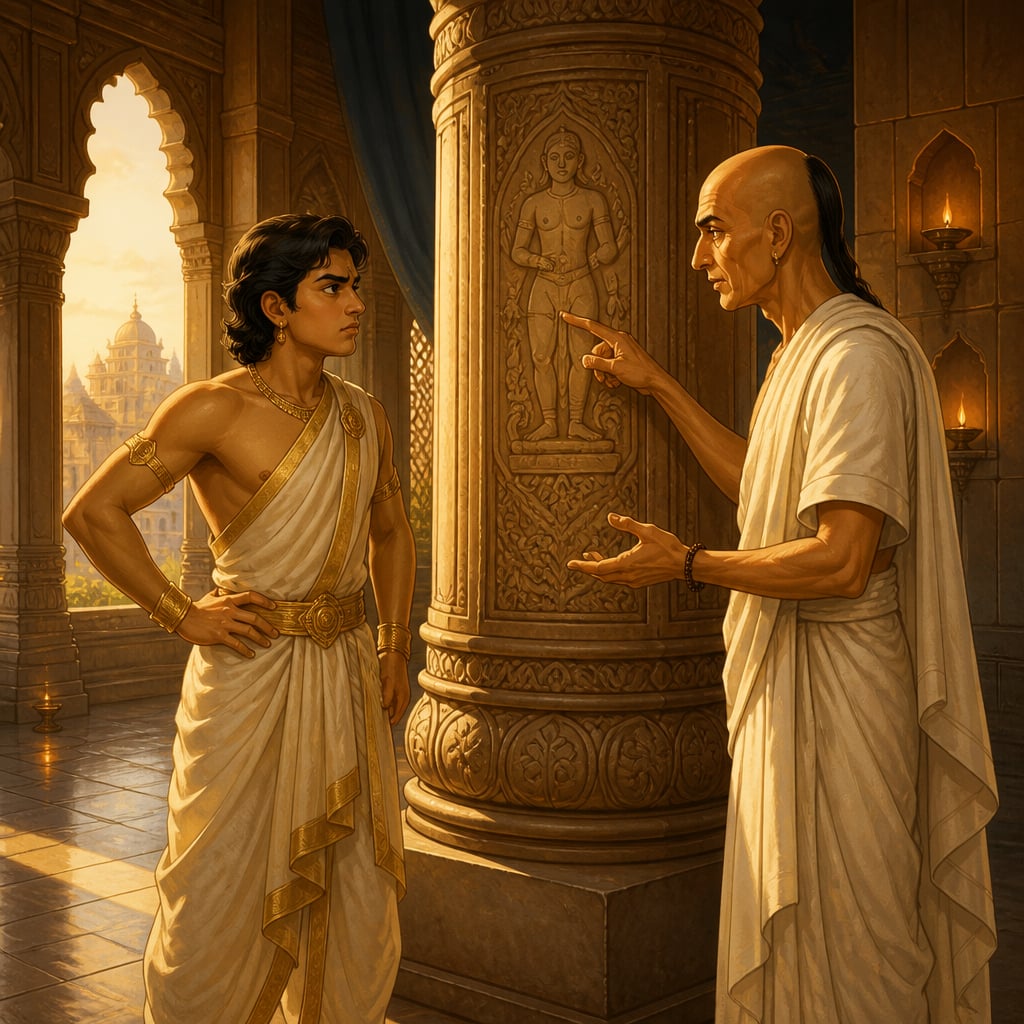
Chandragupta Maurya paced the throne room, frustrated. His army was strong. His treasury was full. Yet the eastern provinces kept slipping into rebellion. Spies reported unrest, but nothing seemed to work.
"Teacher," he said to Kautilya, who sat observing, "I have power. Why can't I hold this empire together?"
Kautilya rose slowly and walked to a carved figure of a man on a nearby pillar. "What happens," he asked, "if a man has strong arms but weak legs?"
"He cannot walk."
"And if he has strong legs but no eyes?"
"He walks into walls."
"And if he has all limbs but no head?"
Chandragupta paused. "He is dead."
Kautilya nodded. "A kingdom is the same. It has seven limbs. You focus on two, your army and treasury, while neglecting the others. No wonder your provinces rebel."
This teaching moment gave birth to one of Kautilya's most enduring frameworks: the Saptanga, the seven limbs of the state.
The Seven Limbs
Kautilya declared:
"स्वाम्यमात्यजनपददुर्गकोशदण्डमित्राणि प्रकृतयः"
"Swami, Amatya, Janapada, Durga, Kosha, Danda, and Mitra, these are the essential elements of the state."
Let us examine each:
Swami (स्वामी) - The Ruler
The head of the body. The one who directs, decides, and takes responsibility. Not just any person with power, but a leader with virtue, discipline, and vision. A kingdom with a weak Swami is like a body with a damaged brain, other limbs may be strong, but coordination fails.
Amatya (अमात्य) - The Ministers
The eyes, ears, and voice. Advisors who extend the ruler's perception and capacity. No ruler can see everything or know everything. Amatyas fill this gap, but only if selected for merit, not flattery.
Janapada (जनपद) - Territory and People
The torso, the core that gives substance. Land provides resources. People provide labor, skills, and loyalty. Without productive janapada, there is nothing to govern. The wise ruler nurtures janapada as a farmer nurtures soil.
Durga (दुर्ग) - The Fortification
The skeleton, the structural protection. Fortified capitals, defensive positions, secure borders. Durga allows the body to withstand shocks. Without it, even temporary weakness invites destruction.
Kosha (कोश) - The Treasury
The blood, circulating resources where needed. Gold, grain, reserves. Kosha funds the army, pays officials, builds infrastructure, survives famines. A kingdom without kosha cannot respond to crisis.
Danda (दण्ड) - The Army and Law
The arms, the capacity for force. Both external military and internal enforcement. Danda deters enemies, punishes criminals, and maintains order. But like arms, it serves the body, not the other way around.
Mitra (मित्र) - Allies
The friends who extend your reach. No kingdom stands alone. Allies provide support, intelligence, and leverage. The wise ruler cultivates mitra carefully, knowing that today's friend shapes tomorrow's security.
The Body Metaphor
Why does Kautilya use the body metaphor? Because it reveals essential truths:
Interdependence: A strong arm cannot compensate for weak legs. Excellence in one element cannot substitute for failure in another. Chandragupta's powerful army meant nothing if corrupt ministers mismanaged the provinces.
Organic Unity: The body works as a whole or not at all. Policies that strengthen one limb while weakening another ultimately harm the entire organism.
Hierarchy of Function: The head (Swami) directs, but depends absolutely on the body. Kautilya places Swami first not because rulers are most important as persons, but because leadership function must be clear.
Vulnerability Analysis: To defeat an enemy, identify their weakest limb. A kingdom with weak Amatya can be corrupted from within. One with weak Mitra can be isolated. The body metaphor becomes strategic tool.
The Cascade of Weakness
Kautilya observed a troubling pattern: weakness spreads.
Consider a kingdom with corrupt Amatya (ministers):
- They misreport information to Swami (ruler)
- Bad decisions follow
- Janapada (people) suffer and lose loyalty
- Kosha (treasury) shrinks as corruption diverts resources
- Danda (army) weakens from unpaid soldiers
- Mitra (allies) distance themselves from a failing state
- Durga (fortifications) crumble from neglect
One weak limb infected all the others. This is why Kautilya insisted on constant vigilance across all seven, not just attending to the squeaky wheel.

The Nanda Dynasty exemplified this cascade. Their treasury was legendary, mountains of gold. But their Swami was tyrannical, their Amatya were sycophants, their Janapada was oppressed, and their Mitra had abandoned them. When Chandragupta challenged them, the gold-filled treasury couldn't save them.
Modern Applications
The Saptanga applies far beyond ancient kingdoms.
For Organizations:
- CEO (Swami) - Leadership and vision
- Management (Amatya) - The leadership team
- Employees & Customers (Janapada) - The productive base
- Infrastructure (Durga) - Physical and digital systems
- Capital (Kosha) - Financial reserves
- Security & Legal (Danda) - Protection and enforcement
- Partners (Mitra) - Strategic alliances
Amazon succeeds because Jeff Bezos and successors maintained strength across all seven: clear leadership vision, capable management, devoted customer base, massive infrastructure, substantial capital reserves, sophisticated security, and strategic partnerships.
WeWork failed because it was all Swami and no Kosha, charismatic leadership with no financial discipline. The body collapsed.
For Individuals:
- Mind (Swami) - Self-direction
- Skills (Amatya) - Capabilities that extend your reach
- Health (Janapada) - Physical foundation
- Home (Durga) - Stable base
- Savings (Kosha) - Financial reserves
- Boundaries (Danda) - Self-protection
- Relationships (Mitra) - Support network
A person with brilliant ideas but no savings, poor health, and toxic relationships cannot thrive. Flourishing requires all seven limbs.
The Priority Question
Kautilya listed the limbs in order: Swami first, Mitra last. Does this mean rulers matter most and allies least?
Not exactly. The order reflects dependency, not importance:
- Without Swami, the other six lack coordination
- Without Amatya, Swami cannot implement vision
- Without Janapada, there is nothing to govern
- Without Durga, gains cannot be protected
- Without Kosha, operations cannot be funded
- Without Danda, order cannot be maintained
- Without Mitra, the kingdom stands alone against many
Each depends on those before it. But all are necessary. The last limb is not least, it is the capstone that completes the structure.
Your Assessment
Kautilya would ask you: examine the kingdoms, organizations, and selves you know. Which limbs are strong? Which are weak?
The failing business, is it truly a "market problem," or has leadership (Swami) failed, or has the management team (Amatya) grown complacent?
The struggling nation, is it truly "poor," or are resources (Kosha) being stolen by corrupt officials (weak Amatya) while the people (Janapada) are neglected?
Your own life, are you truly "unlucky," or have you neglected savings (Kosha), relationships (Mitra), or self-discipline (Swami)?
The Saptanga is not just theory. It is diagnostic tool and action guide. Identify the weak limb. Strengthen it. Watch the body heal.
In the lessons ahead, we will examine each limb in depth. But never forget: the body is one. The limbs only work together.
Peter Senge's 'The Fifth Discipline' (1990) introduced systems thinking to modern management. W. Edwards Deming taught that most problems are system problems, not people problems. Eli Goldratt's 'Theory of Constraints' focuses on finding the weakest link. All echo Kautilya's insight that you must understand the whole system to fix any part.
While modern systems thinking often remains abstract, Kautilya provided a specific framework: seven defined elements with known interdependencies. This makes diagnosis practical rather than philosophical. You don't need to map the entire system from scratch, the Saptanga gives you a starting checklist.
The decline of the Roman Empire wasn't primarily military (Danda), it was fiscal (Kosha) from overextension, political (Amatya) from succession crises, and demographic (Janapada) from population decline. Historians who blamed only the barbarian invasions missed the systemic rot. A Saptanga analysis would have revealed multiple weakening limbs decades before collapse.
Jim Collins in 'Good to Great' found that enduringly successful companies weren't the most innovative or aggressive, they were the most disciplined across multiple dimensions. Warren Buffett invests in companies with multiple 'moats' (competitive advantages) rather than single strengths. Modern portfolio theory in finance emphasizes diversification over concentration. All validate Kautilya's balance principle.
Kautilya goes beyond generic 'be balanced' advice by specifying exactly what must be balanced: the seven elements. This precision enables actionable assessment. You can rate each element, identify the weakest, and know exactly what to strengthen. The vagueness of 'balance' is replaced by the clarity of Saptanga.
Imperial Spain in the 16th century had enormous military power (Danda) and wealth from the Americas (Kosha), but neglected domestic economy (Janapada) and created enemies everywhere (weak Mitra). Despite peak power, the imbalance caused steady decline. Compare to the Dutch Republic, which maintained moderate strength across all elements and punched above its weight for centuries.
Aristotle's 'the whole is greater than the sum of its parts' expresses similar insight. Modern complexity theory studies how simple elements combining create emergent properties. Chester Barnard's theory of organizations emphasizes how coordination creates capabilities individuals lack. All recognize what Kautilya formalized: proper combination is multiplicative, not additive.
Kautilya provides the specific recipe for political emergence: these seven elements, combined properly, create state capability. This is more precise than abstract discussions of synergy. He shows not just that combination matters but exactly what must be combined. The Saptanga is a formula for organizational power.

The Mauryan Empire's power far exceeded what any of its elements could have achieved alone. Chandragupta's personal abilities, multiplied by Kautilya's counsel, implemented through capable ministers, supported by a loyal population, protected by fortifications, funded by treasury, enforced by army, and extended by allies, this combination conquered India. Remove any element and the emergence would fail.
Verses
स्वाम्यमात्यजनपददुर्गकोशदण्डमित्राणि प्रकृतयः
svāmy-amātya-janapada-durga-kośa-daṇḍa-mitrāṇi prakṛtayaḥ
The ruler, ministers, territory and people, fortification, treasury, army, and allies are the constituent elements of the state.
This foundational sutra defines what a state actually IS. Not just a ruler with subjects, but an organic system of seven interdependent elements.
Book 6, Chapter 1, Verse 1 (R.P. Kangle)
एकदेशविकले राज्ये सर्वं विकलम्
eka-deśa-vikale rājye sarvaṃ vikalam
When one element of the state is defective, everything becomes defective.
This sutra captures Kautilya's systems thinking. Weakness is not localized, it spreads.
Book 6, Chapter 1, Verse 6 (Patrick Olivelle)
प्रकृतिसम्पन्नो राजा विजिगीषुः
prakṛti-sampanno rājā vijigīṣuḥ
A king endowed with all the state elements is fit to be a conqueror.
Only the ruler whose seven limbs are all strong can expand. This isn't just military advice, it's strategic wisdom.
Book 6, Chapter 1, Verse 15-16 (L.N. Rangarajan)
Case studies
The Fall of the Nanda Dynasty
Dhana Nanda ruled over enormous wealth. His treasury was legendary, some sources claim 200,000 infantry, 20,000 cavalry, 2,000 war chariots, 3,000 elephants, and vast gold reserves. On paper, he was invincible. Yet Chandragupta and Kautilya, starting with almost nothing, overthrew him within a few years.
Using Saptanga analysis: Swami (Nanda) - Tyrannical, lacking self-discipline. Amatya (ministers) - Sycophants who told him what he wanted to hear. Janapada (people) - Oppressed, resentful, willing to support alternatives. Durga (defenses) - Strong but undermined by internal rot. Kosha (treasury) - Enormous but couldn't buy loyalty. Danda (army) - Large but poorly led and demoralized. Mitra (allies) - Alienated by arrogance. Despite peak strength in one element (Kosha), critical weakness in others made the dynasty fragile.
Chandragupta's comprehensive strength, disciplined leadership, capable advisors, popular support, strategic alliances, overcame Nanda's concentrated wealth. The Mauryan victory validated Kautilya's framework: balanced strength beats lopsided power.
Impressive strength in one area cannot compensate for weakness in others. The Nanda example should haunt every organization that pours resources into its strongest area while neglecting foundations. Eventually, the weak limbs fail and bring down the whole body.
Nokia's collapse in 2013 and Blockbuster's in 2010 followed this identical pattern. Both had dominant market positions and massive resources but neglected critical organizational capabilities until competitors exploited those gaps. Strength in one dimension never compensates for weakness in the foundations.
Greek historian Plutarch recorded that the Nanda treasury held 80,000 talents of gold, yet the dynasty fell in under a year when Chandragupta's rebellion leveraged popular discontent against Nanda tyranny.
Apple Inc.: Saptanga Success and Near-Failure
In 1997, Apple was weeks from bankruptcy. By 2023, it was the world's most valuable company. What changed? And what does Saptanga reveal about why Apple struggled and then thrived?
Pre-1997 Apple: Swami (leadership) - Unclear, with CEO changes. Amatya (management) - Political, unfocused. Janapada (employees/customers) - Demoralized, defecting. Durga (infrastructure) - Outdated. Kosha (treasury) - Nearly empty. Danda (execution) - Weak, products delayed or cancelled. Mitra (partners) - Abandoning the platform. Post-1997 with Jobs: Swami - Clarity of vision restored. Amatya - A-team assembled. Janapada - Employees inspired, customers converted. Durga - Modern manufacturing. Kosha - Growing cash reserves. Danda - Disciplined execution. Mitra - Strategic partnerships (Microsoft, Intel, carriers). All seven strengthened systematically.
Apple's resurrection came not from one factor but from comprehensive renewal. Jobs didn't just bring vision (Swami), he rebuilt every limb. The iPhone's success required all seven elements working together: clear direction, capable team, devoted customers, global supply chain, massive cash reserves, operational excellence, and carrier partnerships.
Turnarounds require comprehensive strengthening. Jobs understood intuitively what Kautilya formalized: you cannot fix an organization by fixing one thing. Each limb must be addressed, and together they create capabilities none could provide alone. Apple's emergence as the world's most valuable company was the emergence of seven strong limbs working as one.
The pattern applies to any turnaround, from startups to nations. Japan's post-bubble stagnation ended only when structural reforms addressed multiple weaknesses simultaneously. Single-variable fixes, like monetary easing alone, repeatedly failed until complemented by labor, regulatory, and cultural changes.
Apple's market capitalization plunged to $2 billion in 1997 when the company was 90 days from bankruptcy, then climbed to $3 trillion by January 2023, the first company in history to reach that valuation.
Historical context
c. 4th century BCE
The Saptanga framework emerged from observing the successes and failures of the Mahajanapadas (great realms) competing in 4th century BCE India. Kautilya saw kingdoms rise and fall based not on single factors but on the health of their overall systems. The Nanda dynasty's fall despite enormous wealth, and the Mauryan rise through systematic strength-building, validated his organic view of state power.
The Saptanga framework represented a major advance in political thinking, from seeing states as rulers commanding subjects to seeing them as organic systems with interdependent elements. This shift enabled more sophisticated strategy, better diagnosis of weakness, and more effective governance. The framework remains useful today for analyzing any organization's health and capability.
Reflection
- Think of an organization you know well, workplace, school, community group. Using the Saptanga framework, which of its seven 'limbs' is strongest? Which is weakest? How does the weakness affect the whole?
- Apply the seven limbs to your own life. Rate each from 1-10. Where are you strongest? Where are you weakest? What would it take to strengthen your weakest limb?
- Kautilya says 'when one element is defective, everything becomes defective.' Have you seen this cascade effect? Can you trace how a problem in one area spread to others?