Janapada: Territory and People

The Body of the State

Land without people is wilderness. People without productive land are refugees. Janapada, the territory and its inhabitants, is the living body that ruler and ministers serve. Kautilya understood: a state exists for its people, not the other way around.

The Empty Fortress
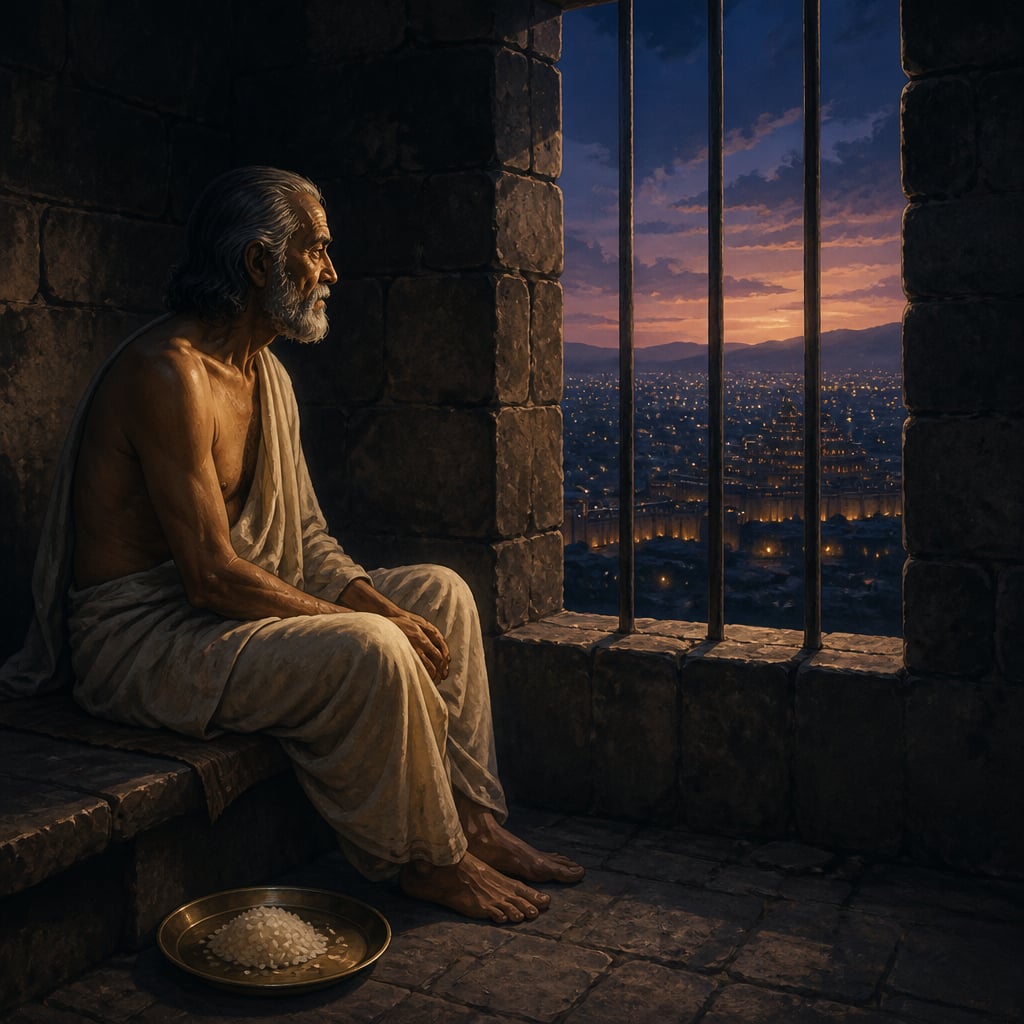
Bimbisara imprisoned alone in his own empty fortress

Bimbisara had built the greatest fortress in Magadha. Walls thick enough to resist any siege. Granaries stocked for years. Wells that would never run dry. It was perfect, except for one thing.

When his son Ajatashatru seized power and imprisoned him, no one came to rescue the old king. The peasants didn't rebel. The merchants didn't protest. The fortress was impregnable, but the people inside were indifferent.

"A fortress without loyal subjects," Kautilya later wrote, "is a prison the king builds for himself."

This insight shaped his understanding of the third limb: Janapada, the territory and its people. Not walls. Not land. Not resources. People. Everything else was merely their support.

The Foundation of Power

Kautilya was explicit about what matters most:

"प्रजासुखे सुखं राज्ञः प्रजानां च हिते हितम्"

"In the happiness of the subjects lies the king's happiness; in their welfare, his welfare."

This wasn't sentiment, it was strategy. A ruler's power ultimately rests on whether people accept his rule. They can be coerced temporarily but not permanently. Every rebellion in history began with subjects who decided their ruler served them poorly.

Consider the arithmetic: One king. Perhaps a thousand soldiers. But millions of subjects. If even a fraction refuse cooperation, governance becomes impossible. If they actively resist, armies cannot maintain control. The ruler who treats subjects as resources to be extracted eventually finds he has extracted everything, including their loyalty.

The Nanda kings learned this. They taxed heavily, conscripted freely, showed contempt for ordinary people. When Chandragupta arrived, the population didn't fight for their rulers, they welcomed the challenger. All that Nanda power vanished because Janapada had been alienated.

What Makes Janapada Strong

Kautilya identified specific factors that make a territory and its people strong:
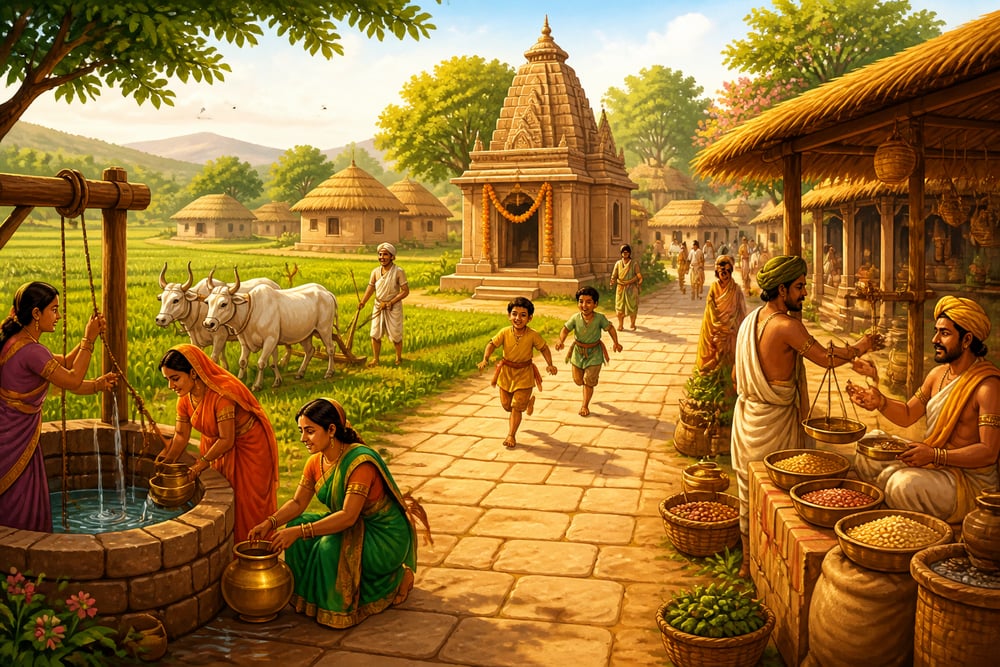
A prosperous Mauryan village at midmorning

Productive Land: The land must be capable of supporting agriculture, trade, and industry. A kingdom of sand sustains no one. Location matters, access to trade routes, fertile soil, water sources, natural resources.

Skilled Population: People who can farm, build, trade, create. Kautilya valued economic diversity: farmers, artisans, merchants, priests, warriors. Each contributed differently. A population of only one type was vulnerable.

Contentment: Not passive acceptance but genuine satisfaction with governance. Content people work productively, pay taxes willingly, defend territory enthusiastically. Discontented people sabotage everything subtly.

Loyalty: Identification with the kingdom and its ruler. Loyalty comes from being treated fairly, protected effectively, governed honestly. It cannot be commanded, only earned.

Growth: A growing population indicated good governance. People had children when they felt secure about the future. Population decline signaled that something was deeply wrong, war, disease, or (often) misrule.

The King's Debt to His People

Kautilya reversed the common assumption of his time, and ours. Many rulers believe subjects exist to serve them. Kautilya taught the opposite:

"राजा प्रकृतिरञ्जनात्"

"The king exists to please his people."

The word ranjana means to color, to please, to delight. The king's job is to make his people's lives better, not to extract maximum tribute from them.

This created specific obligations:

Protection: The primary duty. People submit to governance in exchange for security, from external invasion, internal crime, natural disaster. A king who cannot protect has broken the fundamental bargain.

Justice: Disputes must be resolved fairly. Crimes must be punished appropriately. The strong must not prey on the weak. When justice fails, people take matters into their own hands, and order dissolves.

Infrastructure: Roads, irrigation, wells, markets. The king enables prosperity by providing what individuals cannot build alone. This investment returns through taxation of increased wealth.

Emergency Relief: When floods, famines, or epidemics strike, the king must act. Kautilya specified: open granaries, reduce taxes, import grain, provide work. Abandoning people in crisis destroys all loyalty.

Taxation: The Gardener vs. The Butcher

Kautilya's most famous economic teaching concerned how rulers should extract resources from Janapada:

The gardener taking fruit without uprooting the tree

"माली इव फलं गृह्णीयात् न मूलोच्छेदेन"

"Take fruit like a gardener, not by uprooting the tree."

The butcher kills the goose for golden eggs. The gardener cultivates the tree for years of fruit. Which approach yields more in the long run?

Chandragupta implemented this. Mauryan taxation was systematic but not predatory. Standard rates that people could plan around. Exemptions during hardship. Investment in irrigation that increased harvests and thus tax base. The treasury grew because Janapada prospered.

Compare this to Dhana Nanda, who squeezed subjects for immediate revenue. Short-term, his treasury swelled. But farmers abandoned fields. Merchants fled to other kingdoms. When Chandragupta attacked, the treasury couldn't buy loyalty that had already been spent.

Modern economists rediscovered this as the "Laffer Curve", at some point, higher tax rates produce lower revenue because economic activity declines. Kautilya understood this 2,300 years earlier: the state's prosperity depends on the people's prosperity.

Settlement and Development

Kautilya devoted considerable attention to expanding and developing Janapada:

New Settlements: Establish villages in fertile but empty areas. Bring populations from overcrowded regions. Provide tools, seed, animals, tax holidays. These investments paid returns for generations.

Integration: Conquered peoples must be assimilated, not oppressed. Let them keep customs, honor their leaders, integrate gradually. The goal is new loyal subjects, not perpetual occupation.

Diversity: Encourage different occupations and origins. A population of only farmers cannot make tools. A population of only warriors cannot grow food. Diversity creates resilience and prosperity.

Urban Development: Cities as centers of trade, culture, administration. Kautilya specified: good planning, clean water, sanitation, markets, temples. The city should attract people, not repel them.

Singapore under Lee Kuan Yew exemplified Kautilyan development. A tiny territory with no resources became prosperous through investment in people, education, housing, healthcare, infrastructure. The government existed to serve citizens' development, and citizens prospered remarkably.

Listening to the People

How does a ruler know if Janapada is content or suffering? People rarely tell the powerful the truth directly. Kautilya's solution:

Spies Among the People: Not to suppress dissent but to understand it. Agents reporting genuine grievances, growing resentments, emerging problems. The ruler who knows what people actually think can address issues before they become crises.

Accessible Justice: Courts where ordinary people could bring complaints, even against officials. The petition system gave voice to the voiceless. Rulers who heard complaints could correct mistakes.

Regular Tours: The king shouldn't stay in the capital. Travel through the territory. See conditions directly. Talk to people outside official channels. What the capital reports and what the countryside experiences often differ.

Trustworthy Ministers: Amatyas who tell hard truths. If advisors only report what the king wants to hear, he governs in fantasy while reality deteriorates.

When Janapada is Neglected

Kautilya catalogued the signs of a failing state:

Population Decline: People leave for better-governed territories or simply stop having children. The ultimate vote against a regime.

Economic Decay: Fields left fallow, trades abandoned, merchants absent. When people stop producing, something is very wrong.

Corruption: Officials extracting from subjects for personal gain. The ruler's laws say one thing; actual practice says another.

Unrest: Protests, riots, rebellions. These don't appear suddenly, they build from ignored grievances over time.

Vulnerability to Invasion: When people don't care who rules, conquest becomes easy. Why fight for a king who hasn't fought for you?

Janapada in Your Life

Kautilya's teaching on Janapada extends beyond kingdoms. Consider your own domains:

If you lead a team: The team is your Janapada. Do you serve their development, or extract their labor? Do they prosper under your leadership? Are they loyal because coerced or because treated well?

If you run a business: Employees and customers are your people. Do you invest in their success? Do you listen to their feedback? Is your relationship extractive or generative?

If you're part of a family: Family members are your closest Janapada. Do you contribute to their flourishing? Is your presence a blessing or a burden?

The fundamental question Kautilya poses: What is the point of your position? Is it to be served, or to serve?

The Body Serves the Head That Serves the Body

The Saptanga metaphor reveals a paradox. Yes, Swami is the head and Janapada is the body. But what kind of head harms its own body? The head that starves the body soon has no body to direct. The head that ignores the body's pain eventually loses all function.

Kautilya's revolutionary insight: The ruler exists for the ruled. Power is a trust, not a possession. The state is an instrument of people's welfare, not the reverse.

This principle, radical in his time, remains contested today. Governments still treat citizens as resources. Leaders still confuse their interest with public interest. The fundamental choice Kautilya identified persists: Will you govern like a gardener cultivating future harvests, or like a butcher consuming the stock?

Robert Greenleaf coined 'servant leadership' in 1970, arguing that the best leaders are servants first. Jim Collins' 'Level 5 Leaders' display compelling humility alongside fierce resolve. These modern frameworks rediscover what Kautilya articulated: leadership legitimacy comes from service, not position.

Kautilya grounds servant leadership in strategic reality, not just ethics. Serving people isn't merely right, it's effective. The ruler who fails to serve will fail, period. This makes servant leadership not optional virtue but survival requirement.

Emperor Ashoka's transformation after Kalinga demonstrates this shift. His early conquests treated population as obstacles; his later governance treated them as purpose. The rock edicts announce: 'All men are my children.' Ashoka's peaceful reign outlasted his violent conquests because he learned to serve rather than merely rule.

The Laffer Curve shows that beyond certain points, higher tax rates produce lower revenue. Modern sustainability thinking applies similar logic to natural resources. Economists distinguish between income and capital, consuming capital destroys future income. All these frameworks echo Kautilya's gardener.

The gardener metaphor makes abstract economics visceral and memorable. Everyone understands that killing the goose for golden eggs is stupid. By grounding economics in agricultural imagery his audience knew intimately, Kautilya made sophisticated concepts accessible and unforgettable.

The Bengal Famine of 1943 demonstrated root-cutting. British colonial extraction during wartime disrupted food distribution, contributed to the death of millions. Short-term wartime needs were prioritized over population survival. The 'root' of Bengal's agricultural system was devastated, affecting the region for decades.

Modern development economics identifies infrastructure and human capital as growth foundations. Studies show returns on education exceed most investments. The Asian Tigers, South Korea, Taiwan, Singapore, Hong Kong, demonstrated that deliberate development investment creates prosperity within decades. This is applied Kautilya.

Kautilya specified concrete investments: irrigation systems, road networks, new settlements, craft development. He understood that different investments yield different returns and must be prioritized. His specificity enabled action rather than remaining in abstract theory.

The Mauryan road network, including the Grand Trunk Road precursor, enabled trade across the subcontinent. This infrastructure investment probably cost significant treasury resources initially. But the trade it enabled generated tax revenue for centuries. Investment created the capacity that funded further investment, a virtuous cycle.

Verses

प्रजासुखे सुखं राज्ञः प्रजानां च हिते हितम्

prajā-sukhe sukhaṃ rājñaḥ prajānāṃ ca hite hitam

In the happiness of the subjects lies the king's happiness; in their welfare, his welfare.

This sutra inverts the common assumption that rulers benefit while subjects sacrifice. Kautilya argues the opposite: the ruler's genuine interest aligns with his people's prosperity.

Book 1, Chapter 19, Verse 34 (R.P. Kangle)

माली इव फलं गृह्णीयात् न मूलोच्छेदेन

mālī iva phalaṃ gṛhṇīyāt na mūlochedena

One should take fruit like a gardener, not by cutting the root.

The most elegant economic teaching in the Arthashastra. Extraction must preserve the source.

Book 5, Chapter 2, Verse 70 (Patrick Olivelle)

देशविधानं कोशमूलम्

deśa-vidhānaṃ kośa-mūlam

The proper development of the territory is the foundation of the treasury.

Revenue doesn't appear from nowhere, it grows from productive territory and people. Investing in development isn't expense but investment: irrigation increases harvests, roads increase trade, education increases skills, all of which increase taxable wealth.

Book 7, Chapter 14, Verse 18 (L.N. Rangarajan)

Case studies

Singapore's Developmental State

In 1965, Singapore was expelled from Malaysia, a tiny island with no natural resources, no agricultural hinterland, and uncertain future. Under Lee Kuan Yew, the government made a deliberate choice: invest everything in developing the population. Education became world-class. Housing was universally provided. Healthcare was affordable. Infrastructure was pristine.

Singapore exemplifies Kautilya's 'desa-vidhanam kosha-mulam', territory development as treasury foundation. Without resources to extract, Singapore could only prosper by developing its people. The government served Janapada's development; developed Janapada funded further development. The virtuous cycle transformed a Third World city into a First World nation within one generation.

Singapore's GDP per capita grew from around $500 in 1965 to over $65,000 today. Citizens consistently rate high on quality of life measures. The government maintains legitimacy through visible service delivery. Lee Kuan Yew demonstrated that serving people works even, especially, when you have nothing else.

Investment in people is the fundamental investment. Resources can be extracted until depleted, but developed human capacity creates indefinitely. The government that serves its Janapada builds the foundation for sustainable prosperity. This works whether you're governing a nation or managing a team.

South Korea followed the same development blueprint in the 1960s through the 1990s, investing heavily in education and skills development even during periods of political authoritarianism. Today, its semiconductor and automobile industries are direct products of that human capital investment.

Singapore invested 20% of its national budget in education during its early development years. By 2023, its students ranked first globally in mathematics and science on PISA assessments.

The Nanda Collapse

The Nanda dynasty controlled the richest territory in India. Their treasury was legendary. Their army was the subcontinent's largest. They seemed invincible. But Dhana Nanda taxed oppressively, treated subjects harshly, and surrounded himself with sycophants who hid the growing resentment.

The Nandas cut roots to take fruit. Maximum extraction left Janapada impoverished and bitter. When Chandragupta challenged them, population support flipped. The Nanda army couldn't fight an insurgency that the population supported. All that wealth and power evaporated because the foundation, loyal Janapada, had been destroyed.

Chandragupta's revolution succeeded far faster than material factors predicted. The Nanda regime collapsed from within, its subjects unwilling to fight for rulers who hadn't fought for them. Kautilya used this victory as proof that governance quality, not just material power, determines outcomes.

Power that alienates its base is hollow. The strongest walls can't protect a ruler his people want removed. Conversely, rulers who serve their people can overcome material disadvantages. Legitimacy, earned through service, matters more than military strength.

Modern tax revolts, from the Gilets Jaunes movement in France to protests over property taxes in American cities, reveal the same dynamic. When citizens perceive taxation as extraction rather than investment, the social contract erodes regardless of the government's military or police strength.

The Nanda dynasty extracted taxes at rates reportedly reaching 1/4 of all agricultural produce, compared to Kautilya's prescribed 1/6, driving mass discontent that enabled the Mauryan revolution.

Historical context

c. 4th century BCE

The Mahajanapada period saw sixteen major kingdoms competing for dominance. Success correlated with how well rulers treated their Janapada. Magadha's rise came partly from productive territory and effective governance. Kingdoms that exploited their people lost them to better-governed neighbors.

The relationship between government and governed remains contested. Do states serve citizens or extract from them? Is taxation investment or theft? Should government maximize revenue or prosperity? Kautilya's framework, government exists to serve people's welfare, wise extraction cultivates the source, offers principles for evaluating governance quality that apply across time and culture.

Reflection

More in Saptanga: The Seven Limbs

All lessons in Saptanga: The Seven Limbs · Arthashastra: Philosophy of Power course