Danda and Mitra: Force and Alliance

The Sword and the Handshake

No state survives by fortification alone. Danda, the capacity for force, enables enforcement within and defense without. Mitra, allies and friends, multiplies strength through partnership. Together, these final limbs extend the state's reach into the wider world.

The King Who Trusted No One
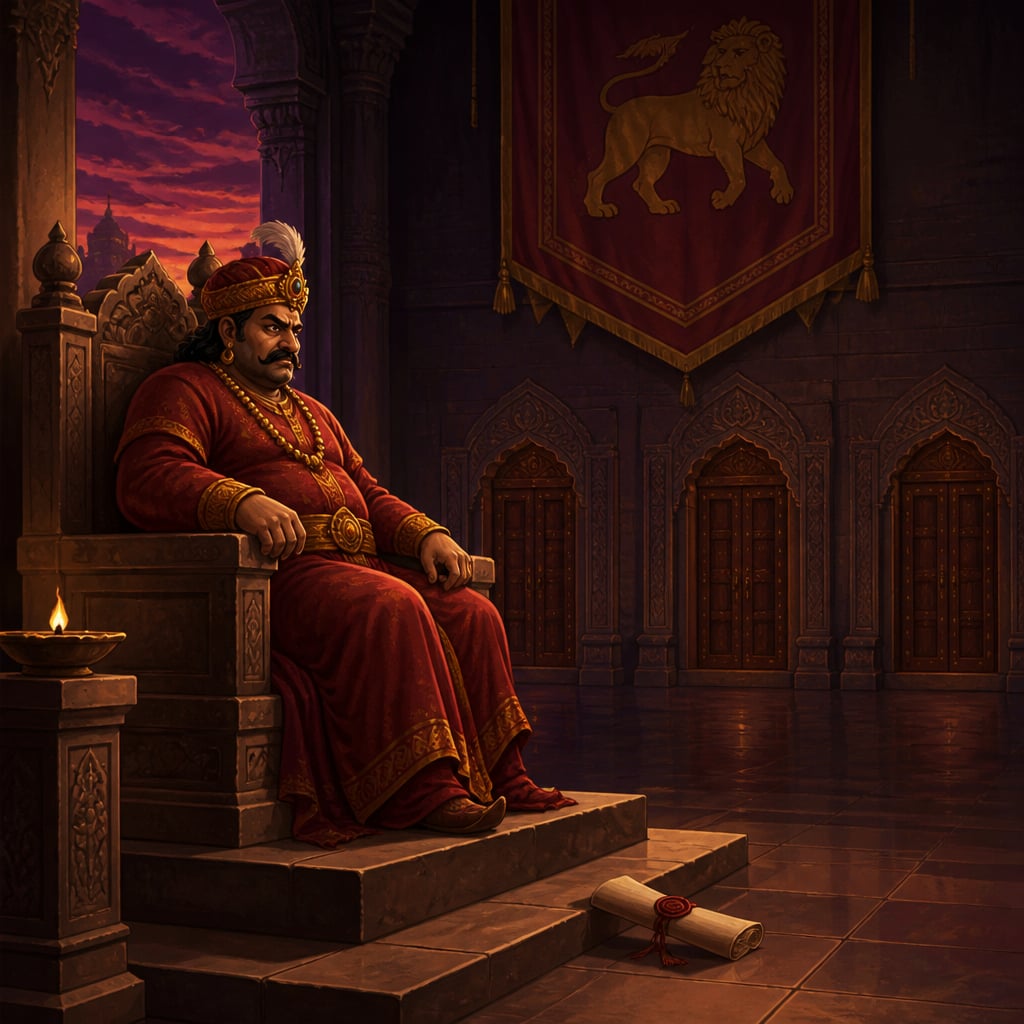
Mahapadma Nanda alone on his throne after refusing alliances

Mahapadma Nanda had conquered most of northern India through sheer force. His army was enormous, reportedly 200,000 infantry, 20,000 cavalry, 2,000 war chariots, and 3,000 war elephants. No kingdom could resist him directly.

But Mahapadma had no friends. He had crushed his neighbors, humiliated their rulers, treated vassals as servants. When trouble came, not one ally appeared to help. His successors inherited enemies on every border, and eventually, one young challenger with a single brilliant advisor.

"An army without allies," Kautilya observed, "is like a single tree in a storm. Strong winds topple what a forest would withstand."

This insight shaped his understanding of the final two limbs: Danda, the capacity for force, and Mitra, the network of allies. Both are necessary. Neither is sufficient alone. Together, they project the state's power outward.

Danda: The Staff of Authority

Danda literally means staff or rod, the symbol of authority carried by rulers. In the Saptanga, it represents all forms of coercive capacity:

Internal enforcement: Police, courts, prisons. The ability to maintain order, enforce laws, punish crimes.

External defense: Military forces that protect borders and deter aggression.

Offensive capacity: The ability to project power when necessary, to rescue allies, punish aggressors, secure interests abroad.

"दण्डो हि विद्यामूलो राज्ञः"

"Force, rooted in knowledge, is the king's essence."

But notice: "rooted in knowledge." Danda without wisdom is dangerous. Force without strategy destroys as readily as it protects. The untrained army becomes a mob. The brutal police create resentment. The aggressive military provokes coalitions against itself.

The Proper Use of Force

Kautilya was neither pacifist nor militarist. He prescribed force carefully:

Force as last resort: Try negotiation, conciliation, division, bribery before battle. War is expensive, risky, and unpredictable. Even victory has costs.

Force proportionate to need: Overwhelming force against minor threats wastes resources. Insufficient force against major threats invites defeat. Match the response to the challenge.

Force with exit strategy: What happens after military action? How does victory become stable peace? The war easily started but hard to end is worse than the war avoided.

Force within limits: Even in conflict, maintain standards. Cruelty that terrifies enemies also horrifies neutrals and potential allies. Victory through atrocity plants seeds of future conflict.

Chandragupta conquered the Nanda empire but immediately offered amnesty to soldiers who surrendered, retained capable administrators regardless of past loyalty, and treated conquered populations fairly. His Danda was effective but restrained, creating stable governance rather than festering resentment.

The Four Upayas

Kautilya's famous four methods of statecraft show Danda's place in the hierarchy:

Kautilya teaching the four upayas to Chandragupta

Sama (Conciliation): Diplomacy, negotiation, persuasion. Always try first. The problem solved without force costs least.

Dana (Gifts/Bribery): Incentives, subsidies, payments. Sometimes it's cheaper to buy cooperation than to compel it.

Bheda (Division): Creating splits in enemy coalitions. Turning opponents against each other. Weakening the enemy before battle.

Danda (Force): Military action, coercion, punishment. The final option when others fail.

Notice the order: force is last. Not because Kautilya was squeamish, he was famously ruthless, but because he was practical. Force is expensive, risky, and creates enemies. Use it only when necessary.

"शममेव प्रथमं प्रयुञ्जीत"

"One should employ conciliation first."

Mitra: The Network of Friends

If Danda is the sword, Mitra is the handshake. The sixth limb represents allies, friends, partners, those who strengthen the state through cooperation:

Military allies: Who will fight beside you when attacked? Whose armies add to your strength?

Economic partners: Who trades with you, invests in you, depends on your prosperity?

Diplomatic friends: Who speaks for you in neutral courts, vouches for your integrity, supports your positions?

Intelligence allies: Who shares information, warns of dangers, helps you understand distant threats?

Kautilya developed sophisticated alliance theory, the Mandala (circle) framework showing how geography and interest create natural friends and enemies:

Your immediate neighbor is often your rival, competing for the same resources and influence.

Your neighbor's neighbor is potentially your friend, sharing an adversary creates common interest.

Neutral powers can be swayed through benefits, they have no inherent stake in your conflict.

This geometric logic helps identify where to seek Mitra and where to expect opposition.

Building and Maintaining Alliances

Alliances don't happen automatically. Kautilya specified how to cultivate Mitra:

Shared interests: The strongest alliances rest on genuine common benefit. Both parties gain from cooperation. These alliances survive stress.

Mutual respect: Treat allies as partners, not subordinates. The ally you humiliate becomes the ally who abandons you. Dignity matters.

Reliable behavior: Keep commitments. Appear when promised. Support when needed. The ally who fails obligations finds no allies later.

Clear communication: Misunderstandings destroy alliances. Ensure both sides understand expectations. Clarify before crises force decisions.

Proportional benefit: Both sides should gain according to contribution. Alliances where one side does all the work and another takes all the benefit don't last.

Chandragupta and Seleucus sealing the Mauryan-Greek peace

The Seleucid-Mauryan peace exemplified successful alliance building. After initial conflict, Chandragupta and Seleucus found common interest against other threats. Territory was exchanged. A marriage alliance sealed the peace. Ambassadors maintained communication. Both empires benefited for decades.

When Alliances Fail

Not all alliances work. Kautilya catalogued failure modes:

Interests diverge: What once aligned now conflicts. As circumstances change, allies become rivals.

Commitments aren't honored: One party fails to appear, pay, or support. Trust breaks.

Power imbalances grow: The weak ally becomes burden; the strong ally becomes dominator. Neither situation is stable.

Enemies offer better terms: Your ally's adversary offers them more than you can. Loyalty has limits.

Internal changes: New leaders with different priorities. Revolutions that overturn foreign policy. The ally you cultivated is replaced by someone who doesn't know you.

The wise ruler expects some alliances to fail and maintains alternatives. Over-reliance on a single ally creates vulnerability. A network of friends provides resilience.

Danda and Mitra Together

These limbs are complementary:

Strong Danda attracts Mitra. States want powerful allies. The kingdom that can't defend itself is burden, not partner. Military strength makes you attractive.

Strong Mitra enhances Danda. Allied forces add to your own. Intelligence from friends improves strategy. Economic partnerships fund military capacity.

Weak Danda repels Mitra. Who wants an ally that cannot help when needed? The defenseless kingdom finds itself without friends when crisis comes.

Isolated Danda invites coalition. The strong state without friends appears threatening. Neighbors unite against it. Single-tree syndrome applies.

The ideal: sufficient force to be valuable ally and credible defender, combined with relationships that multiply strength and provide alternatives.

The Limits of Force

Kautilya, despite his reputation for ruthlessness, recognized Danda's limitations:

Force creates enemies. Those you coerce remember. Given opportunity, they retaliate. Victory in battle can create long-term adversaries.

Force is expensive. Armies cost money constantly. Wars cost more. Even successful conquest may cost more than it gains.

Force is uncertain. Battles are won and lost by fortune as well as skill. The stronger army sometimes loses. Risk cannot be eliminated.

Force erodes legitimacy. Subjects who are ruled by fear alone await opportunity to rebel. Governance by force is exhausting.

This is why Kautilya made Danda last among the Upayas. It works, but at high cost with uncertain outcome. Better methods, when available, should be used first.

The Limits of Alliances

Mitra also has limitations:

Allies have their own interests. They will support you when it serves them. When it doesn't, support may vanish.

Allies can betray. The friend today may be enemy tomorrow. Information shared becomes intelligence for adversaries.

Allies create obligations. Supporting others costs resources and freedom. Sometimes allies drag you into conflicts not your own.

Allies can fail. The ally you counted on may be defeated, may collapse internally, may prove weaker than expected.

The wise ruler maintains Mitra while preserving Danda capacity sufficient to survive alliance failure. Friends are valuable but shouldn't become dependencies.

Personal Applications

These state principles apply individually:

Personal Danda, Your capacity to defend interests:

Personal Mitra, Your network of support:

Balance matters. The person who only asserts (pure Danda) has no friends. The person who only pleases (pure Mitra) is exploited. Both capacities are necessary.

The Complete Body

With Danda and Mitra, the Saptanga is complete:

  1. Swami - The ruler who coordinates
  2. Amatya - The ministers who implement
  3. Janapada - The people who are served and who support
  4. Durga - The fortifications that protect
  5. Kosha - The treasury that enables
  6. Danda - The force that enforces
  7. Mitra - The allies who multiply strength

Each limb depends on others. Remove any, and the body is crippled. Strengthen all, and the state prospers.

The metaphor returns: seven limbs, one body. The wise ruler tends all seven, not just personal power (Swami) or military strength (Danda) but the full organism. The state that cultivates every limb becomes resilient, capable, and enduring.

This is Kautilya's gift: not a simple formula for power, but a comprehensive framework for governance that accounts for internal quality, external relationships, resources, security, and human welfare. Twenty-three centuries later, states still face the challenges he analyzed, and his Saptanga still illuminates the path.

Clausewitz taught that war is politics by other means, implying that political means should be exhausted first. Modern conflict theory emphasizes de-escalation and proportional response. Crisis negotiators always seek non-violent resolution before force. All echo Kautilya's hierarchy.

Kautilya specifies four distinct methods with clear progression. This framework is memorable and applicable: When facing resistance, ask: Have I tried sama? Dana? Bheda? Only then danda. The structured approach prevents premature escalation while not precluding force when needed.

The Cuban Missile Crisis (1962) followed this progression. Kennedy tried sama (negotiations), dana (offering to remove missiles from Turkey), bheda (back-channel communications dividing Soviet leadership), before preparing danda (military options). The crisis resolved without war because earlier methods worked.

NATO's collective defense principle (Article 5) institutionalizes mitra: an attack on one is attack on all. The theory of hegemonic stability argues that international order depends on networks of allied states. Balance of power theory shows how alliance shifts determine outcomes. All confirm Kautilya's insight.

Kautilya's mandala framework provides geometric logic for identifying natural friends and enemies. This systematic approach enables strategic alliance building rather than opportunistic scrambling. Know who should be your friend before you need friendship desperately.

World War I demonstrated alliance power, and danger. The Central Powers (Germany, Austria-Hungary, Ottoman Empire) faced the Entente (Britain, France, Russia, later others). Neither side fought alone. Eventually, Allied resource superiority prevailed. But the alliance system also widened a local conflict into world war.

Joseph Nye's 'soft power' concept distinguishes attraction from coercion as sources of influence. But Nye also emphasizes 'smart power', the integration of hard and soft power. This synthesis matches Kautilya's danda-mitra combination: capability and relationship together.

Kautilya makes the interdependence explicit: your danda makes your mitra want you; your mitra make your danda effective. The virtuous cycle requires both. Neglect either and the system degrades. This integration prevents the mistake of choosing between them.

Post-WWII America combined overwhelming military and economic power (danda) with extensive alliance networks (mitra). NATO, the UN system, trade agreements, these relationships multiplied American influence beyond what force alone could achieve. When either element weakened, overall influence declined.

Verses

दण्डो हि विद्यामूलो राज्ञः

daṇḍo hi vidyā-mūlo rājñaḥ

Force, rooted in knowledge, is indeed the king's essence.

Power without wisdom is dangerous, like a sword in the hands of a child. But wisdom without power is impotent, like a plan with no execution.

Book 1, Chapter 4, Verse 3 (R.P. Kangle)

शममेव प्रथमं प्रयुञ्जीत

śamam eva prathamaṃ prayuñjīta

One should employ conciliation first.

Force is not the first tool but the last. Before fighting, try negotiating.

Book 7, Chapter 1, Verse 6 (Patrick Olivelle)

सहायसाध्यं राज्यम्

sahāya-sādhyaṃ rājyam

A kingdom is achieved through allies.

No ruler succeeds alone. Even the greatest conquerors needed generals, advisors, and allied forces.

Book 7, Chapter 18, Verse 1 (L.N. Rangarajan)

Case studies

Bismarck's Unification Wars

In the 1860s, Prussia was one of several German states, not obviously destined for dominance. Otto von Bismarck, as Prussian Minister-President, sought German unification under Prussian leadership. He faced Austrian rivalry, French opposition, and skepticism from other German states.

Bismarck employed all four upayas systematically. Sama: negotiations with German states about benefits of unity. Dana: economic incentives through the Zollverein customs union. Bheda: isolating each opponent diplomatically before war (neutralizing France before fighting Austria, neutralizing Austria before fighting France). Danda: three quick, decisive wars. The complete toolkit, wielded in proper sequence.

Germany unified under Prussia by 1871. But Bismarck knew when to stop: after defeating France, he resisted calls for further conquest. His alliance system (mitra with Austria-Hungary, Russia, later Italy) kept peace for two decades. When successors abandoned his careful balancing, World War I followed.

Force works but must be carefully sequenced and limited. Bismarck fought three wars but always with clear objectives and exit strategies. His post-war diplomacy was as careful as his wartime strategy. The statesman who knows when to fight also knows when to stop and when to befriend yesterday's enemy.

Modern conflict resolution follows this sequencing. NATO's approach to the Balkans in the 1990s moved through diplomatic pressure, economic sanctions, and limited military intervention before achieving peace agreements. Each escalation had defined objectives and exit conditions.

Bismarck fought three wars in just seven years (1864-1871) to unify Germany, then maintained European peace for the next 19 years through a complex alliance system involving five major treaties.

The Chandragupta-Seleucus Peace

Around 305 BCE, Seleucus Nicator, ruler of the eastern portion of Alexander's fragmented empire, invaded India to reclaim territories Alexander had conquered. He faced Chandragupta Maurya's growing empire. War ensued.

After testing each other's strength (danda), both sides recognized that continued war was costly without clear winner. They shifted to sama: negotiations that resulted in peace. Seleucus ceded significant territory; Chandragupta provided 500 war elephants; a marriage alliance sealed the deal. Former enemies became mitra, with Megasthenes' embassy maintaining relations for decades.

Both empires benefited. Chandragupta secured his western frontier, freeing resources for other challenges. Seleucus gained elephants that helped him win the Battle of Ipsus against rival successors. The mitra relationship served both parties' interests.

Yesterday's enemy can become tomorrow's ally when interests align. The transition from danda to mitra required both sides to recognize mutual benefit. This wasn't weakness but wisdom, both empires prospered more through partnership than either could have through continued war.

The Abraham Accords (2020) between Israel, the UAE, and Bahrain follow this exact pattern. Former adversaries found that economic cooperation and security alignment created more value than continued hostility. Trade between Israel and the UAE exceeded $2 billion within two years of normalization.

The Chandragupta-Seleucus treaty of 305 BCE transferred 500 war elephants to Seleucus in exchange for territories covering modern Afghanistan and Balochistan. These elephants helped Seleucus win the decisive Battle of Ipsus in 301 BCE.

Historical context

c. 4th century BCE

The Mahajanapada period saw constant warfare among sixteen major kingdoms plus smaller states. Alliances shifted continuously. Today's friend was yesterday's enemy. This volatile environment generated sophisticated thinking about when to fight, whom to befriend, and how to navigate the mandala of competing powers.

International relations still operates on principles Kautilya described. Alliances shift based on interest. Force remains the ultimate arbiter when other methods fail. The progression from negotiation through incentives through division to war still structures conflict resolution. His framework provides vocabulary and logic for understanding power politics.

Reflection

More in Saptanga: The Seven Limbs

All lessons in Saptanga: The Seven Limbs · Arthashastra: Philosophy of Power course