Amatya: The Council

Eyes, Ears, and Voice of Power

No ruler can see everything or know everything. Amatya - ministers and advisors - extend the leader's perception and capacity. But only if chosen for competence over flattery, and trusted to speak uncomfortable truths.

The Minister Who Saved an Empire
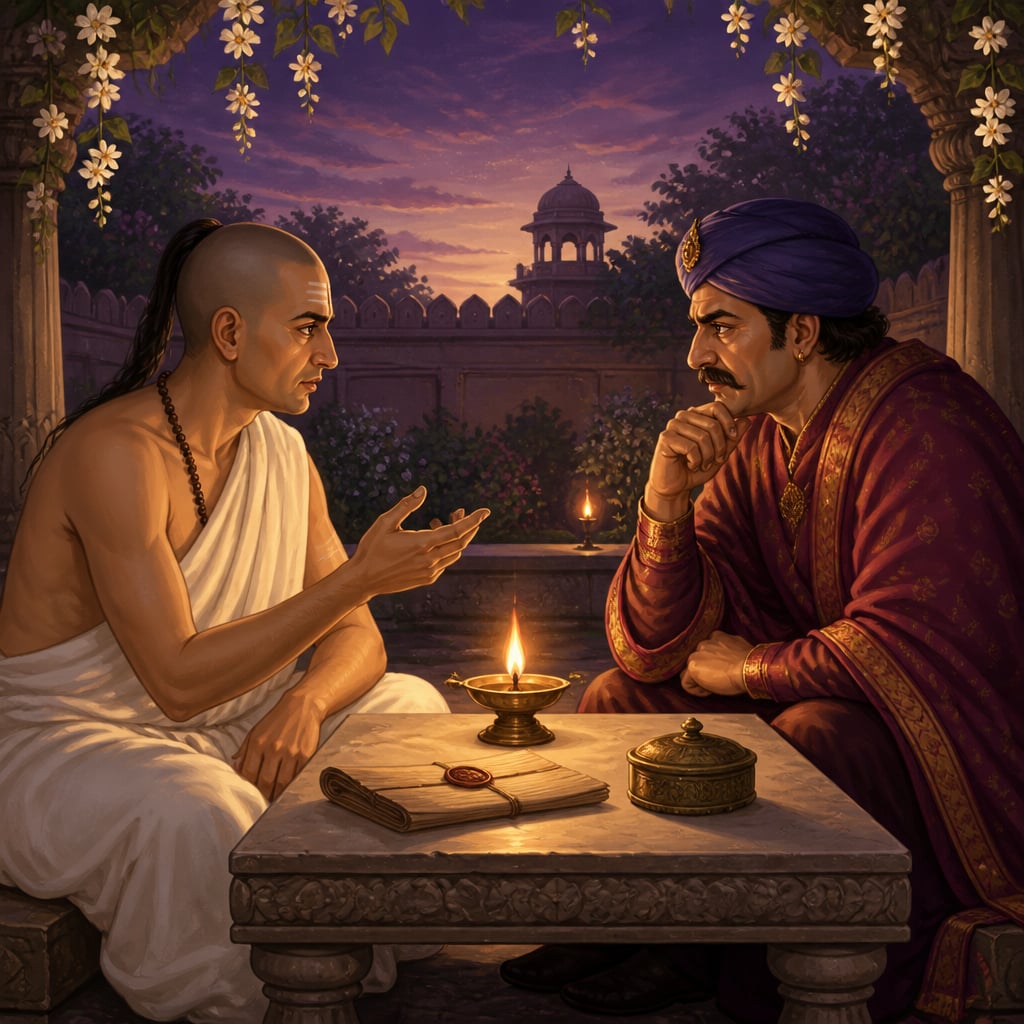
Kautilya recruiting Rakshasa in a palace garden at twilight

Rakshasa had served the Nanda dynasty loyally for years. When Chandragupta and Kautilya conquered the empire, most ministers fled or switched allegiance overnight. Rakshasa refused.

For months, he plotted against the new regime. He was intelligent, capable, and utterly opposed to Chandragupta. Any ordinary king would have had him executed.

Kautilya did something extraordinary: he spent months maneuvering to recruit Rakshasa.

Why? Because Kautilya understood what makes a true Amatya, and Rakshasa had it.

"A loyal minister who flatters," Kautilya explained to the puzzled Chandragupta, "is less valuable than a capable minister who opposes. Rakshasa has demonstrated integrity, intelligence, and skill. These are rare. His opposition to us proves he doesn't switch sides easily. Once he serves us, he will serve with the same loyalty he showed the Nandas."

Rakshasa eventually accepted, and became one of the Mauryan Empire's greatest administrators. The lesson: choose ministers for capacity, not comfort.

The Second Limb

Amatya, the ministers, advisors, and officials who extend the ruler's reach, is the second of seven limbs. Where Swami is the head, Amatya are the eyes, ears, and voice.

"अमात्यः चक्षुः राज्ञः"

"The minister is the eye of the king."

No ruler can personally observe everything in their domain. Ministers gather information, process it, and present it for decision. No ruler can personally implement every decision. Ministers translate commands into action across the state.

Without capable Amatya, the Swami is blind and mute, seeing nothing beyond their immediate presence, unable to project power beyond their personal reach.

Selection: Merit Over Loyalty

How should Amatya be selected? Kautilya was revolutionary:

"कुलशीलदेशकालविद्याबुद्धिसम्पन्नः सचिवः"

"A minister should be endowed with family background, character, native country, knowledge, and intelligence."

Note what comes first: family background and character. But notice what determines selection: knowledge and intelligence. Kautilya wanted ministers with both ethical foundation AND practical capability.

He explicitly warned against selecting ministers for:

Birth alone: Noble family without personal merit produces entitled incompetents.

Flattery: Those who tell you what you want to hear guarantee bad decisions.

Personal loyalty: Friends make comfortable advisors but not necessarily effective ones.

Past favors: Debt shouldn't determine who manages your treasury.

The revolutionary implication: a capable person of lower birth is preferable to an incompetent person of noble birth. In ancient India's caste-conscious society, this was genuinely radical.

The Testing of Ministers

Kautilya didn't trust résumés. He prescribed elaborate tests for prospective ministers:

Dharma Test: Does the candidate maintain ethical principles under pressure? Offer them opportunities to gain through unethical means. Those who resist have integrity.

Artha Test: Can the candidate resist material temptation? Expose them to opportunities for corruption. Those who remain honest can be trusted with treasury.

Kama Test: Can the candidate resist sensual temptation? Rulers' enemies often use seduction to compromise officials. Those who maintain discipline are safer.

Bhaya Test: How does the candidate respond to threats? Apply pressure and observe. Those who remain steady under pressure won't crack when enemies threaten.

Only candidates who passed all four tests should receive sensitive positions. Trust but verify, before trusting.

The Mantraparishad: Council of Ministers

Kautilya didn't envision a single all-powerful minister but a council, the Mantraparishad, with specialized roles:

Purohita: The spiritual advisor, maintaining dharmic orientation.

Senapati: The military commander, managing defense.

Yuvaraja: The crown prince, learning governance.

Plus specialized ministers for treasury, justice, agriculture, intelligence, and other domains.

The Mantraparishad deliberating around the Mauryan map

The council structure ensured that no single minister became too powerful, that multiple perspectives informed decisions, and that specialized knowledge was applied to specialized problems.

Modern cabinets and corporate C-suites echo this structure. The CEO (Swami) surrounded by CFO, COO, CTO, CMO (specialized Amatyas) making collective decisions. Kautilya's framework anticipated modern organizational design.

Speaking Truth to Power

The most valuable, and rarest, quality in an Amatya: willingness to tell the Swami uncomfortable truths.

"हितं च प्रियं च वक्तव्यम्"

"What is beneficial should be spoken, even if unpleasant."

Kautilya knew that rulers tend to punish bad news, so messengers learn to bring only good news. This creates dangerous blindness. The ruler who only hears what they want to hear will be blindsided by what they need to hear.

The solution is structural:

A minister delivering hard truth to Chandragupta in private audience

The ruler who makes it safe to speak truth will hear it. The ruler who punishes bad news will receive only good news, until disaster strikes.

When Amatya Fail

Corrupt or incompetent ministers can destroy a state faster than any external enemy:

The Sycophant: Tells the ruler what they want to hear. Blinds the ruler to problems until they become crises.

The Corrupt: Steals from treasury, sells offices, takes bribes. Hollows out state capacity while enriching themselves.

The Ambitious: Seeks personal power at the expense of state welfare. May plot against the ruler or undermine rivals destructively.

The Incompetent: Means well but lacks ability. Good intentions don't compensate for bad outcomes.

The Nanda Dynasty fell partly because its Amatya had become sycophants and profiteers. Dhana Nanda heard only flattery while his empire rotted. By the time reality penetrated, Chandragupta was at the gates.

Modern Applications

In Organizations:

Jeff Bezos institutionalized Kautilyan principles at Amazon. He required written memos instead of PowerPoints, forcing clear thinking. He designated "devil's advocates" in meetings. He famously said he'd rather have truth-tellers who were sometimes uncomfortable than comfortable liars.

In Personal Life:

Building Your Council

Even if you're not a ruler, you have Amatyas, the people who advise you, inform you, and extend your capacity:

Mentors: Those with experience who guide your development.

Experts: Those with specialized knowledge you lack.

Challengers: Those who push back on your ideas.

Connectors: Those who extend your network and access.

Supporters: Those who provide emotional sustenance.

A complete "council" includes all these types. Too many supporters and not enough challengers makes you comfortable but blind. Too many challengers and not enough supporters makes you anxious but well-informed.

Kautilya would ask: who are your Amatyas? Are they selected for merit or convenience? Do they tell you uncomfortable truths? Do you make it safe for them to do so?

The quality of your advisors determines the quality of your decisions. Choose wisely. Then listen.

Jim Collins found that 'Level 5 Leaders' surrounded themselves with people who would argue with them. Ray Dalio built Bridgewater around 'radical transparency' and disagreement. Research on group decision-making shows diverse teams outperform homogeneous ones.

Kautilya specified not just 'hire capable people' but how to test capability across multiple dimensions (the four upadha). This precision enables action.

Lincoln's 'Team of Rivals', including political opponents in his cabinet, demonstrated Kautilyan wisdom. He prioritized capability and diversity over comfort and loyalty. The result: effective governance through Civil War.

Amy Edmondson's research on psychological safety shows that teams where members feel safe to speak up outperform those where they don't. Google's Project Aristotle found psychological safety was the top predictor of team effectiveness.

Kautilya didn't just advise 'listen to truth', he designed structural protections: multiple information sources, protected truth-tellers, anonymous channels. He engineered for truth.

NASA's Challenger disaster happened partly because engineers' concerns were dismissed. The organizational culture didn't make it safe to push back on launch decisions. Truth existed but couldn't reach decision-makers. Kautilya would have recognized the failure.

Modern due diligence in hiring, background checks, reference calls, skills assessments, echoes Kautilya's testing approach. The principle: verify before trusting, especially for positions of power.

Kautilya's four tests covered comprehensive character dimensions: ethics, material integrity, self-control, and courage. This holistic assessment is more thorough than typical modern approaches.

Enron's leadership passed all conventional credentials, MBAs, impressive résumés, business success, but failed character tests that weren't administered. Better testing might have revealed the ethical failures that destroyed the company.

Verses

अमात्यः चक्षुः राज्ञः

amātyaḥ cakṣuḥ rājñaḥ

The minister is the eye of the king.

This metaphor captures the essential relationship: the Swami sees through the Amatya. Just as eyes must be clear and honest for the brain to perceive reality, ministers must be capable and truthful for the ruler to understand the situation.

Book 1, Chapter 8, Verse 1 (R.P. Kangle)

कुलशीलदेशकालविद्याबुद्धिसम्पन्नः सचिवः

kula-śīla-deśa-kāla-vidyā-buddhi-sampannaḥ sacivaḥ

A minister should be endowed with good family background, character, knowledge of place and time, and intelligence.

Kautilya balanced multiple criteria. Family and character provide ethical foundation.

Book 1, Chapter 9, Verse 1 (Patrick Olivelle)

हितं च प्रियं च वक्तव्यम्

hitaṃ ca priyaṃ ca vaktavyam

What is beneficial should be spoken, even if unpleasant, and ideally made pleasant.

The ideal is truth delivered skillfully. But when forced to choose, benefit trumps pleasantness.

Book 1, Chapter 15, Verse 2 (L.N. Rangarajan)

Case studies

Lincoln's Team of Rivals

When Abraham Lincoln became President in 1861, he appointed his main political rivals to key cabinet positions: William Seward (State), Salmon Chase (Treasury), and Edward Bates (Attorney General). All had expected to win the presidency themselves. Many thought Lincoln foolish.

Lincoln applied Kautilyan principles: select for capability, not comfort. His rivals were capable men whose perspectives he needed. They would challenge him, which made decisions stronger. Their inclusion in the cabinet defused opposition and united the party.

Despite initial tensions, the cabinet became effective. Members who disagreed with Lincoln also respected him. The diverse perspectives improved decision-making during the Civil War. Lincoln's willingness to be challenged by capable rivals strengthened governance.

The best advisors may not be the most comfortable ones. Leaders who can tolerate disagreement and even opposition gain access to perspectives that yes-men can never provide. Ego must yield to effectiveness.

Effective CEOs today deliberately build executive teams with diverse perspectives and the psychological safety to disagree. Google's Project Aristotle found that the highest-performing teams are defined not by individual talent but by an environment where members feel safe to challenge each other.

Lincoln appointed three of his direct rivals for the Republican presidential nomination to his cabinet: Seward, Chase, and Bates. All three had initially considered Lincoln unqualified for the presidency.

Theranos: The Cost of Sycophancy

Theranos built a board of luminaries, former Secretaries of State, Senators, and military leaders. But none had healthcare expertise. They didn't ask hard questions. When scientists raised concerns, they were silenced. The company collapsed when its technology was revealed as fraudulent.

Theranos violated every Kautilyan principle: board members were selected for prestige rather than relevant competence, dissent was punished rather than welcomed, truth-tellers were fired rather than protected. The organization became blind.

The company collapsed, founder was convicted of fraud, patients received incorrect medical results. Billions in value destroyed. All because the 'Amatya' were decorative rather than functional, and truth couldn't reach decision-makers.

Impressive credentials don't equal relevant competence. Advisors who can't or won't challenge the leader aren't advising, they're enabling. Organizations that punish truth-telling guarantee their own blindness.

Boeing's 737 MAX crisis followed a near-identical pattern. Engineers raised safety concerns that management dismissed under delivery pressure. The board lacked aerospace engineering expertise. Two crashes killing 346 people resulted from an organization that systematically silenced internal dissent.

Theranos's board included two former U.S. Secretaries of State and two former U.S. Senators, yet had zero members with medical diagnostics or biotech expertise when the fraud was uncovered.

Historical context

c. 4th century BCE

Ancient Indian kingdoms relied heavily on ministers, creating both opportunity and risk. Good ministers could compensate for weak rulers; corrupt ministers could destroy strong ones. Kautilya systematized observations about what made ministers effective or dangerous.

The question of how to select, empower, and constrain advisors remains central to governance. Every organization, from startups to superpowers, faces the challenges Kautilya addressed. His analysis remains relevant because the problems persist.

Reflection

More in Saptanga: The Seven Limbs

All lessons in Saptanga: The Seven Limbs · Arthashastra: Philosophy of Power course