Swami: The Ruler

The Head of the Body

The first limb is the ruler - but not just anyone with power. Kautilya's ideal Swami has conquered internal enemies before governing others. What makes a true leader? Character, knowledge, and self-mastery.

The Prince Who Wasn't Ready

Young Chandragupta in dawn sword training under Kautilya

Dhana Nanda inherited the mightiest empire in India. His father had built it. His treasury overflowed. His army was legendary. Yet within years, he had lost everything to a young challenger with almost nothing.

Why?

Kautilya knew. He had studied the Nanda court and seen the rot at the top. The king was a slave to his senses, addicted to luxury, deaf to criticism, surrounded by flatterers. He was Swami in title only.

"A king who cannot govern himself," Kautilya told his young student Chandragupta, "cannot govern anything. This is why we will defeat him."

Swami, the ruler, is the first of the seven limbs. But what makes a true Swami? Not birth. Not conquest. Not wealth. The real qualification is self-mastery.

The Six Internal Enemies

Kautilya identified six internal enemies that destroy rulers from within:

"कामः क्रोधो लोभो मानो मदो हर्षश्चेति षड्वर्गः"

"Kama (lust), Krodha (anger), Lobha (greed), Mana (arrogance), Mada (intoxication), and Harsha (over-excitement), these are the six-fold enemies."

Kama (Lust): Not just sexual desire but craving for any pleasure that clouds judgment. The ruler who chases pleasure neglects duty.

Krodha (Anger): Decisions made in fury are rarely wise. The angry ruler punishes too harshly, alienates allies, and creates enemies.

Lobha (Greed): The greedy ruler overtaxes subjects, steals from the treasury, and destroys the prosperity he should protect.

Mana (Arrogance): The arrogant ruler dismisses advice, underestimates opponents, and overestimates his own abilities.

Mada (Intoxication): Not just alcohol but any substance or state that impairs judgment, including intoxication with power itself.

Harsha (Over-excitement): Excessive joy at success leads to recklessness. The excited ruler makes promises he cannot keep and commitments he cannot sustain.
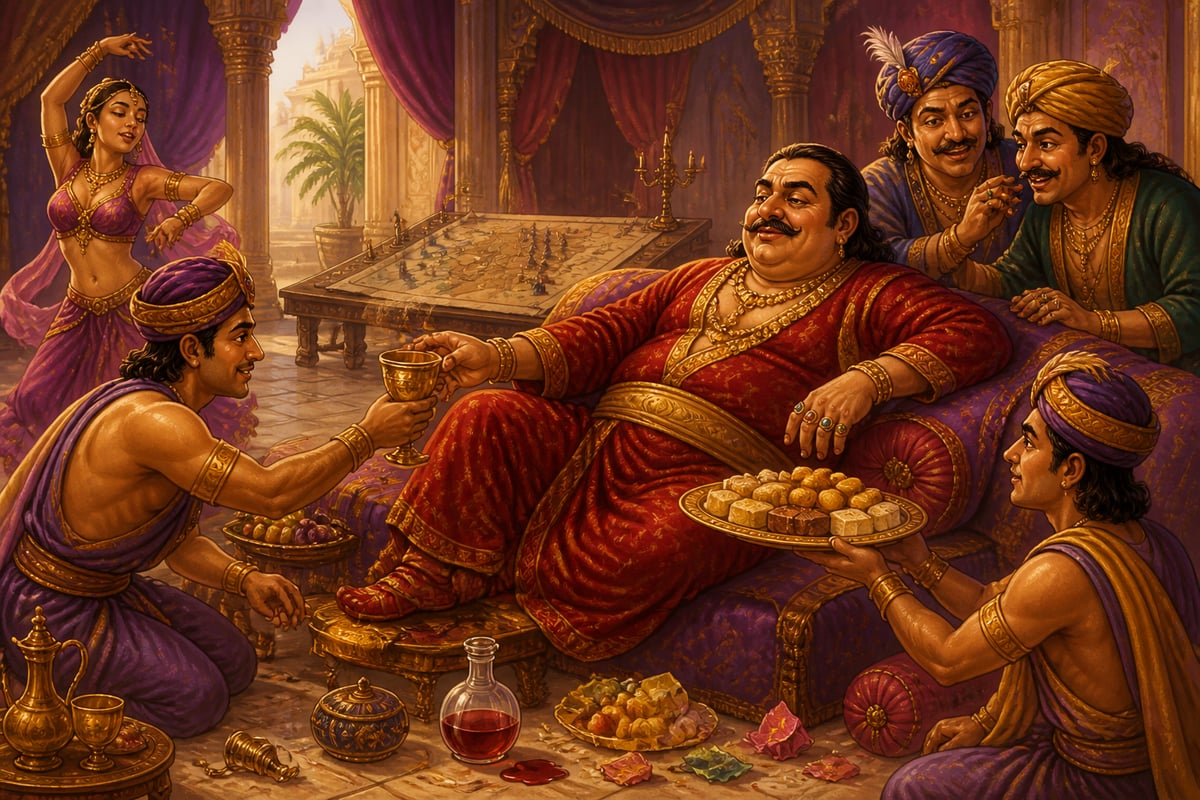
Dhana Nanda overcome by the six internal enemies in his pleasure court

Every fallen ruler, Kautilya observed, was conquered by at least one of these internal enemies before external ones arrived.

Self-Conquest First

Kautilya's prescription was clear:

"जितात्मा जितेन्द्रियः राजा भवेत्"

"One who has conquered the self and conquered the senses should become king."

This isn't moral preaching, it's strategic necessity. A ruler enslaved to anger will make enemies through harsh punishment. One enslaved to greed will drain the treasury. One enslaved to arrogance will ignore warnings until too late.

Chandragupta's training under Kautilya was as much about self-discipline as strategy. Before he could command armies, he had to command himself. Before he could delegate to ministers, he had to master his own impulses.

The legendary Greek ambassador Megasthenes visited the Mauryan court and was stunned by Chandragupta's discipline. The emperor followed strict routines, meals, exercise, work, rest, with military precision. This wasn't personality; it was training.

The Qualities of a True Swami

Beyond self-conquest, Kautilya specified positive qualities the ruler must develop:

Vinaya (Discipline): Regular habits, systematic approach, consistent behavior. The disciplined ruler is predictable to allies and reliable to subjects.

Shushrusha (Willingness to Learn): The ruler must remain a student throughout life. New challenges require new knowledge. The ruler who stops learning stagnates.

Prajna (Wisdom): Not just intelligence but the ability to distinguish important from unimportant, urgent from non-urgent, true from false.

Utsaha (Energy): Ruling is exhausting. The effective ruler maintains physical and mental energy for sustained effort.

Vakya Shakti (Power of Speech): The ability to communicate clearly, persuade effectively, and inspire action.

Danda Shakti (Power of Authority): The capacity to make decisions and enforce them, not through cruelty but through legitimate command.

Prabhu Shakti (Sovereign Capacity): The combination of resources, position, and capability that enables action at scale.

The Swami's Daily Routine

Kautilya didn't just describe ideal qualities, he prescribed specific practices. The Arthashastra outlines a demanding daily schedule:

The Swami in dawn meditation before the day begins

Dawn: Wake before sunrise. Physical exercise. Receive reports from spies.

Morning: Review finances and administration. Meet with ministers. Handle correspondence.

Midday: Meal (simple, not luxurious). Brief rest. Study and learning.

Afternoon: Military matters. Inspection of forces. Strategic planning.

Evening: Meet with advisors. Hear petitions. Dispense justice.

Night: Entertainment and relaxation (moderate). Planning for next day. Sleep by set time.

This schedule served multiple purposes: it maximized the ruler's effectiveness, demonstrated discipline to observers, and left no time for the six enemies to find purchase.

Lee Kuan Yew of Singapore followed remarkably similar patterns, early rising, systematic work blocks, continuous learning, disciplined routine. His success in transforming Singapore echoed Kautilya's insight: effective leadership requires disciplined habits.

Swami and the Other Limbs

The Swami doesn't rule alone, that's why six other limbs exist. But the Swami's relationship to each is crucial:

To Amatya (Ministers): Select for merit, not loyalty. Listen to disagreement. Delegate but verify.

To Janapada (People): Serve their welfare. Tax justly. Protect their property and lives.

To Durga (Fortifications): Invest in security. Don't trust defense to chance.

To Kosha (Treasury): Spend wisely. Maintain reserves. Never confuse state wealth with personal wealth.

To Danda (Army): Train and equip properly. Lead personally when needed. Never use force against your own people without dire cause.

To Mitra (Allies): Cultivate carefully. Honor commitments. Understand their interests.

The Swami who manages all six relationships well creates a functioning state-body. The one who neglects any relationship weakens the whole.

When Swami Fails

What happens when the ruler fails? The body loses its head.

Kautilya observed three types of Swami failure:

The Weak Swami: Cannot make decisions, cannot enforce commands, becomes puppet of ministers or external powers. The state drifts.

The Tyrannical Swami: Oppresses subjects, steals from treasury, alienates allies. The state revolts or collapses from within.

The Incompetent Swami: Lacks knowledge or energy to govern effectively. The state decays through neglect.

All three types invite external conquest. Enemies watch for Swami weakness the way predators watch for injured prey. This is why succession planning is critical, the state is vulnerable between strong rulers.

Becoming Swami of Your Life

Kautilya's teachings on Swami apply beyond kingdoms. You are the ruler of your own life:

Conquer the six enemies: What internal weaknesses undermine your effectiveness? Anger that damages relationships? Greed that compromises ethics? Arrogance that prevents learning?

Develop the seven qualities: Are you disciplined? Do you keep learning? Can you distinguish important from urgent? Do you maintain energy? Can you communicate and lead?

Establish routines: Do you have systematic practices that structure your days? Or do you drift from impulse to impulse?

Manage your limbs: How are your relationships with the other elements of your life, your skills (Amatya), health (Janapada), security (Durga), finances (Kosha), boundaries (Danda), relationships (Mitra)?

The person who masters themselves can master circumstances. The person enslaved to internal enemies will always struggle, no matter their external resources.

The Swami's Burden

Kautilya never romanticized rulership. Being Swami meant:

"राज्ञः प्रियो न कश्चित्"

"No one is truly the king's friend."

This sounds bleak, but Kautilya meant it practically: the ruler cannot afford the casual intimacy others enjoy. Every relationship has strategic dimension. Every interaction is observed. Every weakness will be exploited.

This is the price of power. Those who aren't willing to pay it shouldn't seek the role.

Daniel Goleman's 'Emotional Intelligence' (1995) demonstrated that self-awareness and self-regulation predict leadership success better than IQ. Jim Collins' 'Level 5 Leaders' are characterized by personal humility and professional will, self-mastery expressed in leadership. Both validate Kautilya's ancient insight.

Kautilya goes beyond identifying self-mastery as important to specifying exactly what must be mastered (the six enemies) and how (disciplined practice, structured routines). This precision enables action rather than vague aspiration. He provides the curriculum for self-development.

Marcus Aurelius, the Roman philosopher-emperor, demonstrated Kautilyan self-mastery in Western context. His 'Meditations' reveal constant struggle against anger, pleasure, and arrogance, the Roman equivalent of the six enemies. His reign is remembered as the height of Roman peace and prosperity precisely because of this inner discipline.

Cognitive psychology identifies numerous biases, confirmation bias, sunk cost fallacy, emotional reasoning, that impair judgment. Daniel Kahneman's 'Thinking, Fast and Slow' catalogs systematic irrationality. Kautilya's six enemies overlap significantly: greed creates sunk cost fallacy, arrogance creates confirmation bias, anger creates emotional reasoning.

Rather than abstract categories, Kautilya identified six specific, recognizable emotions that cause trouble. This concreteness aids application. When you feel a surge of anger, you can immediately recognize 'ah, Krodha, one of the six enemies.' Recognition creates space for response.

Napoleon's Russian campaign demonstrates the six enemies in action. Success bred arrogance (Mana) that dismissed warnings. Greed (Lobha) for territory overrode strategic sense. Excitement (Harsha) at early victories prevented retreat when needed. The greatest military genius of his age was defeated by his own internal enemies before Russian winter finished the job.

James Clear's 'Atomic Habits' shows how small consistent actions compound into significant change. Charles Duhigg's 'The Power of Habit' explains the neuroscience of habit formation. Both validate Kautilya's approach: don't try to become disciplined all at once, build practices that create discipline over time.

Kautilya didn't just advise 'be disciplined', he specified exact routines. Wake at this time, do these activities, rest at that time. This precision enabled implementation. The modern productivity literature reinvents what Kautilya understood: specific habits matter more than general intentions.

Benjamin Franklin famously tracked 13 virtues daily, working on one each week in rotation. This systematic approach to character development echoes Kautilya's structured routines. Franklin's remarkable achievements across multiple domains, publishing, science, diplomacy, rested on this disciplined foundation. Practice built the person who achieved the results.

Verses

इन्द्रियजयः शास्त्रोद्देश्यः कृत्यानुष्ठानात्

indriya-jayaḥ śāstroddeśyaḥ kṛtyānuṣṭhānāt

Conquest of the senses, which is the purpose of the sciences, comes from performing one's duties.

Self-mastery isn't achieved through willpower alone but through disciplined action. By performing duties consistently, the structured routines Kautilya prescribes, the ruler trains the senses.

Book 1, Chapter 6, Verse 1 (R.P. Kangle)

कामः क्रोधो लोभो मानो मदो हर्षश्चेति षड्वर्गः

kāmaḥ krodho lobho māno mado harṣaś ceti ṣaḍ-vargaḥ

Lust, anger, greed, arrogance, intoxication, and over-excitement, these are the six-fold enemies.

These internal enemies are more dangerous than external ones because they cannot be defeated with armies. They attack from within, corrupting judgment, destroying relationships, and opening vulnerabilities that external enemies exploit.

Book 1, Chapter 6, Verse 3 (Patrick Olivelle)

विनयमूलो दण्डः

vinaya-mūlo daṇḍaḥ

Discipline is the foundation of authority.

The ruler's authority (danda) rests ultimately on personal discipline (vinaya). Without self-discipline, authority becomes arbitrary and eventually collapses.

Book 1, Chapter 7, Verse 1 (L.N. Rangarajan)

Case studies

Marcus Aurelius: The Philosopher King

Marcus Aurelius ruled the Roman Empire at its height (161-180 CE). He faced constant warfare, plague, rebellion, and personal tragedy. Yet he maintained philosophical composure, continuing to write his 'Meditations' even while campaigning. His reign is remembered as the peak of Roman peace and prosperity.

Marcus exemplified Kautilya's disciplined Swami. His 'Meditations' reveal constant struggle against the six enemies, anger at injustice, desire for comfort, temptation to arrogance. But he developed specific practices: morning reflection, evening review, philosophical principles kept ready for challenges. His self-governance enabled effective governance.

Despite incredible pressures, 15+ years of continuous warfare, devastating plague, his own poor health, Marcus maintained effective rule. The contrast with his undisciplined successors, whose reigns saw Rome's decline begin, validates Kautilya's teaching: the ruler's self-mastery determines the empire's fate.

Self-mastery isn't just for easy times. Marcus faced challenges that would break most people, yet his philosophical discipline enabled not just survival but excellence. The practices he'd built in calmer times carried him through crisis. Build your discipline now, before you need it.

Navy SEALs and elite athletes train emotional regulation as rigorously as physical skills. The modern performance psychology field, from Olympians to surgeons, confirms that self-mastery under pressure is a trainable skill, not an innate trait. Those who build the practice in calm conditions perform when stakes are highest.

Marcus Aurelius ruled Rome for 19 years (161-180 CE) through the Antonine Plague that killed an estimated 5 million people, continuous Germanic wars, and the revolt of Avidius Cassius, while still writing 12 books of philosophical Meditations.

Elizabeth Holmes: Unchecked Ambition

Elizabeth Holmes founded Theranos with genuine vision: democratize blood testing. She attracted billions in investment and was hailed as the next Steve Jobs. But when the technology didn't work as promised, she chose deception over honesty. In 2022, she was convicted of fraud.

Holmes demonstrated the six enemies in action. Greed (Lobha) for success and status. Arrogance (Mana) that dismissed scientific objections. Intoxication (Mada) with her own image. Over-excitement (Harsha) at early acclaim that prevented honest assessment. These internal enemies transformed vision into fraud.

Theranos collapsed. Holmes faced criminal conviction. Patients received incorrect medical results. Employees who raised concerns were punished. What began with genuine innovation ended in ruins, not from external enemies but from internal ones unchecked.

Brilliance and vision without self-mastery become weapons against yourself and others. Holmes had every external advantage, talent, money, connections, opportunity. But the six enemies conquered her, and she conquered nothing. Self-governance is not optional for those with power.

The pattern repeats across industries. Adam Neumann at WeWork, Travis Kalanick at Uber, and Sam Bankman-Fried at FTX all had genuine vision and early success. In each case, unchecked ego and the inability to accept limitations turned promising ventures into cautionary tales.

Theranos raised over $700 million from investors at a peak valuation of $9 billion, but its core blood-testing technology never worked as claimed, processing fewer than 12 of its advertised 200+ tests on its proprietary device.

Historical context

c. 4th century BCE

The Mahajanapada period showed wide variation in ruler quality. Some kings were disciplined and their kingdoms thrived; others were undisciplined and their kingdoms suffered. Kautilya systematized observations of what distinguished successful from unsuccessful rulers into teachable principles.

The qualities Kautilya described are observable in effective leaders across all eras and cultures. Self-discipline, emotional control, continuous learning, sustained energy, these characterize successful leadership from ancient empires to modern corporations. His analysis remains relevant because human psychology hasn't changed.

Reflection

More in Saptanga: The Seven Limbs

All lessons in Saptanga: The Seven Limbs · Arthashastra: Philosophy of Power course