Durga and Kosha: Fortification and Finance

The Shield and the Sinew

A state without defense is prey. A state without treasury is paralyzed. Durga provides the walls that protect; Kosha provides the resources that enable action. These two limbs work in concert, security requires funding, and wealth requires security to accumulate.

The King Who Couldn't Pay His Army
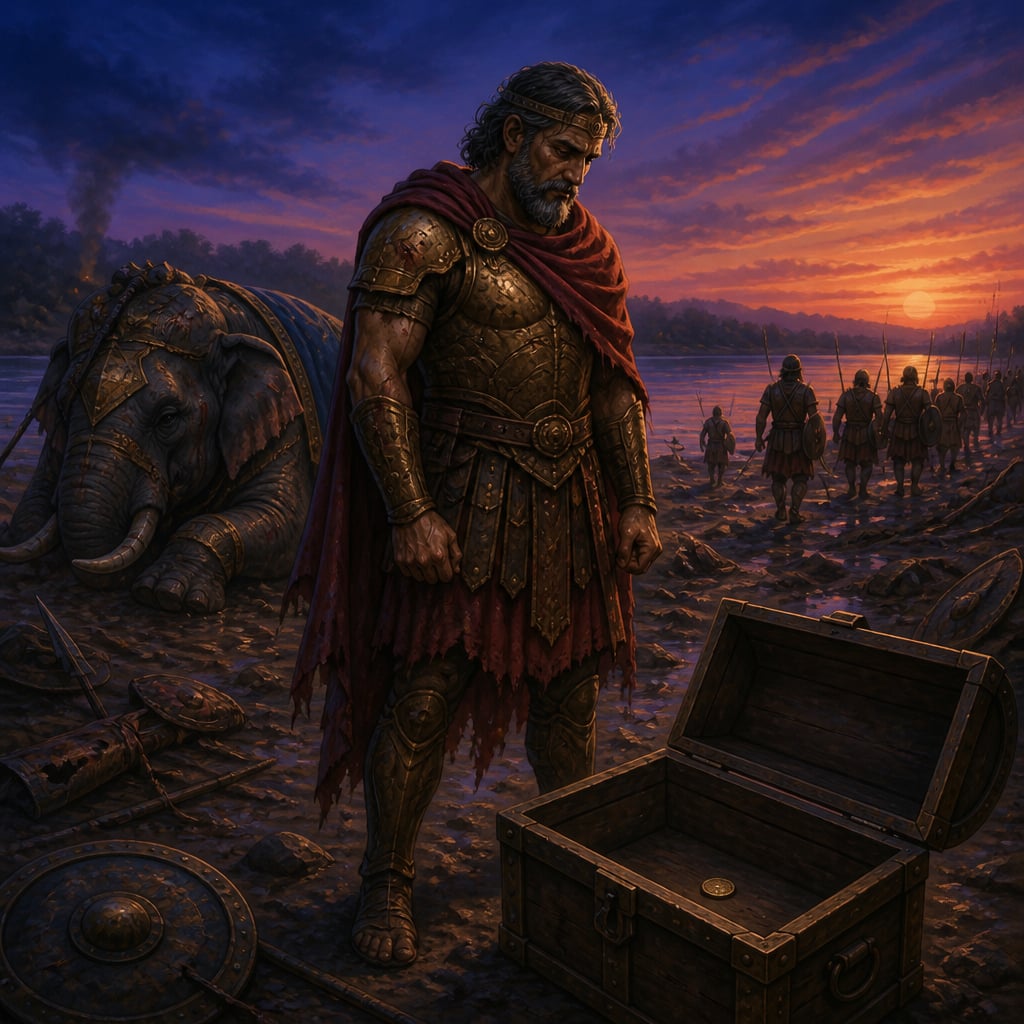
Porus standing weary beside his emptied treasury after Hydaspes

Porus had just fought Alexander the Great to a standstill at the Hydaspes River. His war elephants had terrified the Macedonians. His warriors had stood firm against the world's greatest army. It was a moral victory.

But Porus was broke.

His treasury, depleted by the war, couldn't pay soldiers, couldn't repair fortifications, couldn't feed the wounded elephants. When Alexander offered alliance rather than subjugation, Porus had no choice but to accept. The king who matched Alexander in battle was defeated by an empty treasury.

"Bravery without resources is honorable suicide," Kautilya observed. He had watched the Punjab kingdoms fall one by one, not always on the battlefield but often in the counting house. This is why Durga and Kosha, fortification and treasury, form the structural foundation of the Saptanga.

Durga: The Fortress

Durga means fortification, but not just walls. Kautilya identified four types:

Audaka Durga (Water Fort): Protected by rivers, lakes, or seas. Difficult to attack, easy to supply by water. Island fortresses. Cities surrounded by moats.
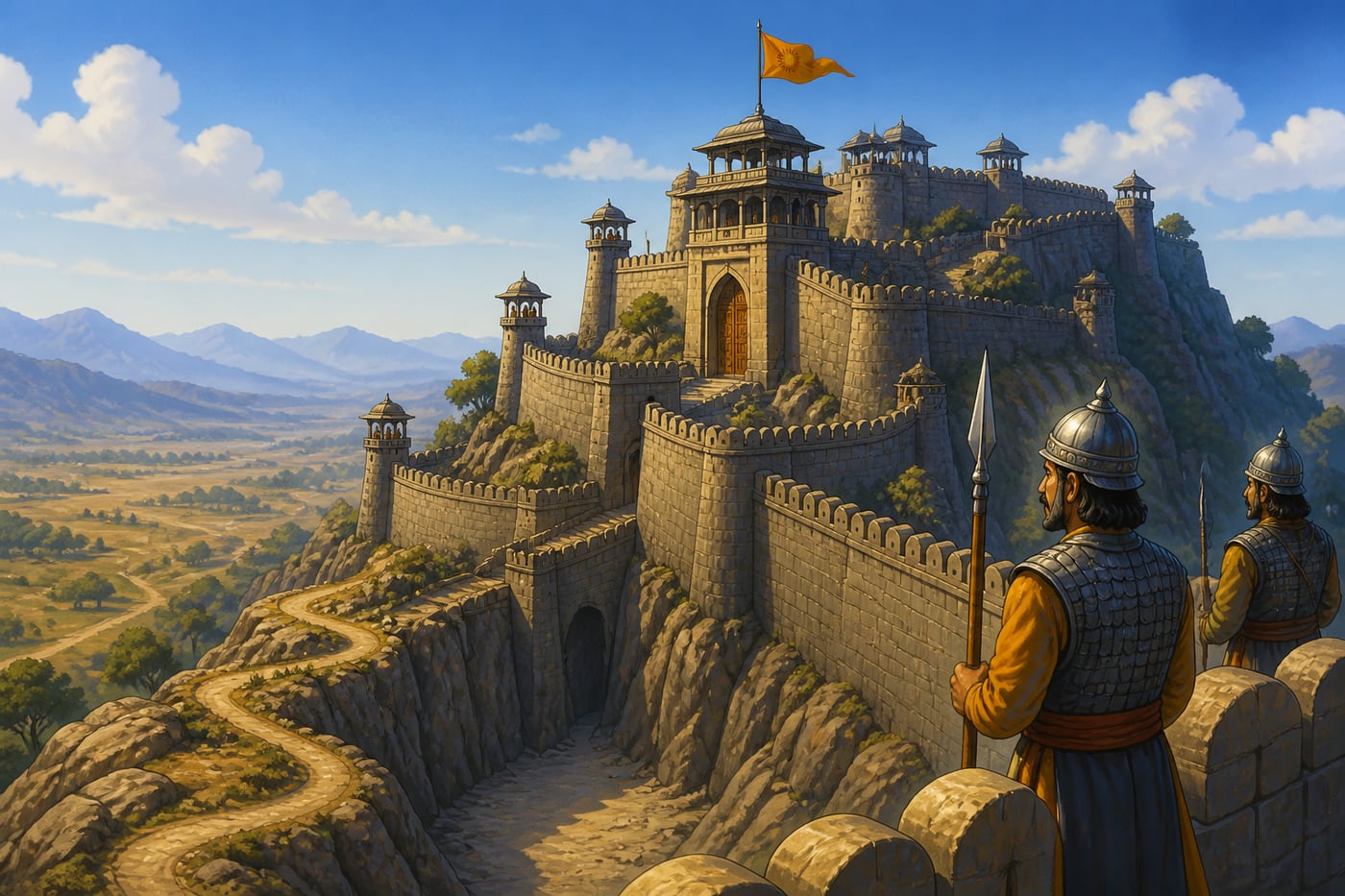
A Mauryan hill fortress on a steep ridge at midday

Parvata Durga (Mountain Fort): High ground that is hard to assault, easy to defend. Natural walls of stone. The defender looks down on attackers.

Dhanvana Durga (Desert Fort): Surrounded by barren land that exhausts attackers before they arrive. The fortress sustains itself while enemies wither.

Vana Durga (Forest Fort): Hidden in dense vegetation. Hard to find, harder to besiege. The jungle fights for the defender.

Kautilya's insight: use natural obstacles, not just constructed ones. The best fortifications leverage geography. Build where nature helps defend.

"दुर्गं हि राज्ञः प्रतिष्ठा"

"The fortress is the king's foundation."

Without Durga, everything else is temporary. The finest court, the richest treasury, the most loyal people, all can be swept away by invasion. Durga buys time: time to gather forces, time to seek allies, time to negotiate. In crisis, the fortress becomes the state's essential refuge.

Building True Security

But Kautilya didn't romanticize fortresses. He was brutally practical:

Location matters more than walls. A fortress in the wrong place, too far from population centers, too hard to supply, too easy to bypass, is worthless.

Maintenance is continuous. Neglected walls crumble. Unmanned towers are useless. The fortress requires constant investment, not one-time construction.

Walls don't fight, people do. The strongest fortress falls if defenders lack will. Durga requires trained garrison, sufficient supplies, loyal population. The physical structure is necessary but not sufficient.

Multiple layers beat single walls. Defense in depth, outer walls, inner citadel, fallback positions. Each layer buys time and costs attackers.

Chandragupta built the most extensive fortification system India had seen, but he paired it with diplomacy, intelligence, and Janapada loyalty. The walls were last resort, not first reliance. When Seleucus Nicator invaded, the combination of strong defenses and strong governance convinced him to negotiate rather than besiege.

The Mauryan treasury vault under lamplight

Kosha: The Treasury

If Durga is the shield, Kosha is the sinew, the treasury that enables movement and action:

"कोशमूलो दण्डः"

"The treasury is the foundation of force."

Armies require payment. Fortresses require construction. Allies require subsidies. Emergencies require reserves. Without Kosha, the state is paralyzed, unable to respond to threats, unable to seize opportunities, unable to survive crisis.

Kautilya specified what the treasury must fund:

Military: Soldiers, weapons, elephants, horses, fortifications. The immediate cost of security.

Administration: Officials, courts, infrastructure. The cost of governance.

Development: Irrigation, roads, new settlements. Investment in future prosperity.

Reserves: Emergency funds for war, famine, disaster. The prudent margin.

Diplomacy: Gifts, subsidies, bribes when necessary. The cost of managing neighbors.

Revenue Without Destruction

Where does Kosha come from? Kautilya catalogued sources:

Agricultural taxes: Typically one-sixth of harvest, enough to fund the state, not so much as to discourage farming.

Commercial taxes: Duties on trade, market fees, port charges. Commerce should be encouraged, not strangled.

State enterprises: Mines, forests, salt works, manufacturing. The state as productive participant, not just extractive collector.

Crown lands: Properties directly owned by the state, generating rents.

Fines and fees: Justice system revenue, license fees, regulatory charges.

But Kautilya constantly warned against over-extraction. Remember the gardener versus the butcher. Revenue that destroys productive capacity is self-defeating:

"न हि प्रजाः पीडयित्वा धर्मार्थावुपाददीत"

"One should not acquire dharma and artha by oppressing the people."

Taxation should be systematic, predictable, and fair. Subjects who know what they owe can plan and prosper. Subjects facing arbitrary extraction stop producing.

The Treasury Must Be Full

Kautilya was emphatic: an empty treasury is catastrophic:

You cannot respond to crises. When invasion threatens, when famine strikes, when rebellion erupts, response requires resources. The empty treasury means watching disasters unfold.

Allies won't help. Alliances require maintenance. The king who cannot provide gifts, subsidies, or military support finds friends absent when needed.

Officials become corrupt. Underpaid administrators supplement income through extortion. The empty treasury creates the corruption it cannot afford to punish.

Soldiers become unreliable. Unpaid troops desert or mutiny. The army you cannot pay becomes the army that serves your enemies.

Enemies sense weakness. Neighbors watch treasury health. The depleted state invites aggression; the wealthy state deters it.

Kautilya advised maintaining reserves even in peacetime, ideally, funds to cover years of operation. This insurance against catastrophe was not luxury but necessity.

The Cycle of Security and Prosperity

Durga and Kosha reinforce each other in a virtuous cycle:

Security enables prosperity: People invest, trade, build when protected from invasion and crime. Durga creates conditions for Kosha to grow.

Prosperity funds security: A wealthy treasury can afford walls, soldiers, weapons. Kosha creates the capacity for Durga.

Weakness spirals downward: Insufficient security discourages production; reduced production depletes treasury; empty treasury cannot fund defense; weaker defense invites attack.

Strength spirals upward: Strong defense attracts merchants and settlers; growth fills treasury; full treasury funds better defense; stronger defense enables more growth.

Kautilya understood this feedback loop. Breaking it, through neglecting either limb, started decline that was hard to reverse. Maintaining it required balanced investment in both.

When Durga and Kosha Conflict

Sometimes security and treasury seem to conflict:

Fortress building is expensive. Should treasury fund walls or development?

Military spending diverts resources. More soldiers means less investment.

Security measures can hurt commerce. Border controls slow trade.

Kautilya's resolution: balance for the long term. Short-term savings on defense lead to long-term losses. Short-term military spending that bankrupts the state is equally foolish. The wise ruler invests enough in security to protect prosperity while preserving enough prosperity to fund security.

Japan after World War II exemplifies this balance. Constitutional limits on military spending freed resources for economic development. But Japan relied on American security guarantee, they outsourced Durga while building Kosha. When security is assured, investing in prosperity makes sense.

Israel shows the opposite calculation. Surrounded by threats, they invest heavily in Durga even at economic cost. But they've also built a sophisticated economy that funds their security. The balance differs based on circumstances.

Your Personal Durga and Kosha

These principles apply beyond states:

Personal Durga, Security foundations:

Personal Kosha, Resource capacity:

Neglect either and you're vulnerable:

Strong finances, weak security: The wealthy person without health insurance, emergency skills, or protective relationships is one crisis from disaster.

Strong security, weak finances: The protected person without savings, income, or assets is secure but immobilized, unable to pursue opportunities.

Building Both Together

Kautilya's advice for states applies personally:

Invest in security when times are good. Build skills and relationships before you need them desperately. The emergency is the wrong time to start networking.

Maintain reserves against bad times. Emergency funds aren't optional luxury. The standard advice, three to six months of expenses, is personal Kosha.

Use natural advantages. Geographic and social position matter. Build on existing strengths rather than starting from nothing.

Balance current needs and future capacity. Spending everything leaves no reserves. Saving everything means living poorly. Find the sustainable balance.

The Modern Lesson

Nations still balance Durga and Kosha. Defense budgets versus social spending. Security measures versus economic freedom. Military strength versus fiscal health.

The United States maintains the world's most expensive military, substantial Durga, funded by the world's largest economy, substantial Kosha. But debates about balance never end.

Smaller nations must choose: invest in defense they can't really afford, or hope neighbors remain peaceful? Nordic countries chose minimal defense and maximal development during the Cold War, relying on larger powers for security. It worked, until Ukraine reminded everyone that security isn't guaranteed.

The fundamental insight persists: Security without resources is impotent. Resources without security are precarious. Both must be cultivated together, balanced continuously, adapted to circumstances. The state, or individual, that neglects either invites destruction.

Maslow's hierarchy places safety needs as foundational, before belonging, esteem, or self-actualization. Business strategy literature emphasizes 'sustainable competitive advantage' before growth. Both recognize that achievement built on insecure foundations is temporary.

Kautilya specifies types of security (water, mountain, desert, forest fortresses) and notes that different situations require different protections. His practical specificity enables actual implementation rather than abstract acknowledgment that security matters.

Constantinople's walls protected Byzantine civilization for a millennium. The city's position, surrounded by water, defended by massive fortifications, allowed culture, commerce, and governance to flourish within. When the walls finally fell in 1453, everything else fell with them.

Sun Tzu emphasized logistics: 'The line between disorder and order lies in logistics.' Clausewitz noted that war is politics continued by other means, and those means require funding. Modern business strategy stresses 'runway', how long you can operate before needing results. All recognize Kautilya's insight: resources enable action.

Kautilya connects treasury to everything: army, administration, development, diplomacy, emergency response. This comprehensive view prevents the mistake of building capacity in one domain while neglecting the resources it requires.

The Soviet Union collapsed not on the battlefield but in the budget. Military capacity consumed resources that couldn't fund economic development, which eroded the tax base that funded military capacity. The spiral ended in dissolution. Kosha failure brought down a superpower.

Systems thinking identifies reinforcing loops: success breeds success, failure breeds failure. In economics, 'agglomeration effects' show how centers of prosperity attract more prosperity. In security studies, 'security dilemmas' show how weakness invites aggression. These modern frameworks echo Kautilya's insight.

Kautilya provides practical guidance for managing the loop: invest in security when prosperous (not when threatened), maintain reserves (don't spend everything), balance current needs with future capacity. This operational wisdom enables implementation.

The Dutch Golden Age demonstrated the virtuous cycle: naval security enabled global trade; trade profits funded larger navies; larger navies protected more trade. When the cycle reversed, military costs exceeded trade revenue, decline followed. Rise and fall both followed the Durga-Kosha dynamic.

Verses

दुर्गं हि राज्ञः प्रतिष्ठा

durgaṃ hi rājñaḥ pratiṣṭhā

The fortress is indeed the king's foundation.

Without security, nothing else is permanent. The ruler's court, treasury, laws, and achievements all depend on protection from external destruction.

Book 6, Chapter 1, Verse 10 (R.P. Kangle)

कोशमूलो दण्डः

kośa-mūlo daṇḍaḥ

The treasury is the foundation of force.

Force, whether military, administrative, or diplomatic, requires funding. The empty treasury cannot maintain armies, cannot enforce laws, cannot reward allies or punish enemies.

Book 2, Chapter 8, Verse 2 (Patrick Olivelle)

न हि प्रजाः पीडयित्वा धर्मार्थावुपाददीत

na hi prajāḥ pīḍayitvā dharmārthāv upādadīta

One should not acquire dharma and artha by oppressing the people.

Filling the treasury through oppression is self-defeating. Overtaxed subjects stop producing; terrorized merchants stop trading; exploited farmers abandon fields.

Book 5, Chapter 2, Verse 72 (L.N. Rangarajan)

Case studies

Israel's Security-Prosperity Balance

Israel faces constant security threats: surrounded by historical adversaries, subject to terrorism, lacking strategic depth. Yet it has become a global technology hub, with one of the world's highest rates of startups and patents. Defense spending runs around 5-6% of GDP, high by global standards but not crippling.

Israel demonstrates the Durga-Kosha balance under pressure. Heavy security investment (Durga) is funded by economic innovation (Kosha). Military technology development spurs civilian industry. Universal conscription builds social cohesion. The feedback loop works: security enables the economic activity that funds security.

Israel has maintained both security and prosperity for decades despite extraordinary threats. Neither limb is neglected, the balance adjusts continuously based on threat assessment and economic conditions. The model isn't transferable everywhere, but it proves that both can be achieved under difficult circumstances.

Extreme circumstances don't excuse imbalance, they require more careful balance. Israel could have bankrupted itself on defense or left itself vulnerable to save money. Instead, it found ways to make security and prosperity reinforce each other. Creativity in integration matters as much as investment levels.

Taiwan faces a similar security-prosperity challenge today. Despite constant military pressure from China, it has become the world's leading semiconductor manufacturer. Its defense spending remains disciplined at roughly 2.4% of GDP while channeling resources into the technological capabilities that give it global strategic importance.

Israel spends approximately 5.2% of GDP on defense while simultaneously producing more startups per capita than any other nation, with over 6,000 active tech startups in a country of 9.7 million people.

The Soviet Collapse

The Soviet Union maintained the world's largest military, matching or exceeding American capability in many domains. Nuclear arsenals, massive conventional forces, global presence. But military spending consumed estimated 15-25% of GDP, far more than adversaries could sustain, while the civilian economy stagnated.

The Soviets prioritized Durga over Kosha unsustainably. Military investment didn't generate economic returns. Consumer economy couldn't fund military expansion. The vicious cycle accelerated: military costs hurt economy, weak economy couldn't maintain military, military decline exposed vulnerabilities. The system collapsed without external attack.

The Soviet Union dissolved in 1991, not defeated in war but bankrupted by its own defense burden. All that military investment couldn't save a system that had neglected economic vitality. Durga without sustainable Kosha proved unsustainable.

Security is necessary but not sufficient. The fortress that bankrupts the state defeats itself. Durga must be sized to what Kosha can sustain. Short-term security purchased by long-term economic decline is no security at all, it's postponed collapse.

Russia's current military spending, estimated at over 6% of GDP following the 2022 Ukraine invasion, strains its civilian economy in ways that echo Soviet patterns. Sanctions compound the effect, demonstrating that military overreach still carries the same economic costs Kautilya warned about.

Soviet military spending consumed an estimated 15-25% of GDP throughout the 1980s, compared to 6% for the United States, leaving consumer goods production at roughly 1/10th of American levels.

Historical context

c. 4th century BCE

Indian subcontinent geography created natural fortification opportunities, the Himalayan barrier, the Thar Desert, river systems. Kautilya's Durga categories reflected what he observed: kingdoms using water, mountains, forests, and deserts as defensive assets. Treasury management was sophisticated, land revenue systems, trade taxation, state enterprises.

Nations still debate guns versus butter, defense versus development spending. Security guarantees require payment. Economic growth requires protection. The balance Kautilya identified remains fundamental to statecraft. His insight that these aren't alternative choices but complementary necessities applies from ancient empires to modern democracies.

Reflection

More in Saptanga: The Seven Limbs

All lessons in Saptanga: The Seven Limbs · Arthashastra: Philosophy of Power course