Training the Crown Prince
Yuvaraja - Preparing the Heir
A kingdom is only as stable as its succession. Kautilya's system for training crown princes ensured continuity of governance and prevented power vacuums that invite tyranny.
The Most Dangerous Moment
Every transition of power is a moment of vulnerability. Enemies circle. Ambitious ministers scheme. Uncertainty breeds chaos. History is littered with kingdoms that collapsed not because they lacked good rulers, but because they failed to produce the next one.
Kautilya understood this fundamental truth: good governance must outlast any individual.
"A kingdom without a trained heir is like a ship without a rudder - one storm away from disaster."
Succession planning wasn't an afterthought in the Arthashastra - it was a core function of governance.
The Institution of Yuvaraja
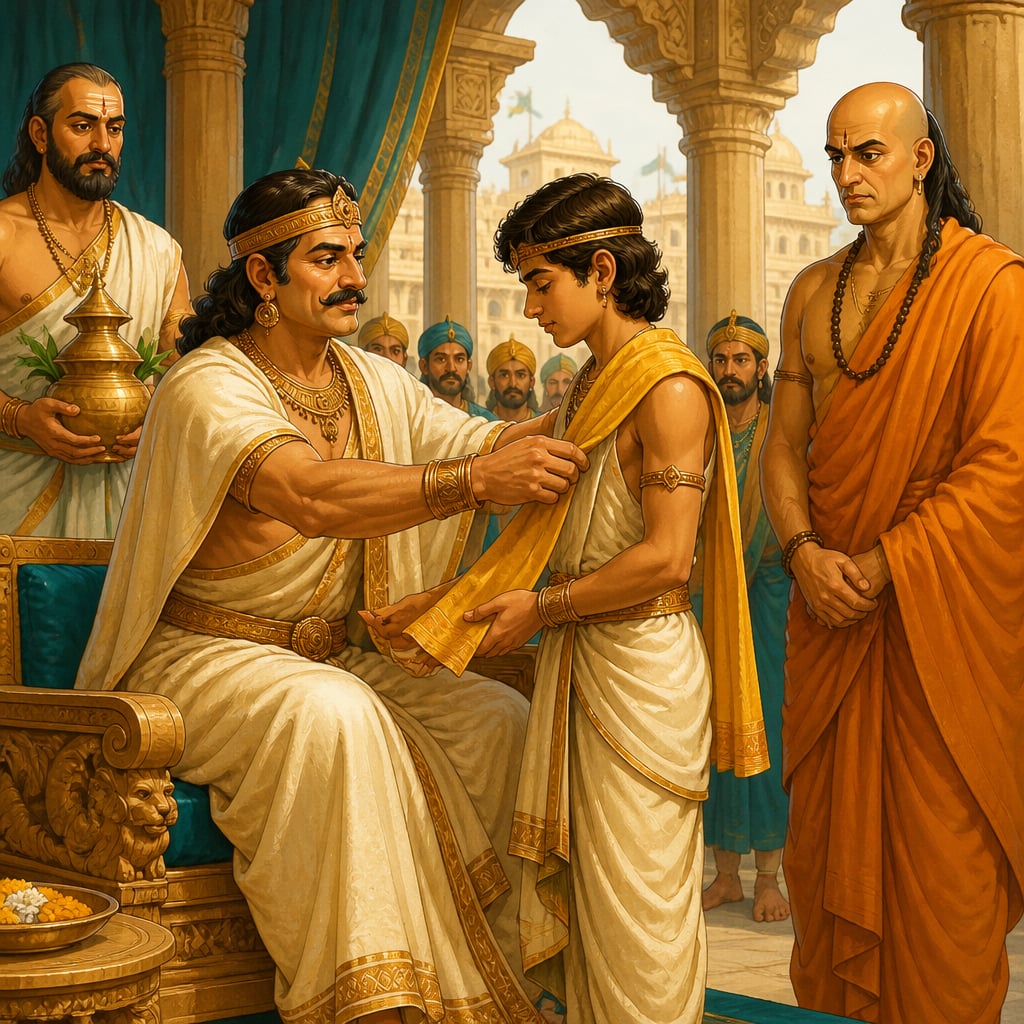
Kautilya's solution was the yuvaraja - literally "young king" - the crown prince who would be formally designated, publicly invested with authority, and systematically trained to rule.
By clearly designating an heir, the kingdom avoided the chaos of disputed successions. This predictability was essential for stability - merchants could plan investments, allies knew treaties would continue, officials understood the chain of command.
The yuvaraja wasn't just waiting to inherit. He was actively governing, gaining real experience under the king's supervision. Kautilya recommended giving the crown prince command of military expeditions, governorship of provinces, authority over departments, and responsibility for dispute resolution. You cannot learn to rule from books alone - the prince needed to make decisions, experience consequences, and develop judgment.
A yuvaraja who had already been exercising authority could seamlessly step into full power. The officials had worked with him. The people knew him. The transition was natural, not revolutionary. Moreover, a crown prince who had already commanded armies and governed provinces had his own power base - attempting to bypass him meant civil war.
The Selection of the Heir
Kautilya was pragmatic about succession. While he acknowledged that eldest sons typically inherited, he insisted that competence must trump mere birth order.
"Better a kingdom pass to a capable younger son than collapse under an incompetent elder."
The ideal yuvaraja possessed intellectual qualities (quick understanding, strategic thinking), moral qualities (self-discipline, courage, compassion), physical qualities (good health, endurance), and temperamental qualities (even-tempered, decisive, able to keep secrets).
If multiple sons possessed these qualities, priority went to the eldest. But an incompetent eldest could be passed over. This was radical - in most societies, primogeniture was absolute. Kautilya insisted that the kingdom's welfare came first.
The Training Curriculum

The young prince's education began early, focusing on the four sciences (philosophy, Vedas, economics, and statecraft), physical training (riding, archery, wrestling), and character development (control of the senses, discipline, responsibility).
Once mature, the yuvaraja took on real responsibilities. He would lead military expeditions, learning strategy and the burden of command. He might govern a distant province, dealing with taxation, justice, and administration. He sat in council, observing debates and learning when to speak and when to listen. Major initiatives - building forts, establishing settlements, negotiating with allies - gave him experience in execution.

In his later years, a wise king would gradually transfer authority to the yuvaraja while remaining available for counsel. This ensured the prince learned from mistakes while his father could still correct course, continuity of policy was maintained, and when the king died, governance continued seamlessly.
The Libertarian Insight
Kautilya's succession system reveals a profound understanding: predictable governance protects freedom.
When succession is uncertain, rivals fight for power dragging society into civil war, winners feel insecure becoming tyrannical, institutions weaken, and rights become vulnerable to arbitrary seizure.
When succession is orderly, people can plan for the future with confidence, rulers focus on governance not consolidating power, institutions grow stronger than individuals, and freedom is preserved through continuity.
This is why modern democracies obsess over smooth transfers of power - the peaceful handover isn't just ceremony, it's the foundation of political stability.
Dangers to Avoid
Kautilya warned against several pitfalls. An ambitious yuvaraja who couldn't wait for natural succession might plot against his father - Kautilya advised giving the prince real power to satisfy his ambitions, keeping him busy with demanding responsibilities, and watching for signs of conspiracy.
A king who failed to train his heir properly doomed the succession. The kingdom might survive his reign but collapse under his unprepared son. This was a moral failing - a ruler's duty extended beyond his own lifetime.
Unclear designation led to succession wars. Kautilya insisted: designate the heir early, invest him publicly with authority, and make the succession unambiguous.
The Modern Parallel
We no longer have hereditary monarchies (mostly), but succession remains critical. Family firms that don't train the next generation often fail in the transition. Nonprofits and companies that neglect succession planning face leadership crises. Stable democracies have clear constitutional procedures for succession.
The principle is universal: institutions must be stronger than individuals.
The Ultimate Goal
Kautilya's system aimed to create "anti-fragile" governance - a state that not only survived transitions but emerged stronger. Each generation of rulers, properly trained and tested, would bring fresh energy while maintaining institutional continuity.
At its core is a simple libertarian truth: the best protection against tyranny is a government that doesn't depend on finding a tyrant-proof leader. Train successors well, establish clear procedures, and power becomes predictable rather than personal.
Succession crises occur when heirs are unprepared or unknown. Early designation and genuine delegation prevent power vacuums while building capability through practice.
Tradition provides stability through predictability, but blind adherence to tradition when it conflicts with competence destroys what tradition aims to preserve.
Uncertainty about succession invites power struggles and prevents stakeholders from planning. Public designation creates clarity that stabilizes expectations.
Verses
युवराजमभिषिच्य प्रदेशे वा कार्यान्ते वा योजयेत्
yuvarājam abhiṣicya pradeśe vā kāryānte vā yojayet
Having formally invested the crown prince, one should employ him in governing a province or in administrative responsibilities.
Succession planning isn't theoretical - it requires giving real authority and responsibility to the designated heir. This serves both as training and as public demonstration of legitimacy, preventing succession disputes.
Book 1, Chapter 17, Verse 1-2 (R.P. Kangle)
गुणवान् ज्येष्ठः पुत्रो युवराज्यमर्हति
guṇavān jyeṣṭhaḥ putro yuvarājyam arhati
The eldest son who possesses the necessary virtues merits the position of crown prince.
Merit matters more than mere birth order. While the eldest has priority, incompetence disqualifies him.
Book 1, Chapter 17, Verse 5 (L.N. Rangarajan)
राज्यं विना युवराजेन अस्थिरम्
rājyaṃ vinā yuvarājena asthiram
A kingdom without a designated crown prince is unstable.
Uncertainty about succession creates instability even while the current ruler lives. Clear succession planning isn't preparation for death - it's essential for present stability and confidence.
Book 1, Chapter 17, Verse 9 (R. Shamasastry)
Case studies
The Mauryan Succession Model
Chandragupta Maurya faced the challenge of ensuring his empire would survive his death. He had multiple sons, potential rivals, and an empire still consolidating power. One succession crisis could undo everything he had built.
Following Kautilya's advice, Chandragupta designated Bindusara as yuvaraja early, gave him governorship of Taxila (a strategic province), and publicly invested him with authority. When Chandragupta abdicated to become a Jain monk, Bindusara smoothly assumed full power.
The Mauryan Empire continued to expand under Bindusara. No succession war occurred. Officials and allies knew who to follow. The transition from Chandragupta to Bindusara was one of the smoothest in ancient history.
Clear designation plus real training plus public investiture equals stable succession. All three elements were necessary - remove any one, and succession becomes contested.
Family businesses that survive across generations follow this pattern. Studies show that only 30% of family businesses survive to the second generation and 12% to the third. The common factor in those that endure: early designation of successors, real operational responsibility before transition, and public acknowledgment that removes ambiguity.
The Mauryan succession from Chandragupta to Bindusara (c. 298 BCE) occurred without civil war or political disruption. The empire governed approximately 50 million people across 5 million square kilometers, making it the largest state in Indian history at that time.
Alexander's Succession Disaster
When Alexander the Great died in 323 BCE, he had conquered the largest empire in the world. But he had no trained heir, no clear succession plan. When asked on his deathbed who should succeed him, he allegedly said 'the strongest' - guaranteeing civil war.
Alexander violated every principle Kautilya taught: no designated heir, no public investiture, no trained successor with established authority. The result was immediate fragmentation as generals fought for pieces of the empire.
The Wars of the Diadochi lasted for decades. Alexander's empire split into multiple kingdoms. His family was murdered. His legacy of conquest was destroyed by his failure to plan succession.
Military genius without succession planning equals disaster. Even the greatest leader cannot ensure their life's work survives without institutional continuity.
Apple after Steve Jobs provides the counterexample. Jobs designated Tim Cook, gave him operational authority, and publicly invested confidence in him. The result was the smoothest CEO transition in tech history, with Apple's market cap growing from $350 billion to over $3 trillion. Planning succession is the final test of leadership.
Alexander's empire, spanning 5.2 million square kilometers at his death in 323 BCE, fractured into 4 major successor kingdoms within 20 years. The Wars of the Diadochi lasted 40 years (322 to 281 BCE) and resulted in the murder of Alexander's entire family.
Historical context
c. 4th century BCE
Before Mauryan consolidation, succession wars were common in Indian kingdoms. The Nanda dynasty itself likely fell partly due to internal succession disputes that Chandragupta exploited.
The yuvaraja system helped the Mauryan Empire maintain stability for over a century, avoiding the succession crises that destroyed other contemporary empires.
Living traditions
- Corporate Succession Planning: Formal discipline of identifying, developing, and transitioning leadership in organizations to prevent power vacuums
- Constitutional Heir Apparent Systems: Modern constitutional monarchies maintaining clear succession designation while limiting arbitrary royal power
- Family Business Succession Programs: Structured programs for training next-generation leadership in family-owned enterprises
- Harvard Business School: Offers executive education programs on succession planning and leadership transitions
- Indian Institute of Management: Studies family business succession in Indian context
- Pataliputra Archaeological Site: Ancient Maurya capital where the yuvaraja system was implemented, training heirs like Bindusara and Ashoka
- Rashtrapati Bhavan: Modern India's seat of presidential power with clear constitutional succession procedures
Reflection
- Kautilya allowed incompetent eldest sons to be passed over. How do you balance tradition and stability (which favor clear rules like primogeniture) against merit and effectiveness?
- Why does Kautilya insist that kingdoms without designated heirs are unstable? What does this tell us about the relationship between predictability and freedom?
- In your own work or family life, what would it mean to train your successor? Are you building something that will outlast you, or creating dependence on your irreplaceability?