Managing Succession Crises

When Plans Fail - Emergency Protocols

Despite perfect planning, succession crises occur. Kautilya's protocols for sudden deaths, disputed claims, and unexpected disasters reveal how to prevent power vacuums from becoming tyrannies.

When Everything Goes Wrong
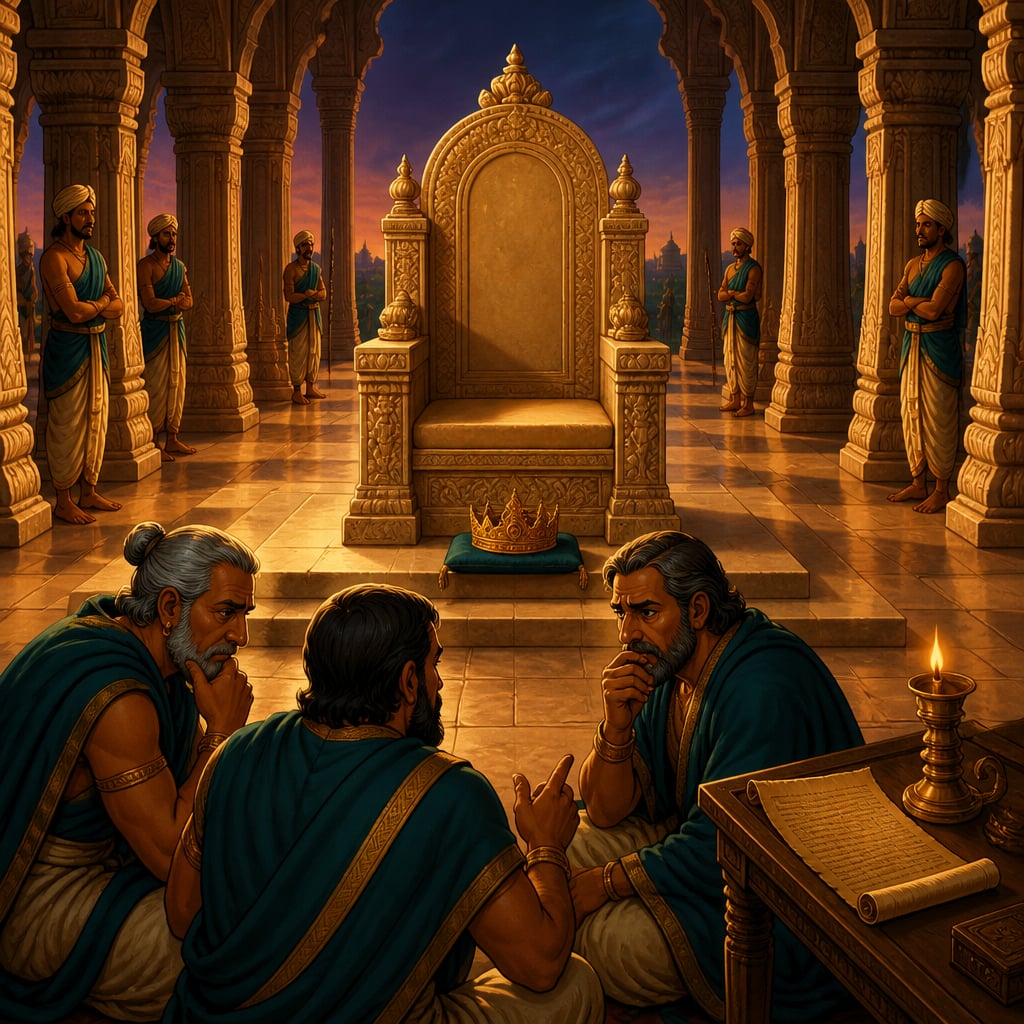
An empty Mauryan throne with worried ministers gathered before it

The king dies suddenly. No heir was designated. Or worse - multiple claimants emerge, each with armed supporters. The kingdom teeters on civil war.

This is the succession crisis, the most dangerous moment in any state's existence. All the planning, all the training, all the careful preparation - rendered useless by fate, ambition, or incompetence.

Kautilya understood that plans fail. The question wasn't whether succession crises would occur, but how to manage them when they did.

"When the throne is empty, every ambitious man imagines himself king."

Types of Succession Crises

The Sudden Death

The king dies unexpectedly - assassination, accident, illness. No clear heir exists, or the heir is a child.

Immediate Dangers: Power vacuum as ministers and generals compete for control, external invasion exploiting weakness, internal rebellion as provinces attempt independence, and economic collapse as merchants flee uncertainty.

Kautilya's Protocol:

  1. Immediate Regency Council - Senior ministers form collective authority. No single person claims the throne. Council rules until succession is determined.

  2. Secure the Capital - Treasury locked and guarded, palace secured, army confined to barracks, foreign embassies reassured.

  3. Rapid Succession Determination - Follow established succession rules strictly. If heir is a child, appoint trusted regent. Conduct coronation immediately to establish legitimacy.

  4. Project Continuity - All existing treaties honored, officials remain in positions, no sudden policy changes. Message: "The king is dead; the kingdom continues."

The Disputed Succession

Multiple sons claim the throne. Each has supporters. The kingdom fractures along factional lines.

Kautilya's Options (in order of preference):
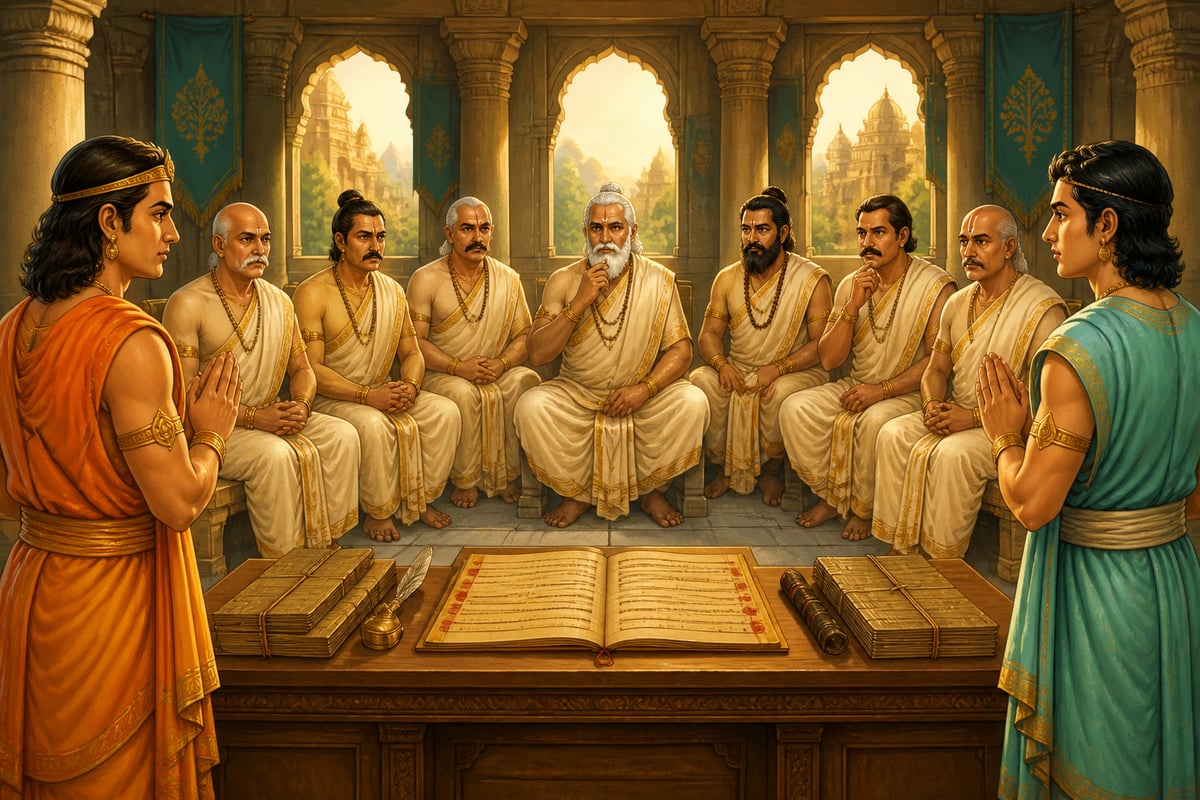
A Mauryan council arbitrating between two princely brothers' rival claims

Option 1: Council Arbitration

A council of senior ministers, priests, and respected nobles examines all claims systematically. They investigate: Who was formally designated as heir? Who is most qualified by training and competence? Who has the broadest support among nobles, army, and populace? Who would least destabilize the kingdom? The council's decision is binding on both claimants, who must swear beforehand to accept the outcome.

This works only under specific conditions: both sides respect the council's authority and believe it will be fair, the council is genuinely neutral with no factional loyalties, and the decision can actually be enforced with army support if necessary.

Option 2: Partition

If neither claimant will yield and both command sufficient forces that civil war is inevitable, partition becomes preferable to destruction. Each brother rules a clearly defined portion of the kingdom with formal boundaries. Both maintain alliance against external enemies. Communication and coordination structures are preserved. The possibility of eventual reunification remains open.

This prevents immediate civil war and massive bloodshed, though it permanently weakens the state by dividing resources and creating potential future conflicts over the border.

Option 3: Combat Trial

In extremis, when partition is rejected and civil war is unavoidable, limit the conflict through ritualized combat or a single decisive military engagement rather than prolonged war. Specific rules are established beforehand: the victor becomes king, the loser must accept exile or subordinate position, no revenge against the loser's supporters. This prevents full civil war from devastating the entire kingdom and establishes a clear victor quickly.

Kautilya deeply disliked this option because of escalation risks - what starts as limited combat can spiral into total war - but saw it as preferable to years of civil conflict destroying the kingdom entirely.

Option 4: External Mediation

As an absolute last resort, invite a respected neighboring king or powerful ally to arbitrate the dispute. This external mediator hears both claims and renders a binding judgment.

Serious Dangers: This establishes precedent of foreign influence in internal succession, giving outsiders leverage over future decisions. The mediator might exploit the kingdom's weakness for territorial or political concessions. Both internal claimants may reject an outsider's authority as illegitimate.

When to use: Only when all internal solutions have failed completely, civil war is absolutely imminent and will destroy the kingdom, and the external mediator is genuinely neutral, respected by both sides, and has no direct territorial ambitions.

The Incompetent Heir

The designated heir proves disastrously unfit after ascending - cruel, mad, or catastrophically incompetent.

Kautilya's Three-Phase Protocol:

Phase 1: Soft Constraint - Ministers "assist" the king with increasing control. Royal orders require ministerial countersignature. Gradually isolate the king from actual power while preserving the fiction of royal authority.

Phase 2: Formal Regency - If soft constraint fails, declare the king ill or incapacitated. Appoint formal regent while king retains ceremonial role. All real power transfers to regent.

Phase 3: Deposition (Last Resort) - If the king actively threatens the kingdom, council formally deposes him, citing specific failures. Install alternative from royal family.

Kautilya's Warning: Deposition is incredibly dangerous as it establishes precedent that kings can be removed. Use only when the alternative is the kingdom's destruction.

The Child Heir

A trusted regent reviewing a decree for the young Mauryan child-king

The king dies leaving a young child as heir.

Kautilya's Regency Framework:

The Regent Must Be: Unambiguously loyal to the child, respected by ministers and nobles, competent in governance, without personal ambition for throne. Ideally a senior royal family member or trusted minister.

Checks on Regent: Cannot make major policy changes without council approval, cannot alter succession, must maintain detailed records, provides regular reports to council of nobles, and faces explicit term limits when heir reaches majority.

Protect the Child: Separate household with trusted guardians chosen by council, education continues systematically, child appears publicly regularly to maintain legitimacy. Regent rules in child's name, not his own.

Greatest Danger: A regent who refuses to relinquish power. This is why the council must have authority to enforce the transition when the heir reaches majority (usually 16).

Preventing Crises Before They Occur

Kautilya's real genius was preventing most crises from arising:

1. Clear Succession Laws

Write down the rules: Who inherits? What if no sons? What constitutes disqualification? Who decides disputes? Ambiguity invites crisis. Clarity prevents it.

2. Early Designation

Publicly designate and invest the heir years before succession. Everyone knows who's next. Potential rivals are discouraged. Smooth transition is prepared.

3. Multiple Contingencies

Identify primary heir, secondary heir if primary dies, tertiary heir if both die, regent if heir is minor, and council authority if all else fails. Plan for every scenario.

4. Institutional Continuity

Ensure government functions independently of any individual. Bureaucracy continues operations, tax collection doesn't stop, justice system keeps functioning, army maintains discipline, treaties remain valid. The kingdom shouldn't depend on one person.

5. Intelligence Network

Monitor potential crisis points: ambitious princes plotting, external enemies waiting to exploit weakness, factionalism among nobles, popular discontent that could explode during transition. Know problems before they become crises.

The Libertarian Dimension

Succession crises reveal a profound truth: Power vacuums don't create freedom - they create chaos that invites tyranny.

When authority is unclear, strongmen seize power, civil wars devastate the economy, rights become meaningless, and survival trumps liberty. Kautilya's crisis protocols aimed to preserve institutional continuity precisely to prevent this descent.

The modern parallel is clear. Failed states don't produce freedom - they produce warlordism. Political instability invites authoritarian strongmen promising order. Clear constitutional succession protects liberty better than revolutionary chaos.

This is why stable democracies obsess over succession. Presidential succession is clearly defined (VP, Speaker, etc.). Constitutional crises like Bush v. Gore are resolved through established institutions. Peaceful transfer of power is treated as a sacred principle.

The lesson: Predictable, lawful succession protects freedom better than leaving it to chance or force.

Modern Applications

Business Succession: Companies facing sudden founder death or CEO departure need clear succession plans, designated interim leaders, emergency protocols, and board authority to manage transitions.

Family Matters: Families face succession in estates and businesses. Wills must be clearly written, executors designated, dispute resolution mechanisms established, and multiple contingencies planned. Ambiguity breeds family feuds.

Political Stability: Democracies need constitutional clarity on succession, institutions that function independently of individuals, mechanisms for resolving electoral disputes, and peaceful transfer of power as a sacred norm.

The Ultimate Lesson

Kautilya's succession crisis protocols teach something profound:

Good governance isn't about having perfect people. It's about having systems that work even with imperfect people in imperfect circumstances.

Succession crises will happen. Leaders die unexpectedly. Heirs prove unworthy. Plans fail. Disputes emerge. The question isn't whether these crises occur, but whether you have protocols to manage them without descending into chaos or tyranny.

The libertarian wisdom: Stable, predictable institutions constrain power better than hoping for virtuous leaders. Plan for the worst. Build systems that survive failures. Make succession boring, predictable, and automatic.

Because the alternative to managed succession isn't freedom - it's the chaos that destroys freedom and invites tyranny.

As Kautilya understood: The empty throne is the most dangerous place in any kingdom. Fill it quickly, fill it legitimately, fill it according to established law - or watch everything burn.

Succession crises are the most dangerous moments in any state's existence because power vacuums invite competing factions, external invasion, internal rebellion, and economic collapse. By establishing emergency protocols in advance, Kautilya ensured that even catastrophic leadership failures would be managed through institutional processes rather than descending into chaos or civil war.

Individual virtue is unreliable, but institutional processes can be made predictable. By vesting crisis authority in councils rather than strongmen, Kautilya prevented usurpation while ensuring continuity. The system didn't depend on having exceptionally virtuous individuals - it worked even with average or self-interested people constrained by institutional rules.

Power vacuums are inherently unstable and dangerous. When authority is unclear, ambitious actors compete for control, external enemies exploit weakness, and institutions begin to fracture. The longer the vacuum persists, the more these destructive forces gain momentum. Rapid, legitimate succession cuts off these dangers before they metastasize into civil war or state collapse.

Verses

राज्यविकलं विनाशमाप्नोति

rājya-vikalaṃ vināśam āpnoti

A kingdom lacking (proper succession) meets destruction.

Succession voids are existential threats. Without clear authority, kingdoms collapse into civil war, invasion, or chaos.

Book 5, Chapter 6, Verse 38-40 (R.P. Kangle)

विवदमानानां पुत्राणां मध्ये मन्त्रिणो निर्णयं कुर्युः

vivadamānānāṃ putrāṇāṃ madhye mantriṇo nirṇayaṃ kuryuḥ

Among disputing sons, the ministers should make the decision.

When succession is contested, neutral arbitration prevents civil war. Established institutional authority (ministers/council) decides, not raw power.

Book 1, Chapter 17, Verse 46 (L.N. Rangarajan)

बालस्य राज्ञः सचिवा राज्यं पालयेयुः

bālasya rājñaḥ sacivā rājyaṃ pālayeyuḥ

In the case of a child king, the ministers should maintain the kingdom.

Regency through institutional authority prevents chaos and usurpation. Ministers govern collectively for the child heir, preserving succession while ensuring competent administration.

Book 5, Chapter 6, Verse 1 (R. Shamasastry)

Case studies

The Smooth Mauryan Transition

When Chandragupta Maurya unexpectedly abdicated to become a Jain monk (not a typical succession scenario), the empire faced a potential crisis. The king was leaving voluntarily, not dying, but the transition was unplanned.

The Mauryan administration followed Kautilya's protocols: Bindusara was already designated and invested as yuvaraja, ministers formed continuity, coronation was immediate, all existing arrangements continued. The unexpected became manageable through institutional preparation.

The transition was smooth. Bindusara ruled successfully for 25 years. The empire continued expanding. No civil war, no coup, no chaos - despite the unusual circumstances.

Good succession protocols handle even unexpected scenarios. The system worked not because everything went according to plan, but because the system didn't depend on specific scenarios.

Modern corporate succession planning follows this principle. When Satya Nadella succeeded Steve Ballmer at Microsoft, the transition was smooth because Nadella had been publicly groomed, given major responsibilities (cloud division), and endorsed by the board well before the handover. Companies with documented succession protocols survive leadership transitions that destroy their less-prepared competitors.

Chandragupta's abdication (c. 298 BCE) to become a Jain monk at Shravanabelagola is one of the earliest recorded voluntary transfers of power in world history. Bindusara then ruled for approximately 25 years, expanding the empire southward without succession conflict.

Bush v. Gore - Institutional Crisis Resolution

The 2000 U.S. presidential election produced a disputed result in Florida, with both candidates claiming victory. The nation faced a potential constitutional crisis with unclear authority.

Rather than street violence or coups (which might occur in less institutionalized states), the dispute moved through established mechanisms: state courts, federal courts, ultimately Supreme Court. Both sides accepted institutional resolution rather than appealing to force.

The Supreme Court decided Bush v. Gore. Gore conceded. The transition proceeded peacefully. Many disagreed with the outcome, but the institutional resolution prevented chaos.

Kautilya's insight validated: established procedures for resolving succession disputes prevent violence. Not everyone likes the outcome, but institutional resolution beats civil war.

The peaceful transfer of power in democracies depends on exactly these institutional mechanisms. The January 6, 2021 attack on the U.S. Capitol showed what happens when institutional norms are weakened. The system held, but the episode demonstrated that succession mechanisms require active maintenance and broad acceptance to function under stress.

The 2000 U.S. election was decided by 537 votes in Florida out of nearly 6 million cast in the state and 105 million nationally. The Supreme Court's 5-4 decision in Bush v. Gore resolved the dispute 36 days after Election Day, and the transition proceeded peacefully.

Historical context

c. 4th century BCE

Ancient Indian kingdoms frequently collapsed due to succession crises. The fate of the Nanda dynasty - possibly falling to internal succession disputes - was recent history informing Kautilya's protocols.

The Mauryan Empire's relative stability through multiple successions (Chandragupta to Bindusara to Ashoka) demonstrated that Kautilya's crisis management protocols worked in practice.

Living traditions

Reflection

More in Vyasana: Calamities and Continuity

All lessons in Vyasana: Calamities and Continuity · Arthashastra: Science of Governance course