Testing the Heir

Upapara - Trials Before the Throne

Education alone doesn't prove fitness to rule. Kautilya prescribed rigorous tests - moral, practical, and strategic - to evaluate whether crown princes were truly ready for power.

Beyond Books and Drills

A prince can memorize the four sciences and demonstrate military prowess. But can he rule?

Kautilya understood that theoretical knowledge wasn't enough. Character reveals itself under pressure. A crown prince needed testing that exposed his true nature - judgment, integrity, courage, and wisdom.

"Test gold through fire; test character through trials."

The Four Temptations

Kautilya's most famous tests were the four temptations (upadhanas) - secret trials designed to reveal whether a prince could resist corruption.

The Religious Temptation

A trusted teacher approaches the prince privately with heretical ideas: "Your father has become weak. The gods ordain that you should rule now. Religious law permits removing an incompetent king."

This tested piety, loyalty, resistance to manipulation by religious authorities, and ability to distinguish genuine dharma from self-serving interpretation.

The Financial Temptation
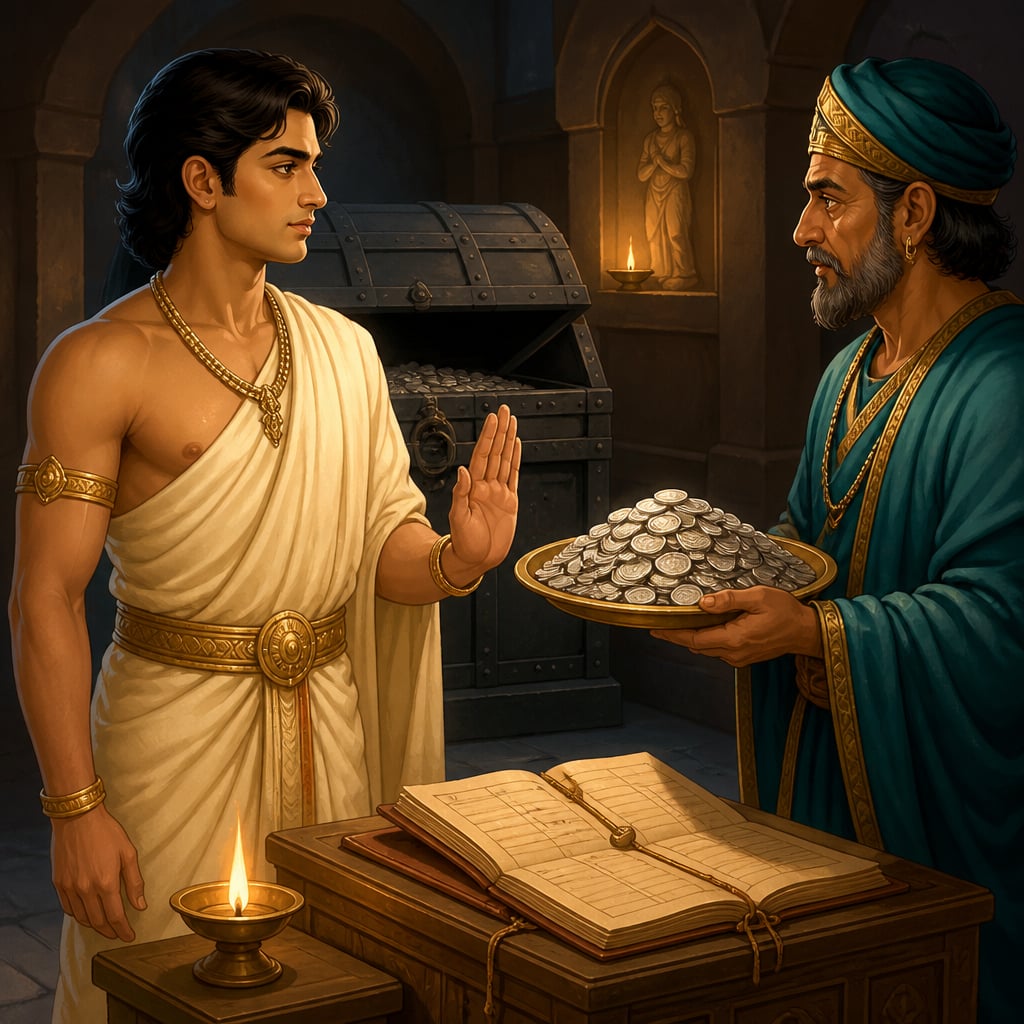
The crown prince refusing the treasurer's offer of state funds

The treasurer privately offers state funds: "Your allowance is insufficient. The treasury is vast. Take what you deserve. Your father needn't know."

This tested honesty, financial integrity, self-discipline regarding wealth, and understanding that the treasury serves the state, not personal desires.

The Pleasure Temptation

A beautiful person seduces the prince, then reveals they are forbidden: "Your father would execute us. But what he doesn't know can't hurt us."

This tested sexual self-control, respect for law, ability to defer gratification, and judgment about when passion overrides duty.

The Military Temptation

A general suggests a coup: "The army loves you. Your father is old. We could make the transition smoothly. Think of the kingdom's welfare."

This tested patience, loyalty, understanding of legitimate succession, and resistance to flattery and conspiracy.

Passing and Failing

The ideal response was immediate rejection and reporting to the king.

Kautilya was ruthless. Better to pass over an incompetent son than doom the kingdom.

Beyond the Four Temptations

Kautilya advised constant evaluation through:

The crown prince responding to a drought crisis in a village field

Crisis Management: Give the prince responsibility during actual crises - drought, military threat, disputes. How does he react under pressure?

Ethical Dilemmas: Present genuine moral conflicts. Does he choose expediency or principle? Can he find creative solutions?

Intelligence Tests: Can he distinguish reliable from unreliable informants? Recognize flattery versus honest advice? Learn from mistakes?

People Skills: How does he interact with subordinates, superiors, people he dislikes? Is he fair in judging disputes?

Self-Awareness: Does he seek counsel or assume omniscience? Can he admit errors? Is he humble enough to learn?

The Intelligence Network

Mauryan intelligence agents discreetly observing the prince at dusk

The king shouldn't rely solely on formal tests. The secret service should continuously monitor:

Character reveals itself in unguarded moments.

The Libertarian Insight

Concentrated power demands rigorous vetting.

In a monarchy, one person wields enormous authority. That person's character determines whether power serves or oppresses.

Kautilya's testing aimed to ensure:

These tests were quality control for political authority. The libertarian parallel: If you must have government, ensure those wielding power are worthy.

Modern Applications

Corporate Succession: Modern businesses test potential CEOs through running divisions with P&L responsibility, managing crises, 360-degree feedback, and assessment centers.

Political Leadership: While democracies don't formally test candidates, primary campaigns reveal character under stress, debates show thinking under pressure, and past decisions indicate judgment.

Personal Life: Before trusting someone with significant responsibility, observe how they handle small trust first, see how they react to temptation, watch behavior when unobserved.

The Ultimate Test

When the aging king offers to abdicate, does the prince accept eagerly (suggesting ambition exceeds duty), refuse absolutely (false modesty?), or accept reluctantly with concern for the king's welfare (ideal)?

This revealed whether the prince viewed rule as prize or burden, privilege or duty.

Lessons for All

We may not be crown princes, but we all face tests:

Professional: Are you ready for that promotion? Have you been tested under pressure?

Personal: Can you handle greater responsibility? Have you proven yourself in small things?

Civic: Are leaders worthy of power? Have they been tested, or merely elected?

Character matters more than credentials. And character reveals itself under trial.

Character under temptation reveals more than character under observation. The four upadhas targeted the classic vulnerabilities that destroy rulers: religious manipulation, financial corruption, sexual compromise, and political ambition. A prince who failed these tests would inevitably fail when wielding actual power, causing massive harm. Testing with low stakes (during apprenticeship) prevents disasters at high stakes (during rule).

People can control their public performance but struggle to maintain facades in private. How someone behaves when they think no one important is watching reveals their true character more reliably than how they behave during formal evaluations. The intelligence network's continuous surveillance complemented formal tests, catching what staged trials might miss.

Reactive evaluation discovers problems after they cause damage. Proactive testing reveals issues when they can still be addressed through more training or alternative succession. Creating deliberate trials at low stakes prevents catastrophic failures at high stakes. The investment in systematic testing pays massive dividends in prevented disasters.

Verses

धर्मोपधया आचार्येण अर्थोपधया अमात्येन कामोपधया योषिता दण्डोपधया मन्त्रिणा

dharmopadha-yā ācāryeṇa arthopadha-yā amātyena kāmopadha-yā yoṣitā daṇḍopadha-yā mantriṇā

Test through religious temptation by a teacher, financial temptation by a minister, pleasure temptation by a woman, and military temptation by a counselor.

Character reveals itself under temptation. The four temptations expose whether a heir can resist corruption through religion, wealth, pleasure, or power - the classic vulnerabilities of rulers.

Book 1, Chapter 10, Verse 1-3 (R.P. Kangle)

कर्मणा चरित्रं परीक्ष्यते

karmaṇā caritraṃ parīkṣyate

Character is tested through action.

Theoretical knowledge and stated values mean little. True character reveals itself in decisions and actions, especially under pressure.

Book 1, Chapter 10, Verse 8 (L.N. Rangarajan)

गुणैः परीक्षितः पुत्रः योग्यः राज्याय

guṇaiḥ parīkṣitaḥ putraḥ yogyaḥ rājyāya

A son tested and proven in virtues is fit for kingship.

Birth creates presumption of succession, but fitness must be proven through testing. Mere heredity isn't enough - character and capability must be demonstrated before conferring power.

Book 1, Chapter 17, Verse 51 (R. Shamasastry)

Case studies

The Testing of Ashoka

According to Buddhist sources, young Ashoka was tested repeatedly before being considered for succession. He was sent to suppress a revolt in Taxila, given difficult provincial governorships, and tested for cruelty versus justice. He wasn't the eldest son, but proved most capable.

Ashoka's testing paralleled Kautilya's system - real crises revealing character, capability proven through action, fitness trumping birth order. His eventual selection demonstrated that the system worked: choose the tested, proven heir.

Ashoka initially ruled harshly (as some tests had predicted), but after the Kalinga war underwent a transformation. His proven capability in governance, tested before succession, enabled his later reign as a dharma-focused emperor.

Testing isn't perfect prediction, but it's better than no evaluation. Ashoka's capabilities were proven before succession, even if his full character development came later.

Modern leadership development programs at companies like Amazon and Google follow this testing model. Amazon's "bar raiser" interview process and Google's structured leadership evaluations both test candidates through real scenarios before granting authority. The principle remains: proven capability before power, not power as a test of capability.

Ashoka was appointed governor of Ujjain and later sent to suppress the Taxila revolt before becoming emperor around 268 BCE. His 33 surviving edicts, inscribed on rocks and pillars across South Asia, constitute the largest body of inscriptions from any ancient Indian ruler.

GE's Leadership Assessment System

General Electric under Jack Welch developed sophisticated systems for testing potential executives - running divisions with P&L responsibility, handling crisis situations, receiving 360-degree feedback, undergoing assessment center evaluations. Succession wasn't based on seniority but proven performance.

GE's system paralleled Kautilya's approach: test through real responsibility (like the yuvaraja governing provinces), observe character under pressure (like the upadhas), use multiple evaluation methods (like combining formal tests with intelligence networks).

GE's rigorous testing produced capable leaders across multiple divisions. While the company has struggled in recent decades, this reflected changing industries more than the leadership development system, which other companies studied and copied.

Systematic testing and evaluation before conferring major authority works in modern corporations as it did in ancient kingdoms. Character and capability can be assessed through designed challenges.

The modern trend toward assessment centers, simulated business challenges, and 90-day evaluation periods for new executives reflects this ancient wisdom. Companies that promote based solely on past performance in different roles (the Peter Principle) consistently underperform those that test candidates in the actual context of the new responsibility.

GE's leadership development center at Crotonville trained over 10,000 executives annually during its peak years. The company produced 170+ Fortune 500 CEOs between 1935 and 2020, more than any other company, demonstrating systematic leadership development at scale.

Historical context

c. 4th century BCE

Many Indian kingdoms fell because untested heirs proved incompetent or vicious once in power. The Nanda dynasty's last king was reportedly cruel and arbitrary - exactly what Kautilya's testing aimed to prevent.

Kautilya's testing system helped ensure that Mauryan succession was based on proven capability rather than mere birth order, contributing to the dynasty's relative stability.

Living traditions

Reflection

More in Vyasana: Calamities and Continuity

All lessons in Vyasana: Calamities and Continuity · Arthashastra: Science of Governance course